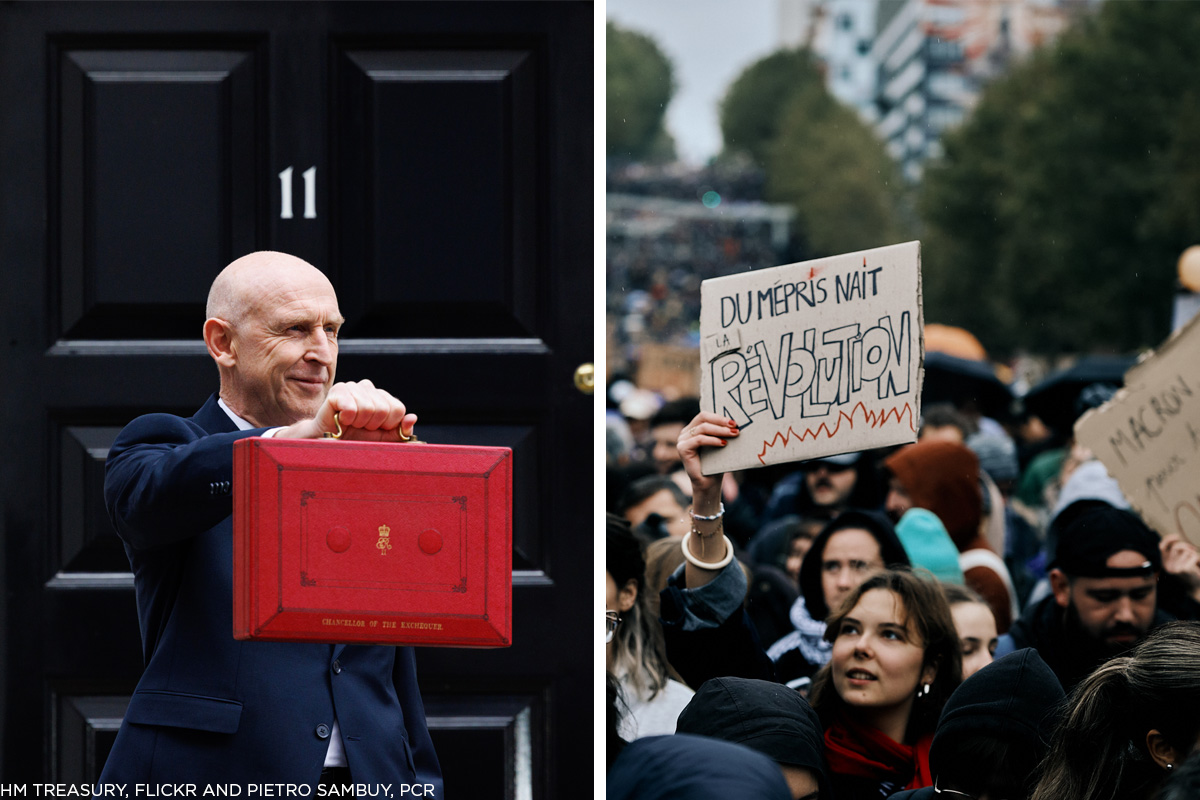
With the notable exception of Liz Truss’ notorious mini-budget of chaos in September 2022, the Chancellor of the Exchequer’s fiscal announcements are usually a fairly humdrum affair. And so it was with the government’s latest Autumn Budget, which did nothing to break this mundane mould.
The capitalists and their mouthpieces were hoping for promises of serious ‘reform’ and ‘deregulation’ in Labour Chancellor John Healey’s statement. In layman’s terms, this means counter-reforms and cuts; austerity and attacks.
Slashing welfare, business costs, and any restrictions on their profit-making: this is what the bankers and bosses were demanding ahead of yesterday’s Budget announcement. And on this front, these well-heeled ladies and gentlemen came away disappointed.
Labour’s “lacklustre budget” does “little to tackle deeper problems” concluded The Economist, the longstanding liberal journal. “Healey fiddles while the UK stagnates” summarised a disgruntled Martin Wolf, chief economics commentator at the Financial Times, a more sober organ of British capitalism.
At the same time, big business was relieved not to be burdened with any extra taxes. And the bond markets also signalled their approval. The Chancellor pledged to adhere to his predecessor’s ‘fiscal rules’, meaning the government will balance its books and pay back its debts. In turn, wealthy investors will continue to get their pound of flesh.
“The Budget avoids any shocks, meets the basic expectations of the bond market [and] is less bad for banks than feared,” stated Krishna Guha, vice-chair at global investment firm Evercore ISI, voicing the sentiments of the speculators and financiers.
On the other hand, Healey’s Budget was full of tweaks and gimmicks, in order to give the appearance that the government is providing a “breathing space” for ordinary families. For example, the Chancellor outlined plans for a one-off £100 payment for up to 20 million households to help with rising energy bills.
Such tokenistic measures are a far cry from the sweeping change that Andy Burnham promised upon entering Downing Street this summer.
As Tory leader Kemi Badenoch remarked, responding to the Budget in the House of Commons: “The Prime Minister came in promising to reverse 40 years of neoliberalism. Instead, we got 4p off gherkins.”
Or in the words of Aesop’s fable: the mountain laboured and brought forth… a mouse!
‘Between the bond markets and the barricades’
Healey’s prosaic, banal Budget is a reflection of the conflicting class pressures that are bearing down on Burnham’s government, which leave no room for manoeuvre.
On the one side are the ruling class, insisting on the attacks that British capitalism needs to be competitive and attract investors, alongside cuts to welfare to pay for warfare.
On the other side are the working class, whose hopes and expectations have been raised by Burnham, with his pledges to turn the clock back on decades of austerity, privatisation, deregulation, and deindustrialisation.
As the crisis of capitalism deepens globally, both of these antagonistic pressures are intensifying – not only on the UK government, but on political leaders across the world.
Voir cette publication sur Instagram
The bankers and bond holders are getting jittery, reflected in rising yields – i.e. borrowing costs – for governments looking to fill their budgetary black holes and finance their stubborn deficits.
At the same time, workers and youth are also growing restless and rebellious, as demonstrated by the wave of militant protest that is sweeping through the streets of Paris, Madrid, Milan, Tirana, and more.
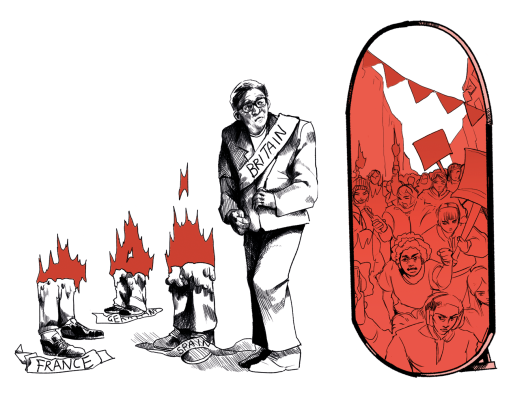
No doubt events across the Channel would have been preying on the minds of Burnham and Healey in advance of their first Budget statement. The spectre of revolt that is currently haunting Europe must equally be striking fear into the hearts of those in Downing Street.
After all, the restrictive vice that grips Macron’s government in France constrains Burnham and his ministers also.
As the Financial Times outlined in a recent article, France’s political leaders are “caught between the protesters on the street calling for more funds from the government and ‘bond vigilantes’ in the markets who punish perceived fiscal irresponsibility by betting against the country’s debt”.
Investors might not have Britain in their sights at the moment. And the Gen Z revolution may not have arrived on the UK’s shores just yet. Nevertheless, Burnham’s government faces the same dilemma as that described above.
While President Macron is trapped “between the bond markets and the barricades”, as the FT’s headline aptly put it, the Labour leader is paralysed by the opposing forces encapsulated in Britain’s red ink and Europe’s Red Autumn.
Iceberg ahead
This explains the mundanity of the Treasury’s latest statement regarding its plans for the public finances. “The political imperative” of Burnham’s first Budget, commented Robert Shrimsley of the Financial Times, “was to bore the markets and keep the vibe of a government ‘on your side’.”
This dull but delicate balancing act will not last long, however. Burnham and co. cannot keep everyone calm and content forever. To paraphrase Abraham Lincoln: you can please some of the people all of time, or all of the people some of the time, but you can’t please all of the people all of the time.
At the end of the day, the capitalists will only be happy when the axe properly starts to fall. On the other side, workers will not be satisfied until they see a tangible improvement in their living standards.
This is why the ruling class remains frustrated: because the ‘difficult decisions’ that need to be taken to rescue British capitalism have only been delayed and deferred to a later date, purely so that Burnham’s Labour can avoid a confrontation with the working class.
Questions around social spending cuts and military expenditure commitments, for example, have been left unresolved – kicked into the long grass, otherwise known as next year’s Whitehall spending review.
The result is forecasts from the Office for Budget Responsibility (OBR) of economic stagnation, rising inflation, and growing debt interest payments in the coming years; that is, of a worsening situation for British capitalism.
At the same time, the OBR’s predictions show how unsustainable ‘business as usual’ is for the working class. According to the fiscal watchdog’s estimates, household disposable income will fall in real terms this year. By the end of the decade, it will only be one percent higher than before the pandemic.
Meanwhile, the Resolution Foundation released a report this week which predicts that the 2020s will be by far the worst decade for UK income growth since records began – second only to the 2010s.
And these projections are likely a best-case scenario. The senile capitalist system is lunging from one crisis to the next. The entire old world order is unravelling. The global economy is being beaten and battered by a series of shocks – from military conflicts to climate catastrophe. Any number of ‘unforeseen events’ could therefore blow the ruling class’ plans off course.
British capitalism – fraying from years of austerity layered atop decades of decline and decay – is particularly vulnerable to this volatility.
The UK economy is completely dependent on imports, foreign investment, fragile supply chains, and continuing world trade – all of which are threatened by the breakdown of globalisation, the rise of economic nationalism, and the heightening tensions between the big imperialist powers.
And that is before accounting for a potential bursting of the massive AI bubble, or a flare-up of the sovereign debt crisis that looms over the advanced capitalist countries.
No wonder the more serious and far-sighted strategists of capital are so concerned: accusing Burnham and his government of fiddling while Rome burns; of rearranging the deckchairs on the Titanic – or whatever ominous and alarming metaphor fits the bill.
World revolution
The Labour leaders will try to keep on kicking the can down the road for as long as possible. But eventually they will run out of tarmac.
They may have bought themselves a momentary ‘breathing space’ with their ‘do-no-harm’ Budget. But any reprieve for Burnham and co. will prove to be fleeting. Soon enough, they will be feeling the squeeze of the same suffocating straitjacket that shackles every politician who tries to operate within the confines of capitalism.
As night follows day, Burnham’s government will become a government of crisis – just like those of Starmer, Sunak, Truss, Johnson, May, and Cameron before him.
In turn, the latest occupant of Number 10 will be revealed for what he truly is: a wolf in sheep’s clothing. And any ‘honeymoon period’ or ‘Burnham bounce’ for Labour will give way to a profound political crisis, as the mask slips and the class struggle sharpens.
Voir cette publication sur Instagram
This is the perspective that the Revolutionary Communist Party is preparing for.
Rather than sowing illusions in capitalist careerists like Burnham, as many so-called ‘lefts’ scandalously do, we are building our forces on the basis of a clear class outlook and revolutionary programme.
We have no time to waste. It won’t be long before the inspiring scenes currently playing out in Europe are brought to Britain – as part of the process of world revolution that is unfolding before our eyes.