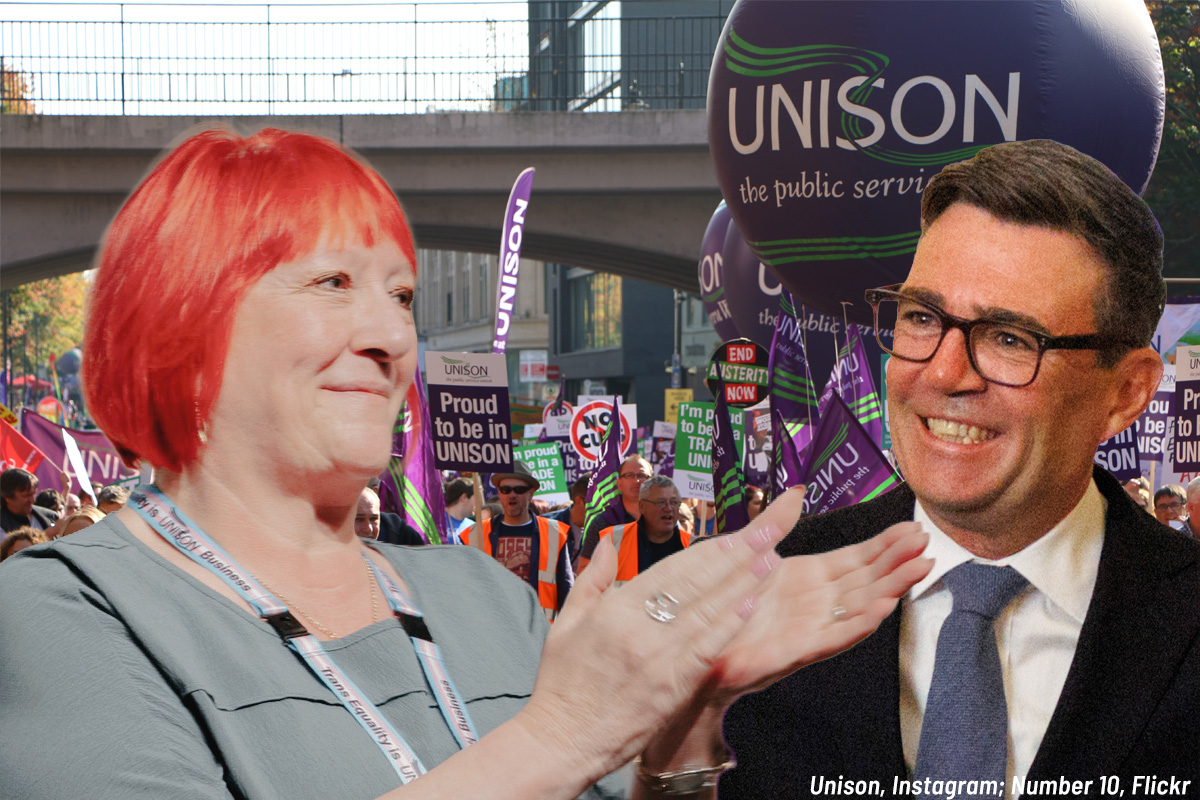
Last month, 200,000 Unison council and school workers were ballotted for strike action – demanding a 10 percent pay rise (or £3,000, whichever was greater), in addition to a £15 per hour minimum wage.
A national action of this proportion could have raised the sights of the whole working class, putting the question of fighting the cost-of-living crisis through methods of class struggle on the agenda. It could have acted as the firing shot for a new strike wave, inspiring workers to turn the anger that is bubbling across Britain into action.
View this post on Instagram
Those who cast votes in the ballot overwhelmingly voted in favour of strike action, with 81.8 percent voting to reject the bosses’ insulting offer of 3.3 percent. However, with a turnout of 28.4 percent, the ballot did not cross the 50 percent threshold mandated by anti-trade union legislation.
Clearly, there is an appetite among the ranks for a fightback against decades of real pay cuts. Why then did the union leadership fail to get the turnout?
Breaking inertia
Many ordinary members likely felt sceptical about undertaking strike action, because they lack trust in the out-of-touch union bureaucracy.
Historically, the Unison leadership and its vast bureaucracy have acted as a brake on the class struggle. The previous general secretary, Christina McAnea, had a sordid record of betraying strikes, collaborating with employers, and loyally backing the most hated prime minister Britain had ever seen (yet). This is not a general you would want to follow into battle.
Thankfully earlier this year, McAnea got her comeuppance when Andrea Egan replaced her as the first left-wing general secretary in the union’s history.
As she was elected on the promise of transforming the union, you would think she would be regarded as a breath of fresh air come the recent industrial ballot – offering an opportunity to put grassroots members in control of a militant struggle.
View this post on Instagram
But unfortunately, the fact that a new, more militant leader is at the helm has not been enough on its own to inspire council workers to back strike action.
That can partially be explained by inertia: having been accustomed to disappointment for so long, few Unison members know or care who the officials of the union are. This also stands for Egan, who was elected on a low turnout of 7.5 percent last December.
Consequently, people have little confidence that a strike ballot would affect anything this time around.
So if members are to believe that the union can represent something different – an instrument of struggle, which they can genuinely control – then a lot of ice has to be broken.
Blindly backing Burnham
If Egan was going to convince the ranks of her own ability to lead a national strike, therefore, what was required first and foremost was a clear message and a class-struggle programme.
Unfortunately however, Egan has been doing the exact opposite. She has been sowing illusions in Andy Burnham as a “chance for tangible change”.
In a television appearance, Egan said she was “pleased to see him take up his position” and hoped he would keep his promises about increasing funding for local government.
View this post on Instagram
This sends a confused message to the membership – after all, why take strike action against a government your leadership describes as a hope for change?
Ordinary members know that the only promises Burnham will be preparing to keep are the ones he has made regarding fiscal responsibility – meaning more cuts are on the way.
Meanwhile, it is a tragic irony that the ballot failed at the 50 percent threshold – a reactionary law that Labour promised to abolish under the Employments Rights Act. Its implementation, however, has been endlessly delayed by Starmer’s and Burnham’s governments.
And yet, Egan and the rest of the Unison machine have celebrated the Act as a “landmark step forward”!
Real change
At the same time, if Egan were really to take a more militant stance against the government and embolden the ranks, she would need to go to war against the old bureaucracy. If she set herself apart from them, rejected the compromising methods of the past, and appealed to the ranks, she would definitely get support.
However, all the signs are that since her election she has searched to appease and coexist with this bureaucracy. There has been very little stirring of the waters.
View this post on Instagram
That means, on the one hand, that the old assistant general secretaries, national executive committee, full-time officials and so on are still firmly in the saddle. On the other, Egan appears to the ranks to be indistinguishable from those bureaucrats.
Now, the union leadership has just rolled over and accepted the national council bosses’ derisory 3.3 percent pay rise. This fact can only further reinforce the notion in members’ minds that nothing has fundamentally changed.
The way forward
The defeat of this ballot therefore represents a serious setback: it keeps the lid on a new industrial upsurge in Britain a little longer; it will demoralise further the 200,000 local government workers who were balloted; and it is also a blow to Egan’s credibility and the struggle to transform the biggest union in the country.
The turbulent period we are in will offer new opportunities. But to take advantage of these, it is imperative that the left learn the lessons of this setback.
What was required was a programme which said plainly and clearly to members that the only way the government will grant us a fair pay rise is through forcing them to; touring branches with this programme; openly calling for coordinated struggle with other trade unions, through fiery media appearances; challenging the anti-trade union laws, which hamper the movement; and preparing the membership to break them when they get in the way.
An inspiring leadership that makes it clear they are prepared to lead a militant struggle could win over plenty of workers to fight, and through that struggle transform the union.
For leadership, not letters: Trade union leaders offer tepid opposition to Labour’s warmongering
Owen Rees-Hattersley, Bloomsbury
10 British trade union leaders recently issued an open letter to Andy Burnham, asking him to cease the use of British bases in Trump and Netanyahu’s kamikaze campaign of destruction in Iran.
The authors of the letter cite the dire consequences that this war is having and will have on the cost of living crisis in Britain. “Since the war started,” they say, “the average British household has seen its annual energy bill rise by £221, while monthly food bills are forecast to rise by £32.80”.
And they are quite right, too! Whilst there is always money for guns, bombs, and bullets, Labour have left behind schools, hospitals, and communities with their policy of militarism.
View this post on Instagram
Pretty please?
But making kind appeals to Burnham – whom all of the signatories supported in getting to power – is a rather sorry excuse for an anti-militarist fight. Burnham is continuing the same foreign policy as Starmer before him. He is continuing to bend over backwards to appease Washington.
In Ukraine, Burnham has pledged to back Zelensky and continue arming the Ukrainians. Burnham has still refused to call the genocide in Gaza what it is, and arms manufactured in Britain are still making their way to Israel. And of course, as the letter points out, British bases are still being used to provide “logistical support” for Trump’s war on Iran.
Andy Burnham thinks dancing and joking around means we will forget the genocide.
Andy Burnham thinks having a northern accent absolves his governments attacks against the working class.
If you work for the capitalist system, you have chosen the side of the oppressor. pic.twitter.com/DHL9lNQwRF
— Fiona Lali (@fiona_lali) July 17, 2026
In fact, Burnham is only the last in a long line of prime ministers – Tory and Labour alike – who have all perpetuated the sordid tradition of British imperialist meddling.
From Tony Blair’s disastrous war in Iraq all the way back to the violent suppression of the Malayan uprising under Clement Attlee’s watch, blood has stained the hands of every Labour administration.
The driving force in today’s remilitarisation drive is Britain’s diminishing position on the world stage and damaged economy, wrecked by years of deindustrialisation and under-investment.
In order to claw back a semblance of prestige and maintain ‘our’ alliance with the US, Britain’s ruling class is compelled to follow every ill-fated adventure of American imperialism.
The idea that the labour movement is going to convince Number 10’s latest, willing servant of British imperialism with a ‘pretty please’ is therefore naive.
Morning Star — Sat/Sun 15–16 August — #TomorrowsPapersToday
Workers and campaigners demand Burnham stop US bombers using UK bases for Trump’s war on Iran, rallying at RAF Fairford pic.twitter.com/84VAQJzpJh— Andrew Clifford (@newcastlejourno) August 14, 2026
Halt the war machine with class struggle
So are the trade unions powerless in the face of the overwhelming geopolitical forces compelling Burnham? Not at all. In fact, there are many things that could be done to fight against warmongering and militarism right now.
Fran Heathcote, one of the letter’s signatories, heads PCS, which organises workers in the civil service. These workers have the power to bring the Ministry of Defence to a halt with workers’ boycotts, strikes, or even occupations.
Daniel Kebede and the National Education Union could mobilise school workers to fight for funding for ‘books, not bombs’.
All of these unions could link up together and organise a genuine anti-imperialist struggle against this government that has continued the shameful policy of collaboration with American imperialism. Their leaders should be taking inspiration from the marvellous bloquiamo tutto general strike for Gaza in Italy last year.
The unions in Britain represent millions of members. If a real effort was made to connect with these layers and bring them out into the struggle against imperialism, there would be no limit to what could be achieved.
Ultimately, to fight imperialism abroad and cuts at home it is not enough to write pleading letters. We need action to bring the war-machine to a halt. The union leaders have already dithered for too long. Now is the time to mobilise and organise a genuine mass movement against imperialism and war.
No sweet deal for sugar factory workers
Harvey Tingle, Norwich
British manufacturing took another blow on 21 July when British Sugar suddenly ‘proposed’ the total closure of its sugar factory in the Norfolk village of Cantley by February next year.
With all 104 workers to be laid off, the closure of the 114-year-old plant means both a huge loss of jobs and of identity to the small village.
Interviewed, one local went as far as to describe it as ripping “the life and heart” out of Cantley.
Local farmers who grow sugar beet for the factory now also face a long-term struggle, with the chair of the National Farmers Union sugar board stating that “this is a critical moment for the future of UK sugar beet.” The ripple effect of job losses locally will therefore be massive.
British Sugar, which sells under the brand name Silver Spoon, operated 18 factories only a few decades ago. These latest plans will take them down to just three.
Workers at Cantley have been worked to the bone in the leadup to the announcement. “They were asking us to be really tight with our tool and equipment usage for the last six months,” revealed one worker I spoke with.
He also expressed belief that the ‘proposal’ was a scare tactic to encourage workers to leave for other jobs, giving British Sugar the excuse they needed to fully close the plant before the February date, and avoid making redundancy payouts.
Just last year, the company received £11 million from the government for investment in the Cantley plant, with more millions doled out to their other three. But meanwhile, the CEO of British Sugar’s parent company, Associated British Foods, earns around £3.6 million per year in salary and bonuses.
Evidently, even this life support of taxpayers’ money is not enough to keep British industry competitive – and certainly not while bosses still expect to leech millions off the top.
The workers of the Cantley plant and beyond are asked to pay the cost, while the fat cats move on to their next six-figure salary.
Shockingly however, well over a month after the ‘proposal’, Unite – which organises the workers in Cantley’s factory – has yet to make any official statement about its closure.
While some sort of fight may still erupt, no doubt some of the union leaders are looking back at the experience of the closures and layoffs at Port Talbot’s steelworks and Lindsey oil refinery with a sense of hopelessness.
The real lesson from those experiences, however, was precisely not that it was useless to fight, but that the leadership failed to issue the call for militant action like occupation, and bold, socialist demands to save the jobs like workers’ control and expropriation of the factories.
The workers at Cantley do not have to take this beating lying down. But if they are to rise, they will need leaders with a militant perspective.