The Times recently published a poll of voting intentions among union members, showing that Labour and Reform are running neck-and-neck. 28 percent of respondents said they would vote for either party in a general election, which is more than twice the number for any other party.
In Unite and GMB – two of the biggest unions in the country, with 1.2 million and 630,000 members respectively – Reform is leading Labour by 5 to 9 percentage points.
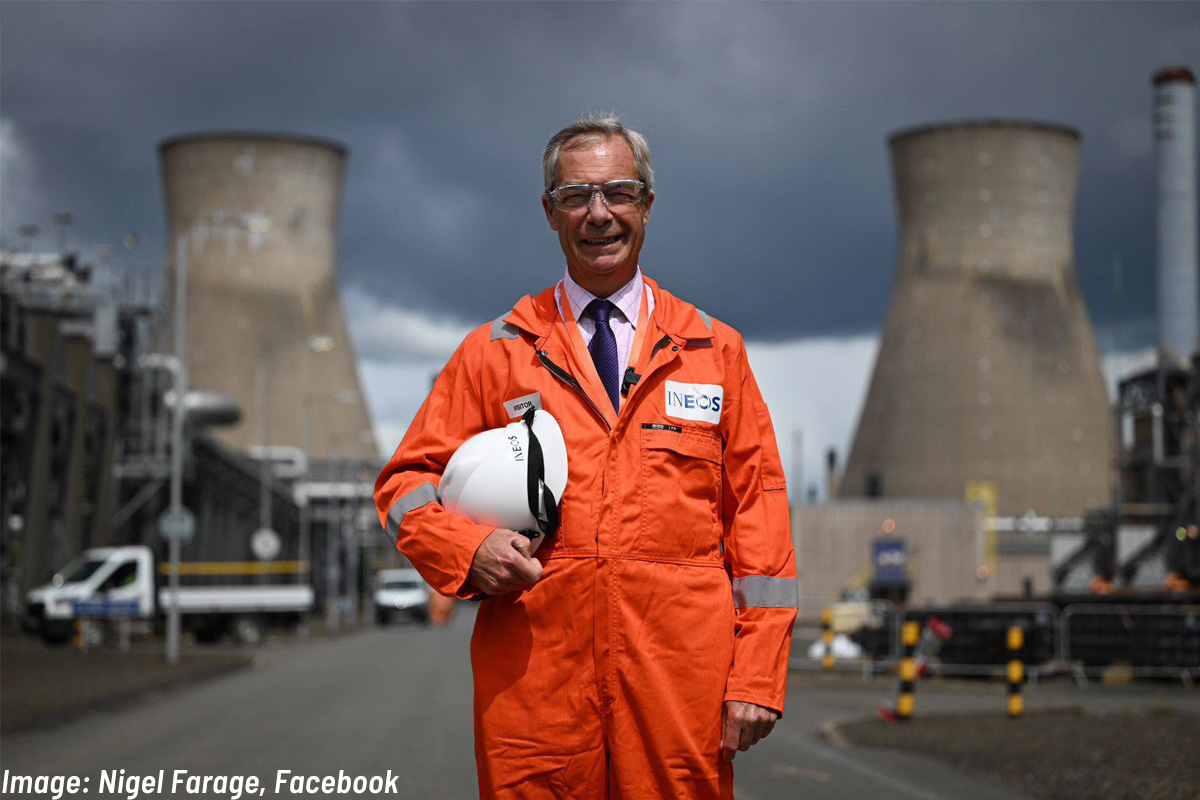
Unsurprisingly, Farage is feeling buoyed by this, stating that: “Labour is no longer the party of the patriotic working class. Instead, that mantle now belongs to Reform.”
Labour’s meteoric fall
Labour’s loss of ground in the unions has been a long time in the making. Nonetheless, this marks a historic watershed. Unlike most other social-democratic parties, the Labour Party was created by the trade unions. The unions still have half of the vote at Labour conferences.
Until Blair took over the party in the 1990s, there was a revolving door between the Trades Union Congress (TUC), trade union leaders, and the top of the Labour Party. Some union leaders today still enjoy this perk of the job – through, for instance, the notorious Unison Labour Link.
Because of these ties, the Labour Party enjoyed a monolithic position for a century as ‘the party of the working class’. This authority, in turn, became a fundamental pillar of stability for British capitalism.
The conservative outlook of the trade union leaders held back the class struggle. They lived in symbiosis with the Labour leaders: sowing trust in the Labour Party as an excuse to restrain strikes; while using their bloc vote as a brake against radical policies in the party.
Len McCluskey, for example, at the head of Unite during the Corbyn era, held back industrial action under the pretext of “waiting for Labour”, while using the union’s vote against the pro-Corbyn ranks, who wanted radical policies and mandatory reselection.
On this basis, the ruling class could trust the Labour Party to do its bidding once in power – acting as a reserve team to come in and do the dirty work whenever the Tories had been discredited.
The fact that today, amongst its own traditional social base, Labour is haemorrhaging support to Reform, is a damning indictment for the party. After decades of betrayals, industrial decline, and years of capitalist crisis, Labour has wound up becoming hated by a majority of workers.
At the same time, this will be a factor in heightening instability for the ruling class, who need strong, established, and trusted parties to carry out the austerity and attacks against the working class that they need.
In this sense, Labour’s loss of its voter base is among the earth-shattering events that are paving the way for the British revolution.
Sowing illusions
Labour’s downfall has not been precipitated by any lack of support from the trade union leaders, however. Rather, they have done their best to sow illusions in Starmer and his potential successors.
As general secretary of the TUC, Paul Nowak’s social media is awash with posts warning about the dangers of Reform. Meanwhile, he lauds the Labour Party’s supposed achievements, saying the government should “shout from the rooftops” about the Employment Rights’ Act to “show working people the government is on their side”.
Voir cette publication sur Instagram
The leaders of Unison, PCS (civil service), and NEU (teachers) – to name a few – have all made statements to the same effect.
And in response to The Times’ poll, the Morning Star – mouthpiece of the Stalinist ‘Communist’ Party of Britain, and of the so-called ‘left’ of the union officialdom – published a bizarre editorial.
This piece ends up urging trade union leaders to “work with MPs to impose a new political strategy”, and to “coalesce behind a single candidate for Labour Leader, based on reconnecting the party with its working-class roots”.
This is code for: support Andy Burnham; stick with Labour, for lack of a better option; and stop Reform.
The union leaders’ instinct to fight Reform – a reactionary, racist party that will carry out devastating austerity against the working class – is correct. But evidently they are failing to inspire their members to do so.
Crisis of leadership
Chief among the causes of their failure is the fact that their authority – like that of the Labour leaders – is not what it was in the past. Today, most union members, let alone the ordinary person on the street, would be hard-pressed to recall the name of any trade union leader.
This is because, all too often, the union itself feels like something removed from the workplace.
Frequently, the union is not seen by workers as a vehicle for struggle – for better wages, conditions and standards of living. Instead, it is little more than an insurance policy to be taken out for a rainy day.
This alienation of workers from the unions was seen, for instance, in the tiny turnout for Unite’s recent leadership elections.
Indeed, who would listen to their insurance provider for recommendations on how to vote in elections? Why would workers, who are looking for a way to land blows against the establishment, listen to leaders who have never proven themselves capable of fighting?
Like the fall of the Labour Party, the loss of authority of the old, reformist, bureaucratic union leaders has potentially revolutionary implications for the future of the class struggle in Britain.
In the short-term, however, it also means that there is a vacuum of leadership – into which reactionary demagogues like Farage are stepping.
Political weakness
Insofar as they are able to reach anyone with their anti-Reform message, the trade union leaders are failing to convince anyone because their message is politically weak.
Many union leaders have correctly understood that the rise of Reform is linked with the austerity that Labour is carrying out. This includes Unison’s Andrea Egan, Unite’s Sharon Graham, and the aforementioned Morning Star editorial.
But without fail, they have concluded that Labour simply has to “change tack” and adopt a pro-worker policy.
Labour risks handing power to Reform without drastic change, says Andrea Eganhttps://t.co/mcguEn7mIk
Speaking to Iain Watson @BBCr4today ahead of her first speech as UNISON general secretary this week to the union’s national conference #r4Today #uNDC26 pic.twitter.com/8Fq2UrdYO2
— UNISON – UK’s largest union (@unisontheunion) June 16, 2026
This reflects a political weakness of the reformist union leaders: the utopian belief that austerity is a political choice, and not a harsh necessity dictated to a willingly compliant Starmer by the bond markets.
They therefore believe in throwing their weight behind this-or-that politician who they think might make a different ‘choice’, but who ultimately is not willing to challenge the capitalists and bankers.
This keeps the labour movement within the respectable bounds of parliamentarianism – rather than wresting reforms from the capitalists, by mobilising the working class for political and industrial struggle around bold socialist demands.
At the same time, they have failed to register that Labour is an utterly discredited political force among workers, due to its inability to offer any real change; due to the craven attitude of the party’s leaders towards big business and the billionaires.
Unpopular fronts
Consequently, the union leaders are forced into all sorts of bizarre contortions when it comes to political strategy.
At times, they chase after broad ‘popular fronts’, such as the Together Alliance – adopting liberal slogans against Reform like “love, hope, and unity”.
Even then, this front has been left twisting in the wind since the 28 March demonstration – which was a strong mobilisation in spite of the leaders’ weak slogans.
The fact that precisely nothing has come of the Together Alliance highlights the union leaders’ complete lack of strategy and understanding.
At other times, the union leaders criticise Labour and flirt with disaffiliation.
Under @UniteSharon‘s leadership, Unite has stopped giving blank cheques to The Labour Party.
➡️Affiliation cut by 40%
➡️Challenged Labour on its failures – Birmingham bins, Winter Fuel
➡️Refused to back Labour’s weak manifesto in 2024 pic.twitter.com/ovBWY2Bztm— Workers Unite (Official) (@WorkersUnite__) June 12, 2026
And on some occasions, recognising the likelihood of Reform coming to power, some are even drawn towards ‘talking with the devil’ and doing deals with Farage, to quote Sharon Graham.
Recognising this potential, Farage has now appealed to unions to affiliate to Reform – in a bid to strengthen his ‘pro-worker’ credentials.
It is unlikely that any union leaders will follow his advice – not least because they are allergic to anything that might rock the boat.
Nonetheless, Farage’s appeal shows the pressure that trade union leaders will come under: to drop moralistic, anti-Reform postures, and take a more ‘pragmatic’ approach, so that they can ‘negotiate’ better wages and so on. Such is the reasoning of a union bureaucrat.
In all cases, the disoriented and impressionistic trade union leaders fail to perform their elementary duty: to organise and unite the working class; fight for genuine improvements to workers’ lives; and give workers confidence in their own strength and power.
Need for militancy
In reality, support for Reform within the unions is very shallow, as The Times’ poll itself shows.
As opposed to the 28 percent who said they would vote for Reform, only 13 percent said they had a ‘very favourable’ view of Farage, whereas 36 percent said ‘very unfavourable’. His net approval is minus 6.
The real competition is over which politician is the least unpopular.
Farage’s rise could be rapidly cut across if the unions provided an alternative pole of attraction, and sliced through the culture war by putting class struggle on the agenda.
Above all, this would mean building for and launching a mass strike movement: against inflation and workplace attacks; but also over political questions such as austerity, war and militarism, state repression, anti-union laws, and more.
For that to happen, the unions must fully break with the Labour leaders politically, and stand as the real opposition to Starmer’s hated government, on the basis of militant class struggle and a clear socialist programme: for the nationalisation of the banks, monopolies, and construction companies, without compensation and under workers’ control; and the establishment of a planned economy.
The current crop of trade union leaders – mired in a conservative outlook, and steeped in pessimism thanks to the defeats of the past – will not take such steps unless pushed from below.
The next period, however, will put massive pressure on the trade union leaders to act. Either they will venture out to sea, or they will be carried away by the tide of history.
Fury at the BMA leadership: A taste of rank-and-file radicalisation
The doctors’ union, the BMA, has issued a last-minute cancellation of the latest round of resident doctors’ strikes – the sixteenth in our years-long struggle for full pay restoration. The reaction in the rank-and-file is seething towards the leadership – with many accusations of betrayal.
Horrendous. The fact that @fletchjack has gone above the wider committee AND the membership with this reflects his self-serving motives. This is hardly better than any offers that were outright rejected.
— Nathan (@NayCowley) June 13, 2026
The offer made by the Labour government – and serving as a pretext to call off the strike – includes a pay rise of 6.6 percent (including the pre-existing guarantee of 3.5 percent), partial reimbursement of exam and training costs, and unspecified proposals for additional training posts.
This offer is low, vague on the details, and kicks the can down the road. The next expected pay rise will be in 2027 (can we even expect Labour to survive until then to fulfil this promise?)
On strike group chats and online, doctors have criticised the leadership for undermining union democracy; the cynical timing of this offer, coinciding with the upcoming Makerfield by-elections; and the leadership failing to escalate the strikes. To give a taster:
“Excusing the language, but it sounds like what’s happened today has really fucked things up and the lot of them should be quite ashamed of their actions if they consider themselves representatives.”
Imitating a chat between James Murray, Labour’s Health Secretary; and Jack Fletcher, the head of the BMA resident doctors’ committee; another member wrote:
“‘look, we’re probably going to lose this by election unless we do something, PM is in hot water, so Jack do you think you can give us a quick boost here?’ Cheers’ from James Murray
“I hope the 30 pieces of silver was worth it.”
At Saturday 13 June’s national conference, delegates voted to censure the current leadership of the union. The rank-and-file are losing trust in the bureaucracy – which was already being reflected in decreasing strike ballot turnouts.
Resident doctors have maintained militancy in the face of media hostility, moral pressure, and threats to enforce strikebreaking ‘minimum service’ legislation. Meanwhile, the careerist BMA leadership have limited strike action to rounds of a few days, while turning pickets into photoshoots. Then they negotiate poor offers behind closed doors.
What we need is a fighting union with a perspective of escalation, not capitulation. To quote another conversation:
“Bank and save was a ridiculous option. Strikes should have been drastically escalated.”
“The Koreans managed to do a mass resignation and walkout with even more dire labour laws than the UK has.”
Resident doctors have been at the forefront of the class struggle in Britain. These quotes are a foretaste of the lessons workers will draw across the labour movement, through their experience with industrial action – not least a desire to take matters into their own hands.
We say: the BMA leaders should be subject to immediate recall if they no longer represent their members. Democratic discussion can take place in local mess meetings and branches. Instead of last-minute backroom deals, we demand full transparency. We demand to control our union.
Above all, we need a leadership that is prepared to go the full way to win. That means broadening our dispute to our healthcare colleagues through cross-sector strike committees at rank-and-file level. To defend against the cuts to public services, our perspective should be a public sector-wide general strike.
The bosses and bankers want to drive the NHS into the ground and fight over its carcass. It is our task to organise against this with fighting unions.
Patricia Moseley and Kiran Pillai, BMA (personal capacity)