It hasn’t been a good summer for Nigel Farage and Reform UK.
From riding high in the polls at the start of the year, Reform has now slumped down to around 23 percent – sliding behind Andy Burnham’s Labour, and sitting neck-and-neck with Kemi Badenoch’s Tories.
Farage’s party suffered defeat in the bellwether by-election in Makerfield, and received a paltry result in the Manchester-wide mayoral election, where Reform’s hard-right challenger Restore Britain made sizeable gains.
At the same time, Reform has been tainted by its association with the violent riots that swept the UK in June, which were goaded on by Farage’s “white-lives-matter” rhetoric and calls for “pure, cold rage”.
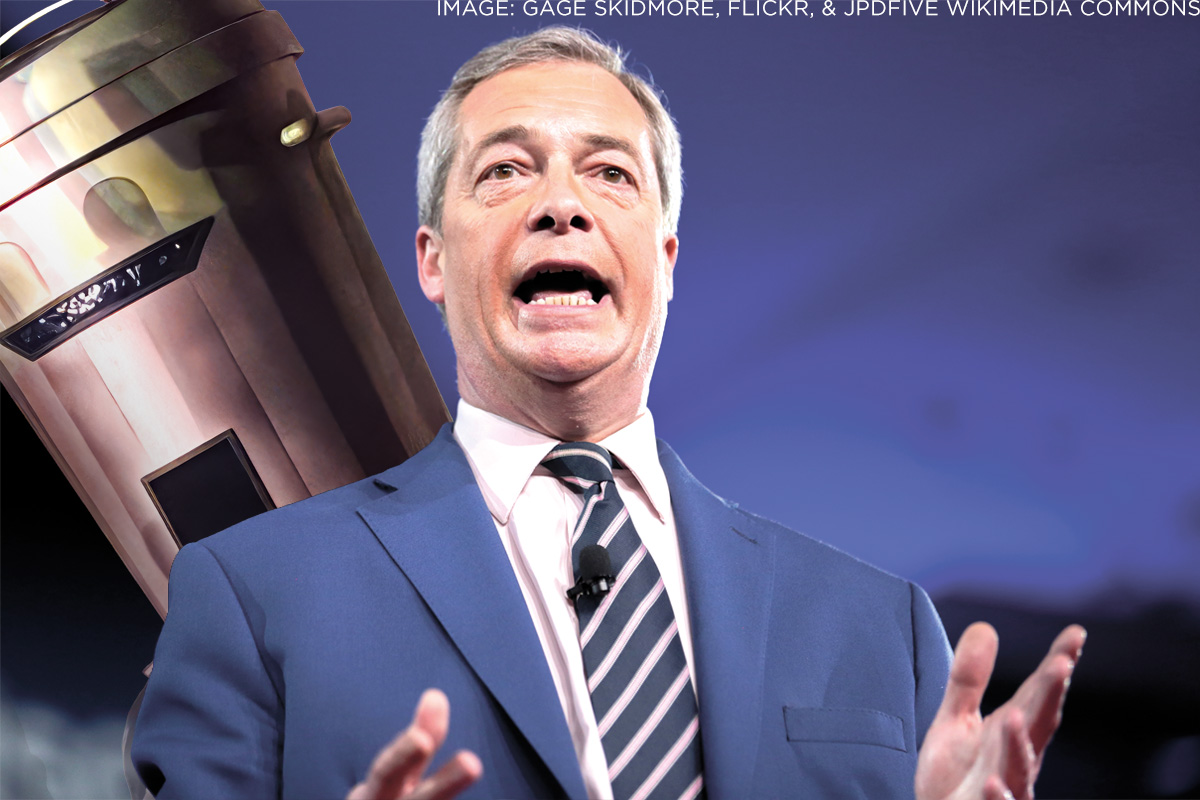
Most recently, Farage has been ridiculed by the establishment press for the stunt by-election he triggered in his Clacton-on-sea constituency, where his foremost opponent was a joke candidate dressed as a bin.
But that’s not all. Alongside all of this, Reform has been battling allegations of corruption, relating to dodgy donations from wealthy overseas donors.
The establishment media has relentlessly scrutinised the party’s finances: from the £5 million donation from Thailand-based crypto tycoon Christopher Harborne; to last week’s highly-publicised exposé, aired by Channel 4, which showed undercover investigators catching high-ranking Reform apparatchiks as they facilitated potentially unlawful donations from a (fake) American businessman.
The high-ranking apparatchiks in question – Reform’s evangelicist head of policy, James Orr, and senior aide Dan Jukes – have resigned, with Farage dismissing them in the press as mere “contractors”.
As the sour cherry on this Etonian mess, this latest bombshell dropped right on the eve of Reform’s annual party conference, which took place over the weekend.
While mailed crusaders had their plastic swords confiscated, and cane-wielding pensioners violently assaulted young climate protestors, Reform’s frontmen faced a grilling from the press over accusations of corruption.
Reform UK delegates seriously assaulting women at their conference whilst Farage laughs from the stage.pic.twitter.com/dbf4P70Mkn
— Socialist Opera Singer (@OperaSocialist) September 5, 2026
No wonder Farage nipped down to the local Spoons after the first day of this chaotic gathering. As he stared into the dregs of his performative pint of bitter, he might well have ruminated to himself on where it all went wrong.
Beginning of the end?
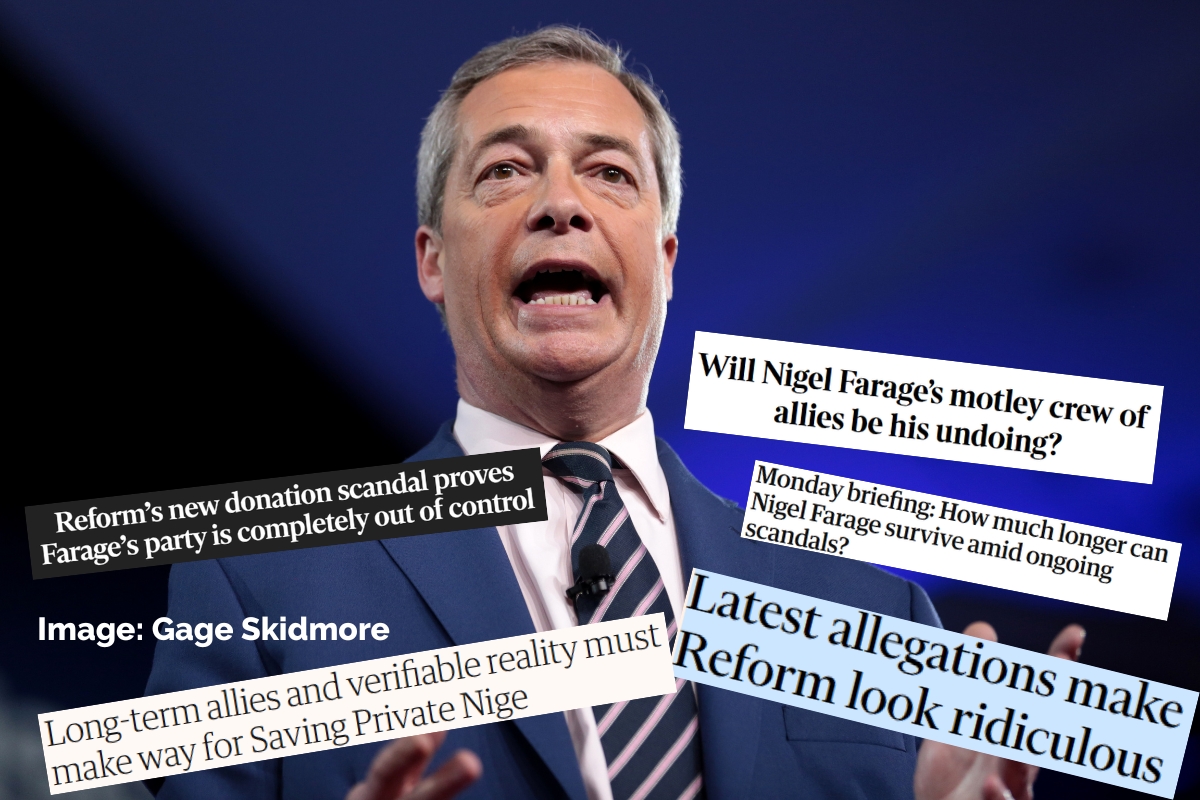
By all accounts, Farage’s party is going through a rough patch. As the Financial Times’ Stephen Bush curtly summarised: “Reform look ridiculous”.
But does this mean that this is the beginning of the end for Reform, and for the threat of right populism more widely?
“How much longer can Nigel Farage survive amid ongoing scandals?” asks today’s Guardian. “Can Reform UK recover from its summer horribilis?” inquires another liberal think-piece. The Independent takes a more declarative tone: “The end of Farage is nigh… again”.
Some opponents of Reform even entertain hopes that Farage will face a lengthy legal investigation on the back of these corruption allegations, anticipating that this latest scandal will drag his party into disrepute and ruin.
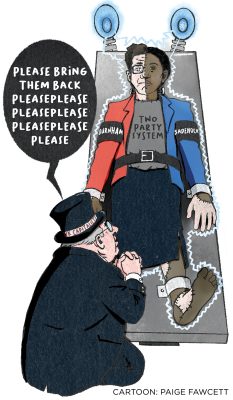
In turn, they envision, Britain’s glorious, centuries-old two-party system could be on its way to being saved. Soon enough, the country will awaken from this populist nightmare, and breathe a heavy sigh of relief.
Certainly, that is what the liberal establishment and their media mouthpieces would like to believe. The last thing they want – with the UK economy already down the drain, and discontent everywhere – is these unreliable populist mavericks at the helm, with their pogrom-mongering, threats of mass deportations, and embarrassing infighting. All of this would only add more explosive instability into the mix for British capitalism.
For a time, it looked like sections of the ruling class had resigned themselves to the probability of a reined-in Reform-led government by the end of the decade.
Towards the end of last year, Farage was addressing audiences of bankers and business leaders in the City of London, promising ‘fiscal restraint’ (austerity). With this, big-business donations started pouring in, along with ex-Tory careerists like Robert Jenrick and Suella Braverman.
But now, the political landscape has shifted – on the surface, at least.
Labour is enjoying a temporary ‘Burnham bounce’ after deposing Keir Starmer, its unpopular former leader.
On the other side of the parliamentary aisle, meanwhile, big business is starting to warm to the Conservatives again.
Under Badenoch’s leadership, the Tories have cleaned up their image in the eyes of the establishment, and appear to have put behind them the years of ‘psycho-drama’ infighting that characterised the last decade. In turn, the media have played their part in fawning over Badenoch’s ‘fiery’ performances in PMQs.
This explains why the establishment media’s attack campaign against Reform has ramped up lately. Sensing that Farage was on the backfoot – and that the Harborne corruption scandal was touching a nerve – they have decided to turn the screws, attempting to humiliate Farage on the eve of his ‘reset conference’.
At the very least, they hope, this smear campaign will clip Reform’s wings, make Farage and his party more pliant to the demands of big business, and restore a semblance of stability to British politics.
Will this work?
Those who think that a quick-and-simple media assault will finish off Farage will be left sorely disappointed.
The entire experience of US and European politics in the past decade has proved that right-wing populists cannot be crushed through media smears, legal attacks, and moralistic outcries. Nor can they be stopped by cordons sanitaires: attempts to erect a political ‘firewall’ around them.
In fact, such liberal efforts only lead to the complete opposite outcome from that intended.
In 2016, for example, the pro-EU establishment vilified the Brexit campaign with ‘project fear’ – and the Leave campaign succeeded all the more for it.
Similarly, the liberal wing of the US ruling class tried to prosecute Donald Trump for all manner of accused crimes. Yet Trump returned to power in 2024 with an even bigger mandate.
Elsewhere, the French state has blocked Le Pen from running for public office. But right now, she currently has a higher rating in the presidential polls than her next two opponents combined.
In Germany, meanwhile, the establishment is trying to completely ostracise the AfD. Yet the AfD has just won its best result to date, in Saxony-Anhalt, where it will likely lead the state government.
The ladies and gentlemen of the liberal establishment – cut off from reality in their comfortable, bourgeois bubble – always forget one crucial fact: the rise of these right-populist parties is driven precisely by a seething, anti-establishment anger against their institutions.
Millions upon millions of people, on the right and left, have lost all faith and trust in the mainstream media, the legal system, and the fetid swamp of parliamentary politics. They have burned their bridges with the traditional parties. In short: they hate the establishment with a passion.
By contrast, demagogic figures like Farage, Trump, Le Pen, and co. claim to stand up for ordinary people. They assert that they are different from the rest. They admit that life for the majority is hard and miserable. And they state that the status quo is broken.
All of this understandably chimes with a downtrodden layer of society.
So when middle-class journalists and paid-for politicians attack their preferred candidate, this only bolsters the anti-establishment credentials of Farage and his ilk, and galvanises the support for the right-populist parties.
You can even see a glimpse of this in the farcical contest between Farage and Count Binface. The left-behind people of Clacton felt like they were being laughed at by haughty, sneering, out-of-touch journalists, having a joke at their expense.
As a result, the turnout for this by-election increased compared to the last vote in the constituency, even though none of the main parties took part in this recent contest.
This brings us back to the latest attacks on Farage over Channel 4’s undercover investigation. Certainly, this will sow doubts in the minds of some of Reform’s more moderate supporters. But a brief glance at some of the hundreds of social media comments on this story gives us a glimpse of what the party’s base think and feel:
“All parties are at it. Let’s see more investigations, especially into the dodgy leftie ones.”
“Sounds like lefties are desperate to be rid of Reform.”
“Why doesn’t channel 4 investigate labour the same way.”
“Establishment are coming for reform!!! People need to remember what labour and the conservatives have done!!!”
“Should try this on Labour, you know the ones destroying the country. But no, they do it to the ones they fear are the threat to Labour and their corruption. Just shows again how controlled the media are.”
The sentiments behind these comments are absolutely justified. Labour, the Tories, and the entire stinking cesspit of Westminster politics are built upon corporate lobbying, hefty big-business donations, backroom deals, and rampant cronyism.
From scandals over parliamentary expenses, to dodgy COVID contracts, to the ‘freebies’ controversy under Starmer – everyone knows that big business governs Britain.
The fact that currently only one political party is being singled out – and not the rest – will smack of hypocrisy to millions of Reform supporters, and will only entrench the party’s support more deeply.
Farage knows this. Hence why he has come out swinging against these attacks: denying any wrongdoing, and branding the Channel 4 sting operation as a hit-job by the liberal media. On the latter, at least, he’s not wrong!
Has Reform’s anti-establishment shine rubbed off?
It is true, as we have commented before, that some of the anti-establishment shine has come off Reform, as they have shifted towards a more centre-ground, pro-austerity position on economic matters.
But this is only one side of the question. It’s important to remember that the other parties are caked in the filth of the establishment. And as long as Reform remains untested at a national level, they will appeal to many ordinary people as a fresh alternative worth trying – or, at the very least, as a way of holding up two fingers to the system responsible for their misery, and to all those who uphold this rotten order.
The rise of right populism – on an international scale – is deeply rooted in the objective situation: the intractable crisis of capitalism; decades of social decline and decay; the lack of trust in the entire establishment, including its institutions and parties; the discrediting of the capitalist media and of parliamentary democracy as a whole.
All of this has been compounded by the mistakes and betrayals of the left leaders, who have completely failed to present a real, class-based alternative, thereby leaving the field wide open for reactionary demagogues and opportunists.
The rise of right-populist parties like Reform is part of an inexorable process, which transcends the superficial ups-and-downs of the news cycle and the opinion polls.
Britain’s two-party system is crumbling – that much is certain. This will be a protracted death agony, however, which doesn’t preclude temporary revivals in the electoral fortunes of Labour and the Tories. Nor can we rule out short periods of seeming stability, punctuating an otherwise extremely volatile situation, just as everything appears calm before a storm.
Short-sighted, impressionistic liberals cannot see this bigger picture. Instead, in their desperation for a return to political ‘normality’, they pounce at any opportunity to write off Farage and Reform.
Communists, on the other hand, remain level-headed. We focus on the long-term perspective for the capitalist system: one of deepening crisis and instability, at every level, which can only mean a continued collapse in support for the main establishment parties.
What lies ahead?
None of this means that Reform isn’t facing a very tricky situation.
While trying to prepare the party for power and win the trust of the ruling class, Farage and co. – like all right-populist parties – must also hold together a hodgepodge coalition of different social groups, with contradictory interests.
And, while battling an establishment attack campaign on one side, they are also facing a challenge on their right flank from Rupert Lowe’s hard-line Restore Britain, which is hovering at around 4-5 percent in the polls.
To stave off this electoral threat, Reform is adopting even more extreme positions on immigration and culture-war issues, and tentatively flirting with far-right street movements.
The result of these conflicting pressures was exemplified on day one of their recent conference, where two headline announcements were made.
Ex-Tory minister Robert Jenrick, now Reform’s Treasury spokesperson, took to the stage to assure everyone that Reform is “the party of fiscal responsibility”, and that he aims to “earn the trust of the markets”.
As a token of the party’s trustworthiness to the bankers, Jenrick pledged £80 billion in public spending cuts – more than half of which will come from the welfare bill. Hardly a vote winner!
At the same time, Reform’s spokesperson for home affairs, Zia Yusuf, underscored Reform’s pledge to deport 600,000 immigrants, promising to “deliver net negative migration and carry out the biggest mass deportation operation in modern history.”
Reform announces our mass deportation policy: pic.twitter.com/iCtQMpLvPx
— Zia Yusuf (@ZiaYusufUK) August 26, 2025
He has followed this up with a social media post defending masked ‘stop-the-boats’ protestors in Portsmouth. Clearly, the racist riots seen earlier in the summer weren’t enough for this fanatical nutcase. He is playing a dangerous game indeed.
It is hard to see exactly where things will head on the right of British politics, or to speculate precisely what the composition of a future right-wing government might look like. A lot of things could happen between now and the next election. The coming period is set to be the most turbulent and disturbed in living memory.
All we know for certain is that it will take more than establishment attacks, liberal fantasies, and so-called ‘progressive alliances’ to truly wipe out Reform.
Farage and the forces of reaction can be defeated. But this task can only be accomplished by radical workers and youth, not by those who defend capitalism’s stinking status quo.