From the Hundred Years’ War between England and France in medieval times; to the Napoleonic battles of the early-19th century; to the imperialist conflicts of WW1 and WW2: the relationship between Britain and Europe has always been complicated, to say the least.
Less bloody than these events, but equally historic, was the Brexit vote of June 2016, which represented a definitive rupture in Anglo-European relations.
The aftershocks of this political earthquake are still being felt today.
British capitalism bears the scars of losing free access to the market of its biggest trading partner. Government ministers are talking about a ‘reset’ between the UK and Europe. Careerists like Wes Streeting, meanwhile, have gone even further, calling for Britain to rejoin the European Union (EU).
On the other side, Reform UK – formerly known as the Brexit Party – is currently riding high in the polls. And its leader, the prominent Leave campaigner Nigel Farage, is eyeing up a residency in Number 10.
A decade on from the EU referendum, therefore, it is clear that the subject of Europe still haunts British politics.
This raises a number of pertinent questions. How did Brexit come about in the first place? What attitude should communists have towards ‘the European project’? And what is the perspective for Britain and the continent’s relationship with one another in the coming period, an era of deepening capitalist crisis?
Hang together or hang separately
The current map of Europe was shaped dramatically by the outcome of the Second World War – and, in particular, by the interests of the conflict’s primary imperialist victor: the USA.
The war had left Western Europe in ruins. To the East, meanwhile, now stood the Soviet Union and its Stalinist satellite states.
Afraid of the threat of revolution and the spread of ‘communism’, Washington encouraged the devastated European powers to band together, lest they hang separately.
This was facilitated by a healthy dose of reconstruction aid and investment from the US under the Marshall Plan, along with the formation of NATO, western imperialism’s military and security alliance.
Europe’s biggest players also had an interest in huddling together. French and German capitalism, amongst others, had been devastated by the war. Weak and divided, these now-second-rate powers had no chance of retaining their markets and influence, unless they joined forces.
The Americans’ need for a bulwark against the USSR therefore aligned with the European ruling classes’ desire to retain their relevance on the world stage. Hence the formation of the European Coal and Steel Community under the Treaty of Paris in 1951, and later the European Economic Community (EEC) in 1957 – the forerunners to the European Union.
Delusions of grandeur
Britain initially steered clear of this process of European integration. This was much to the annoyance of the Americans, who hoped to see their ‘special relationship’ partners at the centre of this venture, as a reliable pawn for US imperialism’s interests.
Coming out of the war, still puffed up with delusions of grandeur, the British establishment thought that they could rely upon their Empire – and later the Commonwealth – when it came to plundering the planet and keeping the profits flowing into the City of London.
Even after the humiliation of the Suez Crisis in 1956, when British and French troops were forced to back out of Nasser’s Egypt, Britain’s ruling class looked more across the Atlantic than it did across the Channel.
The scepticism ran both ways. The French, in particular, objected to Britain’s involvement in the European project, fearing – rightly – that it would act as a Trojan Horse for American imperialism inside the continent’s walls.
Furthermore, France and Germany did not want a rival to their hegemonic alliance when it came to leadership of the European ‘community’.
Both camps, in other words, were happy for Britain and Europe to chart their own courses.
Postwar changes
The changing balance of forces in the postwar period eventually altered these arrangements.
These decades saw an unprecedented upswing for capitalism globally. This rising tide lifted all boats, with world trade increasing at a blistering pace.
Voir cette publication sur Instagram
This helped to paper over the national antagonisms between the different European powers, for the time being, enabling closer economic connections within the tariff-free EEC.
The benefits of the postwar boom were not spread evenly, however. British capitalism, whilst growing in absolute terms, was losing out relative to its main rivals.
While the British Empire crumbled, German and French industry flourished. Between 1950-70, Germany’s economy grew at an average rate of 6.2 percent a year, while its manufacturing base expanded by 8 percent a year. In France, the equivalent figures were 5 percent and 5.8 percent, respectively. For Britain, a paltry 2.7 percent and 3.3 percent.
For the EEC as a whole, meanwhile, economic output per person grew by 215 percent overall between 1961-74, compared to just 88 percent in Britain.
British industry and manufacturing was gradually falling behind, becoming less and less competitive internationally. This was reflected in the UK’s share of global exports, which fell from more than a quarter in 1950 to just a tenth in 1971.
As a result, over time, British capitalism organically began to forge greater economic ties with Europe. In 1948, the Commonwealth accounted for almost one third of UK exports. By 1962, however, Britain was trading more with Western Europe than with its former colonies.
Big business in Britain and on the continent, therefore, increasingly had a mutual interest in seeing the UK join the EEC, also known as the European Common Market.
By this point, it was also clear that Britain’s ‘special relationship’ with America was far from being a partnership of equals. To maintain its importance to Washington, the British establishment needed to offer the US imperialists what they had always desired: a bridgehead into Europe for American capital.
Britain therefore applied to join the EEC: first in 1961, and again in 1967. But on both occasions, these applications were blocked by French President Charles de Gaulle, due to the aforementioned scepticism towards Britain’s role and goal within Europe.
Following de Gaulle’s death in 1969, Britain made a third – now successful – attempt at EEC membership. And after a few years of negotiations and legislation, the UK eventually joined the Common Market on 1 January 1973.
Learning to love Europe
At that time, the British ruling class and its representatives were wholly united behind this move to join the capitalist Common Market. This included the leaderships of both the Tories and the Labour Party.
By contrast, there was a strong current on the left and within the trade unions that was opposed to the Common Market. This included figures like Tony Benn, who rejected the EEC on the grounds that it would sabotage any attempts by a Labour government to implement nationalisations and socialist economic policies.
In 1974, therefore, under pressure from a left opposition within the labour movement, freshly-elected Labour Prime Minister Harold Wilson called a referendum on Britain’s membership of the EEC, as pledged in the party’s campaign manifesto.
This non-binding vote was held on 5 June 1975, yielding a result of two-thirds in favour of staying in the EEC, on a 64 percent turnout.
This seemed to settle the matter of Europe for a generation or two, as far as British politics was concerned.
In the 1980s, Margaret Thatcher pushed her agenda of privatisation and free markets inside the EEC, on behalf of Britain’s bankers and bosses. And she became a champion for invigorating economic competition within Europe, driving the idea of a cohesive single market.
The trade unions, meanwhile, also warmed to Europe: jettisoning demands for nationalisation and economic sovereignty, and coming to see Brussels as a protector of workers’ rights, following Thatcher’s onslaught against the labour movement.
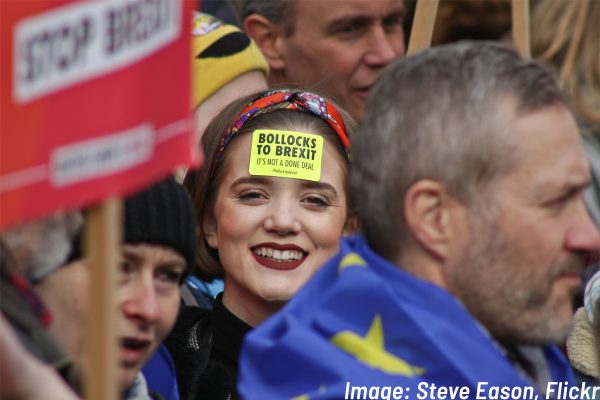
A major turning point came in September 1988, when President of the European Commission Jacques Delors was invited to speak at the TUC’s annual conference in Bournemouth.
In an effort to woo delegates, and win the trade unions’ support for the capitalist single market, Delors emphasised the need for a “social dimension” to the European project. This included promises of funding for deindustrialised areas and collective bargaining guarantees.
This was enough to convince the intended audience of union bureaucrats and officials.
“In the short term, we have not a cat in hell’s chance in Westminster,” declared Ron Todd, the formerly eurosceptic leader of the Transport and General Workers’ Union, in response to Delors’ superficially pro-worker speech. “The only card game in town at the moment is in Brussels.”
In essence, demoralised by the defeat of the miners’ strike, these tame reformist leaders were abandoning any perspective of class struggle at home. Instead, they placed all their hopes in Brussels, looking to the idea of a ‘social Europe’ as their saving grace.
Brussels bashing
Events – domestically and internationally – began to chip away at the apparent political consensus over Europe, however.
On the one hand, with the decline and decay of British capitalism came a degeneration of its political representatives.
In the past, Trotsky explained, British capitalism produced leaders who were capable of “thinking in terms of continents and centuries”. But by the 1980s, the Tory Party, big business’ A-team, was overrun with short-sighted, petit-bourgeois Little Englanders.
The election of Margaret Thatcher – the speculation-loving shopkeeper’s daughter from the Lincolnshire market town of Grantham – as Conservative leader in 1979 epitomised this trend.
On the other hand, this period also saw the growing weight and influence of France and Germany inside Europe. This was accompanied by a greater concentration of powers in Brussels’ hands, including moves to standardise social regulations across the continent and form a monetary union.
Eventually, these two processes – the degeneracy of British capitalism and its leaders, and tighter European integration – came into conflict with one another.
Unable to take British capitalism forwards, Thatcher increasingly leant on English nationalism to appease her base. This included jingoistic drum-beating by the UK Prime Minister about British ‘sovereignty’ and ‘independence’, and denunciations of Europe’s overreaching leaders.
In the same month as Delors was speaking to TUC delegates in 1988, for example, Thatcher was railing against the European Commission.
“We have not successfully rolled back the frontiers of the state in Britain,” declared the tub-thumping Tory PM, “only to see them reimposed at a European level, with a European superstate exercising a new dominance from Brussels.”
These words were not just demagogic chauvinism. They also reflected a widening divergence of interests between the different imperialist powers when it came to the European project.
Thatcher and her bourgeois supporters primarily saw the EEC as a market to be exploited by British (and American) capital. By contrast, European leaders – particularly in France and Germany – saw it as a necessary attempt to forge an imperialist bloc that could hold its own on the world stage, and thereby defend the profits of the big European monopolies.
Losing sovereignty
Thatcher’s Brussels-bashing stance also ruffled feathers within her cabinet. Alongside her government’s defeat at the hands of the mass anti-poll tax movement, these splits at the top of the Conservative Party over Europe helped to hasten the downfall of Britain’s so-called ‘Iron Lady’.
Her downfall was not enough to kill off euroscepticism inside the Tory Party, however. Rather, it only grew in the following years.
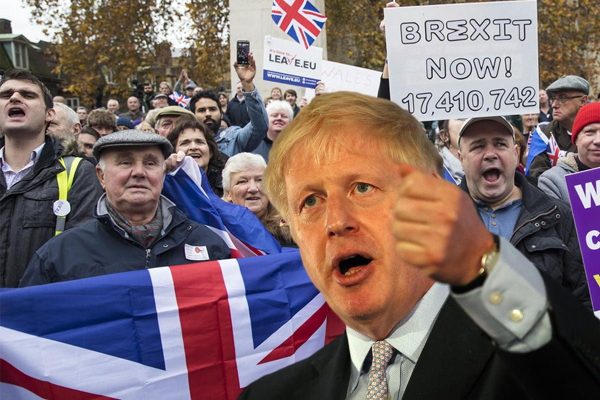
The 1990s saw a renewal for capitalism. This included a new era of globalisation, with post-Soviet Russia and Deng’s China reentering the world market.
On this basis, the process of European integration deepened. The EU was officially founded in 1993, when the Maastricht Treaty came into effect. This was followed by the creation of the borderless ‘Schengen zone’ in 1995, and the establishment of the euro – Europe’s single currency – in 1999.
By 2013, meanwhile, from its founding 12 members, the EU had enlarged to include 28 countries.
All of this only riled English nationalists within the Tory Party, who denounced the creeping loss of economic and political sovereignty to ‘faceless eurocrats’ in Brussels.
This included cacophonous complaints about stifling EU regulations, such as supposed ‘bans on bendy bananas’; and, later, about the prospect of uncontrolled immigration, as the EU expanded to encompass much of Eastern Europe.
A section of the ruling class happily whipped up all this xenophobia and anger against Europe, as a convenient scapegoat for the problems facing British capitalism and the working class.
In doing so, however, they created a Frankenstein’s monster of euroscepticism – within the Tory Party and more widely – that had its own narrow interests and nationalist delusions, and which they were increasingly unable to control.
Black Wednesday
Events such as ‘Black Wednesday’ also traumatised the Tories.
On this day, 16 September 1992, financial panic shook the UK economy and the Conservative government, following Britain’s forced ejection from the European Exchange Rate Mechanism (ERM).
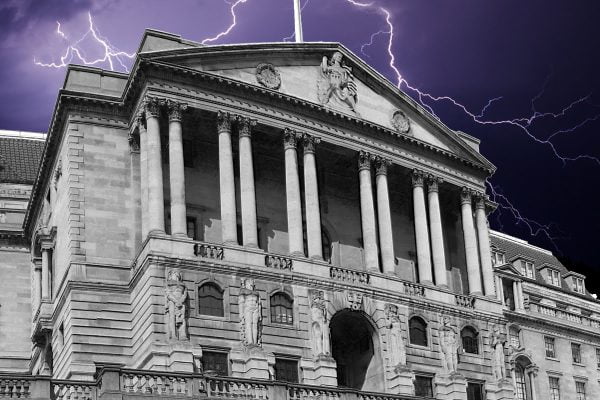
The ERM committed EEC members to coordinate monetary policy, in order to ensure the mutual stability of their currencies, and thereby prepare the way for the euro.
This framework was built around Europe’s dominant economic power, Germany, with all other countries pegging their currencies to the Deutschmark.
In essence, this was a monetarist agreement: restricting governments from carrying out inflationary or expansionist economic policies. In effect, this imposed an austerity agenda on the European working class, just as the Maastricht Treaty later did with its limits on budgetary deficits and national debts.
Thatcher’s government signed Britain up to the ERM in 1990, hoping this would bring the UK economy benefits such as lower inflation and lower interest rates.
As a point of nationalistic pride, however, the Tory leaders joined the ERM with a sterling-mark peg that was unsustainable, given the lack of competitiveness of British capitalism.
At a rate of 2.95 Deutsche marks per pound sterling, the UK currency was overvalued. This, in particular, made life difficult for British manufacturing, making their exports more expensive on the world market.
Furthermore, at this time, the UK economy was entering into a recession. Germany, meanwhile, was attempting to tackle high inflation, arising from the country’s reunification and the absorption of the poorer East into the economically-stronger West.
This meant that British and German capitalism required different monetary treatments. The UK economy needed lower interest rates to stimulate demand and stave off a slump. The German Bundesbank, meanwhile, was raising interest rates in order to tame inflation.
The ERM, however, forced Britain and other member states to follow Frankfurt’s lead when it came to monetary policy. And so the Bank of England had to tighten the money supply precisely at a time when a looser approach was called for.
It wasn’t long before the strain began to show, as hubristic Tory chancellors – refusing to devalue the UK currency as a matter of deluded vanity – struggled to maintain the pound’s link to the mark.
Speculators smelled blood and began to bet against sterling. George Soros, for example, pocketed an estimated £1 billion as he ‘broke the Bank of England’ and helped to drive Britain off of the ERM.
This was a humiliating blow for the Tory government of the time – one that left an indelible mark on the party and its leaders.
For Conservative eurosceptics, the ERM debacle cemented the idea that Britain was ‘different’; that the UK’s interests were best served by maintaining the country’s independence and distance from Europe; that politicians in Berlin and Brussels could not be trusted to look out for ‘us’.
At the same time, the ERM experiment was an early symptom of the contradictions of trying to achieve any form of monetary or economic union in a bloc of capitalist countries, all with their own different – and sometimes divergent – national needs and interests.
The UK’s disastrous experience of the ERM even left an impact upon Tony Blair’s pro-Europe government, highly influencing the New Labour leaders’ decision not to sign Britain up to the euro.
By the turn of the millennium, then, the fissures between the UK and the continent were clearly widening.
The rise of UKIP
Fights over Europe continued to plague the Tories in their wilderness years, in opposition. These skirmishes were stoked, in part, by the rise of the United Kingdom Independence Party (UKIP).
UKIP was founded as a single-issue party in 1993, in response to the signing of the Maastricht Treaty, the establishment of the EU, and the increasing centralisation of power in Brussels’ hands.
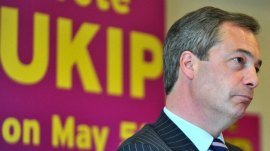
For around a decade, UKIP largely remained on the fringes of British politics, picking up a few protest votes from disaffected Tories, but not much more. In the 2001 general election, for example, the party gained just 1.5 percent of the vote nationally, with only one of its 428 candidates keeping their deposit.
Ironically, it was elections for the European Parliament – a body that UKIP wanted to abolish – that provided the party and its leaders with the launchpad they needed to boost their profile.
UKIP gained around 2.5 million votes (16 percent) in both the 2004 and 2009 European elections, coming in third and second place, respectively.
The election of Nigel Farage as leader in 2006 – and re-election in 2010 – was also a turning point for the party.
On the one hand, Farage was keen to attract a wider layer of Tory voters, alongside business owners and donors who saw the EU and its regulations as a hindrance to their money making.
On the other hand, the new leader represented a wing within UKIP that wanted to broaden the party’s appeal, beyond its narrow traditional social base of eurosceptic Tories and rural Conservatives.
This meant adopting a more ‘populist’ character: railing against not just Brussels bureaucrats, but against the elites more widely; championing the cause of the ‘ordinary bloke’; taking up local issues, particularly in ‘left behind’ working-class communities; as well as whipping up xenophobia around immigration.
This approach particularly struck a chord with voters in the wake of the 2008 slump, and with the coming to power of the Tory-Lib-Dem government in 2010.
The austerity agenda pursued by David Cameron’s coalition, following years of neglect under successive New Labour governments, fuelled a powerful anger against the entire political establishment. And Farage’s UKIP skillfully tapped into this.
This led to major electoral gains and successes for UKIP: in the 2012 and 2013 local elections; in a series of by-elections; and, perhaps most notably, in the 2014 European elections, where the party came top nationally with 27 percent of the vote – the first time neither the Tories nor Labour had won a national contest in over 100 years.
This was followed by the party gaining its first two MPs: initially with the defection of former Tory Douglas Carswell, and then with the victory of UKIP candidate Mark Reckless in the 2014 Rochester & Strood by-election
Political calculations
All of this set off alarm bells in the corridors of Westminster – particularly inside Conservative HQ.
Under pressure from eurosceptics on the Tory backbenches and within the party’s ranks, as well as from this growing UKIP electoral threat, Cameron lit the fuse on the EU referendum.
On 23 January 2013, in a speech at the Bloomberg offices in London, the Tory PM committed himself to an effort to renegotiate Britain’s relationship with Brussels. Furthermore, he promised a national vote on the UK’s membership of the EU; a plebiscite with a simple ‘In’ or ‘Out’ choice.
Cameron’s aim was not so much to placate the ‘swivel-eyed loons’ in his own party, but rather to shut them up – certain as he was that a referendum would yield a majority in favour of remaining in the EU.
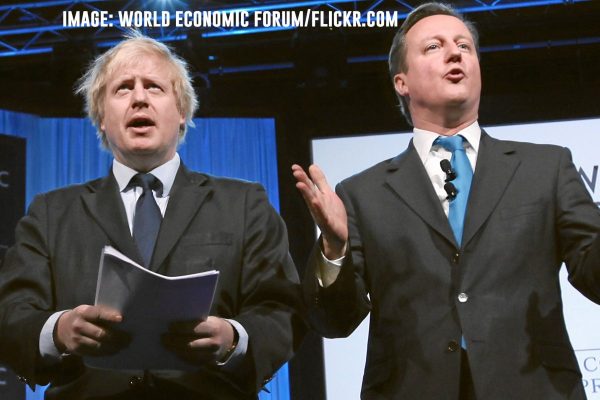
Shortly after being elected Tory leader, as part of an attempt to ‘modernise’ the party and soften its image, Cameron had asserted that the Conservatives kept losing elections because they wouldn’t stop “banging on about Europe”.
He soon found, however, that every bone he threw in their direction only led the rabid, ravenous Tory ranks to bark even more loudly and clamour for further red meat.
Within months of his Bloomberg speech, for example, over 100 Tory MPs rebelled to demand that Cameron’s referendum pledge be enshrined in law via the Queen’s Speech. Failures to negotiate an improved settlement with Brussels, meanwhile, only added grist to the eurosceptics’ mill.
Cameron’s Tories therefore went into the 2015 general election with a manifesto promise to call a referendum on Britain’s EU status: partially to placate Conservative backbenchers, but also to lure back voters who were considering abandoning the Tories for UKIP.
UKIP performed strongly in this election – coming third in terms of vote share, on 12.6 percent (but gaining just one MP) – by tapping into the anti-establishment anger in society. This only added to the pressure on the PM to follow through with his referendum commitment.
So it was that Britain was dragged into the 2016 EU referendum: not because of any widespread demand for such a vote – either amongst the general public, or within the ruling class – but because of the short-term political calculations of David Cameron.
In short, the referendum was intended as a means for Cameron to temporarily escape a dual pressure: from Europe-obsessed members in his own party; and from UKIP electorally. The desires of voters more widely and the needs of British capitalism were an afterthought, if that.
This only highlighted how far the degeneration of the Tory Party – once the most stable and successful bourgeois party on the planet – had gone; how short-sighted and reckless its leaders had become: willing to gamble with the future of British capitalism simply for their own narrow interests.
Hubris and myopia
The Tory leader’s Etonian hubris and myopia backfired spectacularly, however.
Cameron, a prominent ‘Remain’ advocate, thought he would easily win the referendum, neuter the eurosceptics within his party, and put the issue of Europe to bed.
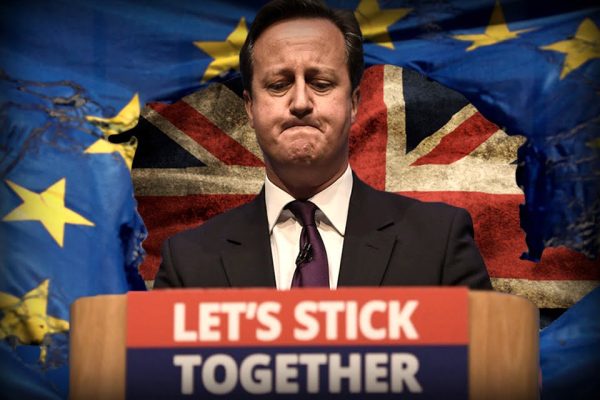
The Tory PM had already won two referenda – on electoral reform in 2011, and then on Scottish independence in 2014 – and was drunk on these successes.
But third time’s a charm. And aloof and out of touch, he did not account for the mood of the masses.
On 23 June 2016, despite (or perhaps because of) almost the entire establishment campaigning vigorously on the side of ‘Remain’, millions of voters – 52 percent on a 72 percent turnout – chose ‘Leave’.
The die was cast. The next day, the humiliated Prime Minister packed his bags and vacated Downing Street. Britain was on a one-way road to Brexit.
Establishment losers
All of this, so far, only provides one side of Britain’s Brexit story: why the EU referendum was called. The other side of this question is why the ‘Leave’ camp won.
To answer this, we must first explore the programme of the losing team, the Remainers: captained, primarily, not only by Cameron, but also by Tony Blair and the majority of big businesses; that is, by the bulk of the British establishment.
These well-to-do ladies and gentlemen were shocked by the Brexit vote. They had pushed for the UK to stay in the EU. And until the final few months before the referendum, polling seemed to suggest that their side would win. Even on the night before the results came in, Farage was conceding defeat.
By contrast, the liberal establishment’s support for Remain was no surprise. Maintaining tight relations with Europe was vital for British capitalism, given the country’s economic, political, and military ties to the continent.
The EU was (and still is) Britain’s biggest trading partner, accounting for 42.3 percent of UK exports in 2015 and 52.5 percent of imports (compared to 41.4 percent and 49.0 percent today, respectively). EU citizens, meanwhile, made up 43 percent of those immigrating into Britain in this same year, providing a valuable source of both skilled and unskilled labour for the bosses.
Cut adrift from Europe, meanwhile, Britain would lose its importance to Washington and Wall Street, thereby damaging the UK-US ‘special relationship’. And without its bigger brothers – America and the EU – to cosy up to for protection, British imperialism’s diminished stature and real status as a second- or third-rate power would quickly become apparent.
Why Remain?
These were the main arguments put forward by the leaders of the Remain campaign: in essence, that the British public should (nay, must) vote to stay in the EU, in order to safeguard the country’s so-called ‘national interests’ – that is to say, the interests of Britain’s bosses and bankers.
They were supported in their efforts by the majority of the leaders of the ‘left’ and the labour movement.
These reformists not only parroted the liberal establishment’s line, but even bolstered it with their own naive defence of the EU: primarily, that it was a supposed guardian of workers’ rights and migrants, against the Tories and racists like Farage.
In effect, this was the same position that Delors had won the trade union leaders over to in the 1980s. Only by now, the ‘left’ leaders had – on the whole – become even more tepid and weak politically; even more attached to the liberals and the so-called ‘progressive’ wing of the capitalist class.
Yet, for millions, all of this fell on deaf ears. In fact, for many workers it sounded like a sick joke.
The liberals and their mouthpieces sang the praises of Europe’s free market and freedom of movement. But what had any of this brought the working class in Britain? Nothing but a race to the bottom in terms of wages and conditions, alongside decades of social decay.
Similarly, the ‘left’ talked about the virtues of the EU: its guarantee of workers’ rights and defence of migrants. Yet by 2016, European leaders were imposing austerity on the people of Greece, Spain, Portugal, and Ireland. And they were drowning refugees and migrants in the Mediterranean Sea, in an effort to create a ‘Fortress Europe’.
In other words, despite the establishment’s protestations, it seemed to many ordinary workers that they had little to gain and even less to lose from voting ‘Remain’.
Kick in the teeth
But even this does not fully explain why a slim majority voted to Leave.
In many respects, the vote for Brexit had little to do with Europe at all. Yes, there were of course the traditionally eurosceptic layers who waved their Union Jacks, and banged the drum about ‘taking back control’ from Brussels. But for large numbers of working-class Leave supporters, opinions about the EU were almost secondary.
More than anything, for the most downtrodden swathes of the electorate, the 2016 referendum was a chance to give the establishment and the elites a good kick in the teeth; to start where Guy Fawkes had left off, by lobbing a giant stick of dynamite into the heart of Westminster.
The spread of the Leave vote demonstrates this. Support for Brexit was concentrated in former industrial towns and regions in the North of England, the Midlands, and Wales: places that had suffered the most from the decline and decay of British capitalism; from austerity and attacks – and which therefore despised the political establishment that had left workers and their communities to rot.
Yet the liberals who advocated Remain were completely blind to all of this. The real, grim conditions in these areas of the country were a closed book to these cossetted types and their hacks in the capitalist press.
And so – instead of accepting responsibility for the Brexit vote, which they and their system had given rise to – they blamed the ‘ignorant’ and ‘racist’ working class for inflicting this ruinous injury upon the country (read: upon British capitalism).
Popular front
Unfortunately, many of the ‘lefts’ weren’t much better.
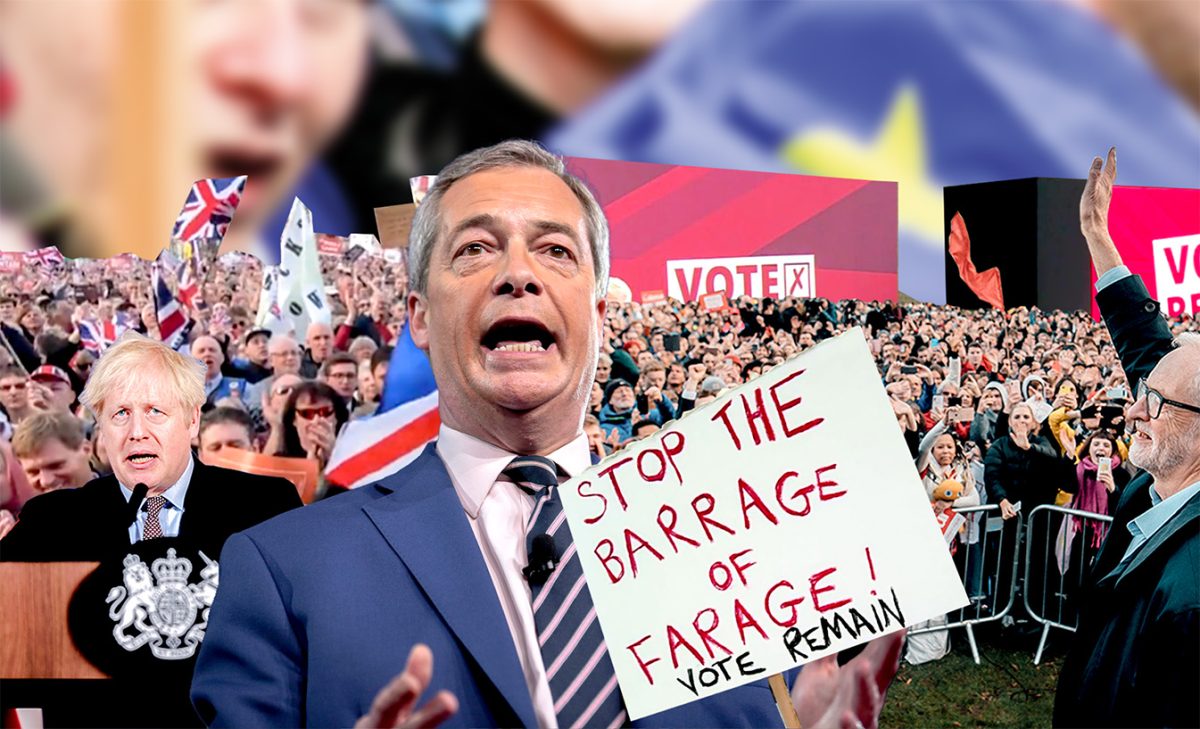
The reformist leaders too had helped to push workers into the Brexit camp – and into the arms of reactionary charlatans like Nigel Farage and Boris Johnson – by failing to provide a genuine socialist alternative: not only in the run-up to the referendum, but in the years and decades prior.
The most petty-bourgeois ‘lefts’, meanwhile, echoed the patronising, condescending tone of the liberal establishment, as they hysterically wrung their hands about how Britain was ‘sliding toward fascism’ and becoming a ‘racist island’.
It was no coincidence, therefore, that all of these demoralised cynics were soon huddling together for warmth inside the so-called ‘People’s Vote’ campaign: a popular front of enraged Remainers, uniting across class lines to demand a second referendum and overturn the Brexit vote. How democratic!
This, in turn, acted as a kiss of death for the Corbyn movement, as the ‘left’ leaders allowed themselves to be pressured by the liberal establishment into doing their bidding and supporting their push for a second referendum.
In the eyes of Leave-voting workers in former Labour heartlands, this was a giant black mark against the names of these ‘lefts’.
Corbyn and co. ended up with the worst of both worlds: blamed by the establishment and its mouthpieces for not supporting the EU enthusiastically enough; but also seen by working-class Brexit supporters as being both weak and servile, yet also lofty – willing to override their democratic decision.
Capitalist club
This all begs the question: what stance should the British left and labour movement have taken in relation to the 2016 EU referendum? And, more broadly, what attitude do communists have towards the European project?
We, the Marxists, have always been crystal clear on our position. From our ideological forebearers to our party today: genuine communists have consistently opposed the idea of European integration on a capitalist basis.
“From the standpoint of the economic conditions of imperialism,” writes Lenin, for example, “a United States of Europe, under capitalism, is either impossible or reactionary.”
“Capital has become international and monopolist,” he continues. “A United States of Europe under capitalism is tantamount to an agreement on the partition of colonies. Under capitalism, however, no other basis and no other principle of division are possible except force.”
“The imperialist half-unification of Europe might be achieved,” explained Leon Trotsky, similarly, “as a result of a decisive victory of one group of the great powers as well as a consequence of an inconclusive outcome of the war.”
“In either instance, the unification of Europe would signify the complete trampling underfoot of the principle of self-determination with respect to all weak nations and the preservation and centralisation of all the forces and weapons of European reaction: monarchies, standing armies, and secret diplomacy.”
In other words, a united Europe under capitalism, as far as this can be achieved, will only ever be an imperialist bloc; a capitalist club, designed to protect the profits and markets of the major monopolies, and the spheres of influence of the big European powers.
This analysis applies as equally to the demand for a ‘United States of Europe’, which Lenin and Trotsky were discussing over 100 years ago, as it does to understanding the class character of today’s EU.
It was this class perspective that led the Marxists in Britain to oppose the UK’s membership of the EEC in the 1975 referendum. And it was the basis for our refusal to endorse the Remain campaign in 2016, and to instead expose and emphasise the reactionary, imperialist nature of the European Union.
Socialist alternative
For these reasons, we called on the leaders of the left and the labour movement to adopt a clear socialist stance in relation to the EU referendum.
First and foremost, in the negative, this meant opposing a Remain vote, rejecting class collaboration with the liberal establishment, and explaining the capitalist interests and imperialist essence at the heart of the European Union.
In the positive, meanwhile, it meant calling for a Leave vote on a bold socialist programme; that is, on an independent class basis.
Leaving the EU should not be done for the nationalistic and chauvinistic reasons advocated by Johnson, Farage, and co., we explained, nor with a parochial protectionist outlook, as had been the tradition of the trade union left in the 1970s, but with internationalist and revolutionary aims.
Britain’s departure from the EU, we outlined, should be linked to militant class demands and socialist policies: an end to austerity and privatisation; expropriation of the bosses and billionaires; and the nationalisation of the banks and monopolies, under workers’ control and management, as part of a socialist plan of production.
The goal of ‘Brexit’, in other words, should not be to create an ‘independent’, isolated capitalist UK, but to act as a stepping stone towards a Socialist Britain and a Socialist United States of Europe.
Neither Brussels, nor the City
As already explained, however, the left and trade union leaders did not take such a position.
And in the absence of a proper socialist Leave campaign from the workers’ movement, we explained that the Johnson-Farage-led Brexit camp offered no solution either.
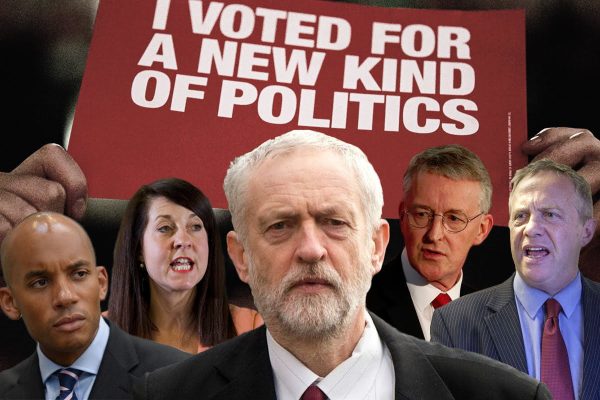
Due to the failures of the ‘left’ leaders, in other words, the working class was being presented with two equally reactionary options: a big business Remain campaign led by the liberal establishment; and a racist Leave crusade led by demagogues and reprobates.
In essence, the referendum had become a squabble between two wings of the ruling class; a quarrel between two factions of the Tory Party: both of which were cynically attempting to use voters to advance their own interests.
The ‘choice’ presented to the working class was no choice at all. Both camps offered workers the continued rule of the bankers and bosses. But for Remainer elites, this came cloaked in the starry blue-and-yellow flag of the European Union, whilst for Leavers it came wrapped in the red-white-and-blue of the Union Jack.
On both ‘sides’, there was no answer to the real problems that workers face: the crumbling state of the NHS and of local services; the stagnation of pay and living conditions; the shortage of jobs and housing, and so on.
In or out of the EU, we emphasised, would make no fundamental difference. British capitalism would continue its downward trajectory of decline either way. And workers would continue to face endless cuts, chaos, and crises.
In this civil war within the capitalist class, therefore, we refused to ‘pick a side’ – just as Marx and Engels had explained how workers in Britain were under no obligation to support either bourgeois camp in the debates over free trade and protectionism in the 19th century, neither of which was a solution for the working class.
Our stance was not simply a call for abstentionism. It was a principled, independent class position; a call for workers to organise, mobilise, and fight on their own terms, with their own methods, for their own class interests.
Our organisation was not big enough to be a decisive influence within the left and the labour movement. Instead, we aimed our propaganda at the most politically conscious and advanced layers, patiently and skillfully explaining our Marxist programme and perspectives with the most radicalised workers and youth.
All the while, we shouted our communist slogan loudly and proudly: No to the bosses’ EU! No to austerity Britain! For the Socialist United States of Europe!
Festering wound
A decade on from the Brexit vote, and the question of Europe remains a festering wound within British politics.
Today, however, in contrast to the past, it is less the eurosceptics on the right who are picking at this sore, but rather the liberal establishment and its representatives.
As mentioned at the start, a wing of the capitalist establishment is increasingly making noises about a possible ‘reset’ with Europe. And some are even raising the prospect of Britain rejoining the EU.
The reasons for this are clear. On the one hand, Brexit has been a disaster for British capitalism – accelerating the pre-existing decline of UK industry, and cutting the country off from one of its key markets.
“Brexit was the biggest act of economic self-harm any country’s ever done,” asserts London Mayor Sadiq Khan, another Labour Rejoiner.
According to various studies, for example, the UK’s departure from the EU has lowered GDP per person in Britain by an estimated 4-8 percent, due to its impact on trade, investment, and productivity.
A shrinking economic pie, in turn, means that profits are even harder to come by. The majority of British bosses and bankers therefore have a material interest in pushing for improved relations with Europe – although they are also wary about pushing for a new EU referendum, given the instability and disruption that this would provoke.
At the same time, geopolitical shifts are also playing a role. Above all, Trump’s ‘America First’ approach has set the cat amongst the pigeons in London, Paris, and Berlin.
British and European leaders are panicking that they may be abandoned by Washington, and in turn forced to pick up the bill when it comes to military and security matters.
This is forcing a serious rethink within the British establishment, which has tied itself hand and foot to US imperialism – economically, politically, and militarily – over the last 80-or-so years. And some are drawing the conclusion that closer alignment with Europe may be necessary as a hedge against the risk of being jilted by America.
This, along with a certain amount of careerist opportunism, explains the recent comments by Wes Streeting, who stated that Brexit was a “catastrophic mistake”.
“We need a new Special Relationship with the EU,” the Blairite MP said, at a point when he was weighing up a Labour leadership challenge, “because Britain’s future lies with Europe and one day back in the European Union.”
It is one thing to declare such an ambition, however, and another thing to accomplish it.
‘Bregret’
Europhile advocates of a ‘Rejoin’ like to point to a number of recent surveys which suggest that support for Brexit has softened, and that many Leave voters now suffer from ‘Bregret’.
YouGov estimates that 56 percent of Britons would support the UK rejoining the EU, for example, while other studies report that a similar percentage – 58 percent – think that Brexit was a mistake.
A number of barriers lie in the way of any attempts for Britain to rejoin the EU, however, or even just to ‘reset’ relations.
First of all, there is the political instability within Britain itself.
As outlined above, Brexit was a product of the decline of British capitalism and of the degeneration within the Tory Party. But cause becomes effect, and effect becomes cause.
The Brexit vote has acted as a catalyst for these interconnected processes, and for the rise of right-wing populism. As a result, 10 years on, the next UK government – after the next general election – could well be led by Farage, who would likely harden the country’s split with Europe, not reverse it.
In turn, there is the potential opposition to any UK-EU reunion that would come from within Europe itself.
European leaders would be extremely wary about allowing such a volatile, destabilising element (back) into their ‘family’. And certainly not if this came with similar attempts by Britain to ‘cherry pick’ its terms of membership, as was seen in the runup to the 2016 referendum.
Splits and divisions
Finally, and perhaps most importantly, there is also the question of what kind of Europe Britain would be seeking to reattach itself to.
The EU that Streeting and co. are looking to rejoin today is not the same as that which was originally formed in 1993 – nor even that which Britain voted to leave in 2016.
As discussed, the Common Market was established and sustained in the postwar period thanks to the unprecedented upswing of capitalism and expansion of the world market. Similarly, the EU was founded and developed in a period of globalisation and boom for capitalism.
But the European project today faces very different conditions. The present epoch – for capitalism in Europe and everywhere – is not one of peace, growth, and free trade, but of conflict, stagnation, and protectionism.
In many respects, Brexit was itself an early symptom of this process; a sign that the capitalist system had reached, and gone beyond, its limits; and, in turn, a harbinger of the collapse of the old world order, which is increasingly being replaced by a new world disorder.
Europe is particularly suffering in the midst of this global breakdown.
European capitalism’s entire model – based on cheap energy, open transatlantic trade, and US military protection – is crumbling.
Externally, Europe is under pressure on all sides: from Trump’s tariffs; from Chinese competition; and from a stronger, more assertive Russia on its eastern flank.
Internally, meanwhile, European unity is being torn apart by the advance of eurosceptic, right-wing populists, alongside a number of centripetal forces.
All of this is bringing to the surface the contradiction of the nation state: the tensions and antagonisms between the 27 remaining members of the EU; the divergent interests of the ruling classes in these various capitalist countries, along many different axes; and in turn, the impossibility of genuine European unity.
The eurocrisis in the early 2010s, for example, highlighted the division of Europe between a group of more austere northern creditors (primarily Germany), and the more fiscally profligate debtor nations in the south (most notably as Greece).
The Ukraine War and the question of rearmament, meanwhile, has opened up a further split: between the more hawkish ruling classes in the East (such as the Poles) and certain politicians in the West, such as Spanish PM Pedro Sánchez, who have resisted greater militarism (for their own opportunist reasons).
Similarly, there is a division within Europe over how to relate to both Trump’s America and Putin’s Russia.
The growing weight of China within the world economy, meanwhile, has led not only to clashes between different EU members, but also within the ruling classes of certain European countries – with some seeing China as a beneficial source of investment and trade, and others seeing Chinese capitalism as a deadly rival; an existential threat to domestic industries.
In short, as the crisis of capitalism deepens globally, the vision of a united, integrated European ‘community’ is breaking down and becoming more and more of a pipedream.
End of an era
We predicted all of this long ago.
In 1997, for example, at a time when European leaders were seeking to deepen European integration with the launch of the single currency, Marxist theoretician Alan Woods wrote an extensive analysis of the EU, entitled The Socialist Alternative to the European Union, in which he explained that:
“The problem is that the European capitalists are attempting to move towards union at a time when the general economic conditions are pointing in the opposite direction…
“All this means that a Federal European state on a capitalist basis is ruled out. Especially in conditions of world economic crisis… all the contradictions will come to the fore. It is unlikely that the EU will break up completely because of the need to defend their markets…They have to ‘hang together or hang separately’.
“But the movement towards European union will founder in a sea of national conflicts and bickering. The European bourgeois will have to content themselves with a series of bilateral agreements and shifting alliances…
“Such a situation will be very unstable and pregnant with all kinds of explosions.”
These words have turned out to be extremely prophetic – not by chance, but because of the power of the Marxist method.
Likewise, writing at the time of the 1975 EEC referendum in Britain, Marxist Ted Grant, the theoretical founder of our organisation, explained the capitalist character of the Common Market, and thereby the class interests that stood behind the ‘Yes’ (to stay in the EEC) camp, as discussed earlier.
At the same time, echoing the assertions of Lenin and Trotsky, he explained the limits of European integration within the confines of capitalism, and given the barrier of the nation state.
“The reactionary dream of a single European capitalist super power composed of Britain, France, West Germany, and the other market countries will remain a utopia,” Ted Grant wrote.
“The vested interests of big business in all these countries are expressed by separate armies, civil service, and governments. They can never succeed in overcoming these contradictions. The Common Market remains a customs union – and a very partial customs union at that.
“The moment that any of the Market powers find themselves in serious difficulties they flout and defy the rules. Thus the Common Market can never succeed in its nominal aims.”
“The British ruling class and its parties, to mix metaphors,” Ted Grant concluded, “has hung its hat on a chimera.”
“Capitalist Britain is sick. Inside or outside the EEC there is no cure.”
All of this aptly summarises the situation facing the British establishment today.
Those calling for ‘Rejoin’ are pining after an EU that no longer exists; nostalgically yearning – through rose-tinted glasses – for an era that is long gone, and is not coming back.
Revolutionary road
Half a century on from when Ted Grant wrote these words, and capitalism – in Britain, in Europe, and globally – is still sick: more so than ever.
And unless the real disease – of profit, the market, and the nation state – is addressed, then the reactionary utopia of European integration offers no remedy.
Likewise, lonely and adrift, broken Brexit Britain offers no future for workers and youth, other than more cuts and misery.
The only way forward for the working class of all countries is along the road of revolution.
We leave the final word to Leon Trotsky:
“The democratic republican unification of Europe, a union really capable of guaranteeing the freedom of national development, is possible only on the road of a revolutionary struggle against militarist, imperialist, dynastic centralism; by means of uprisings in individual countries, with the subsequent merger of these upheavals into a general European revolution.”