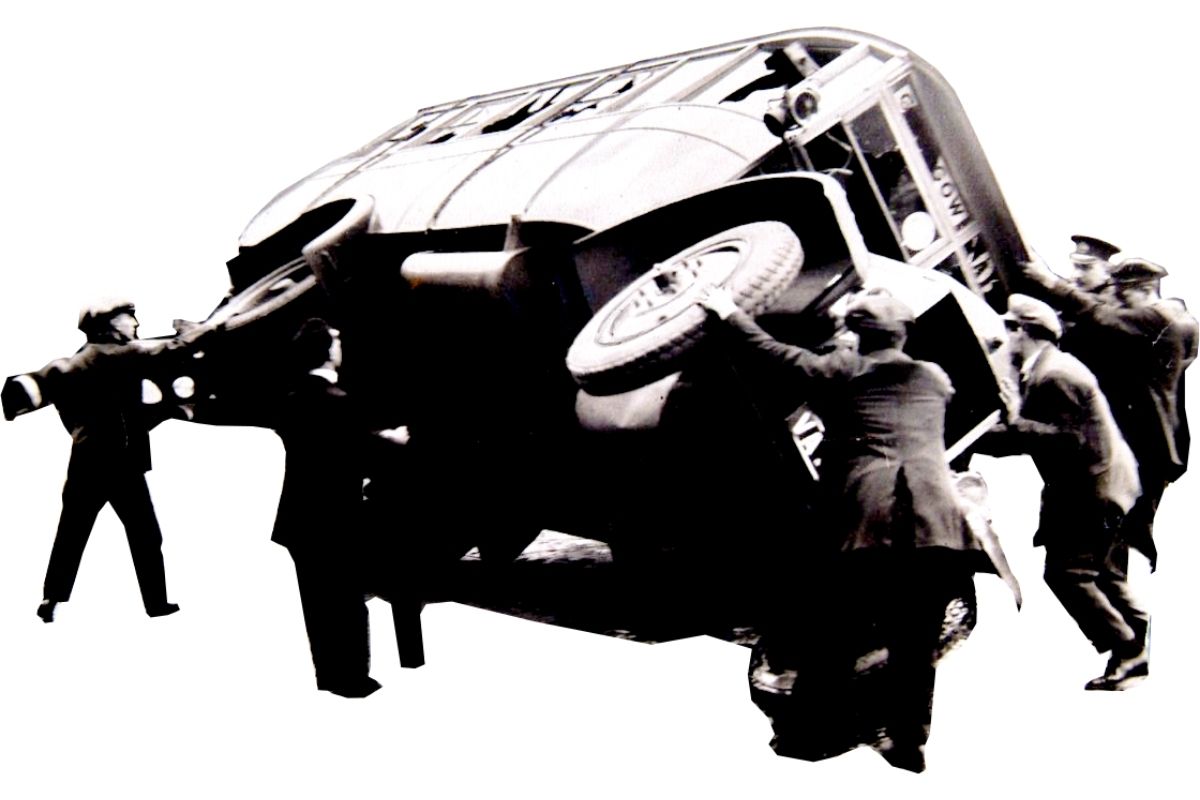
Platform Films’ Chris Reeves recently unearthed a remarkable documentary from 1974 – containing footage of the 1926 British General Strike that had been buried for half a century.
This documentary visually depicts the profound change in the consciousness of the working class – as it takes place – during the British General Strike.
It conveys the enormous revolutionary potential of the British workers and their profound sense of indignation at this historic opportunity being wasted by poor leadership. This atmosphere is best described by the workers themselves:
“It was a grand time, one that you could look back to with nostalgia, almost. We’d dance in the street until the small hours of the night.”
– A woman from south Wales, describing the atmosphere in a mining town
“If it had stuck out a couple of days longer, and I really believe this, the country would have gotten its sense of values right.
“We were just bloody slaves, they had all the power and could do as they wanted. If you dared speak back it was put on your coat; and out of the pit.”
– A miner from South Wales, describing conditions before the strike
The account of the strike is broadly historical, but showcases the standpoint of the workers – especially the miners, who were at the heart of the strike – as well as those on the other side of the pickets.
Interviews with government officials; policemen; middle-class volunteers in the Organisation for the Maintenance of Supplies (OMS, a mass, government-organised, scab-labour force); and even those on the lower-levels of the Trades Union Congress (TUC) are very instructive. The utter disdain for the working class held by our class enemies – and the distrust that trade union officials hold for those they ‘represent’ – proves conclusively that our class can only rely on itself.
It remains true today that, to bosses, a worker is not a person, but rather cannon-fodder to be used and discarded. In a period like 1926, as they begin to feel their power, working people are raised above the level of a slave and feel truly human.
Militancy without leadership
Throughout the documentary, the half-heartedness of the TUC is consistently exposed: from the first tepid strike callout, to the shunning of the councils of action.
Despite this, the documentary shows the immense force of the general strike and how ineffective the ‘specials’ (middle-class volunteers drafted into the police force) and the OMS were – despite the TUC leadership actively holding back workers. Interviews describe the workers’ daily meetings, which organised the distribution of food, issue of travel permits, centralisation of reports from the pickets, and so on.
These first hand accounts irrefutably prove that the working class was beginning to organise society in its own interests. Even back then, with far lower literacy rates, and without modern tools for communication, they were perfectly capable of doing so. Imagine what today’s working class could achieve!
Support for the strike was so widespread that an account describes that schoolboys in South Wales got hold of an issue of the British Gazette (a paper published by the government to spread lies about the strikes) to burn it in their school yard. Even the children had realised the role of the bourgeois press!
View this post on Instagram
Music of the future?
“The General Council got themselves in a revolutionary position but they weren’t revolutionaries, and they got frightened and the had to extricate themselves quickly, which they did.”
– An account given by a striker
Behind the backs of the councils of action and the working class, the TUC leaders, like Citrine, Bevin, and Pugh, had been prepared to sell out the strikers from the start. They especially targeted the miners, with a devastating result.
The documentary depicts a decisive victory for the bosses with embittered interviews and footage of men going back to work. The British national anthem plays in the background.
This tragic ending is by no means guaranteed in the future. Back then, Britain had a strong government with popular, middle-class support as well as a large army and police force. This is clearly not the case today; many of the tools of class rule have been blunted by the special crisis of British capitalism.
Since, the working class has been strengthened numerically; while the youth are radicalising in response to political earthquakes shaking capitalist society. While the subjective problems of the political leadership of the working class remain, that is the part of the equation we can change – by organising and learning from mistakes of the past.
The General Strike: A Revolution Betrayed is available on memory stick, DVD or via digital link. Price £20 (individuals) £60 (institutions). Email norm6344@gmail.com for details.