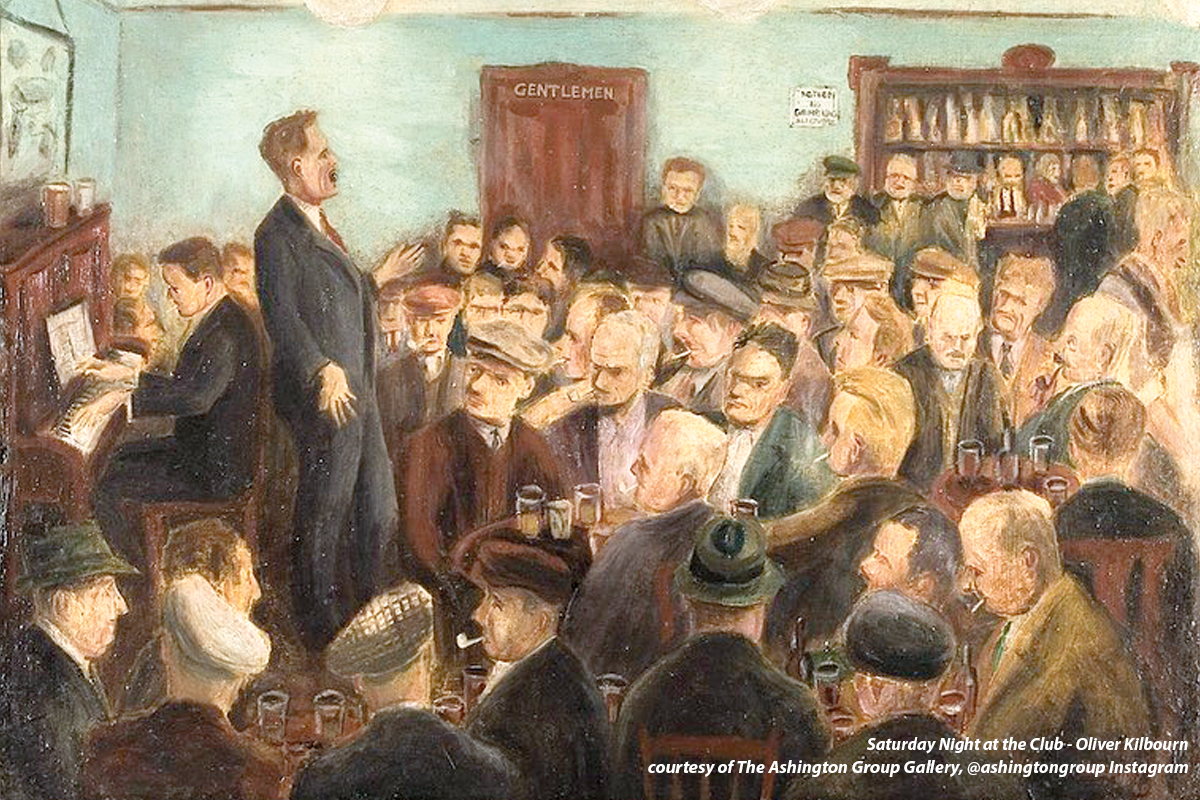
The story of the Ashington Group, known as the ‘Pitmen Painters’, sits in direct contrast to one of capitalism’s myths: that art belongs only to the elite.
Emerging from the mining communities of Northumberland in the 1930s, their paintings were not just an artistic curiosity, but a challenge to the whole class structure of art.
Art for who?
For thousands of years, access to art, education, and culture has been under the control of the ruling class. By using institutions such as biased patronage systems and modern gallery markets, they have positioned themselves as both the authority and primary consumer of ‘sophisticated art’.
View this post on Instagram
Meanwhile, the majority are excluded, most notably the working class today. Not because of any incompetence, but because of their material conditions. Their access to affordable art spaces, materials, and the development of their artistic skill and appreciation is stifled by long hours, financial insecurity and limited education.
Today, funding is being cut for many art programmes in schools and communities. Thus, for many, art becomes something distant and abstract, and this is the context from which the Pitmen Painters were born.
Working-class education
They began as part of the Worker’s Educational Association; a group of miners in Ashington who initially came together for classes in subjects such as biology and evolution.
View this post on Instagram
After turning to classes on art appreciation taught by Robert Lyon, they quickly became dissatisfied with the course.
The traditional, passive study of viewing and interpreting art works created by others felt disconnected from their own lives, and so Lyons suggested that the men begin making their own artwork to be critiqued by their peers, marking a decisive shift from being passive spectators to creators.
Painting real life
The miners’ work in the pits was dangerous, exhausting, and completely devoid of any true creativity. However, when they were given even limited access to artistic practice, they demonstrated not only technical ability, but a profound urge to interpret and depict their own world.
The paintings of the Ashington Group portraying mining life, domestic moments and community gatherings connected art with their lived experiences, as opposed to the commodified and often detached art of the petit bourgeois.
View this post on Instagram
What makes the Pitmen Painters so significant is that they did not simply ‘break into’ the so-called art world, but exposed its artificial boundaries.
Their success in exhibitions from Newcastle and London, along with recognition from figures such as Henry Moore and Julian Trevelyan, demonstrated that artistic brilliance is not the prerogative of the privileged few. In fact, this human potential exists in all people, and is either suppressed or nurtured by their environment.
Fight for bread, and roses, too
The miners of Ashington did not need elite backgrounds or formal academies to create meaningful work, they needed the conditions and means to explore their own humanity.
At the same time, the story of the Pitmen Painters reveals the limits imposed upon them by capitalism. Despite their recognition, they remained workers first and artists second.
Their creative work had to fit around the demands of wage labour in order for them to survive, and so the very system that made their emergence into the art world remarkable, constrained their development. Their art flourished not because of capitalism, but in spite of it.
View this post on Instagram
The lesson we can take from the Pitmen Painters is clear: the struggle to overthrow capitalism is not just a fight for redistribution of wealth, but a fight to reclaim the entirety of human potential.
We must secure the right for every individual to think, feel, create and enjoy a full existence worth living. Art is not a luxury, it is the fundamental expression of human experience and its liberation is inseparable from the fundamental transformation of society itself.
Frida Kahlo: Making a harmless icon
Perry Robert, Bermondsey
The Tate Modern in London has opened a new exhibition: Frida: The Making of an Icon. It charts Mexican artist Frida Kahlo’s (1907-1954) rise to her enduring relevance. She became one of the 20th century’s most famous artists, and, sadly, a figure of commercial appeal.
View this post on Instagram
Revolutionary influence
Kahlo was deeply shaped by the Mexican Revolution (1910-1920), which swept through her youth, overturning the old colonial elite and sparking a cultural flourishing.
Her works reflect this new Mexican identity, rejecting European colonial ‘supremacy’ in favour of indigenous art and culture, which was a legacy endured amongst ordinary Mexicans.
However, the exhibition’s title is telling. Only 33 of the works on display are by Kahlo herself, compared with 80 shown at the Tate’s 2005 exhibition.
Alongside this are Kahlo’s clothes and jewellery, and 200 works by contemporaries or artists she has influenced – so it’s more about Kahlo as an icon than her art or ideas.
View this post on Instagram
Harmless icons
This makes the treatment of her politics all the more striking. Although hailed as a ‘revolutionary’, hers and her husband’s Communist Party membership, and close ties to Trotsky and his wife, are tucked firmly into the background.
In the opening room, her famous Hammer and Sickle (and Unborn Baby), a painted medical plaster cast, is displayed without comment.
View this post on Instagram
This attempt at obfuscation recurs in the rooms exploring her legacy. Marcos Raya’s striking mural Frida the Last Portrait (1985) features protesters, socialist slogans, and even Lenin peeking out beside an Indigenous mask!
Yet the curators have chosen instead to focus on her “pro-activist legacy” and her more confused political ideas – downplaying her communist beliefs.
One cannot help but think of Lenin’s observation in State and Revolution. He notes that revolutionaries during their lifetimes are treated with the most “furious hatred”, but after their deaths “attempts are made to convert them into harmless icons”, blunting their revolutionary edge and vulgarising them.
Reasons to live
In spite of this, for the observant attendee, the enriching influence of Kahlo’s communism on her work and those who followed her shines through, clarifying why she has endured and influenced so many.
The exhibition (ironically) concludes with Fridamania – a room filled with merchandise charting Kahlo’s commercialisation since her death. A rich subject, but the Tate doesn’t critique this. Instead, lacking any sense of irony, they funnel visitors into the gift shop to buy their own slice of ‘Fridamania’.
View this post on Instagram
At its conclusion, we are left wondering… what would Kahlo have made of this? She, who in her later years and ill health, called the revolutionary communist movement “the only reason to live”.
Grenfell painting takes pride of place at North Kensington Fire Station
Nicholas Baldion, communist artist
My painting Honour Guard, Grenfell Silent Walks now hangs in North Kensington Fire Station.
Each year the Grenfell community marches in silence demanding justice, while firefighters form an honour guard in what remains an emotional anniversary.
View this post on Instagram
As the painting was installed, local firefighter and justice campaigner David Badillo spoke to The Communist about Grenfell and the struggle for justice.
“People’s emotions have changed over the last nine years. It’s gone from trauma to disbelief to anger. Anger is the most prominent emotion now. Nine years on there is no accountability, no justice. And because of that there will be no peace.”
There is solidarity between the Grenfell community and firefighters, despite attempts after the fire to direct blame towards the fire service and even residents themselves! All in order to divert attention from those criminally responsible for deregulation and cheating fire tests in the race for profit, resulting in the social murder of 72 people.
Nine years later, the Metropolitan Police have announced they intend to bring charges against 57 individuals before the tenth anniversary.
“I hope it’s not just a token gesture, that they get the right people, the people at the top. Bring them all to justice. I’d like to see jail time. I hope the families who lost loved ones would find peace in that.
“I feel honoured to know these people. The fight and dignity they have shown is admirable. I feel privileged to have become friends with so many.”
View this post on Instagram
Before the fire, residents warned of a “catastrophic fire” on the Grenfell Action Blog, while the Fire Brigades Union repeatedly warned that deregulation and combustible cladding threatened the stay-put policy.
“The firefighters weren’t listened to, like the residents of Grenfell weren’t listened to.”
This all forms the bond between firefighters and the Grenfell community, symbolised each year by the Silent Walk.
“My boxing centre was at the bottom of Grenfell Tower. I knew people there. It was a privilege serving at the local fire station, and when Grenfell happened, we stood, and still stand, with our community in the fight for justice and change.”