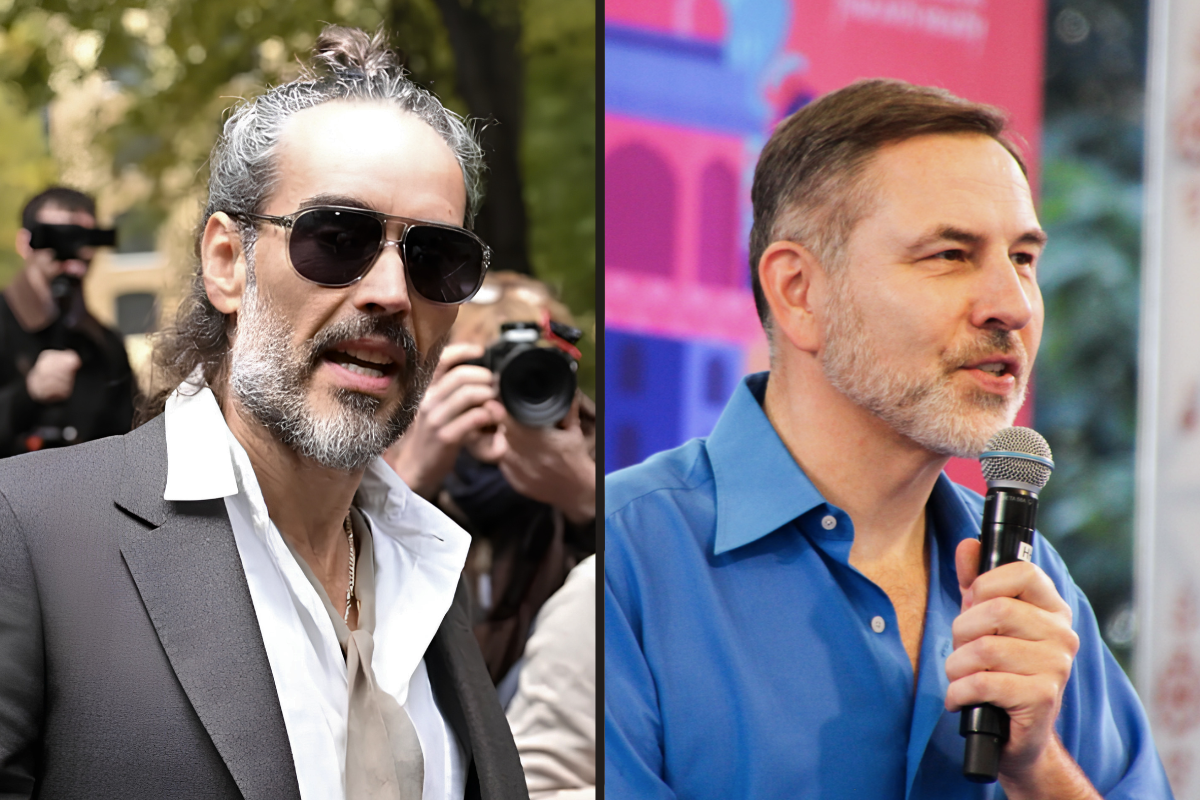
This has been a week of reckoning for the British entertainment industry. On 9 November, comedian and media personality Russell Brand was sentenced to ten and a half years in prison for the rape and sexual assault of four women.
The very next day, allegations emerged that David Walliams – also a comedian and television personality, as well as a best-selling children’s author – had been using his celebrity status to prey on girls as young as 15.
These are two more names to add to a long, long list of men in the entertainment industry – such as Harvey Weinstein, Jimmy Savile, David Sullivan, R Kelly, Kevin Spacey, and P Diddy – who have been exposed as having used their powerful position to rape, abuse, and harass.

That’s not to mention the litany of other rich and powerful monsters that have been outed as abusers, traffickers, and paedophiles in recent years: Jeffrey Epstein, Ghislaine Maxwell, Mohammed Al-Fayed and his brother Salah Al-Fayed, and the former-Prince Andrew.
And, as many commentators and internet users have rightly questioned: how many more of these criminals and sex pests don’t we know about? How many predatory talent-show hosts and TV personalities are also hiding in plain sight?
There’s a clear sense among the public that Brand and Walliams are merely the tip of the iceberg – beneath which lies a whole mountain of covered-up filth and depravity.
Under pressure from the ‘MeToo’ movement a decade ago, which emerged in response to the Harvey Weinstein allegations, the media bosses promised that they had ‘changed the culture’ in the industry, and flushed all these creatures out.
The same can be said about the Met Police’s ‘Operation Yewtree’, which was set up in 2012 in response to the Jimmy Savile scandal, and was supposed to shine a light into the networks of abuse that exist within the entertainment industry.
Yet, in the immediate aftermath of Russell Brand’s sentencing, the Times reported even more women have come forward accusing him of sexual assault.
And similarly, following the allegations against David Walliams, claims have already started circulating that there are several more public figures protected by the media injunctions that initially prevented Walliams’ crimes from being reported on.
‘Risque libertine’?
Russell Brand started out as a stand-up comedian in the early 2000s, known for his purposefully scandalous and provocative style, and his self-crafted image as a sleazy, sex-obsessed libertine.
Brand’s image was part and parcel of the misogynistic ‘lad culture’ was rife at the time, when pornographic magazines were displayed in newsagents across the country, and gutter-press tabloids featured nude ‘page three’ models in every issue.
Brand regularly made jokes about topics most comedians would rightly avoid, such as the Holocaust and rape. In 2008, he went so far as to perform, live on stage, a hoax call to the Northamptonshire Police claiming he had witnessed a sexual assault.
This outrageous, attention-grabbing persona secured him roles as a presenter with Channel 4 and the BBC, making him a household name in the 2000s.
For a time in the 2010s, Brand cultivated a left-wing ‘revolutionary’ persona, with his online show The Trews, and his book Revolution. For a time this did channel, in a distorted way, some of the anti-establishment mood that was building up before the Corbyn movement exploded.
During the Covid pandemic, however, this washed-up opportunist faded from the mainstream and drifted into the mire of right-wing demagogy and conspiracy theories
From starting out promoting ‘anti-vax’ and Covid-19 denialism on his YouTube channel, he wound up becoming a born-again Christian, and a prominent guest speaker at last year’s Turning Point USA conference.
Brand is even good friends with far-right activist Tommy Robinson, who has come to Brand’s defence against this alleged ‘establishment attack’. Clearly, the far right only cares about ‘protecting our women and girls’ when it gives them an excuse to spew Islamophobia and sow hatred against migrants.
View this post on Instagram
But throughout all of these twists and turns, many people in the industry knew that Brand’s ‘risque’ jokes and behaviour were more than just an act.
The harrowing details of Brand’s crimes that his victims laid out in their statements in court are appalling. They paint a clear picture of a callous, entitled man, who had been given free rein to rape, abuse, and humiliate countless women put in his path.
‘National treasure’?
Russell Brand has always been a contentious figure. Even during his time in the limelight, he was a perpetual PR disaster waiting to happen.
That’s why many in the media and the British establishment have felt that they could comfortably wipe their hands clean of this scandal. They had long written off Brand as a bit of a nutjob, and shunned him from their ‘polite society’ accordingly.
But the allegations against David Walliams which emerged the very next day – after a court injunction blocking him from being named was lifted – demonstrate that this disgusting behaviour is by no means limited to the entertainment industry’s most outrageous figures.
Over the last couple of decades, David Walliams has been raised to the status of a ‘national treasure’ by the establishment: a clownish, family-friendly figure; sometimes cheeky, but ultimately harmless.
View this post on Instagram
Until recently, Walliams had (mostly) successfully distanced himself from where his career took off: creating and starring in the once hugely popular – and always profoundly reactionary, bigoted, and racist – comedy show Little Britain.
From starring in blackface and making fun of disabled people and benefits claimants, Walliams pivoted to children’s literature, and became a judge on Britain’s Got Talent.
After completing several charity swims, he was voted “most inspiring person in Britain”. Walliams was even granted an Order of the British Empire for his services to charity and arts in 2017.
View this post on Instagram
But the cracks started to show publicly in 2022, when he was caught making derogatory comments about a Britain’s Got Talent contestant: “She’s like the slightly boring girl you meet in the pub that thinks you want to f*** them, but you don’t.” Following this public backlash, he was dropped as a judge after ten years on the show.
Not long after this, Walliams’ publishers, HarperCollins, undertook an internal inquiry after years of complaints of his inappropriate behaviour with young female staff.
Around the same time as the Britain’s Got Talent scandal, the Guardian and ITV began their three-year investigation into growing rumours that Walliams had long been using his celebrity status to prey on young fans and harass women he came into contact with.
These findings – which were presented in full to Walliams last year, and saw him being dropped by HarperCollins even before details came to light publicly – lay out decades of wrongdoing.
The report alleges that Walliams reached out to multiple teenage female fans – after meet-and-greets or through social media – and groomed them, purposefully waiting until they had reached the age of consent, before inviting them to his home and pressuring them into sexual relationships.
It also shows records of women who had worked with Walliams in both television and publishing, who had to warn each other to ‘be careful’ and to avoid being alone with him.
Open secret
In a statement, David Walliams – who is currently in a psychiatric unit, after claiming to have made multiple attempts on his own life – has denied all the allegations, but has recognised he may have “behaved thoughtlessly” at times.
Limiting what he is being accused of to ‘thoughtlessness’ misconstrues the scale of the situation completely. This is a slap in the face to his victims. What is described in the Guardian-ITV joint investigation is not the unfortunate consequence of early-2000s ‘lad culture’, nor is it just an ‘unwell’ and ‘lonely’ man making a couple of unwanted advances at women.
What ties the cases of both Walliams and Brand together is that they used their position as rich, powerful men to take whatever they wanted from the women and girls around them again and again – and everybody knew.
As early as 2006, singer Dannii Minogue described Russell Brand as “a vile predator”. These words were then used again by comedian Katherine Ryan in an interview in 2022 – where she stated that, although she could not name him at the time, it was an “open secret” that he was “a perpetrator of sexual assault.”
Throwback to Katherine Ryan talking about Russell Brand (before he could be named)
by
u/Dragonogard549 in
LouisTheroux
All of these despicable acts were happening essentially in the open, while the British media establishment turned a blind eye, downplayed whatever did come to light, and made it clear the expectation was to keep hush-hush.
Legal threats, non-disclosure agreements, hush money, and reputational management companies were put at the disposal of powerful men like Walliams who found themselves in hot water, in order to threaten the young – and often working-class – women whom they had abused.
We can see the exact attitude the media establishment takes the crimes taking place in plain sight in this nauseating joke read out by host Jonathan Ross at the 2004 British Comedy Awards:
“The comedy awards are 15 years old – 15 years old! And like most 15-year-olds, it’s drunk, it’s unpredictable and it’s probably going home with David Walliams.”
This was one of several such ‘jokes’ made on television over the years, including one in 2009 when Walliams himself said, “If it is wrong to share your bed with 13-year-old boys, then lock me up and throw away the key”.
Institutionally facilitated
To make matters worse, in many cases Brand and Walliams’ abuse, misconduct, and gross misogyny was not just allowed to happen, but institutionally facilitated by the industry.
For example, comedian Lucy Beaumont has said a young television worker confided in her that he was tasked with bringing young women to Walliam’s dressing room, and how he felt pressured to continue even when he was uncomfortable with it.
In one 2007 segment of Russell Brand’s BBC Radio 2 show, you get a real sense of the institutional web that ties all these vile individuals together, and makes it all the easier for them to act so reprehensibly.
In it, Brand calls up the not-yet-disgraced prolific child abuser Jimmy Savile, and says it would be “very nice one day” to meet him. They then share the following exchange:
Savile: I don’t usually meet fellas, but if you’ve got a sister then that’s okay.
Brand: I’ve got a personal assistant. And part of her job description is that anyone I demand she greet, meet, massages, she has to do it. She’s very attractive, Jimmy.
Savile: Well, well that’s a good start. You could send her along to do some research.
Brand: Would you like her to wear anything in particular, Jimmy?
Savile: I’d actually prefer her to wear nothing.
Brand: [Laughing] There’s nothing wrong with that!
The show continues as if nothing strange has been said. The BBC has since been made to apologise to staff who felt that Brand was “too influential” for them to freely speak up about his predatory behaviour during his time as a radio host.
But this is the same story as we have seen played out with all of the other rich, powerful men whose behaviour came to light before those of Brand and Walliams. This is what allows these men to get away with their abuse for decades at a time.
But this pressure in the entertainment industry to brush gross misconduct under the carpet does not just come from some innate avoidance towards rocking the boat.
The entertainment industry is a system of commercial interests – there are incentives for broadcasters, publishers, and production companies to protect their most profitable personalities, even when serious complaints arise – especially when these complaints come from young working-class girls, and those just starting out in the entertainment business.
In the ITV documentary, one HarperCollins employee astutely states that if David Walliams had not been making them so much money selling some 50 million copies of his books worldwide, “he would just have been some random creep called Dave”.
Regulation or revolution?
Labour’s culture secretary Lisa Nandy has stated that, following the David Walliams allegations, entertainment needs to “draw a line in the sand”. She has said the government will be looking into enforcing tighter safeguarding regulations on the media industry. Currently, membership of the creative industries industry standard body is voluntary.
But who will be doing this ‘independent’ regulation? The very same establishment which is filled with abusers from top to bottom, that is implicated a hundred times over in the Epstein files, and that has okayed state-sanctioned rape and abuse of women with the SpyCops Bill?
Are we to trust the same entertainment industry execs who turned a blind eye to Brand and Walliams’ actions for nearly 30 years, and covered up the crimes of Jimmy Savile for decades more?

Are we to trust the same police that murdered Sarah Everard, and mockingly photographed the dead bodies of murdered sisters Bibaa Henry and Nicole Smallman?
In a statement, Nandy makes reference to how it has been ten years since the ‘MeToo’ movement and almost fifteen since Operation Yewtree – and yet nothing has really changed.
Evidently, this is true. But we must be clear that responsibility for this failure falls to the very same liberal establishment Nandy represents. Let’s not forget that this is the very same Labour government which very recently turned a blind eye to Epstein’s pal Peter Mandelson, as they promoted him to one of the most powerful positions in the British government.
Under the pressure of public outrage, the British establishment has, over the last fifteen years, denounced and occasionally prosecuted individual abusers as they are revealed, and repeated the importance of ‘empowering’ women to ‘speak out’.
But this is as far as the establishment is willing to go.
With each new name, they raise yet another hue and cry about yet another powerful individual abusing the power handed to them by their wealth and status. But they have no issue with the fact people have this power and privilege in the first place.
They call, time and again, for ‘changing the culture’ – without saying a word about changing the system underpinning it, or the fact that the culture of violence against women comes from the top.
As communists, we say it is not enough to pick off powerful abusers years after their crimes have already come to light, while leaving all the conditions that enabled them intact. Empty words and promises to “draw a line in the sand” are not enough.
To actually empower workers in the entertainment industry to fight back against the likes of Brand and Walliams, we need to kick out all these execs happy to turn a blind eye as long as the money keeps rolling in, and run workplaces under the democratic control of the workers themselves.
To fight misogyny and abuse, we must fight to abolish the capitalist system that produces it.