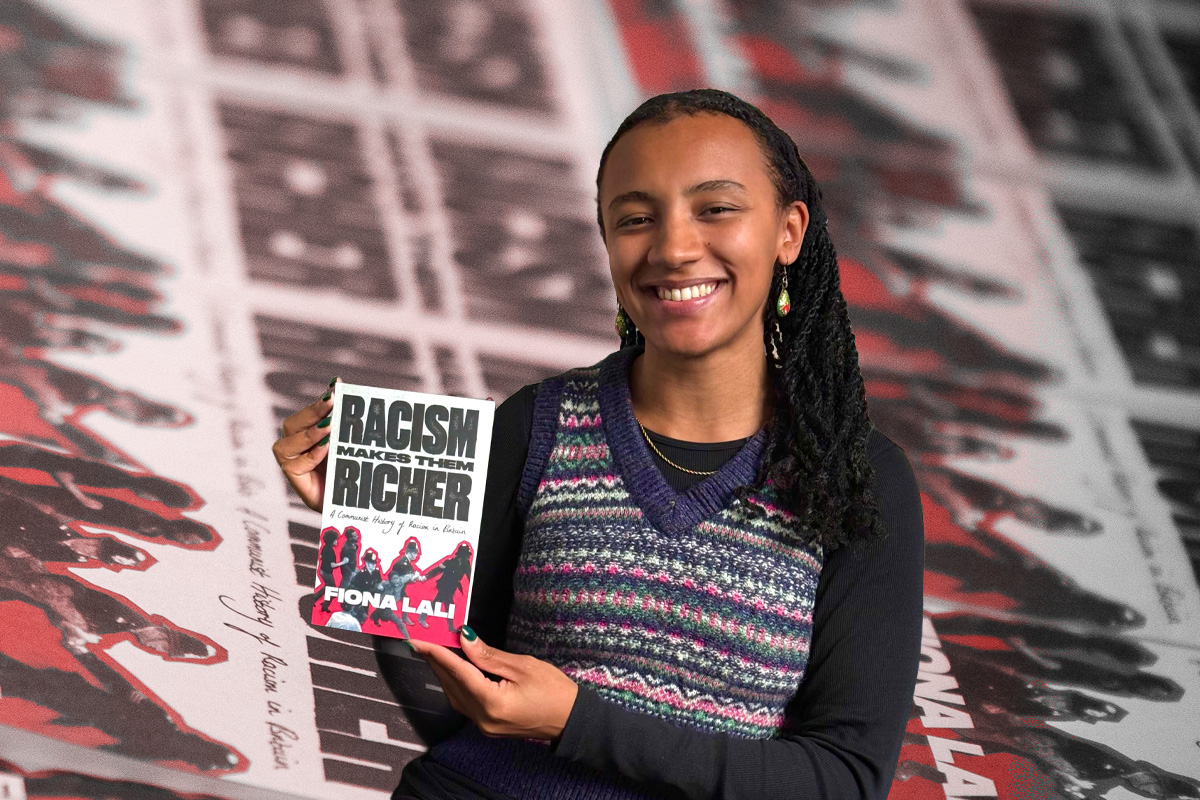

There is truly no other book like this. Fiona Lali’s book Racism Makes Them Richer: A Communist History of Racism in Britain has fundamentally changed my understanding of racism, particularly in the context of Britain.
More than anything, it has given me greater confidence that racism can be fought, and it can be defeated.
As communists, we often say that racism is a tool of the ruling class. But what does that actually mean?
Fiona Lali’s book answers this question, showing concretely how racism has been consciously developed, adapted, and wielded throughout history to serve the interests of the capitalist class.
There are plenty of books that discuss and lament racism. But what I have been looking for is a book that helps me understand it. Racism Makes Them Richer breaks it down with a clarity that I have struggled to find elsewhere.
There is so much I could say about this book, but I’ve narrowed it down to three highlights which I hope will inspire you to pick up a copy.
Voir cette publication sur Instagram
1. The origins and development of racism
One of the most fascinating aspects of this book is how Fiona traces the development of racism alongside the development of capitalism.
She shows that racism is neither natural nor inevitable, but something that has been consciously cultivated and adapted to serve the interests of the ruling class.
For example, she establishes how the British capitalists grew rich from the expanding slave trade. Following this, as the enslaved population in the Americas grew, ethnic divisions were codified into law, to divide slaves from European indentured servants, and allow the capitalists and slavocracy to maintain control.
The section ‘Science and Culture’ is also a particular highlight. Fiona explores how pseudoscientific theories of race, including eugenics, were developed to justify colonialism, and how this racist ideology became embedded into British culture.
She also demonstrates the adaptability of racism. In ‘Old Tricks, New Targets’, Fiona draws connections between anti-Irish xenophobia, the racism faced by the Windrush generation, and the anti-migrant rhetoric that we see today – showing how the same ideas have been repackaged time and again to serve the changing needs of the British ruling class.
As Fiona explains, racism has not always existed in its present form. It has been consciously developed and fostered, and my biggest takeaway from understanding this is that it can be overcome.
Voir cette publication sur Instagram
2. The history of struggle against racism
It would be easy to read a history of racism and come away feeling pessimistic, particularly now, when racist rhetoric is becoming increasingly vicious. But that is certainly not how I felt after reading this book. Quite the opposite.
One of my favourite examples is Fiona’s account of the Grunwick strike of the late 1970s, where predominantly Asian women workers took on their employers and inspired an extraordinary movement of working-class solidarity that cut across racial divisions, at the height of the fascist National Front’s activity.
Alongside Grunwick, the sections ‘Here to Stay, Here to Fight’ and ‘Struggle and Solidarity’ are filled with inspiring accounts of workers and communities organising against racism, often in the face of enormous obstacles. Many of these are also covered in our article series on anti-racist struggles in Britain.
These struggles demonstrate the strength of the working class and its potential to overcome racial divisions here in Britain.
They also show how black and Asian workers themselves have led movements against the racism they faced, only to be held back by leaderships that sought to pacify these struggles. Truly, the history of racism in Britain is also a history of people fighting against it!
For those who feel like racism is too deeply embedded in British society to be defeated, these sections will make for an incredibly inspiring antidote.
3. Understanding systemic racism today
My final highlight is Fiona’s analysis of systemic racism, particularly her examination of the 2017 Grenfell Tower fire.
With the changing character of North Kensington, and the decisions that ultimately placed profit above the safety of Grenfell’s largely black and Asian working-class residents, she demonstrates how racism operates through the material conditions in which people live and work; rather than simply through individual prejudice or racist attitudes.
If there was ever any doubt that capitalism is a racist system, Fiona’s analysis here should shake it. She puts into words something that black and Asian workers, and many white workers horrified by racism, have long recognised in the inequalities around them, but may have struggled to fully explain.
For me, this is what makes the analysis so valuable. It gives us a clearer understanding of the conditions we are fighting against and, with that, a much stronger basis on which to fight them.
You really have to read it!
These are just three highlights from a book absolutely packed with analysis. I’ve barely scratched the surface.
In just 196 pages, Fiona covers all that I have highlighted, plus Black Lives Matter, the police, the rise of Islamophobia, the limits of identity politics, and so much more.
Despite the breadth of history and analysis, the book is incredibly accessible. I would go as far as to say that it will help anyone understand racism far better than any corporate unconscious bias training ever could!
If you’re horrified by the rise of racism in Britain today, if you want to understand where it comes from and, most importantly, how we can defeat it, you need to read this book.
Get your copy of Racism Makes Them Richer today, for only £9.99 from Wellred Books Britain.
Voir cette publication sur Instagram