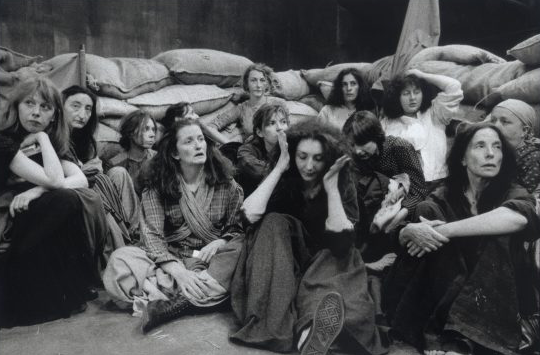

Peter Watkins’s 2000 film La Commune (Paris, 1871) attempts something rare: to give cinematic form to the living, contradictory process of a revolution.
An experimental hybrid of mockumentary and historical reconstruction, the film recreates the first revolutionary workers’ government created after France’s defeat in the Franco-Prussian War.
When the so-called ‘Government of National Defence’ attempted to disarm Paris after the war ended, the people refused. The population of Paris “stormed heaven” (in the words of Karl Marx), drove the government out to Versailles, and elected the Commune to reorganise their city in the interests of working people.
This inspirational state survived for just over two months before being crushed by the Versailles army, which massacred thousands during the ‘Bloody Week’.
The film re-enacts these events in order – other than when the reconstruction is interrupted by performers speaking about political struggle in the 1990s.
Watkins does not present the Commune’s history as a done deal. Over nearly six hours, he follows the Communards through lively meetings and barricades as they argue about wages, education, the church, women’s oppression, military strategy, and the future of the revolution itself.
Watkins shows history as a living process made by real people arguing over what to do and acting without knowing the outcome. Few films have made revolution feel so immediate, unfinished, and alive.
Past to present
The film was shot inside a disused factory in Montreuil, where Watkins built fragments of streets, meeting rooms, and barricades rather than trying to faithfully imitate nineteenth-century Paris.
Television reporters move through this visibly artificial reconstruction of 1871, interviewing Communards and broadcasting rival accounts on ‘Commune TV’ and ‘Versailles TV’. Versailles TV presents the standpoint of the ruling class as ‘neutral’ news, while Commune TV reports from within the revolutionary movement.
The media does not stand outside the class struggle. What appears as order or violence, legitimacy or chaos, depends on which class is speaking.
Almost every major television organisation that was approached refused to fund La Commune. Its marginalisation is hardly accidental: the ruling class does not want to revive the memory of the Commune!
The unusual power of the film also comes from its performers. Watkins recruited more than 220 people from across France, most of whom were not professional actors. They researched the Commune, helped develop their characters, and debated the political questions raised by their study of history.
The protests in France today give these debates renewed urgency: how do we confront state power and organise a struggle capable of defeating it?
These strategic problems recur through the performers’ actions and debates: whether or not to act against Versailles before the counter-revolution recovers, how the revolution should organise its defence, and what kind of leadership it requires. In reality, this means a centralised revolutionary leadership to organise the military defence against Versailles.
Living revolution
None of this makes La Commune a dry intellectual exercise. The film’s length lets us watch performers who know of the defeated revolution become, in spite of themselves, increasingly hopeful for its success. The film doesn’t pretend to be entirely non-fiction, but this actually draws us closer to the historical process.
As arguments unfold, convictions develop, and the threat of Versailles grows, the viewer’s experience becomes physical. I repeatedly found myself leaning forward, fists clenched, palms sweaty; exhilarated as ordinary people discover their collective power, frustrated as opportunities are lost, and filled with dread as the Versailles army closes in.
We know how the story ends, but its participants never seem like pieces being moved towards an inevitable defeat.
The working-class government of 1871 demonstrated to Marx the necessity of smashing the bourgeois state and replacing it with a workers’ state. Marx, Lenin, and Trotsky have subsequently drawn the lessons for revolutionary struggle. Watkins makes its potential and tragedy palpable. Few films demonstrate so powerfully a feeling of revolutionary history being made.
Watch ‘La Commune (Paris, 1871)’ online via your institution here, or for free here.