On its ninth day, the strike was growing. Non-unionised workers continued to join its ranks and the workers kept ‘in reserve’ were itching to walk out.
The day’s reports of the local trades councils overwhelmingly paint the same picture. In Bo’ness, Scotland: “No weakening. All workers solid except five railwaymen, and workers not out wish to come out.”
In Birkenhead, Merseyside, the local organisation reported that the stoppage was extending. Yeovil reported 98 percent adherence, and 100 percent was reported by several trades councils in various sectors. In Canterbury: “No weakening whatever; our difficulty was to keep the men not involved at work.”
These men included the energy workers who held the entire country in their hands. If the TUC leadership had been determined to win, stopping the supply of power to factories and government buildings would have been the obvious next step. But what these leaders feared most was precisely a decisive victory.
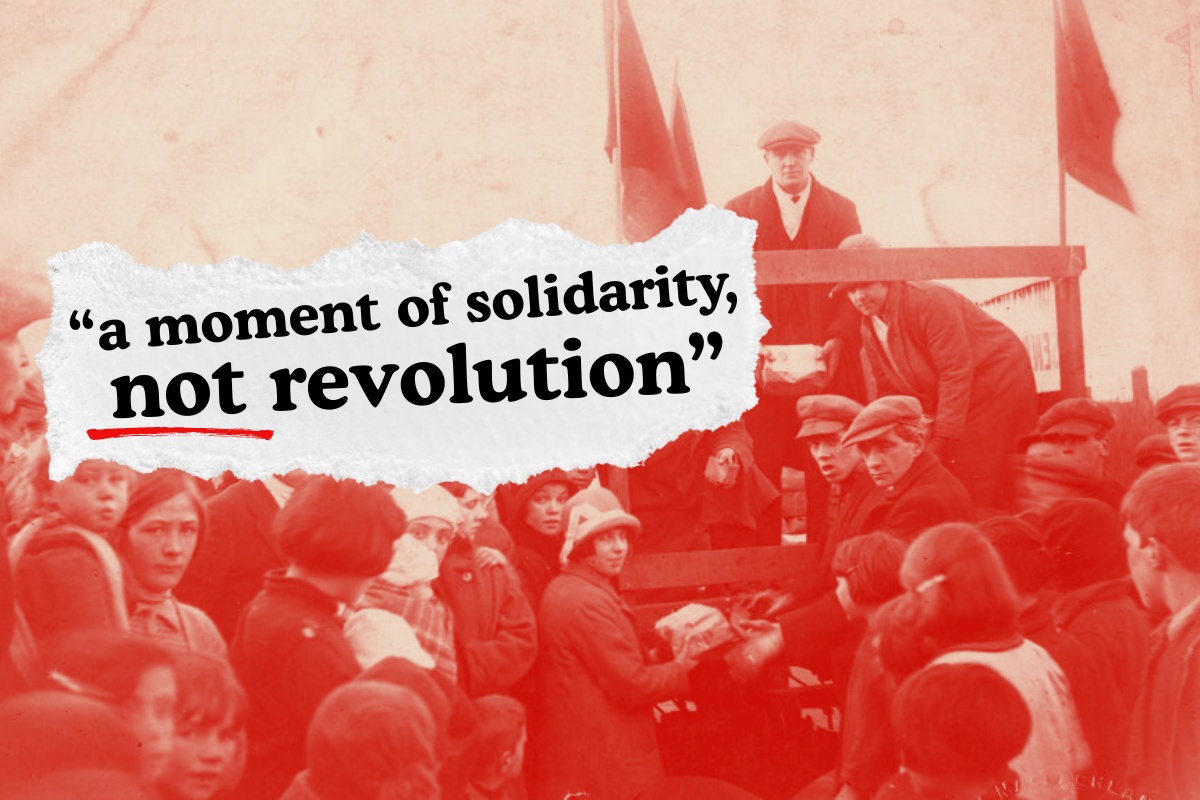
The strike had shown in practice that the working class doesn’t need the bankers and bosses to run society. The local trades councils had been transformed into organs of struggle, and were now beginning to take on more and more of the day-to-day running of society: distributing food and fuel, organising cultural events, dealing with public safety.
The organisation of defence for pickets had turned into regular patrols. In Bath, the 12 May report noted: “Advised mayor first day of strike to disband local specials as superfluosities.”
The mood was described in many places as “splendid”, and order was being maintained by the working class themselves. This was the embryo of a workers’ state, growing not out of the wishes of ‘outside agitators’, but out of the living experience of the workers themselves.
Terrified by these developments, the TUC’s general council decided that the only way to save the system was an unconditional surrender. Snatching defeat from the jaws of victory, they went to Downing Street hat-in-hand, prepared for any humiliation to keep the situation from running out of their control.
In the Prime Minister’s office, Arthur Pugh told an incredulous Baldwin: “The General Strike is to be terminated forthwith in order that negotiations may proceed”. As of 12pm, the strike was officially over. The starting point for negotiations would be the Samuel report, which the miners had already rejected and which the government itself didn’t fully back.
The right-wing trade union leaders correctly estimated that no-one to their left was ready to capitalise on this betrayal. The ‘lefts’ within the General Council went along with this suicide mission, lacking the understanding or determination to continue the struggle.
Meanwhile, the Communist Party of Great Britain and the National Minority Movement it promoted – which should have been preparing to challenge this rotten leadership – had been sowing illusions in these ‘lefts’ as a result of a disastrous policy of diplomacy on the part of the Soviet bureaucracy.
This meant the end of the strike was met with anger in some cases, but much more often with confusion and demoralisation. The Deeside trade union council stated: “Members were surprised at sudden collapse”. Similar language could be seen coming in from all over the country.
The actions of the leaders cannot be explained simply in terms of personal cowardice. After all, a show of strength like the one ‘their’ movement had displayed would encourage even the most timid of leaders!
No, the problem was their political outlook, which was limited to asking for reforms within the limits of the capitalist system. This was especially the case for the ‘lefts’ in the General Council, who likely did not go into this confrontation with the intention of sabotaging the strike.
But instead of breaking with the right and preparing to escalate, all they could do was grovel to Baldwin to provide guarantees that the return to work would be managed ‘fairly’ and that their members wouldn’t be victimised.
Knowing they held all the cards in their hands now, the Tory government gave no guarantees whatsoever. In fact, on 11 May, the strike had been declared illegal. The Manchester Guardian, in the one-page bulletin it was able to publish, reported: “No trade dispute alleged or shown to exist in any of unions affected except miners”.
This would have been completely irrelevant, of course, had the leaders not been preparing to sell out the movement. But when the strike ended, the result was the workers were left wide open to victimisation.
The betrayal of the leaders, combined with the failure of the revolutionary wing of the movement to prepare the working class for this moment, meant that a world-historic opportunity to establish a workers’ state in Britain had been missed. The General Strike was over.
Find more articles in our series ‘The 1926 General Strike as it happened’.