The General Strike in 1926 was the biggest and most significant event in British labour history. So how have the unions commemorated this momentous centenary? And, more importantly, what lessons have they learnt?
Well, if you look at the websites of two of the largest unions, UNISON and the GMB, you will search in vain for any indication that the great strike even happened.
This is surprising for the GMB, which takes pride in its history, starting out as the National Union of Gasworkers and General Labourers organised by Will Thorne and Eleanor Marx, the daughter of Karl Marx. But this bigging-up of its radical roots is largely done to try and cover for its complete opportunism today.
It seems that the bureaucrats who run these unions – despite the welcome victory of left winger Andrea Egan in UNISON – don’t want their members knowing about or discussing the history of their own movement.
1926 is, after all, a story of the Trades Union Congress (TUC) leaders betraying the miners in their hour of need, leading to a period of reaction in the workplaces.
This story is very similar to the betrayal of the 1984-84 Miners’ Strike almost 60 years later – a betrayal that laid the basis for present-day ‘partnership’ between the employers and the union leaders, who helped usher in another counter-revolution on the shop floor.
The TUC
To give a little credit where it is due, the current TUC General Secretary Paul Nowak at the very least wrote an article about the anniversary of 1926. But the credit stops there.
In his post on the TUC blog, he points to the incredible solidarity on display in 1926. That much is evident to anyone who is familiar with this period.
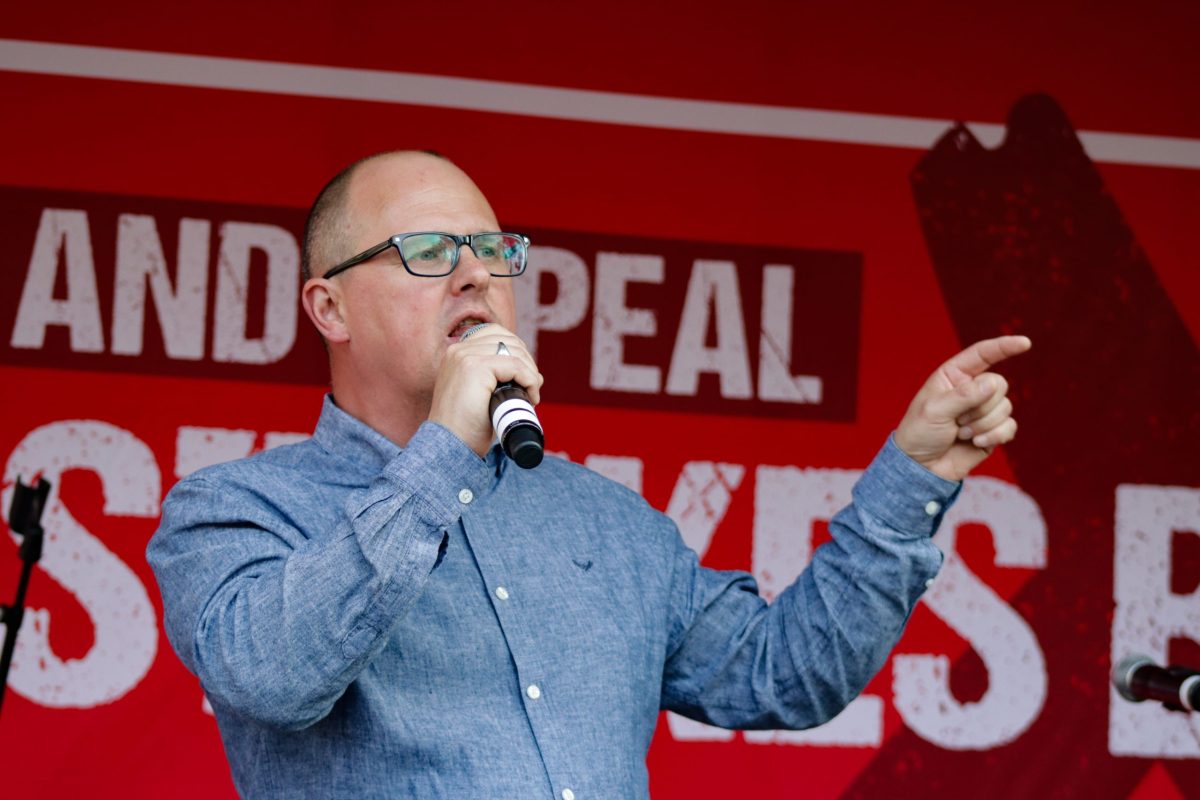
But the main purpose of Nowak’s article is to excuse the betrayal of the strike by the TUC General Council, by pointing out the Baldwin government was as ruthless as Thatcher’s. Such an excuse is presumably always applicable for Nowak, given that capitalist governments will never respond kindly to an all-out general strike.
Nowak glosses over the fact that the strike was called off, not because workers were being frightened back into work, but because the General Council was losing control of the situation, faced with the spontaneous self-organisation of the working class.
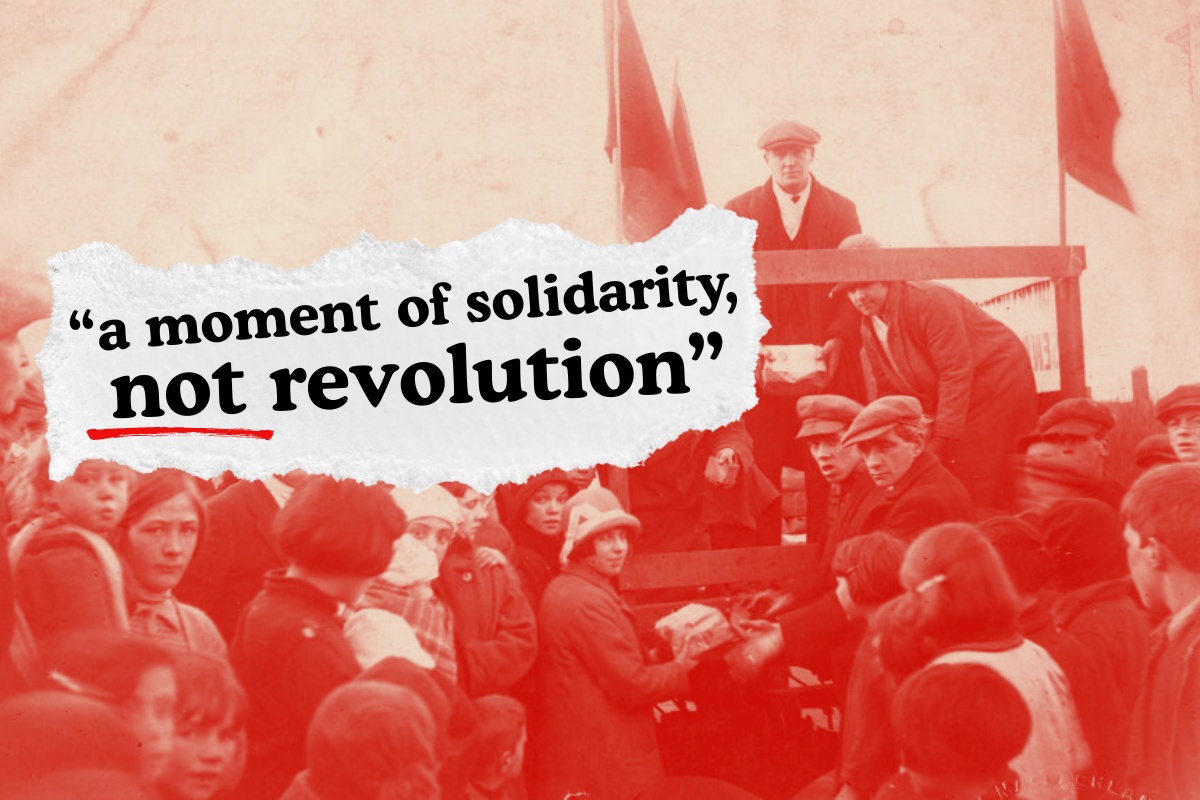
Most egregiously, Nowak says the strike “was a moment of solidarity, not revolution” – that is to say, it was a simple, bread-and-butter industrial dispute:
“[T]he three million workers who answered the call to action were motivated by a desire to bring ministers and mine owners back to the negotiating table. Their goal was to win a fair deal for the miners, not overthrow the government or usurp parliamentary democracy…”
This narrow outlook completely ignores the increasingly political nature of the strike as it grew, with workers organising the distribution of goods and even self-defence in towns and cities across the country.
The only people who were exceedingly anxious to avoid the overthrow of the government were Nowak’s forebears in the TUC leadership, whose deference to the British state restrained and shipwrecked the strike.
Nowak praises the “incredible operation” run from TUC headquarters, but ignores the councils of action, which were the real backbone of the struggle, and posed the question of power in their running of everyday life.
The TUC leader also praises his predecessor, Walter Citrine. Known by some as the “bureaucrats’ bureaucrat”, Citrine was later elevated to the House of Lords, in which he once stated:
“Well, I think – having regard to everything – it [the General Strike] ended very fairly, in a very British manner. I have never said it was a defeat. It marked a turning point in British industrial history, and I was proud to be associated with it”.
If these are the types of characters that Nowak lauds and praises, what does this tell us about how the present-day TUC would respond to similar events today?
ASLEF and the RMT
Nowak’s apologism is supported by Dave Calfe, general secretary of the ASLEF train drivers’ union, in an article he wrote in the Morning Star, the mouthpiece of the Communist Party of Britain.
In it, he quotes his predecessor, the railworkers’ leader John Bromley, who said immediately after the strike that “it is far too early for any but fools to attempt to apportion praise or blame”.
Let’s be clear: these are not the words of a dispassionate historian, but those of a trade union leader who, despite being a ‘left’ and adept at making fiery speeches (some of which Calfe quotes), took part in the shoddy betrayal of his fellow union members.
Criticising a Guardian article from 1926, Calfe comments that the strike was not a civil war, rather it was a strike “to persuade the government to step in and act in the nation’s interest” and to prevent wage cuts.
But the entire period of unrest following the First World War showed graphically that there was not one ‘national interest’ – and nor is there to this day.
Rather, there were the diametrically opposed class interests: of the coal owners, the wider capitalist class, and the state, versus the miners and the working class.
This simple fact is lost on today’s trade union leaders, just as it was back then. After all, they spend the vast majority of their time working in ‘partnership’ with the employers – which in practice means managing the class struggle, rather than fighting it.
Calfe ends by denying that the strike was even defeated (!), completely overlooking the brutal attacks and repression faced by the miners and those victimised. The weight of this crushing defeat held back the British class struggle for years, if not decades.
In distinction to Nowak and Calfe – who have made it their job to excuse the betrayals of the TUC – the leader of the more militant Rail, Maritime and Transport Workers’ union (RMT), Eddie Dempsey, has made it clear that the General Strike did indeed end with a heavy defeat.
Rather than cover for his predecessor, Dempsey is honest about the role of the National Union of Railwaymen leader. He makes the accurate point that the unions were not prepared like the bosses were, in “a battle between working class and the owning class”.
However, he offers no analysis of why the leaders refused to prepare, and in the end surrendered. The solution he poses to avoid the same mistakes today is better organisation and militant leadership, in what seems a perpetual class war.
Unite the union
Trades councils around Britain marked the centenary of the strike as part of the May Day marches and gathering. But by far the biggest commemoration was organised by Unite, in partnership with the Durham Miners’ Association, in Barnsley.
This was billed as a celebration, and the publicity material gave no indication that these talks would discuss the real lessons of the strike.
We had an incredible day yesterday in Barnsley, celebrating the centenary of the General Strike. Yesterday wasn’t just about looking backwards, but also about recognising the importance of trade unionism today. This celebration came at the end of a week when the historic… pic.twitter.com/JPzh2YdYPn
— Unite For A Workers’ Economy (@UniteEconomy) May 3, 2026
One newsletter summarised the events: “At the end of those nine days, new relief committees and funds had formed, a train had been derailed, activists and strikers were imprisoned up and down the country, and the devastating poverty of working communities had been revealed to all of Britain. The miners continued their strike for a further six months.”
These lines give the impression that the strike was merely a protest to highlight conditions, or a mutual aid programme for its own sake, rather than a titanic struggle to defeat the coal owners.
Nor do they acknowledge that this struggle posed a clear question: who is the real power in the land – the bosses, or the workers? Instead, they paint the organisation of relief as a victory of its own accord, rather than an essential – and defensive – ancillary.
At the event, Unite leader Sharon Graham paid tribute to the militancy of the workers and activists then, and linked this to the Unite’s record in fighting industrial disputes and gaining pay rises.
The whole tone of the event was celebration – of how proud we should be to be in a union – downplaying any discussion as to why the workers lost, despite the dedication of the activists, the militancy of the workers, and the millions on strike.
Alongside the event, Unite produced a book titled General Strike, with contributions by several authors. It contains some interesting details, for example about the crucial role of women in the strike. But on the main lessons of the struggle, it is contradictory and defensive of the union leaders.
Unite the union’s General Strike 100 book will be available on Saturday at our centenary event in Barnsley in return for a strike fund donation.
Ten contributions are included here by trade unionists and historians of the strike: CALLUM CANT, STEVE CARTER, DANIEL EDMONDS, RIANNE… pic.twitter.com/0A7rgkkF9Z
— Unite For A Workers’ Economy (@UniteEconomy) April 30, 2026
A summary piece by Keith Laybourn lays out some of the consequences of defeat, with railwaymen having to reapply for their jobs, and overall 3,000 strikers subjected to victimisation.
He parrots the TUC’s defence from criticism levelled at them by the miners’ leader AJ Cook: that the strike’s leaders had not given the government a blank cheque, and that the strike demonstrated the TUC’s power.
Such an assertion flies in the face of the truth: it was the workers organised in the councils of action that had the power – which the TUC actively sabotaged.
In his conclusion, Laybourn tries to scotch the ‘myths’ of the strike – namely that it was a failure, or that it was a revolution. He admits that the strike was called off without guarantees, but says that this was because the TUC realised it could not defeat the government.
In reality, however, the strike could have defeated the government. The TUC sidetracked the struggle precisely because they realised the government and the capitalists could be defeated by the rising tide of workers’ action. Such events, they feared, could lead towards revolution.
Unite also produced a free broadsheet to accompany the celebration, written by socialist historian Mark Metcalf, who makes it clear that the outcome of the strike deserves no celebration.
Metcalf describes how the majority of the General Council were lukewarm from the start, and he describes the betrayal for what it was. He quotes AJ Cook, who said that the TUC leaders “threw away the chance of a victory greater than any British labour has ever won.”
He describes the suffering of the mining communities in the lockout and afterwards – all of which were ignored by the comfortable, well-fed union leaders. He pointedly says “the miners would never again trust the TUC” – a sentiment wholly justified when you look at the inaction of the union leaders over half a century later in the Miners’ Strike of 1984-5.
Metcalf’s analysis of the betrayal, however, doesn’t go further than highlighting the role of right wingers like Jimmy Thomas and the General Council majority. He doesn’t talk about the role of the ‘lefts’, who played second fiddle in this betrayal. But in distinction to the official neglect or triumphalism from the likes of Nowak, Metcalf’s account stands above the rest.
Real history
One hundred years after the tragedy of the defeat of the General Strike, we have the farce of the trade union leaders ignoring, glossing over, or trying to deny the obvious revolutionary character of this struggle. Thereby, they hope to hide the fact that the British working class is capable of more than quietly accepting piecemeal reforms.
This fact only serves to remind us that the leaders of the labour movement have not learned a single lesson from their own history. The same types of people who led the workers to defeat in 1926 are still in charge of the movement today.
In many respects, they have sunk even further into opportunism and class collaboration. They would find themselves even more uncomfortable at the head of a mass upsurge as the likes of Citrine, Thomas, and Bromley.
The task of preserving the real, revolutionary lessons of 1926 has fallen to the communists of the RCP. Union bureaucrats may have short memories, but the job of a Marxist party is to act as the living memory of our class, to prepare the way for future victories.
If you want to unearth the real history of our movement, buried beneath this pack of lies and distortions, then get yourself a copy of A Communist History of the British General Strike – a book written by and for class fighters.
The BBC’s propaganda against the General Strike
Dan Holt, Leeds Beckett
100 years ago over four million workers downed tools and brought the whole country to a standstill.
The 1926 General Strike was a moment where all the anger in class society reached a breaking point, and workers across the nation fought against massive pay cuts that the coal miners faced.
Yet if you read what the BBC published on the centenary of the strike, you could go away thinking the scab labour were the heroes of this period – not the workers fighting to feed their families.
In one article the BBC details the story of a volunteer for the Special Constabulary, who were a group of scab labourers from the government, and how he used his car to help break the strike.
The BBC talks about his family and how they were affected by the strike with “no trains and no London papers available”.
Later on in the article, the BBC talks about people the state arrested and punished for the strike. One woman was given 14 days imprisonment with hard labour, for allegedly breaking a bus window. But the BBC doesn’t humanise her or talk about her family like they did the special constable.
In a separate article, the BBC also undermines the scale of the strike, stating that “more than two million Britons downed tools”. While this is technically true, it purposely hides another two million workers: the article’s author halved the size of the strike!
All of this shows that the BBC does not care about the real history of Britain, and the heroic battles the British working class undertook to defend themselves from attacks.
This is another example that shows the BBC is not neutral or independent, like it claims to be. It is a propaganda machine for British capitalism. This was shown by the BBC’s reporting on the genocide in Gaza, and is shown again by their history of the General Strike.