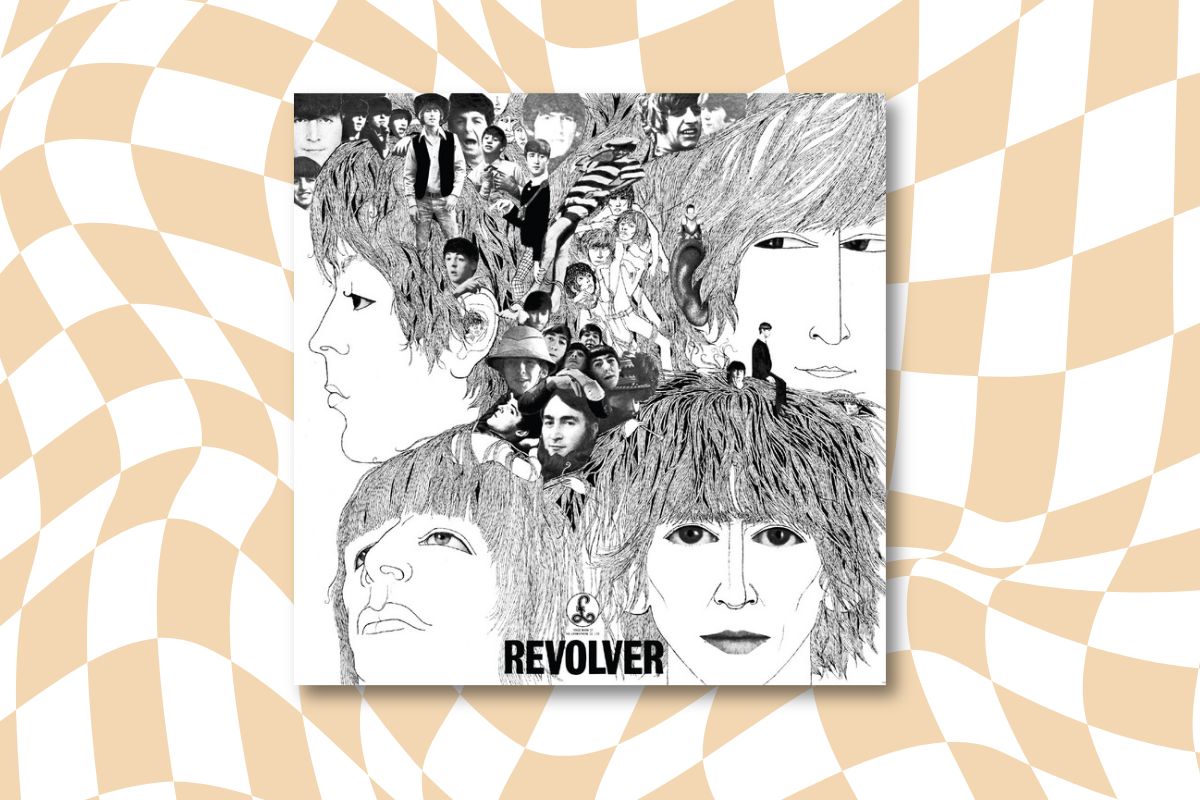
Today is the 60th anniversary of one of The Beatles’ best studio albums, arguably one of the most revolutionary pop/rock albums ever made: Revolver.
The Beatles had already achieved enormous chart success and critical acclaim before the release of Revolver in 1966. But this project, along with Rubber Soul the year before, saw the band’s music heading in a more innovative and experimental direction.
New techniques
Revolver was the first musical album to extensively use the new ‘Automatic Double Tracking’ (ADT) technique. This was a way of using recording tape to create a delayed copy of an audio signal, which is then played back at slightly different speed, creating an echo effect of the two sound signals.
Pioneered by studio technician Ken Townsend, The Beatles made great use of the technique, for example the guitar solo in Harrison’s ‘Taxman’ and the vocals on ‘Eleanor Rigby’ and ‘And Your Bird Can Sing’.
The use of technology on the album is perhaps best exemplified by the last track ‘Tomorrow Never Knows’. This was The Beatles’ most experimental work up to that point, despite it being based around just one chord.
This was very uncommon for the time, and showed the influence of Indian music on the band. The basic track was made up of slowed-down guitar, sitar, Mellotron, distorted vocal samples, and a looping drum sample.
The main vocals were recorded using a Leslie speaker (which has two rotating speakers inside one unit) making John Lennon’s voice swirl around the mix in a kaleidoscopic manner. Doubled up using the ADT method, it gave the song an enticing psychedelic sound.
This new sonic direction both reflected and shaped the burgeoning hippie counterculture in the West, made up of ‘baby boomers’ who rejected the stale norms of post-war society, in favour of individuality, non-conformity, and free thinking.
The method throughout the album’s recording was to use the studio equipment almost as an instrument itself. The Beatles had grown tired of gruelling touring and wanted to make more complex sounds. They retreated into the studio and focused on creating more ambitious music, embracing many techniques along the way.
Even when limited with only a four-track tape recorder, they would ‘track-bounce’ multiple takes down to one and made use of sampling too.
Pushing boundaries
This was a decade of advancement in studio technique, and technology more generally. It’s no surprise that such talented songwriters – including the Beach Boys’ Brian Wilson – were able to take full advantage of it.
Abbey Road studio technician Geoff Emerick and producer George Martin truly became collaborators with the group on this album, and helped them arrange many outside musical instruments, from the tabla and sitar in Harrison’s ‘Love You To’, to the glorious horn sections of McCartney’s ‘Got To Get You Into My Life’.
Lyrically the album was a step forward for the group too, tackling the epidemic of social isolation in ‘Eleanor Rigby’ – the first Beatles song to feature none of the four on instrumentation.
Lennon’s ‘I’m Only Sleeping’ lyrically stands out too. It conveys a strong sense of alienation from the fast pace of modern life, and is expertly reinforced by the song’s weary delivery, ‘sleep’-walking bass line, and reversed guitar parts which convey a dream-like atmosphere.
This was the era in which the Beatles broke away from what was expected of the average pop group, and began to challenge their listeners.
Of course these technological advancements could only work with great songwriting. George Harrison contributed three songs for the first time on a Beatles album. Looking beyond western musical traditions, on ‘Love You To’ Harrison made use of the ‘Kafi Thaat’ raga (scale) of Indian classical music.
This was both a break and a development upon the blues and R&B-dominated influence over most popular rock music at the time, and also reflected a growing interest in eastern cultures amongst the youth, many of whom were being exposed to them for the first time.
Lennon and McCartney delivered too, with ‘Here, There Everywhere’ gracing the album with its inviting melody, never settling in one key but modulating between three.
The Beatles pushed boundaries technologically, lyrically, and musically – and yet the album does not overburden the listener. It’s still first and foremost a pop masterpiece.
Revolver also serves as a reminder that artistic innovation often lies at the intersection of several things: technological breakthroughs, social upheaval, and cultural interactions – along with the talent and creativity needed to express them through art.