
Every night, Sir Keir Starmer must lay awake thinking to himself, “it can’t get any worse, can it?” As it turns out, it certainly can.
The shock back-to-back resignations last week of defence minister John Healey and armed forces minister Al Carns means that seven of Starmer’s front benchers have now resigned in the four weeks since Labour was battered in the May elections.
The much anticipated reveal of the Defence Investment Plan (DIP) was the final straw for Healey. After months and months of dither and delays, the plan amounted to a measly 0.08 percent spending increase by 2030.
This would barely bring Britain an inch closer to its much-vaunted target of 3 percent of GDP on defence by the end of the decade, and is £14.5 billion below what was requested by the Ministry of Defence.
Cracks open at the top
Just as we predicted in our analysis back in March, “the government’s inability to fulfil the funding promises made to military chiefs will continue to cause cracks to open at the top.” Those cracks have now widened, as Starmer’s authority continues to crumble within his own party.
Healey was one of Starmer’s most experienced cabinet ministers, having worked under Blair, Brown, and Corbyn. Losing him means losing a key figure on his front bench – someone who had the confidence and respect of MPs across both wings of the party and, crucially, of those within the military establishment.
Healey’s words have hammered another nail into Starmer’s coffin. In a parting shot, he wrote to the PM that “you have been unable, and the Treasury has been unwilling, to commit the resources that the nation needs to defend the country at this time of rising threats.”
In all fairness to poor Starmer, he has tried to find the resources to fund defence spending – by placing the burden on the most vulnerable in society.
The government attempted to maintain the two-child benefit cap, cut the winter fuel allowance, and slash disability benefits. But in each instance they were met with a huge backlash – with Labour MPs mutinying, reflecting pressure from their constituents – that forced reversals on all three.
This gets to the heart of why DIP isn’t fully-funded, despite the government’s promises and pledges: Starmer has been incapable of making the cuts necessary to raise the money for it. As a result, further delays to the DIP are expected.
Meanwhile, confidence in the government amongst defence companies is being shattered. Kevin Craven, boss of the ADS Group which represents the sector, remarked that Healey’s exit “has sent us reeling”.

Without a clear spending commitment, defence companies won’t invest in expanding production.
The current wrangling over the DIP has exposed that there are clear limits to Britain’s plans for rearmament: on one hand, Britain’s stagnant economy; on the other, the government’s inability to claw back funds from other areas of public spending, like healthcare and welfare.
As we’ve explained elsewhere, Starmer’s weakness stems from being crushed between the twin pressures of the insatiable demands of Britain’s capitalist creditors (and, in this case, the military chiefs), and the enormous pressure of the working class, who won’t take attacks on their conditions lying down.
Decaying state
Even more revealing is Al Carns’ resignation letter, in which he shines a light upon the chaos and backbiting within the British state:
“The machinery of government itself has been left to decay. Decisions that should take days, take months. Departments fight each other instead of the problem. Officials and ministers who know the truth are not always rewarded for telling it.”
This is an incredible indictment of the government, straight from the horse’s mouth. The weight of decades of decline has left the British state decrepit and divided, and unable to stand up to the task of halting Britain’s decline on a world stage.

This resignation, and the failure of the UK to get its act together on arms spending, will damage Britain’s prestige on the world stage even further, bringing into question its reliability as an ally. Already the US administration has piled more pressure on Starmer to increase military spending, with Trump openly accusing the PM of failing to keep Britain safe.
Sensing Starmer’s weakness off the back of these resignations, military chiefs have ramped up their pressure on the government to spend more on rearmament, by whipping up the supposed threat of Russia. Chief of the Defence Staff Sir Richard Knighton, for example, told the BBC that we are living through the most dangerous period for the UK since the Cold War.
This fearmongering about a Russian invasion is, in reality, a desperate attempt to conceal the real reason that military spending needs to increase. It’s not to maintain the safety of Britain from an imaginary enemy, but to maintain the illusion that Britain is still a world power, with all its former imperial glory.
More broadly, Britain and the European imperialist powers are also keen to shore up their geopolitical strength, in order to protect their profits and spheres of interest from a resurgent Russia, in regions like Eastern Europe, Central Asia, and Africa.
President of the NATO Parliamentary Assembly, Madeleine Moon, got to the nub of the dilemma facing the government when she said:
“The people still think we can afford the quality of life that we used to have when there was no threat… this has to be a conversation with the British public about what we can and can’t afford… right now defence has to be our number one priority’”
There you have it: the working class needs to accept massive attacks on its living standards, so that our hated government can waste billions on arms, all in order to protect a stagnant economy, and the interests of our capitalist class. How very patriotic!
Lame duck
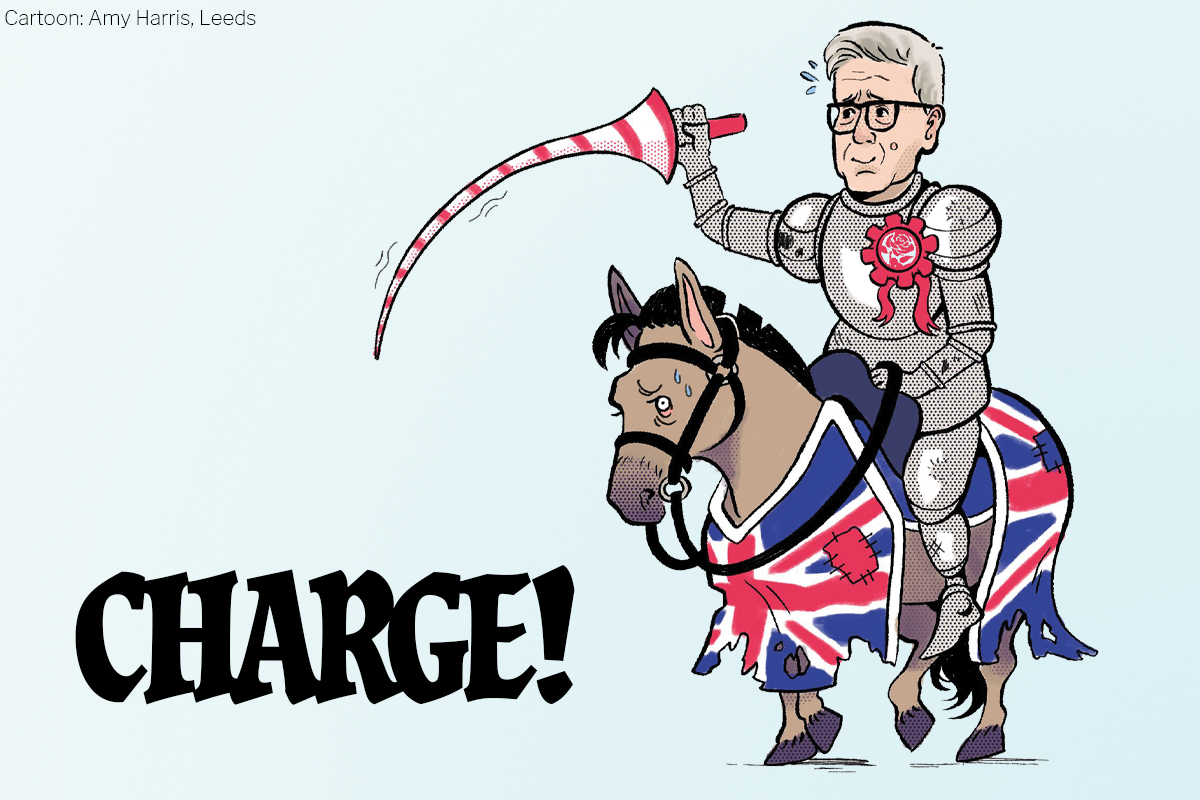
So what does all this mean for our Knight in rusted armour, Sir Keir Starmer?
For all his mistakes and flaws, Starmer has succeeded in one thing: uniting the entire country in their complete disdain for him. Gone are the establishment media’s puff pieces about this so-called ‘Churchillian’ international statesman. All that remains is the spineless warmonger that can’t fulfil a single promise, presiding over ministerial civil war.
Starmer was quick to find a replacement for Healey in another former military man, Dan Jarvis. The new defence minister has already been given his baptism of fire, by being sent off empty-handed to this week’s NATO meeting in Brussels – only to be lambasted for Britain’s lack of defence spending by his American counterpart, Pete Hegseth.
For over 75 years the @NATO alliance has helped keep the UK and our allies safe.
Defence Secretary @DanJarvisMBE is at NATO HQ in Brussels today to strengthen Ukraine’s defence, strengthen NATO deterrence and strengthen our European security. pic.twitter.com/hrTj35nsXg
— Ministry of Defence 🇬🇧 (@DefenceHQ) June 18, 2026
Needless to say, Jarvis won’t be able to solve a single one of the problems facing Britain’s dilapidated armed forces, which stem from the underlying crisis and decline of British imperialism.
Meanwhile, in order to try and paper over this embarrassing debacle, Starmer and Jarvis jointly announced that they had ordered the capture of a Russian ‘shadow tanker’ in the English Channel. This operation was complete with its very own camera crew, no less. What better way to project Britain’s power than to seize an unarmed merchant ship for Instagram likes?
View this post on Instagram
Unfortunately for Starmer, the British public barely noted the passing of this heroic naval escapade. Most Britons were likely too distracted by rising prices and race riots to take notice.
The resignations of Healey and Carns have sealed an already-sealed fate. It’s clear for all to see that the Prime Minister is a dead man walking; a lame duck desperately clinging to his position – hated by the electorate, emptied of any authority, and burning bridges even within his own government.
UK-Japanese relations strained by investment delays
Part of Starmer’s Defence Investment Plan was £6 billion more for the Global Combat Air Programme (GCAP) – a joint venture between Japanese, Italian, and British imperialists to produce next-generation fighter jets in the sky by 2035.
The aim of GCAP for these historic allies of the United States is to reduce their need to rely on an ever-more unreliable US imperialism.
The Japanese imperialists are very keen to kickstart the production of these new fighter jets given the increased tensions with China over Taiwan since November last year, and the strengthening of Chinese imperialism in the Pacific.
Therefore, Britain’s repeated delays and dithering in signing a contract and committing funds to the project have strained the UK-Japan relationship, and demeaned Britain on the international stage.
If any country or capitalist thought that Britain was a serious prospect for military investment, these thoughts have vanished.
Japanese Prime Minister Sanae Takaichi did agree to £18 billion of investment in Britain following her meeting with Starmer on 14 June, where he promised to sign a contract for GCAP at the end of the month.
However, words are cheap – and the words of politicians are worth even less! We shall have to see if anything will materialise. Takaichi is keeping the UK at arm’s length for now, describing the UK-Japan relationship as one of “quasi-allies”.
With every failure to draw in a new ally, the more Starmer is humiliated – and the more tightly he binds Britain’s fate to the whims of its master in Washington.
Alex Gassem