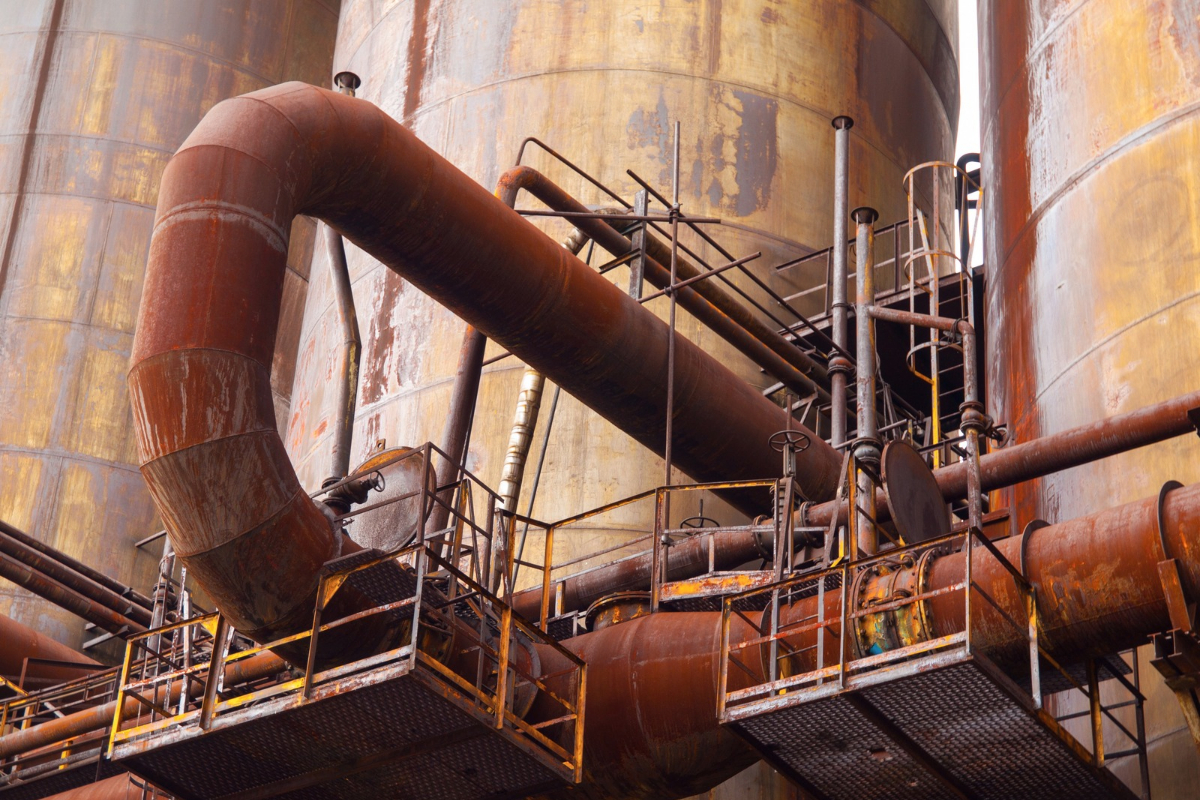
Port Talbot and Scunthorpe steelworks. Grangemouth and Lindsey refineries. Luton and Swindon car factories. 25 chemical plant closures since 2021. Pharma companies relocating to the US. The jobs cull at Jaguar Land Rover (JLR).
The crisis of British industry has steamrollered over all of these sectors with particular force over the last few years.
Manufacturing employee jobs have fallen almost every quarter since December 2022 – totalling an almost 150,000 drop (seasonally-adjusted figures). That represents a 6 percent contraction.
We have explained the key causes of this decline elsewhere. In short, British capitalism – which has underinvested in its industry for the best part of a century – is underproductive and technologically backwards. In the face of a worldwide crisis of overproduction, it is unable to compete against the likes of the USA and China.
Jaguar Land Rover jobs massacre: A graphic illustration of Britain’s decline
Meanwhile, trade wars and regular wars are creating chokepoints in key supply chains, which are placing British industry at a particular disadvantage. In particular, energy costs are higher because of decades of underinvestment in the national grid – meaning Britain has been more greatly affected by the wars in Ukraine and the Middle East.
The British state is far too debt-ridden and its revenue is far too low to put any serious investment into industry to rectify the problem.
Meanwhile, private investors are more concerned with cutting labour costs by any means than investing into the modernisation of industry themselves. The final solution is packing up shop to find faster profits elsewhere.
The decline of British industry, then, is a deeply ingrained process, rooted in the general decline of British imperialism. The question is: what can workers do to fight back against it?
Nothing to show
The first port of call for workers to resist the jobs massacre ought to be their trade union. Indeed, trade unions are the basic economic organisations of our class, which are supposed to defend our fundamental interests.
Unfortunately, however, we must speak plainly with regards to the behaviour of the trade union leaders on this question. It has been lamentable.
In Cantley – where British Sugar is closing the sugar refinery at the heart of the town’s life – Unite has yet to issue any kind of formal response. Instead, the bosses inform us that they are in formal negotiations with the union over redundancy packages.
At JLR, over a month after the job cuts were announced, we have yet to see any serious call for action on the part of Unite’s leadership.
Instead, workers were treated to a statement by general secretary Sharon Graham assuring them that she was on “speed-dial” with Labour’s business secretary, and going to meet with JLR’s CEO “to ensure that no stone is left unturned to mitigate these jobs losses” (our emphasis throughout).
JLR workers “must not pay the price” for failings not of their making.
While the planned cuts are not expected to impact the UK manufacturing footprint or its supply chain, we need to ensure no stone is left unturned to mitigate these job losses in the highly skilled ‘white-collar workforce.’
There are clear differences between the messages given to the workforce on timings and scope, from what was said at the weekend, that need immediate clarification.
I have been on speed-dial over the weekend with business secretary Jonny Reynolds to look at how to mitigate these job losses at JLR. We are both meeting the CEO of JLR tomorrow. Mayor Richard Parker is also part of wider discussions.
@unitetheunion was pivotal in securing the £1.5 billion government facility for JLR after the cyber-attack. Once again Unite will be demanding that all necessary levers are pulled to support JLR workers. It cannot be acceptable that workers are again made to pay the price for failings not of their making.
https://t.co/m92zhPQ9cL
— Sharon Graham (@UniteSharon) September 7, 2026
Further in Unite’s statement, a union official stated that “we are working round the clock to deliver the best possible outcome for our members.”
At first glance, these words appear quite reasonable. But for those who are familiar with these unions leaders’ past record, we have learned to read between the lines.
What their statements really imply is: ‘we are not going to take industrial action to prevent the job cuts. Instead, we are going to meet behind closed doors with employer and government, and try to get you a good redundancy package’.
Workers at Cantley sugar refinery whom our correspondents interviewed certainly think that that is the union strategy – and the lack of leadership is demoralising them.
Disorientation
The inaction of the trade unions today has been built on past defeats. It seems that the more the trade union leaders have failed to overturn the job cuts, the less they believe that any serious resistance is possible
In fact, Unite has released an entire document on the lessons of the Vauxhall factory closure in Luton (‘Consequences of closure: One year on from Vauxhall Luton’ – referred to below as ‘Consequences’).
This document is worth examining. It is very rare for the unions’ officialdom to reflect on the lessons of past defeats. These words can therefore be taken as the most advanced form of thinking in the union officialdom.
And yet, while revealing many interesting details, ‘Consequences’ is conspicuously lacking in any tangible lesson for the labour movement.
Indeed, the only positive lesson that Unite draws out is the power of the working class once it unites on an industrial basis. Namely, Unite organised drivers in its transport sector not to cross the picket line at Vauxhall; and appealed for international solidarity.
‘Consequences’ talks about the potential this solidarity had to disrupt the whole of Vauxhall’s supply chain. And it then draws the lesson – for future struggles, where the union predicts factory closures – that “further preparatory work is necessary” to “map out the supply chain”.
Are we gonna fight? YES! Are we gonna win? YES!!
Stellantis auto workers at Vauxhall Luton won’t back down in the fight to save their profitable EV plant.
Get involved! Tomorrow 8.00-16.00, Gate 1, Vauxhall (IBC Luton), Kimpton Road, Luton, LU2 0JX https://t.co/XOFowBYjmI
— Unite For A Workers’ Economy (@UniteEconomy) December 17, 2024
This is all good stuff. But just after saying this, the union reminds us that “of course, legal restrictions on trade union activity are designed to make this kind of resistance fraught.” In other words, it’s a good strategy… if we thought it was possible!
Without a clear answer as to how these “legal restrictions” can be overcome, the reader is left clueless as to what action Unite is proposing “preparatory work” for.
In fact, the whole document raises more questions than it answers. The reader is left confused and demoralised – like there is nothing to be done – especially after the union lists countless negative consequences of the factory’s closure.
Reformist illusions
Most egregiously, the narrative of ‘Consequences’ gets hopelessly entangled when it comes to the role of the Labour government. It ends up drawing the wrong lessons completely.
On the one hand, the document makes it clear that workers felt completely betrayed by the Labour Party – feeling that “not only were Labour unwilling to support the Luton plant, but they were unable to influence the will of a powerful multinational corporation… When push comes to shove, it was Stellantis who had the power to dictate the transition.”
What they are saying is that the Labour Party is willingly carrying out the dictates of private capital – and has no power to do otherwise. This is correct.
On the other hand, the document reads in large part like advice to Labour. ‘Consequences’ starts with the mission statement: “We call on all politicians and those who claim to speak for and support workers to learn the lessons of Luton.”
Having laid out the electoral damage to Labour in Luton because of the party’s betrayal, the document concludes that “indirectly, local and national politicians” suffer from factory closures. Supposedly, this provides “fertile ground for change if we build the right relationships and ask the right questions”.
Further, the document says that “immediate industrial action” can be appropriate “to buy time or a window for a larger campaign and political intervention.” Otherwise said, they believe that drawn-out, mealy-mouthed campaigns appealing to the government to intervene are the only plausible solution.
The industrial passivity and political weakness of the trade union leaders are two sides of the same coin.
Indeed, the central problem of the trade union leaders is their reformism – their lack of faith in the ability of the working class to transform society, and a narrow belief that capitalism is the only possible economic system.
Owing to this view, for militant, independent action of the working class they substitute class collaboration, and subordinate fighting methods to ‘respectable’ political appeals.
Indeed, ‘Consequences’ summarises the whole outlook of the trade union leaders when it puts the crisis down to the government’s “lack of industrial strategy”. The task, then, is to compel the government to adopt one.
But without proposing an alternative economic programme on the basis of a break with capitalism, all they can do is appeal to Labour’s austerity government to come and save the day. ‘Consequences’ supplements this demand with the idea that “public money must come with strings attached”.
But 99 percent of the time, if the government accepts intervention, that means dishing out money it doesn’t have – and for which it will therefore need to find cuts elsewhere – to line the pockets of bosses. Even then, strings or no strings attached, these parasitic bosses generally continue their plans to leave once the magic money tree gets felled.
The attempt by the union leaders to gently persuade the Labour government is therefore extremely naive. The truth is that no British government can have a rational industrial strategy under the present conditions of capitalist crisis.
Militant action
If the trade unions are to fight back against factory closures, therefore, their leaders will need to exit the corridors of Whitehall – and enter the path of class struggle.
This is a very daunting prospect for the union leaders, however. As ‘Consequences’ spells out:
“…the usual playbook is not really applicable. This is not a traditional industrial dispute where workers can withdraw their labour to inflict damage on the company – the very fact that the company has announced a closure means they have factored in the loss of this site… into their plans.”
The problem is that the playbook of the trade union leaders is very limited as it stands. They are not used to fighting for anything other than a pay rise. And they genuinely believe that using industrial action for any other purpose is impossible.
Britain’s long hot strike summer: Lessons from the strike wave
I had the experience of this myself in the Rail, Maritime, and Transport (RMT) union during the 2022-23 strike wave. When I talked to my co-workers, few of them cared about striking for a pay rise. The conversations at the workplace were all about the job cuts that Network Rail wanted to implement, and the worsening conditions that came packaged up with them.
Yet whenever I raised this in the union, all – from the lay officials to the top brass – would tell me that the members would not strike for such things.
Consequently, the leadership used the redundancies and conditions as a bargaining chip for the pay rise. Members became demoralised because they did not understand the union strategy. Gradually, people did not want to strike anymore.
What a damning indictment on the union leaders’ lack of faith in the very members they are meant to lead to fight!
This narrow point of view, in turn, even leads the trade union leaders to fight poorly for pay rises. They contain almost every strike to single days of action, uncoordinated with other sectors, devoid of any political demands that may raise the struggle to a new level.
No wonder, then, when a much more serious threat comes about – mass layoffs and closures – the trade union leaders are completely underequipped to fight back.
‘Consequences’ admits this plainly: “reps felt unprepared for the daunting task ahead.”
“Better to break the law…”
It is impossible to fight these closures without the perspective of smashing through the anti-union laws – and thereby taking the fight to the government.
Even if the union takes strike action as an immediate response (and as we have seen, striking itself may not go far enough), this action has to be swift.
In Luton, Vauxhall gave a 45-day countdown before closure. By the time the union would have given notice of a ballot, balloted, and then given notice of strike action, the game would be up.
In Port Talbot, these delays contributed to the foot-dragging of the union. In the end, Unite called off the planned indefinite strike before the fight had even begun.
Instead, six months earlier, the union could have organised mass meetings of the workers and the local community – campaigning confidently for a unified indefinite strike; calling on the local families to organise megapickets to defend the strike from the state; and appealing beyond Port Talbot for solidarity.
Even better, the union should have organised workers to occupy the steelworks – as the Revolutionary Communists campaigned for in February 2024 – to physically prevent the closure of the blast furnaces; begin to run the factory under workers’ control; and demand its nationalisation without compensation to the owners.
Voir cette publication sur Instagram
There have in fact been some (rare) instances of occupations in the United Kingdom over the last two decades: Vestas wind turbine factory in 2009; Harland and Wolff shipyards in 2019; P&O Ferries in 2022. The biggest experiment – in terms of the spread of the occupation – was Visteon car parts factories in 2009.
Ultimately these occupations were defeated because the union leadership, in each case, did not escalate them to the wider industry, and beyond.
Yet in the context of job cuts, decay, and closures across the board today, if the trade union leaders went to other workers – starting with those organised in the company’s supply chain, or in the same industry – they would surely be able to build solidarity strike action.
Of course, the union tops would argue that this would mean illegal action. But that is precisely the question: is it better to break the law, or allow workers to be broken by it?
A broader vision
Above all, for the trade union leaders to embark on such a road of such militant struggle, they would have to couple their class struggle methods with a bold political programme.
They would need to demand the expropriation of the bosses closing factories, – the same bosses who have failed to invest, modernise and leached off the public purse for decades.
The union leaders would also have to demand the nationalisation of the monopolies in the most profitable sectors of the economy – the banks, the tech companies, the construction firms, and so on – for the whole of British industry to be harmoniously rejuvenated in a socialist economic plan.
To do all this, they would have to break from their support for the Labour government, and on the contrary lead an industrial upsurge against it and the whole British state.
The current crop of trade union tops believe such demands and methods are outdated, or don’t belong to a sensible, ‘pragmatic’ country like Britain.
But the mood does exist across Britain for a fightback against deindustrialisation, militarism, and austerity. And the union leaders will either be swept along by this rising tide, or swept aside.