Ask pretty much any worker or young person today if the system is broken – if something needs to fundamentally change – and they will say ‘yes’.
Crisis, war, and revolution: this is what defines the period we’re living through. Millions of workers and youth are searching for the answers to how we can change things.
With this in mind, the release of the new edition of Lenin and Trotsky: What They Really Stood For could not have come at a better time.
The first edition was written nearly 60 years ago, in the aftermath of a period of serious upheaval in the world communist movement. In 1956, you had the firing shot of Khrushchev’s ‘secret speech’ and the political revolution in Hungary. Later, you saw the Prague Spring and capitulation of the Communist Party ‘leaders’ in France during May ‘68.
And so, this book was written in 1969 as an appeal to the ranks of the Communist Party and the Young Communist League in Britain – for genuine communists to rediscover the truth about Trotsky and return to the original revolutionary programme of Leninism and Bolshevism.
Today, the book is an appeal to the ever growing layer of workers and youth searching for those same, genuine, revolutionary Marxist ideas to prepare them for the struggles ahead.
View this post on Instagram
Build the revolutionary party
The most pressing task facing revolutionaries today is the need to build a revolutionary leadership. As we have seen in the last few years of ‘Gen Z revolutions’, this isn’t something that will spontaneously emerge during a revolution, but instead must be built for in advance and be ready.
This is no easy task. The building of the Bolshevik Party prior to the Russian Revolution of 1917 was no steady, easy march of progress.
Lenin struggled for the best part of two decades to build the party – contending with revolution and counter-revolution; the betrayal of the Second International; the First World War; and intense ideological struggles which often left him in a minority of one in the party – all while in exile!
Throughout all of this, Lenin based himself on an ironclad grasp of the philosophy and methods of Marxism – and an implacable faith in the working class.
He was the first to understand that the working class needed a professional revolutionary party if it was to take power. And in building it, he prepared the weapon that would lead the first successful workers revolution in 1917.
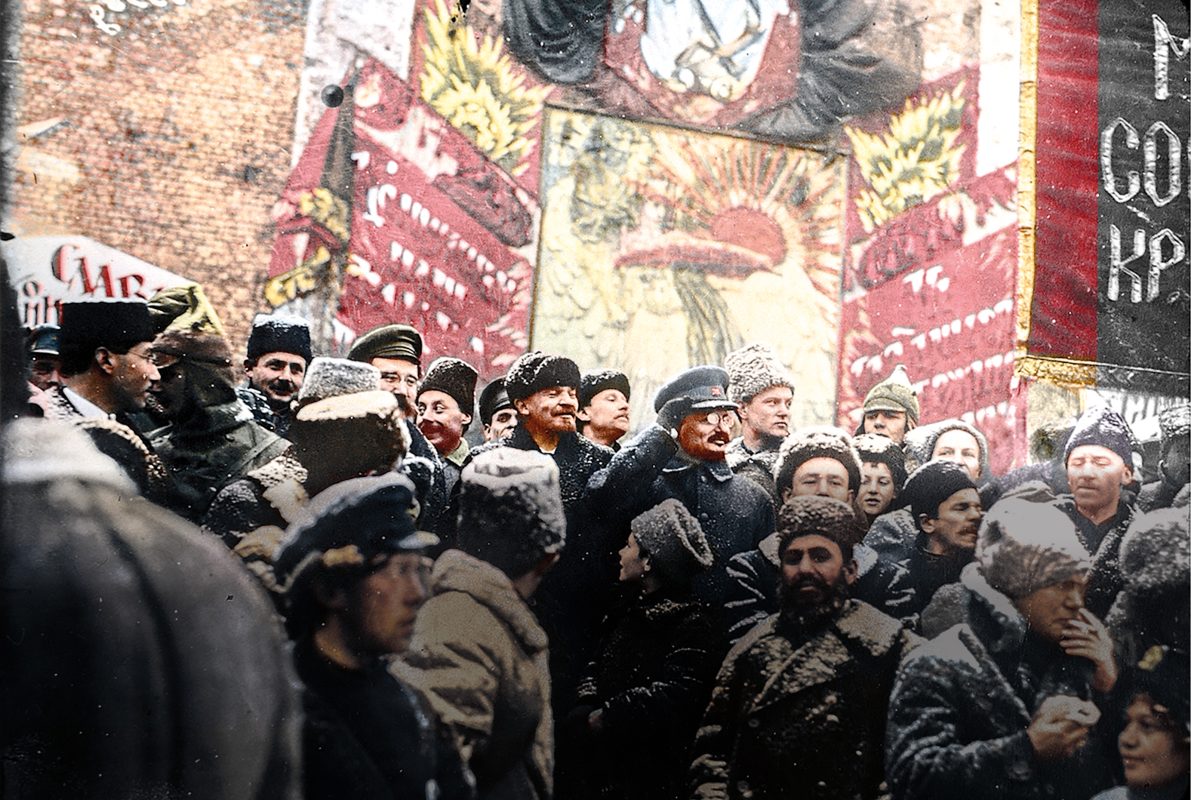
Alongside Lenin, Trotsky was the most important revolutionary figure during the Russian Revolution. And in the immediate aftermath, he played an essential role in building the Red Army from scratch. As Lenin himself said:
“Show me another man who could have practically created a model army in a year and won the respect of the military specialists as well. We have got such a man! We have got everything!”
After Lenin’s death in 1924, the actual history of Trotsky’s role in the revolution was revised by the bureaucracy that was forming in the Soviet Union and his ideas were falsified by the Stalinist regime for decades to come.
Permanent revolution
In Russia’s 1905 Revolution, Trotsky played a leading role as Chairman of the Petrograd Soviet. He used this experience to develop arguably his greatest contribution to Marxist theory: his theory of the permanent revolution.
Trotsky worked out that, as a consequence of the senile state of world capitalism, in backwards countries like Russia the capitalists could not play a revolutionary role as they had been forced to during the Dutch, English, American, and French Revolutions.
The nascent capitalist class had only recently developed – and, at that, under the auspices of foreign imperialists and Tsarist absolutism.
Consequently, they were too weak to carry out democratic and national revolutionary tasks: the formation of a democratic republic; the unification of the country under a common law, language, and culture; the expropriation of the old landlord class; unification and protection of the national market; and so on.
Meanwhile, Russian historical development was back-to-front. In the West, an urban middle class developed over centuries, stratifying itself as it went along. In Russia, a modern, industrial working class arose over half a century in the cities out of a sea of semi-feudal backwardness.
Therefore, the working class would have to lead a revolution and complete the national and democratic tasks that elsewhere were solved by other classes. The workers would not stop here though: they would be compelled to move directly onto the tasks of the socialist revolution.
Only by exporting the revolution from backwards Russia to the advanced West – and the whole world – could this revolution be completed, and in the process be made ‘permanent’.
The myth of Lenin’s ‘anti-Trotskyism’
Lenin initially held the position of calling for a ‘democratic dictatorship of the proletariat and peasantry’ – a position Stalin later revived as a cover to push his Menshevik ‘two-stage’ position.
The problem with this position was it did not state who would lead the revolution: the proletariat, or the peasantry? And if the tasks were to be contained to those of the bourgeois revolution, then how would these latter two classes relate to the capitalists in power?
Through concrete experience, Lenin changed his position to that of Trotsky’s permanent revolution. He decisively broke with his old position – which always had a provisional character – as of the February Revolution in 1917. Realising it had become obsolete, he openly refuted it against his opponents within the Bolsheviks:
“Whoever now talks only of a ‘revolutionary-democratic dictatorship of the proletariat and the peasantry’ is behind the times, has safely gone over to the side of the petty bourgeoisie against the proletarian class struggle; that person should be consigned to the archive of ‘Bolshevik’ pre-revolutionary antiques (which might be called the archive of ‘old Bolsheviks’).”
Even before 1917, what Lenin and Trotsky always agreed on was the ‘permanent’ element of the revolution: that socialism could not be built in a single country in isolation, and therefore the survival of the revolution would depend on the extension of the revolution internationally.
Lenin himself saw the Russian Revolution as the jumping off point for world revolution. Together, they formed the Communist International to help develop revolutionary parties across the world under a single banner.
For Lenin and Trotsky, internationalism was an absolute necessity, not an option. Neither of them ever entertained the possibility of building socialism in one country.
Stalinism
Once they took power, the Russian masses sacrificed heroically to defend their revolution. But sacrifice has its limits, and the isolation of the revolution eventually took its toll. Out of these backwards, impoverished conditions emerged a new social stratum of Soviet officials.
They were in part drawn from the old Tsarist bureaucracy and a handful of bourgeois specialists. But they were also drawn from former workers and communists who had become absorbed into the state and party machinery – and who consequently lost touch with the masses.
It was from this relatively privileged layer of Soviet society – the managers and middlemen, alongside the petty-bourgeois layers – that Stalin’s faction derived its support. They backed Stalin as a figure who could secure their position, and deliver stability.
As the book describes: “The bureaucrat wishes nothing better than peace and quiet to get on with his orderly job of organising those ‘beneath’ him.”
As the accumulation of people protecting their position in the bureaucracy grew, so did the bureaucracy’s consciousness of its own collective interests, opposed to the interests of the masses.
Their aim became the preservation of the bureaucracy, instead of extending and deepening the revolution: “peaceful collaboration with imperialist powers instead of their overthrow and top down command instead of workers’ democracy,” as the book explains.
Whereas Lenin and Trotsky always strove to develop the consciousness of the working class, Stalinism sought to deceive the working class with the illusion of ‘socialism in one country’.
The mistakes and betrayals of Stalinism led to the shipwreck of the revolutions in Germany, Spain, and China in the 1920s and 30s – as well as the rise of fascism and the murder of millions of ‘opponents’, including most of the generation of Bolsheviks who led the Russian Revolution.
A river of blood separates Stalinism from Leninism.
View this post on Instagram
Method
Marxism is a scientific method: not a theory imagined up in the mind of Marx, but an outlook flowing from the study of historical developments and the practical experience of the working class.
Far from being a dusty academic exercise, it is our greatest weapon that can be applied to the practical experience of the working class.
In Lenin and Trotsky: What They Really Stood For, Ted Grant and Alan Woods take this weapon and offer a masterclass in Bolshevism and demonstrate how Marxists today must analyse what is said, by who, and for what reasons. Only by taking a scrupulously honest approach can historical questions be explained – and the corresponding historical tasks be laid out clearly.
Today, the Soviet Union and its Stalinist bureaucracy are no more. In Britain, the influence of the ideas of Stalinism upon the working class and the workers’ movement has been shattered.
That being said, the very same mistakes which that bureaucracy led countless revolutions to make in the 20th Century are still being made today. This is because, at root, they are mistakes of reformism. Such ideas exist within all revolutionary movements.
As support for revolution and communism grows amongst workers and youth around the world, the ability to understand genuine Bolshevik ideas and methods – and stand as firmly in defence of them as Lenin and Trotsky did – becomes more necessary than ever.
Developing this ability is a lifelong task – but Lenin and Trotsky: What They Really Stood For is certainly a good place to start!
View this post on Instagram