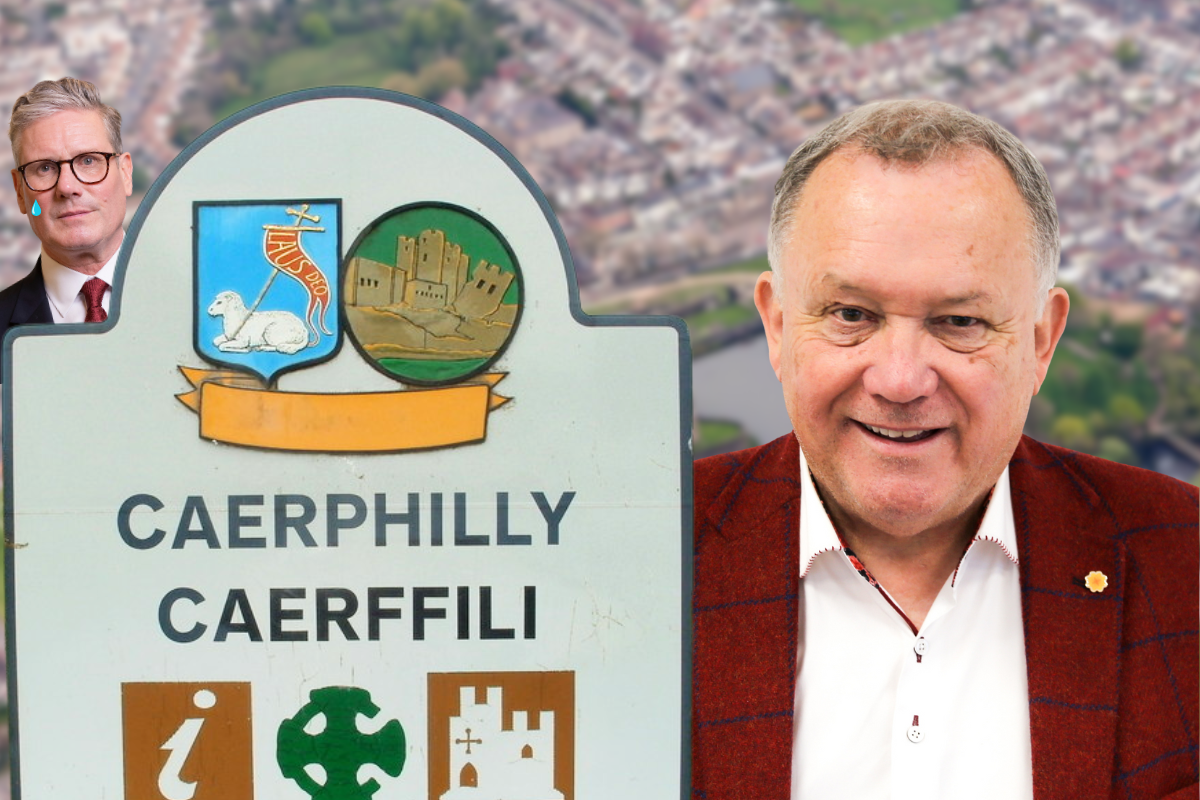
Back in October last year, we described the victory of Plaid Cymru’s Lindsay Whittle in the Caerphilly by-election for the Senedd, the Welsh Parliament, as a harbinger of things to come.
Caerphilly had been a Labour stronghold. The South Wales constituency had elected a Labour MP to Westminster at every general election since 1918. In last October’s by-election, however, voters delivered Labour a bruising defeat.
The same picture used to be seen across most of Wales. In successive general elections after the Second World War, Labour often took three quarters of Wales’ Westminster seats.
It was sometimes joked that, in Labour’s Welsh heartlands, the party’s vote wasn’t counted, it was weighed.
Today, by contrast, with Welsh voters going to the polls on 7 May for the latest Senedd elections, Starmer’s Labour is looking at a veritable collapse.
The shockwave from these elections will reverberate right down the M4, and into the heart of Downing Street – piling further pressure onto Keir Starmer and his crisis-ridden government.
End of an era
For decades, there existed a deep historical memory within the valleys of Wales that the Labour Party is our party, and that the Tory Party is their party.
Now, however, Labour seems to have cashed in all its credit. Tradition weighs very little on the minds of today’s Welsh working class or youth.
One elderly woman in Wales, interviewed by Channel 4, stated that: “I have always voted Labour all my life. I’ve always voted, always. I’ve never, ever missed voting. But I’m not voting this time.”
“I think with me it was a generational vault,” remarked another Welsh voter. “Our families have always voted Labour, and that’s how it’s been.”
“And now?” asked the interviewer. “No, definitely not”, came the response.
As the Senedd election campaign gets underway, just 13% of Welsh people believe the Welsh government is doing a good job
Welsh government
Good job: 13% (-1 from 5-12 Jan)
Neither: 26% (+1)
Bad job: 51% (-1)UK government
Good job: 11% (+1)
Neither: 22% (+2)
Bad job: 64% (-3) pic.twitter.com/9vJGOXQviu— YouGov (@YouGov) April 7, 2026
Staying at home
With the titanic collapse of Labour, and the prospect of a new party in power, the Senedd elections this May could be the most significant in Welsh politics since the introduction of devolution in 1999.
These elections will also see a number of notable changes being introduced. This includes voting rights for 16-17 year-olds, an overhaul of the voting system, and the increase in the number of Senedd representatives from 60 to 96.
Despite being able to vote for the first time in their lives, however, 16-17 year-olds in Wales record the lowest willingness to vote across all four of the UK’s nations.
In fact, following the trend of previous Senedd elections, it is likely that half of those eligible to vote will not exercise this right, and will choose to stay at home instead.
Despite the anger amongst the youth, and wide layers of the working class, for most, the Senedd election hardly registers on their radar. Only 14 percent of young people in Wales are even aware there is an election taking place.
Unstable outcome
The candidate that will benefit most from voters’ discontent, therefore, will likely be ‘none of the above’.
Plaid Cymru and Reform UK will also see a boost, meanwhile, with the two parties in contention for the Senedd’s top spot.
At the time of writing, both parties are hovering at around 28 percent in the opinion polls. But how this translates into seats is very unpredictable, due to the new proportional voting system.
If a party fails to gain around 12 percent of the vote, there is a high chance they won’t win any seats at all. And with Labour now sitting at around 13 percent in the polls, they could just as easily get a dozen seats as none at all.
Nationalism and independence
Some have attempted to paint the contest between Plaid and Reform as a battle between “those who feel Welsh” and “those who feel British” – that is, another culture war, centring around questions of national identity.
In reality, however, both parties have benefited from being seen as an alternative to Labour.
Furthermore, it is class issues – not nationalism – that are primarily on ordinary people’s minds.
When asked what the top three priorities of any incoming government should be, for example, 52 percent of those intending to vote Plaid, and 45 percent of those intending to vote Reform, answered ‘the cost-of-living crisis’. And similar numbers answered ‘health’.
Welsh political net approval ratings (12-19 March 2026)
Rhun ap Iorwerth: +8 net doing well
Zack Polanski: +3
Ed Davey: -13
Nigel Farage: -18
Dan Thomas: -19
Kemi Badenoch: -23
Eluned Morgan: -24
Keir Starmer: -51https://t.co/aZh9vUTAE3 pic.twitter.com/waBiejX672— YouGov (@YouGov) April 7, 2026
Tellingly, only 14 percent of those intending to vote for Plaid included Welsh independence amongst their main priorities.
While a mood for independence exists amongst some layers, especially those aged 16-24, where support for independence stands at around 47 percent, it is in no way the driving force behind Plaid’s recent success.
Against the establishment
Many voters are projecting onto Plaid what they want to see. Despite not acting in an anti-establishment manner, they are seen as an anti-establishment option for the simple reason that they are not Labour.
A vote for Plaid in these elections, in other words, offers disenchanted workers and youth a chance to “give Labour a bloody nose”, as some have said.
In many respects, Plaid are riding the same wave of hatred towards the traditional political parties that Polanski’s Greens are capitalising on in England. This is a testament to the vacuum on the left in Wales.
In truth, however, there is nothing anti-establishment about Plaid’s programme.
The party’s manifesto, for example, is orientated towards businesses, not workers, with promises to establish “a new, business-led National Development Agency for Wales” that “will help Welsh businesses to secure investment, trade, and innovate”.
But this is no different, fundamentally, to what Starmer’s Labour says when it comes to the economy.
Logic of capitalism
Within the confines of capitalism, Plaid would be subject to the same chaotic forces of the market, and thereby forced to implement the same cuts as their predecessors.
One of the party’s proposals is to raise taxes on out-of-town retailers, in order to lower taxes on small businesses in notoriously run-down town centres. But this is a case of tinkering around the edges.
The disastrous impacts of the Iran war – on inflation, for example – will quickly swallow up any penny-pinching savings for these small businesses.
Furthermore, the large-format stores located on the outskirts of town and cities have already faced job cuts in recent years. And increased taxes will further disincentivise the capitalists from investing.
Plaid’s most ambitious targets include the hiring of 100 new GPs, and offering 20 hours of free childcare every week to parents of children aged between nine months to four years.
We would support such proposals, and argue that they should be extended. After all, the British Medical Association, representing doctors and other healthcare professionals, estimates that there is a shortfall of over 600 GPs in Wales.
But how would this be paid for, given the crisis of British capitalism? If the plan is to cut other public services, then this is the equivalent of robbing Peter to pay Paul.
This is all part of the damned-if-you-do, damned-if-you-don’t logic of the capitalist system – the same brutal logic that faces any party in power, as long as it accepts capitalism.
Reform’s appeal
By contrast, Reform’s ‘popularity’ in Wales – insofar as any political party is ‘popular’ – has been built on a more conscious attempt to foster an anti-establishment image.

Reform’s 2024 election manifesto was launched in Merthyr Tydfil, for example, one of the poorest communities in South Wales. And its campaigners have actively targeted areas in former Labour heartlands that feel ‘left behind’ by successive Labour governments.
That being said, as demonstrated in councils now run by Farage’s party, Reform’s programme to cut taxes and slash bureaucracy will run face-first into the brick wall of reality when they discover that services in Wales are already cut to the bone.
Many will no doubt vote Plaid to stop Reform. Much of Plaid’s campaigning material calls on voters to do this. And a desire to keep out Farage certainly played a significant role in the party’s Caerphilly by-election win.
But any ‘anti-racist coalition’ will only drive Reform’s popularity upwards because if it ends up in power, they will implement the same policy of managed decline as previous Labour administrations.
Polanski’s Greens
Last month, in Cathays, Cardiff, the Greens hosted an open Q&A session featuring Zack Polanski, with an audience of over 400 attendees.
Polanski explained that Plaid will win Wales. Nevertheless, he said that it is still important to vote Green to “hold them [Plaid] accountable”. This is hardly fighting talk.
One of those who had spent the day campaigning for Polanski, meanwhile, explained that he felt pushed into action by the war in Iran and by the scandal of sewage in the water.
He said that door-knocking in the build-up to the meeting had been used to present the Green Party as a vehicle for hope and change. Yet the day’s activities had left him none the wiser about any of the Greens’ policies.
There is a groundswell of anger against the political establishment in Wales. But this is only partially being channelled by Plaid and Reform.
A real fighting programme – with language directed against the entire Epstein class – could have galvanised the whole room. An army of volunteers could have been mobilised on the spot.
Instead, many simply left during the event’s intermission, simply “happy that left-wing ideas are being talked about again”.
For a revolutionary alternative
Supposed ‘disinterest’ from the youth; flat political campaigns; and not a single placard in sight, imploring you to vote for this or that party: all of this serves to hide the real mood anger that is brewing below the surface in Wales, as elsewhere.

Already, growing layers are looking beyond the parties on offer in the Senedd, and are turning towards revolutionary ideas.
A taste of this can be found in the applications to join the Revolutionary Communist Party in Wales.
“I’ve been educating myself and finding I agree with a lot of what Communists advocate for,” states one such applicant. “The inequalities people across the world face are structural, and the capitalist system isn’t a sustainable path forward.”
Another reads: “I’m tired of pretending I understand how the world works. It’s petty, vindictive, and selfish. I want to bring down the monsters at the top and make a better world.”
If these words chime with you also, then get in touch and help build the RCP today!