Artist and critic Matthew Collings sat down with The Communist to discuss his series ‘Drawings against Genocide’ which exposes the horrors inflicted by Israel upon Gaza, as well as fighting attacks from Zionists, and how art fits into the class struggle.
“I was always good at art,” Matthew Collings told me over coffee this past week. “When people saw me do clever little drawings, they said, ah, he’ll go far.”
But Collings had an upbringing unlike virtually any other UK art figure, being taken away from his mentally-unwell mother at a young age.
“I spent many years in a children’s home in a very grim part of Kent. I was abused and lived a very very horrifying existence.”
There isn’t much about Collings that says “art world insider.” He carries none of the pomp or self-importance, but sports a big Karl Marx beard, is incredibly friendly, and is fiercely devoted to the Palestinian cause.
View this post on Instagram
The early suffering Collings experienced shaped what he calls his “natural sympathy for trying to fight the suffering of others by psychotic bullies.”
Collings would have ended up the same way millions of other disaffected working-class kids have, if it weren’t for Dr. Rachel Pinney, who was a lesbian, communist, and peace activist. Dr. Pinney pioneered novel therapeutic approaches for children, looked after Collings when he was in the boys home, and encouraged him to pursue art.
“She’d just tell me stuff about, you know, Winston Churchill is bad, and patriarchy fucks everybody up.”
After a foiled attempt to run away abroad, Collings continued to live a tortured life in Kent – until he went to art school, eventually editing an art magazine named Artscribe.
From there he was involved as a producer and presenter on BBC, Channel 2, and Channel 4, making shows popularizing art for an everyday audience, as well as authoring several books on art. His BBC series Renaissance Revolution covers the works of Raphael, Piero, and Hieronymous Bosch.
“I was very established as a sort of person in the world of commentary,” he told us.
Anti-Zionism
Pro-Palestine sentiment is and always has been in short supply in the art world, which is often dominated by Zionist influence and a drive to preserve state funding. So why does Collings stand out?
“The first time I heard the word Zionism was when I dated the daughter of a very important anti-Zionist and survivor of the camps, called Rudy Vrba.”
Vrba escaped Auschwitz in 1944 and co-wrote the Vrba-Wetzler report, detailing the mass murders in the camps. Vrba blamed Hungarian Zionist leaders for collaborating with Eichman, who exchanged the deportation of Jews to save a small group of Zionists.
Upon arriving in Israel after the war, Vrba found some of the same Zionist leaders he deemed responsible for the betrayal in positions of power, which disgusted him and influenced his decision to move to Britain.
Collings’ conviction grew when he met his wife in the 90s, who was a member of the Socialist Workers Party.
“She used to walk out of dinner parties when middle-class TV people I knew would sort of casually be Islamophobic.”
The Corbyn movement radicalized him further, a key point being when notorious pro-Israel Labour MP John Mann attacked Ken Livingstone, saying he was an antisemite. “When I saw the weaponization of antisemitism, I started to understand what the role of Israel in Britain was.”
Collings sees Israel as “a bunch of terrorists who the West enabled to have a state because it was convenient to them,” adding that “genocide is in the DNA of Zionism.”
View this post on Instagram
Collings was aware how support for Palestine and criticism of Israel was suppressed in the art world. But he could not stand idly by. “To be okay with a mass slaughter is to be personally stunted,” he said. “There’s something very wrong with you if you can be indifferent to torture and death”
Art For a Free Palestine
Collings’ drawings cover historical art figures, satire, and current events. After October 7, 2023, he began a series dealing directly with the genocide in Palestine.
A group of activists for Art For a Free Palestine called Collings and asked if they could exhibit these drawings in Margate, which Collings’ was happy to oblige, calling the series Drawings Against Genocide.
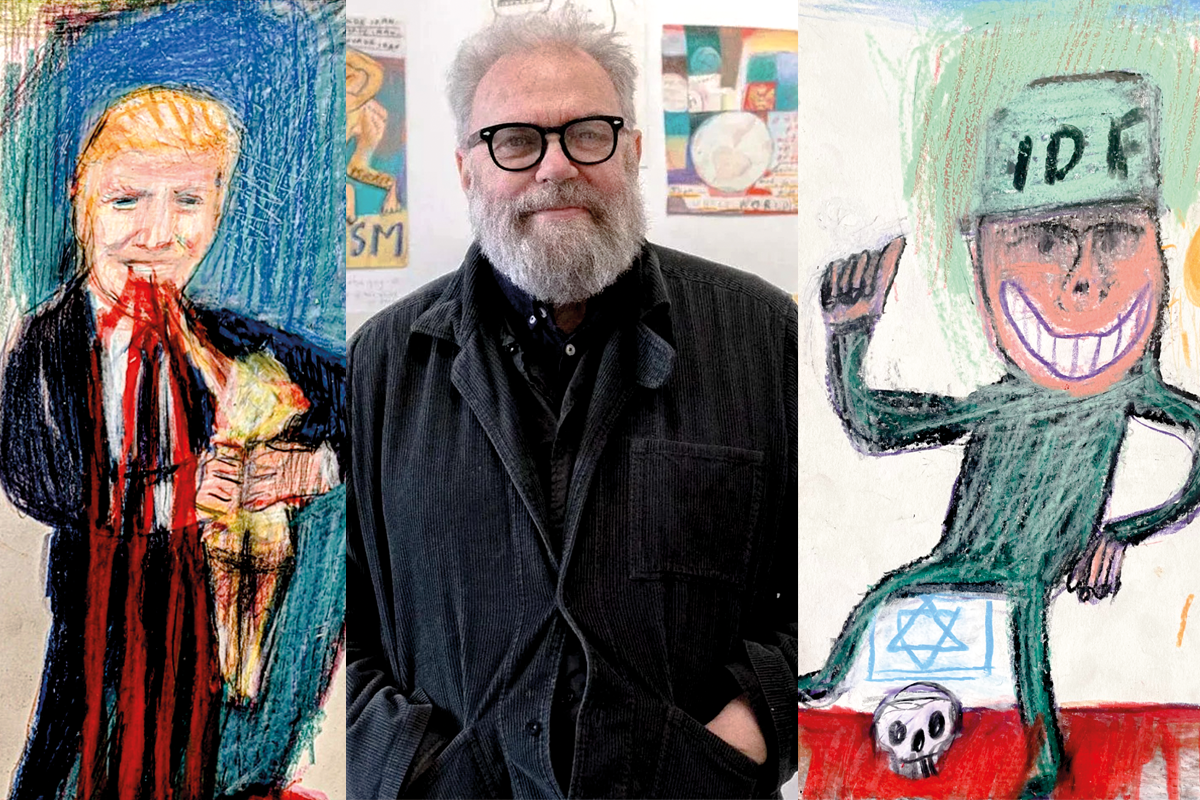
Collings’ drawings are made with coloured pencil and pastel, and are colourful to a near garish degree. They include depictions of the genocide, politicians covered in blood, and IDF soldiers murdering with joy.
The scenes may appear brutish and haphazard, but a closer look shows Collings’ trained eye, which carefully balances each drawing to deliver a calculated punch.
In one scene, Trump is ripping apart a body in the style of Saturn Devouring His Son by Francisco Goya. “I think the whole mood is influenced by Goya,” said Collings. “I have absorbed his sense of cruel, ironic, black humour.”
View this post on Instagram
Goya lived through a world not unlike ours. He personally witnessed the effects of the Peninsula war, which was characterized by ferocious violence on civilians. “He lived through bewildering violence, and the richness of his art reflects all the complexities of societal change and violence, the role of violence in societal change.”
Collings, in a similar way to Goya’s The Disasters of War sketches, deploys an almost journalistic approach to the chaos surrounding us, taking cues from current events and popular imagery.
Zionist attacks
The exhibit was held this March in Margate at the Joseph Wales gallery, which is run by Heidi Rogers. It came under attack before it even opened.
The websites of Rogers, Collings, and his wife were cyberattacked and taken offline. A group named UK Lawyers for Israel sent legal threats to the gallery, which were luckily ignored by Rogers.
Collings and Art For a Free Palestine gave an opening reception on the first day of the exhibit.
“And then while people were milling around, I noticed a person much more expensively dressed than everybody else.” This was, unbeknownst to Collings, Zionist writer Zoe Strimpel.
She began to berate Collings, calling him and his art antisemitic. Bewildered, Collings very calmly explained his art was not antisemitic, but anti-Zionist. Anyone who’s ever argued with one of these people can understand the Sisyphean task of dealing with their level of cognitive dissonance.
Strimpel then went to the police to report the exhibit for being antisemitic. We can imagine her surprise when the police (no friend of the working class) told her that anti-Zionism did not equate antisemitism, and to please stop wasting their time.
Strimpel would go on to write piece after piece about the exhibit, including Lovely time in Margate? No, it was dripping with Jew-hate, saying the exhibit “should be preserved in the annals of anti-Semitic propaganda alongside that of Der Stürmer.”
View this post on Instagram
“The Israeli army is depicted with equally erotically charged levels of dehumanisation, such as the one that shows a soldier-ghoul atop a star of David, stamping on a skull,” she said.
This “proof” of antisemitism is a real scene perpetrated by the IDF in Gaza. But Collings’ hadn’t even seen this photo before making the piece, saying “that drawing is just my iconic, imaginative idea because they kill people and delight in it.”
“Why do I draw IDF soldiers covered in blood and surrounded by skulls? Because the fuckers are covered in blood and surrounded by skulls.”
The smears and slander did not work on the Margate show, but when another exhibit was planned in London, it was successfully shut down by UKLFI. Collings and Art for a Free Palestine are currently looking for another venue to show his drawings.
View this post on Instagram
Uphill battle
This type of art is an uphill battle around the world. Many institutions are more worried about their funding than any type of art which challenges the ruling ideas of the ruling class, which are unabashedly pro-Zionist.
Collings has lost writing gigs for publications like the Evening Standard and Art Review – where he’d been contributing for years – for his support for Corbyn and Palestine, and his opposition to Israel.
There are many artists fighting the same struggle as Collings, like Nan Goldin and Candice Breitz. But what disappoints him the most are the well-known artists who approach him in hushed tones and profess they’re pro-Palestine, while never daring to say it publically. “That’s even worse in a way,” he says. “They’re just obeying orders.”
What also worries Collings is the stranglehold Zionism has on our political system. He ran for parliamentary candidate for Labour in 2019 and was voted in. In the General election of 2024 he would have been standing against Liz Truss. But he was suspended by the Labour Party for claiming Israel controls British politicians, and describing chief rabbi Jonathan Sacks as a “notorious hate-filled racist.”
View this post on Instagram
The exact same tactics would go to be used against Jeremy Corbyn and his supporters to scuttle his election campaign.
Collings sees the unwillingness of Corbyn to fight antisemitism slanders as one of his greatest mistakes, and he refuses to retreat in the face of the same attacks. Today, he sees those same mistakes being replicated in the Green Party.
“There’s a powerful Zionist element within the Greens,” he said, speaking on the undemocratic blocking of the extremely popular “Zionism is Racism” motion at their conference in March.
As far as Collings is concerned, the fight has only just begun, and he’s not stopping any time soon. “The repression is very extreme now precisely because the Zionists know that the whole world sees through them,” he said.
“If you don’t do anything then nothing will happen. You’ve got to do things in the face of the dark days and in the face of repression, and it’s frankly not hard to fight those idiots. They are on the whole pretty stupid.”
Art and revolution
We ended our meeting discussing Trotsky’s writings on art and revolution. Trotsky said art was both a mirror to reflect society, and a hammer with which to shape it. Artists, especially today, cannot afford to sit out the class struggle. Their very existence depends on it.
“Lenin says art has to obey the laws of art before it’s effective as a message,” Collings said. “In other words, he’s saying art has to be good before it’s really effective. There’s a connection between art’s beauty, and its quality and impact.”
Marx was interested in the point of every kind of production. He wrote that the point of art was to create an artistic & beauty-enjoying public — “Production thus produces not only an object for the individual but an individual for the object.” pic.twitter.com/FlHSEOeqWe
— matthew collings (@matthew51691936) January 20, 2021
He added that while art can be useful as propaganda, it’s much more than that. It’s necessary for anyone to live a fulfilled life.
Collings may have made a career off popularizing art to mainstream audiences, but it’s his work depicting the crimes of Israel and fighting Zionism at home which are most needed today.
Readers recommend…
Kneecap’s FENIAN: Anti-imperialist art
Jo Bunkle, Cambridge
Irish-language and anti-imperialist icons Kneecap have released their third album, FENIAN.
A tonal shift from the hedonism of their previous album Fine Art, FENIAN takes aim at the British state for its crimes – like cracking down on the Palestine movement, which landed Mo Chara with charges of ‘terrorism’ for waving a flag!
The album focuses on Britain’s oppression of Irish and Palestinian people in a real tableau of styles, from house to drum and bass.
‘Carnival’ takes aim at the intention of Mo Chara’s trial: a distraction from the real crimes being committed by Israel. The chorus highlights this: “and view their new attraction, circus of distractions, away from their actions is where they will steer you.”
View this post on Instagram
Throughout the album, the trio flip the script to put the British state on trial. In ‘An Ra’, they make a mockery of everything British occupation has brought to Northern Ireland: “fish & chips / TV license / UKIP / mental health crisis / good shit / high rent prices.” It’s like a diss track against imperialism.
Beyond political messaging, the album takes up Kneecap’s personal journeys, reflecting on historic drug abuse in ‘Headcase’, and losing loved ones in ‘Irish Goodbye’.
The unity of these themes with the album’s anti-imperialist fervour describe a growth in character through hardship, including being mercilessly attacked for defying the British state’s line.
FENIAN captures a spirit of defiance against British imperialism and I for one can’t wait to see what Kneecap come up with next.
Les Liaisons Dangereuses: Their Morals and Ours
Patricia Moseley, Wood Green
In Les Liaisons Dangereuses, French high society is revealed to be little more than moral corruption and malice.
Beneath the petticoat of rigid social norms and sensibilities, Christopher Hampton’s play – based on a 1782 novel – is a blistering criticism of the decadence and hypocrisy of the French nobility in the run-up to the French Revolution.
Ex-partners Marquise de Merteuil (played with venom and poise by Lesley Manville) and Vicomte de Valmont (a fiery Aidan Turner) place wagers on how they can morally corrupt naïve youth and other innocents. Through deceit and physical force, they permanently alter the lives of their victims.
It is no coincidence that this play is on stage at the same time as the Epstein scandal. When the Marquise and Vicomte groom the young Cecile de Volanges, or when the Marquise’s incriminating correspondence is leaked to the nobility, we’re reminded that we too are living through the horrors that come with the death agonies of our own Ancien Régime.
View this post on Instagram
The play is punctuated by dance sequences which help to convey the jarring contradiction between the emotional turbulence of the victims and the hunter-like stalking of the main protagonists. Though the script has plenty of jokes and innuendos, none can erase the devastation that the Marquise and Vicomte unleash on their pawns. The lives of the victims are inconsequential to these wealthy parasites.
Their decaying morals are best summarised in the Marquise’s mantra: “never show pity, especially to the vulnerable”. That their arrogance leads to their fall is no justice for their victims, any more so than Epstein’s death or Ghislaine Maxwell’s imprisonment.
The comeuppance for the real-life Marquises and Vicomtes of 18th century France did not come through the courts nor divine intervention, but through the action of the masses in the French Revolution. It is now our task to retie the knot of history, to wipe out our own Epstein class.
Les Liaisons Dangereuses is on show at the National Theatre until 6 June.