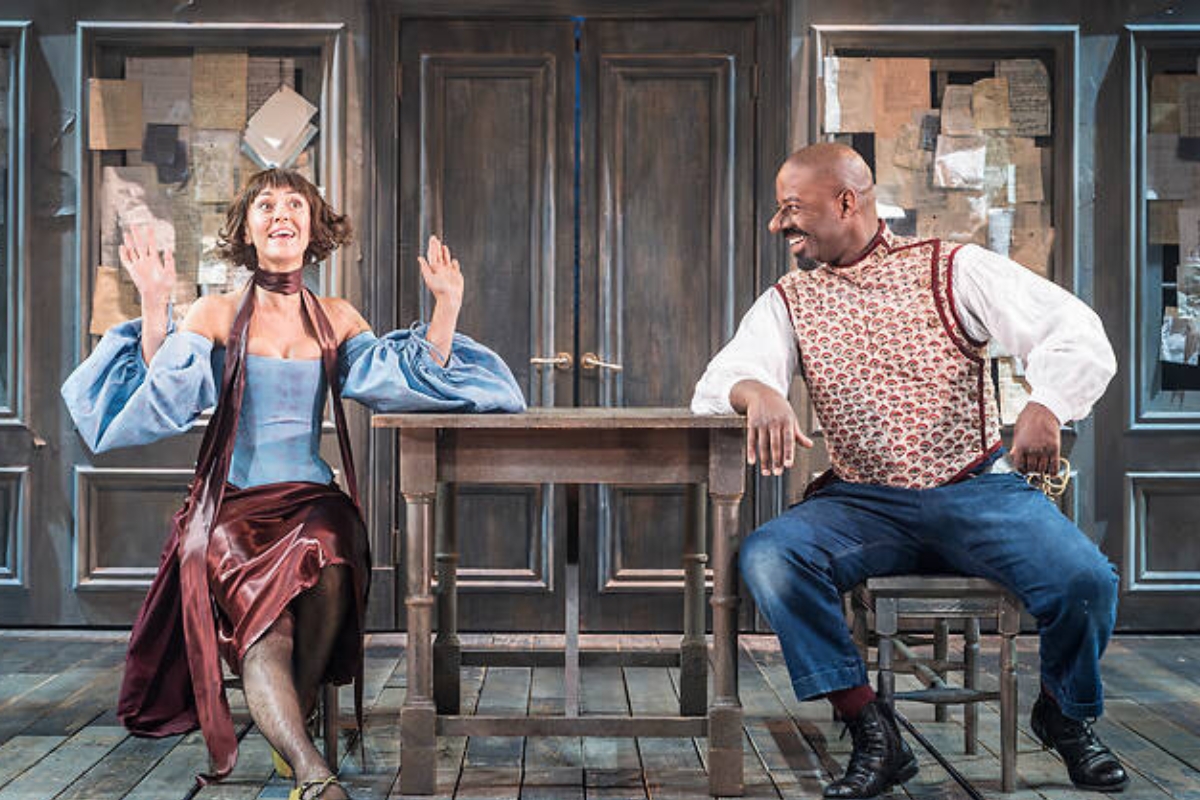

Last month, I had the pleasure of seeing the play Cyrano de Bergerac at the Noël Coward Theatre in London, with Adrian Lester in the titular role.
Unrequited love
The 1897 play is loosely based on the real-life Cyrano, a 17th Century, libertine French nobleman. He indulged in duels alongside his playwriting, and famously had a very large nose – this insecurity prevents him from declaring his love to his distant cousin Roxane.
To Cyrano’s chagrin, she loves Christian – a simple cadet who does not possess Cyrano’s way with words, and is also too shy to court her.
Cyrano begins writing love letters to Roxane, all the while pretending that they are from Christian! He brings the two closer together, while covertly expressing his love.
This subterfuge is the motor force of the play’s light-hearted first act. Lester is charming and hilarious with his prosthetic nose, dispatching his puny rivals with equal doses of swordplay and wordplay; spending his days fighting and writing.
A modern tale
The original text is entirely in verse; in the classical alexandrine form used by Molière and Racine. The current production is based on a new adaptation by director Simon Evans in collaboration with the grime poet Debris Stevenson.
The dialogue is a seamless blend of classical poetic metre, infused with contemporary spoken-word style. Each character speaks in a distinct cadence, drawing the audience into their worldview and emotions.
Often, adaptations that attempt to ‘modernise’ plays use ‘accessibility’ to theatre as an excuse to make ugly, grey sets depicting council estates, and use actors poorly faking ‘working-class’ accents.
This adaptation could not be further from that, and the result is dazzling. The lyricism keeps us in 17th Century France, but the snappy modern rhythm brings us back to the here and now – reminding us of the universal pangs of insecurity and unrequited love.
Thirty Years’ War
Act two dispatches the initial comedic thrust of the story as the Thirty Years’ War changes the tone entirely. Gone are the shenanigans of pining young lovers, and we are instead met head on with the horror, tragedy, and futility of war. We feel as though we were led out onto a ledge, and are now hurtling into the abyss.
Lester and the wider cast portray in earnest how life can so suddenly turn on a knife’s edge – how, all of a sudden, our previous concerns become inconsequential in the face of the brutal force of war. But what remains is bravery, dignity, and honour – these qualities can elevate us above all the drudgery and strife.
Speak as you dare
Ultimately, the reason this production of Cyrano is so successful, is that it respects the emotional intelligence of its audience. It leans into the central conceit of the original play, reminding us that to be exceptional, to be truly alive, is to allow yourself to burn bright with passion. This can be as destructive as it is beautiful, but to live by the sword is also to die by the sword.
Those of us motivated by a burning desire to change the world can heed Cyrano’s words:
“No master to serve, no leash to bear. I walk as I please, and I speak as I dare.”
‘Cyrano de Bergerac’ is showing now at the Noël Coward Theatre