In a recent statement summarising his World Cup thoughts, FIFA President Gianni Infantino accused some vague figures of spreading “hate and division” while FIFA were busy “delivering the best show in the world”. Perhaps he had in mind the crowds who booed him whenever he appeared on the big screens during the tournament.
A few days later, Infantino announced his plan to create FIFA Forward Enterprise (FFE) – a company which would manage commercial and ticketing rights of some of football’s most prestigious tournaments, with private investors invited to own up to 21 percent of it. This immediately promoted cries of corruption, profiteering, and “selling off football”.
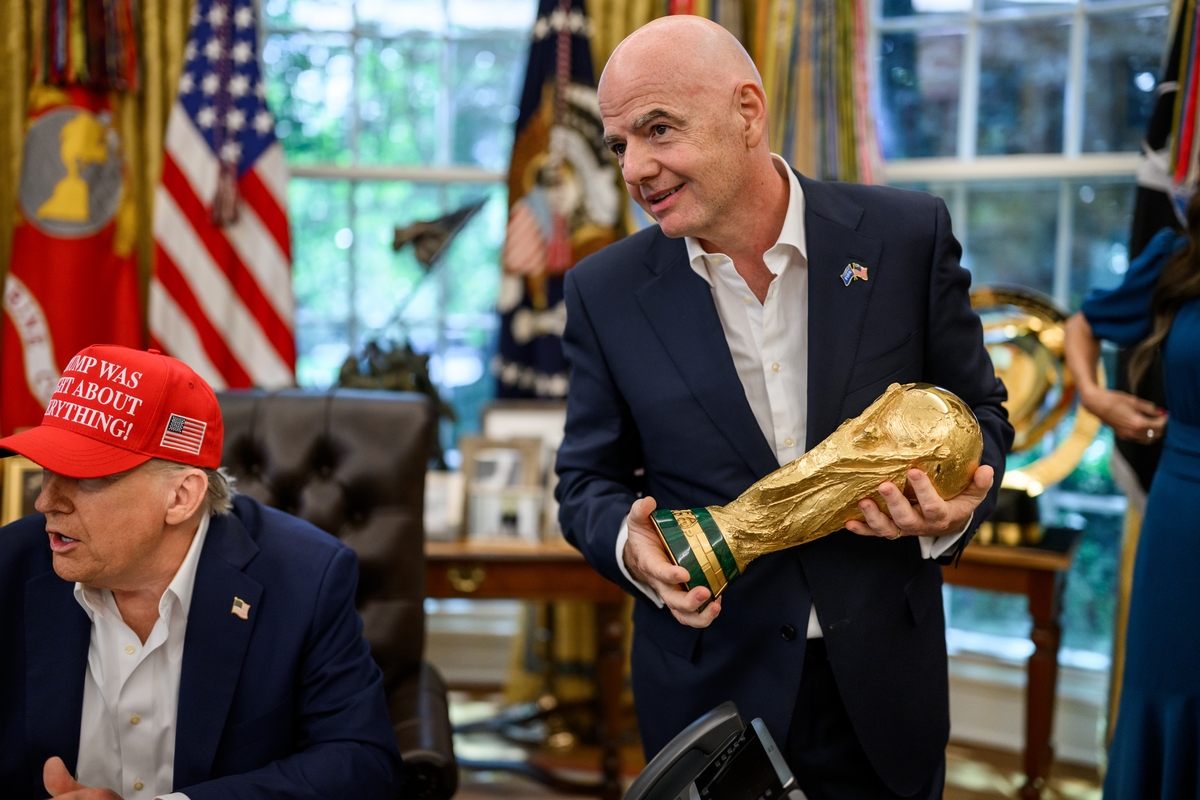
After farcically trying to act as a global diplomat and peacemaker – with stunts including trying to make the Palestinian FA President shake hands with the Israeli FA Vice-President, and giving Trump an invented ‘FIFA Peace prize’ – Infantino looks to have overplayed his hand this time.
Three continental football federations (Europe, Asia, and North & Central America & the Caribbean) plus a host of politicians and former players are calling the FIFA President to stand down over his “deceptive” plans with FFE.
Football’s governing bodies in Europe, Asia, the Caribbean and the Americas have all issued an open letter condemning the Fifa boss, Gianni Infantino, accusing him of breaking trust “through deception”.
Infantino has faced a growing outcry over his plan to sell off stakes in the… pic.twitter.com/iJOP6zD8br
— Channel 4 News (@Channel4News) August 10, 2026
Investment or bribery?
Given that FIFA, despite being a not-for-profit organisation, has reserves of $2 billion and is expected to make around $15 billion from the recent World Cup, the question over exactly why private investment is needed is more than justified.
FIFA stated that each of their 211 member-nations would receive $40 million if the plans were to go through – for development of grassroots football activities and such. But the announcement that $20 million would be made available more-or-less immediately if nations voted to accept FFE at a meeting on 19 September led to cries of bribery.
Taken at face value, the questions raised by this scheme include
- Why FIFA’s existing revenue cannot be used to fund football development.
- Why the amounts are determined by whether nations vote in favour or not.
- What some smaller nations would need or do with $40 million for football-related activities.
However, the main concern was exactly how this private, profit-seeking investment would affect the landscape of football and FIFA’s tournaments. Would the World Cup become an annual event? Would it become even more commercialised?
This is what caused many organisations to demand FIFA renege on these plans – which they eventually did, in order to ‘save the soul’ of football.
President Donald Trump says FIFA would be making a “terrible mistake” if it considered replacing its president, Gianni Infantino, calling him “fantastic” and crediting him with presiding over the “most successful World Cup” in a Truth Social post Monday night. pic.twitter.com/ZNkMQ2gTLg
— CBS News (@CBSNews) August 11, 2026
Hypocrisy
But the cries of corruption and greed by UEFA and other senior football organisations ring hollow given their own recent commercialisation.
For example, in 2024, the European Champions League expanded to include 36 teams beginning with a league stage. No ordinary fans were asking for this, it was a simple calculation: more games means more money for UEFA, their stakeholders, and sponsors.
The same thing can be said for the invention of the UEFA Conference League (a third-tier European competition).
Similarly, the English Premier League sold broadcasting rights for four years for £6.7 billion to three different providers (Sky, Amazon, and TNT) who now have a dominant say over match scheduling.
This means that not only do fans have to pay for at least three different streaming subscriptions (if they want to watch every game), but team supporters have to contend with awkward travel and timing demands depending on what the providers want to broadcast (e.g. asking Newcastle fans to travel to Brighton for a Friday evening game rather than a regular Saturday afternoon game). Meanwhile, ticket and merchandise prices continue to increase.
It seems that there is more money in the game than ever, and everyone involved is getting richer – except from ordinary fans, without which the sport would be nothing, who are getting relentlessly squeezed from all sides.
Part of the system
Despite the constant hawing to ‘keep politics out of sports’, the truth is that football exists within capitalism. The English Football League alone generates up to £10 billion in profits every year.
Football is therefore subject to the same pressures and constraints as the rest of the economy. All the same sleaze, greed, and exploitation that we see in banking, big tech, and other industries appears in football too.
As long as there is the necessity for profit, football will be at the mercy of figures like Infantino, who are more concerned with money and power than the love of the sport. If we want a football free of corruption, we need a system free of profit.