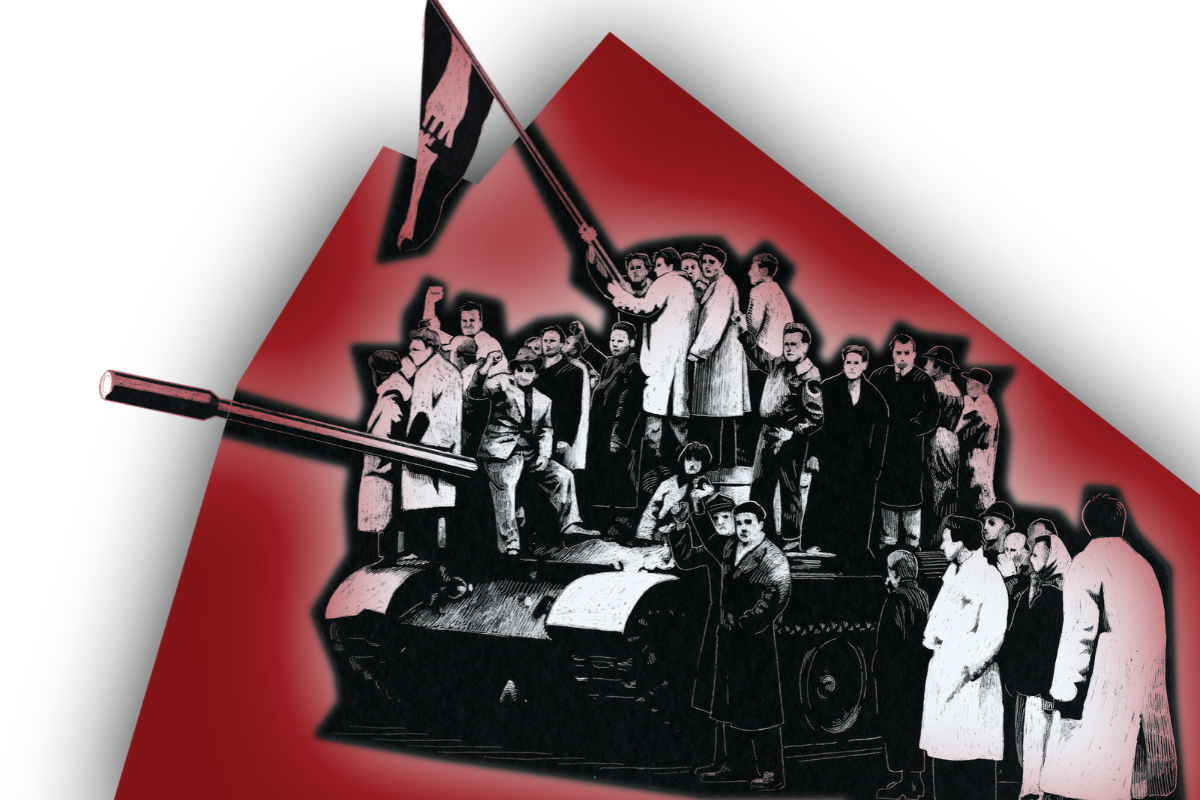
This article was written in the summer of 1957, several months after the defeat of the Hungarian revolution. It was published in the first issue of a journal called the New Reasoner, founded by intellectuals who had been forced out of Communist Party of Great Britain (CPGB) for criticising the Stalinist line of its leadership. Its author, Peter Fryer, had been an eyewitness to the revolution in Hungary in 1956 and its suppression by the Stalinists. He published his eyewitness account in the book Hungarian Tragedy, for which he was expelled from the CPGB. Several months after the revolution, he wrote this article answering many of the slanders that had been thrown by the Stalinists against the Hungarian revolutionaries.
Extremes meet. The ultra-Right and pseudo-Left sometimes find a surprising amount of common ground. A striking example of this is their assessment of the fundamental character of the events in Hungary last October and November.
To both the reactionaries of the Right and the reactionaries of the Left—the Stalinists—these events were essentially counter-revolutionary. The Stalinists deplore what they picture as a premeditated attempt to put the clock back; the Right-wing reactionaries applaud it.
A minority of British Communists, together with many other Socialists, has held that the Hungarian rising cannot be understood in these terms, that basically it was a people’s revolution aimed, not at restoring the rule of capitalists, landowners and Horthyites, but at overthrowing the tyrannical rule of a ‘Communist’ aristocracy and its hired thugs, and so establishing Socialist democracy.
This interpretation has been tragically confirmed by the character of the resistance to the administration set up by the Soviet military authorities last November. It has been confirmed almost daily by the suffering and gallantry of, above all, the industrial workers of Hungary throughout the half year since Russian tanks broke through the barricades at Csepel and Ujpest, Tatabanya and Dunapentele. It has been confirmed by the stubborn refusal of a whole galaxy of the leaders of Hungarian intellectual life—Hay, Dery, Benjamin, Gemes and many more—to co-operate with Kadar.
To read these six books and pamphlets¹ is to find yet more proof in abundance of what the Hungarian revolt really was, who organised it, why it took place, and why it drew into vigorous political and military activity the overwhelming majority of the nation. From these works taken together there emerges the unmistakable picture of the first full-scale anti-bureaucratic revolution in the course of the world transition to Socialism, the harbinger of further mass movements against the bureaucracy whose dictatorship has twisted the fabric of working-class power.
The Hungarian Revolution
The Hungarian revolution was a bold attempt to solve, in a classical way, by the setting up of workers’ councils, the problems which the bureaucracy creates when it usurps working-class power. At the same time there were interwoven with the democratic aims of the rising national-liberation aims, expressed just as clearly. Democracy, independence, human dignity: it was for these the Hungarian people fought. No one who has read and compared these works could deny it.
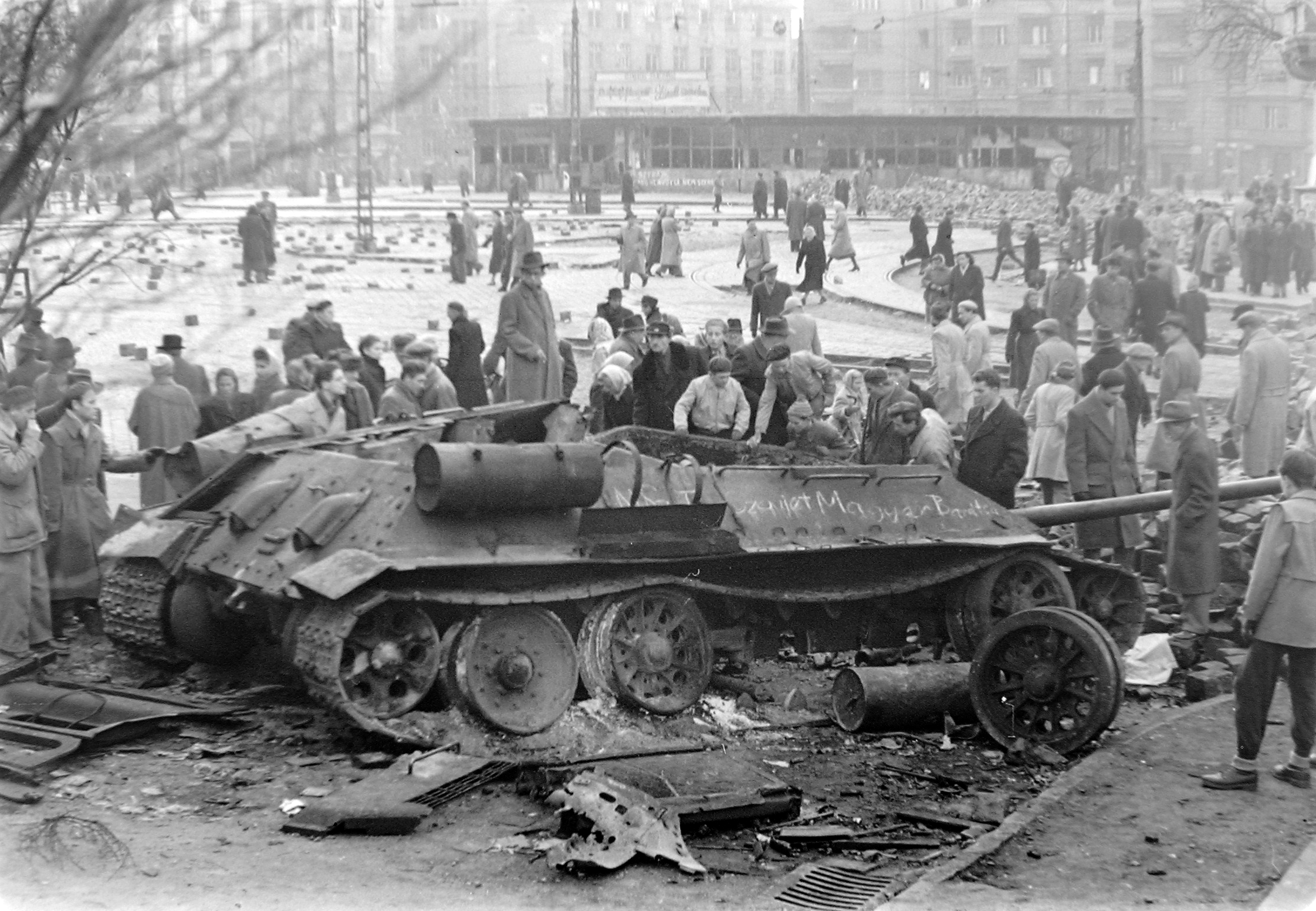
There is indeed no other explanation that takes account of the contradictions which marked—yes, and marred—those thirteen unforgettable days. King Street and Fleet Street alike seized avidly on the lynchings, the hooliganism, the paying off of old scores, the adventurism, the ferment akin at times to chaos, all of which were to be found in plenty in the midst of this levée en masse.
But where is the revolution which has not been besmirched by human baseness at the same time as it has demonstrated the capacity of human beings to rise to exceptional heights of nobility and self-sacrifice? It is the pattern which counts. Then one sees that it was the crimes—those deeds so neatly pigeonholed as ‘violations of Socialist legality’—committed by these well-paid ‘comrades’ of the AVH which led to the terrible hatred and terrible revenge of people who suddenly felt a burden of oppression, of daily and nightly fear, lifted from them.
Mikes tells (p. 118) how passers-by spat at the bodies of AVH men hanging from trees and lamp-posts (there is a dreadful picture of this on p. 77 of The Counter-Revolutionary Forces), though no one touched the money that those who killed them had pinned to their corpses or stuffed in their mouths and set alight.
Such horrors are not to be explained as the work of ‘degenerate fascist killers’¹ (The Counter-Revolutionary Forces, p. 152) or of ‘ruthless gangsters’ (ibid., p. 172), or of Radio Free Europe incitement, or of the agitation by one tortured, eccentric Church dignitary.
Nine million Hungarians loathed the AVH with a passion that had to be witnessed to be believed. They had been treated abominably by the AVH and its masters, Rakosi, Farkas and Gero. They took a brutal revenge. The savagery of the people’s revenge in a mass popular rising is always proportionate to the brutality that has been inflicted on them by the regime they are seeking to overthrow.
‘White Terror’?
Those who see only ‘White Terror‘ in newly-liberated Budapest, who quieten their own doubts and misgivings by supposing that the evils of the Rakosi-Gero regime have been exaggerated, should ponder over the words of Macaulay in his defence of our own revolution:
“It is the nature of the Devil of tyranny to tear and rend the body which he leaves. Are the miseries of continued possession less horrible than the struggles of the tremendous exorcism? … We deplore the outrages which accompany revolutions. But the more violent the outrages, the more assured we feel that a revolution was necessary … The heads of the church and state reaped only that which they had sown … If our rulers … were assailed with blind fury, it was because they had exacted an equally blind submission.”
Let us soberly take the Kadar government’s own publication and see what this alleged ‘White Terror’ amounts to. Throughout, with very few exceptions, AVH men are alluded to under two ‘respectable’ euphemisms: ‘soldier’ and ‘policeman’. There is a section called ‘Fifteen Martyrs’—seven of them, on the booklet’s own admission, are AVH or Army officers.
There is a statement by the woman who was manhandled by the crowds in Budapest; pictures of the incident were prominent in the Agony of Hungary exhibition. The crowd, she says, called her an ‘AVO whore’ (p. 89). English readers are easily shocked, it seems. But what stands out a mile from this statement is that after pummelling her and partly stripping her (she was found in a building occupied by AVH men) the crowd let her go.
‘Come on out, block warden,’ shouts a ‘counter-revolutionary’ to a ‘Communist’ (p. 67). There is no explanation of the term ‘block warden’. No, the authors of the booklet prefer to draw a decent veil over the system of spying and informing on which the AVH terror was based. Complete silence, for instance, on the dossiers, or personal record cards, whose discovery more than anything else frightened the miserable ‘Communists’ who had supplied information about fellow-tenants or workmates.²
The account of the ‘siege’ of the radio building on October 23rd and 24th is a grotesque caricature, exploded in advance by Dora Scarlett, who worked there. If ‘the military action against the Radio was well prepared’ (p. 27), why did those who captured the building from the AVH not stay inside, take it over, and broadcast their ‘counter-revolutionary’ propaganda, instead of leaving it in the hands of a committee, including Communists, elected by the staff which had worked there all along?
The whole booklet bristles with such inconsistencies. If Kadar’s hacks cannot do better than this wretched stuff after six months, they had better stop translating it into English.
The question of ‘White Terror’, and many other questions too, are put into proper perspective in Woroszylski’s remarkable diary. Those responsible for its translation and distribution deserve the warmest congratulations. It is unquestionably the finest, most detailed and most moving eyewitness account of the revolution.
A fight for genuine socialism
Anyone who was in Budapest at the same time relives in reading it the days of hope and expectation, and tastes once more the bitterness and despair of that Sunday dawn when the Russian guns began to bark again from the Gellert heights.
As a Communist Woroszylski records with pride that it was his comrades who, to a great extent, prepared and led the revolution. His comrades: the real Communists, ‘formerly condemned for all sorts of deviations, dismissed, stigmatized and imprisoned,’ who ‘take up again the banner of Communism in such a difficult and dangerous situation, while the orthodox can just manage to carry their precious bodies over the border, leaving the people a burst of gunfire as a farewell gesture.’ This, he adds, ‘is not a paradox, it is a golden rule’. (p. 15).
At Gyor he asks a young man: ‘Were you a party member?’
‘What do you mean “I was”? I am a party member … We have dismissed the party’s bad leaders but the Communists remain … I was and I stay a Communist’ (p. 24).
The famous leading article in Nepszabadsag is quoted:
‘Rakosi and his clique made the party a weapon of tyranny and dispersed its moral capital. The popular rising has overturned this clique … Communist writers, journalists, workers and peasants, and old party members unjustly imprisoned fought in the front ranks and we are proud that you took part in the armed insurrection.’ (p. 16).
Especially moving is Woroszylski’s description of his interview with Professor Lukacs. The new, purified Communist Party might have to pass into opposition, he thinks, for Communism has been compromised. (This was on the Wednesday, October 31st.) ‘But the party will exist to safeguard its ideals, to be an intellectual centre, and in a few years, or dozens of years, who knows …?’ (p. 11).
On the eve of the second Russian intervention Woroszylski ponders over the future of the Hungarian revolution:
“It seems … that we can see a curious synthesis of the fundamental changes brought about by people’s democracy (land to the peasants, factories and banks socialized), and a multiplicity of parties, liberty of the Press and other liberties, proper to liberal democracy, taking shape. Can such a system become one of the roads—possibly very slow—towards Socialism? I cannot confirm this. As to the road along which people like Rakosi have led their country, I am absolutely certain that it could lead to nothing but failure and slavery.” (p. 28).
In other words, it had been a political revolution, to throw off a despotic ruling crust, not a social revolution, to change the property relations, the economic structure of society.
This is again confirmed in Woroszylski’s conversation with ‘a gnarled, thick-set peasant in a hand-woven jacket’ who, when asked what would happen if the landowners tried to come back, ‘raises a clenched fist’ and replies: ‘Then there will be a second insurrection!’ (p. 23).
Woroszylski is frank about the role of Dudas and about the mob-justice meted out to AVH men. He quotes a Communist’s comment (October 30th): ‘Believe me, we are not sadists, but we cannot bring ourselves to regret those kind of people.’ (p. 4).
He puts the number of people lynched in Budapest at ‘somewhere between 70 and 80’. (p. 28). But he stressed from personal observation—confirmed by every other reputable eyewitness—the amazing absence of looting, testifying to the high level of revolutionary discipline of these ‘White Terrorists’.
‘We see shops with shattered windows, where shoes, toys and bottles of wine have remained exposed, but in perfect order. No greedy hands try to seize them …’ (p. 6).
Still more important is his evidence about the way things were returning to normal towards the end of the week. On the Friday he writes:
‘During the last twenty-four hours there have been no summary executions in Budapest’ (p. 17).
And next evening, a few hours before the Russian attack, he and his colleagues gather to exchange the impressions they have formed after separating and visiting various parts of the country. Their conclusion is that:
“The country is settling down and the Government becoming established, supported by all the revolutionary forces. Calm reigns in Budapest today. As on Friday there are no reports of summary executions.” (pp. 27–28).
Nevertheless, at five next morning, they are awakened by explosions, the rumble of tanks and the screaming of jets. Kadar refuses to grant them an interview. An AVH nark in their hotel loses his fear, adopts ‘an amiable smile’ and begins to ply his trade again …
This document contains an immediate message for every British Communist. It is on page 19, where Woroszylski writes of ‘a people who wanted a socialism free from corruption, crimes and lies and who had been driven into an abyss of despair.’ Solidarity with these people, he goes on, ‘was not only necessary for them, but also to us.’ (My emphasis: P. F.).
Those who have corrupted the British ‘Communist Party’ and turned solidarity into docility have no ears for this message. But there are many among the rank and file who will respond to it. For solidarity with the Hungarians, now driven deeper than ever into the abyss, is as necessary to real British Communists as it is to the Poles.
First-hand and retrospective accounts
The interesting thing about Davidson’s short pamphlet is how well it stands up after six months. It was written under the immediate impact of the revolution, by a man who combines deep Socialist convictions with a wide acquaintance with Eastern Europe and an understanding of its problems.
Davidson’s account of the background to the uprising, though necessarily sketchy, is for the most part accurate, and he deals adequately with such controversial points as the absence of anti-Semitism, the status of the Nagy government and the Mindszenty broadcast, which it is both dishonest and ludicrous to describe as the signal for a counter-revolutionary coup. (Anyway, as Davidson points out (p. 19), the new Catholic journal Sziv had declared that same day: ‘We renounce the nationalized estates of the Church’.)
Davidson is perhaps open to criticism in his omission from the list of reasons for the second Russian intervention of what has (subsequently, I admit) stood out more and more clearly as a major reason, if not the primary one: the strength of the workers’ councils.
Davidson does make the point, though—and it comes to much the same thing—that the Hungarian example might have been followed elsewhere in Eastern Europe (p. 22). The organs of insurrection and of popular self-government which sprang up in Hungary are noted for their attractive power and the swiftness with which they spread over national boundaries.
Mikes’ book is a mixture. It is less valuable than the two just discussed because it is not an eyewitness account, relying on the stories of refugees. Such stories are not always reliable. The most trustworthy Hungarians, by and large, stayed behind to carry on the struggle.
Mikes monstrously exaggerates the excesses committed by Russian troops during the second intervention; in fact the Russian troops behaved on the whole as well as British troops would have done in a similar situation. On the other hand there is a great deal of useful information scattered through the book, and, despite the author’s political prejudices and misconceptions about Marxism, there are occasional flashes of real insight.
Provided one checks it with Woroszylski and Davidson, who were there, Mikes’ book is therefore well worth reading, in particular for its account of AVH methods (pp. 107–19), its useful summary of the intellectuals’ revolt and the beginning of the revolution (pp. 64–87) and the interesting passage on the absence of anti-Semitism (pp. 127–28): in one case an AVH man was released by a mob because he was a Jew (‘If you want to live, get rid of that damned uniform as soon as you can’).
The compilation edited by Z. Zinner is very valuable. The Hungarian section, 246 pages long, gives pretty well every document of importance relating to Hungarian politics last year, beginning with the resolution on the lessons of the Twentieth Congress adopted by the Central Committee of the Hungarian Working People’s Party on March 12th–13th, 1956, and ending with Pravda’s attack on Tito on November 23rd.
It is a great pity that though Tito’s famous speech at Pula on November 11th, which drew forth this attack, is given in full, the no less important address by Kardelj to the Yugoslav Parliament on December 7th, which marked a significant advance in the Yugoslav position on Hungary, could not be given too. Missing also are the broadcasts by the Communist radio, Radio Rajk, calling for national resistance to the Russian onslaught.
But there are few other omissions of any consequence. The material from the period October 23rd–November 4th is especially rich, and is full of first-class evidence attesting to the popular nature of the uprising.
View this post on Instagram
The legacy of 1956
Much of it makes strange reading now. How forlorn were the hopes expressed by Nagy in his interview given on October 31st (Soviet troops were withdrawing, and future relations with the USSR would be ‘very good’ I think. ‘Good diplomatic and friendly relations.’ (p. 460)) and in his speech to a mass meeting outside Parliament the same day:
“Hungarian brothers … the revolutionary struggle whose heroes you were has won! … We are living through the first days of our sovereignty and independence … We have expelled the gang of Rakosi and Gero from our country. They will answer for their crimes.” (p. 458).
But Rakosi the murderer goes free and there are ominous hints at a trial of Nagy. The Stalinist mantle of Rakosi and Gero has fallen on Kadar’s shoulders. Striking is punishable by death; a twenty-year-old girl is hanged; a mailed fist quenches every flicker of discontent.
The security police, harsh labour laws and thought control have come back. The Hungarian workers have been enslaved again as surely as if Kadar had branded the letter ‘K’ on their brows.
The open, armed resistance has died down. On March 15th the workers did not allow themselves to be provoked into hopeless sacrifices. There are, of course, more ways than one of resisting. In the workshops of ‘Red Csepel’ the workers greet each other ironically as ‘your fascist Lordship.’
Let no one suppose that Hungary has been made safe for Stalinism. It would need ten times as many Russian tanks to do that. In the next round of political revolutions against the Stalinist bureaucracy, which may not be long delayed, and which may even affect the Soviet Union, the Hungarian proletariat will know how to give a good account of itself.
Notes and References
¹ The six books and pamphlets discussed are:
- The Counter-Revolutionary Forces in the October Events in Hungary. [Budapest:] Information Bureau of the Council of Ministers of the Hungarian People’s Republic. Unpriced.
- Davidson, Basil. What Really Happened in Hungary? A Personal Record. London: Union of Democratic Control. 1s.
- Mikes, George. The Hungarian Revolution. London: Andre Deutsch. 12s. 6d.
- Woroszylski, Wictor. Diary of a Revolt: Budapest Through Polish Eyes. London: Michael Segal and Clive K. Jenkins, 38 Warrington Crescent, W.9. 9d.
- Zinner, Paul E. (ed.). National Communism and Popular Revolt in Eastern Europe: A Selection of Documents on Events in Poland and Hungary, February–November, 1956. New York: Columbia University Press; London: Oxford University Press. 24s.
² A collection of photostats of specimen dossiers, with English translations, is soon to be published by Hungarian writers in Britain.
The New Reasoner, Summer 1957, No. 1.