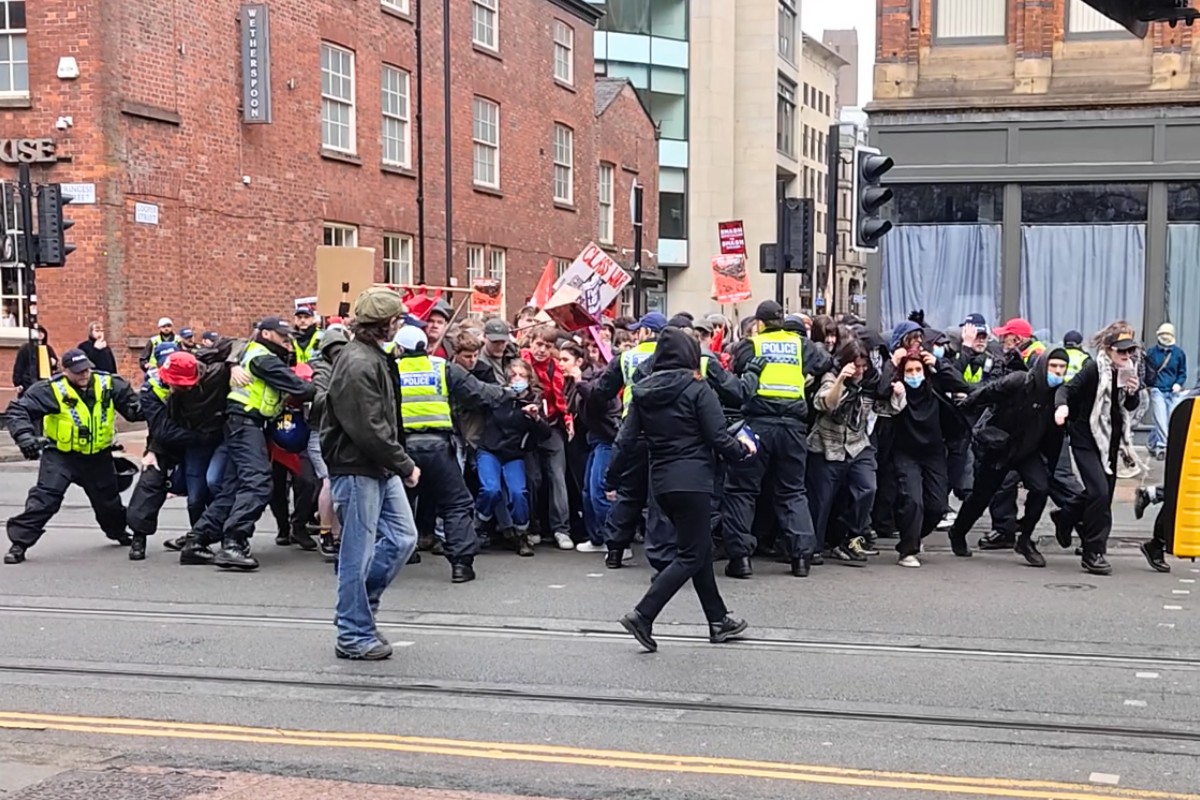
On Saturday 19 April, hundreds of anti-fascist counter-protestors, including a 60-strong Communist bloc, took to the streets in Manchester to oppose Britain First, a far-right organisation marching for “remigration”.
Britain First were certainly outnumbered, bringing around 600 compared to roughly 1,000 counter-demonstrators.
While the far right were eventually forced to give up and go home, this was hardly a decisive victory for the left, as we warned might be the case after the last confrontation back in February.
The police were also out in their hundreds, with the Manchester Evening News reporting that GMP deployed more officers than they would for a Manchester derby day.
View this post on Instagram
While the police cleared the way for Britain First to continue their hate march through the city centre, counter-demonstrators were pushed, pepper-sprayed, and struck with batons. One attendee we spoke with said they overheard officers describing the day as a “total policing disaster”.
The Revolutionary Communist Party’s bloc experienced this heavy-handed policing first-hand. We were held in a tight kettle for almost an hour, shoved around by the police, before eventually forcing our way out.
View this post on Instagram
Once we broke free and re-joined the main demonstration, we used this experience to make clear points attacking the state – exposing who the police serve, and explaining that the same British police who claim they cannot spare resources to investigate Prince Andrew somehow have the capacity to kettle anti-fascists for hours on end.
At our final destination in St Peter’s Square, facing off against Britain First, we continued chanting and delivering speeches attacking the whole establishment.
We explained that far-right groups rearing their ugly heads and running rampage through the streets is not something that happens in normal times. Events like these are a product of a system in decay, which breeds division, alienation, and despair.
Comrades pointed the finger squarely at the capitalist class and its representatives across all the establishment parties, chanting: “Who cuts our jobs to save their profits? Not the migrants, it’s the bosses!”
We also pointed to examples from Britain’s rich, militant history of the working-class struggle against the far right – and contrasted this with the absence of the so-called ‘leaders’ of the labour movement on the day.
View this post on Instagram
No clear leadership
A crowd of a few hundred racists would be easy to sweep off the streets, were there a mass mobilisation of the working class. If the trade unions and left leaders had lifted even a finger, Britain First could have been pushed back into the hole they crawled out of.
We saw a glimpse of the real balance of forces in British society with the ‘Together Alliance’ demonstration on 28 March, where half a million people mobilised in London against racism and the right.
The events in Manchester last Saturday stood in stark contrast to this victory. There was no real organised trade union intervention, and the demonstration was left in the hands of a loose coalition of anti-fascist groups, with no clear leadership.
There was also no sign of the recently-formed ‘Together Alliance’, despite the fact that they mobilised one of the largest anti-racist demonstrations in UK history only a few weeks prior.
View this post on Instagram
The lack of direction was evident throughout the day: counter-demonstrators were repeatedly sent in different directions, with sections broken off into smaller groups across the city centre, leaving activists exposed to police kettling, cavalry charges, and far-right provocations.
By maintaining our energy with politicised speeches and chants, and matching the anger of those who joined our bloc, RCP activists demonstrated that the our party is a serious force on the left in Manchester, and in the wider North West region.
As one young person who joined our bloc put it, they were “tired of groups whose ideas are interesting, but are impotent,” and were glad to see that this was not the case for us.
Despite the encouraging mobilisation by the ‘Together Alliance’ in London on 28 March, it’s clear that the leadership of the anti-racist movement in Britain today is incredibly weak – both politically and organisationally. This is especially the case on a local level.
The RCP is not yet large enough to fill this vacuum. But by intervening in these struggles and offering clear, class-based perspectives and methods, we can connect with revolutionary-minded workers and youth, and on that basis grow and strengthen our forces.