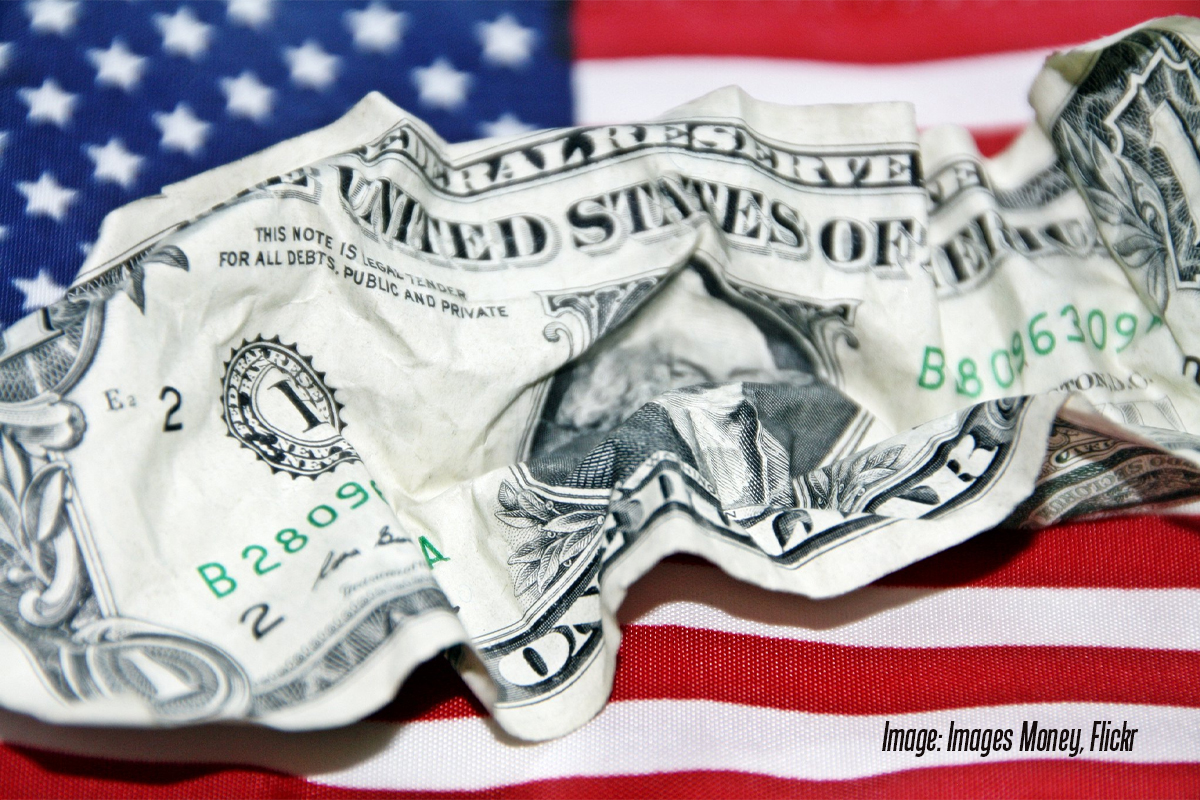

The United States Treasury Department announced this week that it will double the buying of its own bonds. These are desperate measures indeed.
The announcement from Scott Bessent, Secretary of the Treasury, comes in response to a mass sell-off of US long-term treasury bonds (government debt), which had taken the yields (interest rates) on 30-year bonds to their highest point since 2007 – the eve of the financial crash.
Bond yields rise as prices fall. And bond prices fall when investors don’t want to buy government debt.
To try to stop the spiralling crisis, Bessent announced that they would buy back the 30-year bonds from investors, who clearly don’t really want them any more. The Treasury will now at least double the amount of buybacks they make per period, from $2 billion to $4 billion, which could take their total buybacks to $66 billion per year.
Where will Bessent get $66 billion per year? He is planning to issue more short-term bonds to buy back the long-term ones. This is the equivalent of lending yourself money with your own credit card, and then borrowing from short-term loan sharks, to pay off your credit card debt.
Creating more problems
These measures will solve nothing. But they will create deeper problems for US public finances. They may temporarily slow the freefall of bond prices by closing the gap between the excess supply and falling demand, but that will not stop the general tendency towards a higher cost of borrowing for the US government.
People buy bonds as an investment – a place to put their money where they can accumulate interest and make profits. Long-term government bonds used to be the safest place to do this – especially US government bonds, which are called ‘treasuries’.
The reasons for this were that the US government can always pay its debts – and whether your bond is due to be paid pack, with interest, in 2 years, 10 years, or 30 years, the future of the US government is not in question.
But now, according to the world market, this stability is no longer considered to be the case. Investors do not consider long-term US treasury bonds to be a good investment due to a chaotic convergence of several factors.

Firstly, there is the AI stock bubble. The enormous tech companies have an insatiable appetite to borrow, and are even issuing their own bonds, with private investors lending them hundreds of billions. As the stock prices keep rising, these are becoming more attractive investments than government bonds for those looking to make a profit.
Secondly, long-term bonds are becoming riskier investments due to inflation. As the value of currency falls, so do the value of the loans, eroding the profitability of long term bond-yields.
There has been persistent inflation in the US economy now for half a decade. And despite it being the main priority of the Federal Reserve, the Treasury, and the White House to curb inflation – it was one of the main campaign promises in Donald Trump’s second election – they have been unable to bring it under control.
On the contrary, the Iran War has resulted in the closure of the Strait of Hormuz, dislocating trade routes and creating inflation in fuel and fertilisers. Prices for food and everything else will soon likely follow suit. This was a self-imposed blunder by the Trump administration, which does not improve the confidence of those considering lending money to the government.
Thirdly, the political regime in the US appears to be losing control of the situation. Government debt is certainly out of control.
This week total government debt exceeded $40 trillion. $3 trillion has been added in the last year alone, and 15 percent of government expenses go towards servicing this ever-increasing supermassive black hole – more than is spent on welfare or defence.
Policies like the Iran war, and now this unprecedented move by the Treasury, will only serve to undermine confidence further.
As the Financial Times put it this week:
“Some also think the optics of Bessent directly intervening in the Treasury market to influence borrowing costs could itself prompt a further debt sell-off, raising yields further.”
When asked if he was worried about the implications, Trump said “No because the rest of our economy is doing so well”. His new appointee to the Federal Reserve, Kevin Warsh, is also not perceived to be taking inflation seriously enough for investors. According to Reuters: “apparent reluctance to embrace interest rate hikes, with inflation above the Fed’s 2% target for five years and counting, has not gone down well.”
The reckless and blasé attitude of this administration, and their delusional denial of economic realities, undermines the confidence of bond holders further.
Unsolvable crisis
But this crisis is down to more than just Trump’s incompetence. Trump is the president who has increased the state debt more than any other before him.
Before Trump the record holder was Obama, who oversaw much of the state bailout of the banks after the financial crash of 2007-8. At the end of Obama’s second term, and the beginning of Trump’s first term in 2016, total US government debt was around $20 trillion. It has since doubled in a decade. The president who increased state debt most in a single term was Joe Biden.
The point is clear. Whoever is in the driving seat – Democrat or Republican, and regardless of their ideas or campaign promises – is forced to find short-term fixes, in the form of crippling debt, to patch up a deep and unsolvable crisis of US capitalism.
The US government cannot continue to spend as it is without borrowing more, and borrowing more will only cost the government more. It is a doom loop.
Enormous cuts to public spending are on the order of the day, but ordinary Americans are already at boiling point. The current ‘bond market rebellion’ is nothing compared to the rebellion that is brewing within the American working class.