

East Havering, Epping, Elsham, Brick Lane, Blyth, Beaconsfield, Blackpool. All are set to see the building of new data centres. Ever wonder where they are all suddenly coming from?
The UK is planning a massive expansion of data centres across the country, with nearly 100 new facilities expected by 2030. Two of these are expected to have higher UK carbon emissions than ExxonMobil!
The British state is greasing the wheels of big tech. Lenin once remarked that the state is “bound by a thousand threads to the bourgeoisie”. Nowhere is this clearer than the inseparable ties and revolving door between the British state and US tech.
Facing years of economic stagnation and declining industrial output, both the UK and Scottish governments have surrendered planning, energy policy, and public assets to foreign capital. And while the UK is a small market for Silicon Valley, this is an investment the government cannot afford to lose.
As one Downing Street spokesman said:
“You can’t seal your borders off…It’s not without risk but it’s not really in our hands whether it’s developed or not, is it?…You have to have stronger partnership [on AI] with the US…. If not, we will be left behind in a great race for transformation.”
The billions of public subsidies on the table didn’t materialise out of thin air. It was all lobbied for, meeting by meeting, minister by minister. There are zealous advocates of AI within the government who are backed by these lobbyists.
Access is cheap
Gaining access to influence the UK’s AI policy is cheap and unregulated – any successful punter can reach directly into government ministries.
Late last year undercover reporters created a fake Chinese firm and paid former MP Ben Howlett’s firm £5,000 for lobbying – an infinitesimal fraction of the trillions sloshing around the AI bubble. For that small fee, Howlett contacted 50+ Labour MPs, arranged meetings with more than ten (including select committee chairs), and claimed to brief key ministers.
Howlett, who co-owns the AI trade body UKAI, later co-organised a Labour conference event where the Minister for Artificial Intelligence, Kanishka Narayan, promoted “AI growth zones” perfectly demonstrating how easily the bosses can buy political influence.
One lobbyist told a journalist at the New Statesman that the lack of technical expertise around AI was “a lobbyist’s dream”. Westminster, they said, is so consumed by turf wars between departments vying for control that it cannot effectively regulate the technology. They estimate only around 30 MPs currently have any real understanding of AI.
Meanwhile, as much as the SNP like to present Holyrood as a sleaze-free, transparent, modern parliament, they are also not immune to dodgy-deals, lobbying or cowering down to foreign investors.
SPECIAL REPORT: AI data centre developers are engaging in a sustained lobbying blitz of the Scottish Parliament, writes James Walker ✍️ pic.twitter.com/zqrXFU7EGe
— The National (@ScotNational) August 25, 2026
Just watch how Swinney humiliated himself for whiskey tariff relief, dressing up as a jolly Scotsman to thank the King and Trump for their help! Nothing is below the SNP leader, or any Holyrood politician for that matter, so long as the price is right.
The AI-lobby, then, is only the latest in a long list of investors and lobbyists welcomed into Holyrood.
But this lobby’s presence has drawn particular attention, including from the pro-Indy paper The National. Their investigation into Holyrood’s lobbying register found at least 31 logged meetings between the AI infrastructure industry and MSPs since the start of 2025.

US tech companies were found to have targeted more than two dozen MSPs, government ministers, and First Minister John Swinney himself.
Apatura, who are currently developing nine data centres in Scotland’s Central Belt region, logged seven meetings in 2025 alone, targeting constituency MSPs over sites at Ravenscraig, Larbert, and Wester Hermiston.
CoreWeave, the American AI cloud giant, took its case straight to St Andrews House, meeting the First Minister and then-business minister Richard Lochhead to press for backing on a data-centre “growth zone” in North Lanarkshire – built with its Scottish partner DataVita.
That lobbying paid off: the site has since been designated the UK’s latest AI Growth Zone, with £8.2 billion in private investment touted alongside a £543 million “community fund” spread over 15 years; a fraction of the value being extracted.
Revolving door
Beyond transactional access to the corridors of power, there is a revolving door between Westminster and the US tech monopolies.
The same people who are setting UK tech/AI policy one day are, the next, taking up cushy positions as reward for their faithful service: all done in the open, with official sign-off from the Advisory Committee on Business Appointments (ACOBA).
Starting January 2026, former Conservative chancellor George Osborne joined OpenAI as Managing Director and Head of ‘OpenAI for Countries’. This is the arm of the company that works with governments to build data-centre capacity as an extension of its $500bn Stargate initiative.

Former prime minister Rishi Sunak has taken paid advisory roles at both Microsoft and Anthropic. ACOBA itself warned this Anthropic role could offer “unfair access and influence… given the ongoing debate about how to best regulate AI”. This is notable given Sunak’s own government struck a £2.5bn deal with Microsoft in 2023 to invest in new UK data centres. Sunak’s former senior political advisor, Liam Booth-Smith, is also on Anthropic’s payroll.
Meanwhile, former Deputy Prime Minister Nick Clegg served as Meta’s president of global affairs from 2018 until January 2025. While in the position, he described any hesitation around AI as “a mistake”.
Whole institutions have been drawn inside as well.
The Treasury has brought the Tony Blair Institute (funded primarily by US tech entrepreneur Larry Ellison) directly into government. Chief Secretary to the Treasury James Murray chaired a meeting with the institute’s director of AI, the chair of IBM, and executives from Faculty AI to shape how AI gets deployed across public services.
There are 60 members of the House of Lords who have a declarable interest in an AI company.
Meanwhile, the government has signed a memorandum of understanding with OpenAI, Anthropic, and Google DeepMind; has taken £730,000 from Meta to fund ‘AI experts’ inside Whitehall; and has handed Palantir contracts spanning health, defence, and policing.
The result
The result of this intense lobbying over the past two years is that 2026 is expected to see the second-highest year on record for new data-centre supply. Tech firms are moving quickly to secure approvals for their plans, backed by government guarantees and the power to override local councils.
Data-centre developers can apply for national importance (NSIP) status, which ensures these facilities be treated with the same strategic weight as major energy plants or railways.
Projects granted this status can skip local planning authorities and pre-application consultations, receiving direct approval from central government ministers instead. This process cuts months or years off development timelines by removing local zoning and regulation.
View this post on Instagram
This the UK government hopes will give them the edge over other countries for investment.
The government is also creating new ways to free up grid capacity and set some aside for ‘AI Growth Zones’, using powers from the Planning and Infrastructure Bill.
They’re considering letting developers build their own high-voltage lines and substations instead of waiting on network operators. Tellingly, they’ve never proposed anything like this to bring down soaring energy costs for ordinary workers!
In Scotland, lobbying from AI and tech groups, including ScotlandIS, TechUK, and Google, successfully pressured Scottish politicians to remove planning barriers and embrace business friendly regulation. These efforts have yielded 26 proposed data centres across Scotland.
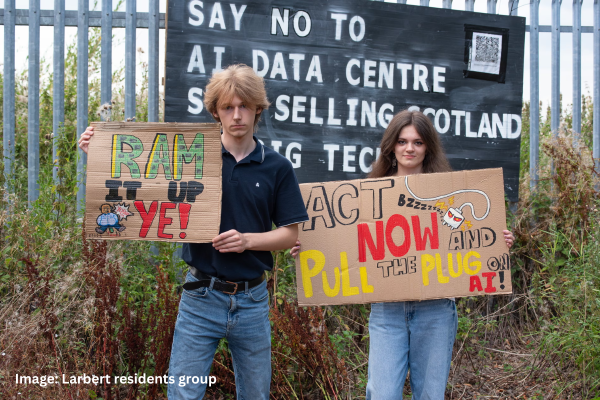
However, opposition to data centres has been mounting from Scottish communities, to the point where Police Scotland issued the first warning to a data-centre developer in Britain over security risks posed by protests.
This presents an opportunity that the SNP will find hard to pass up: appearing to stick up for Scotland against the Westminster establishment. However, as has been said, these centres promise much needed investment in the Scottish economy.
These two conflicting pressures explain the party’s flip-flopping on new data-centre plans.
Currently, a moratorium on new developments has been refused – but, under pressure Swinney has offered up a temporary pause until the question can be addressed in Holyrood after the summer break.
However, even a moratorium would not outright ban new data centres, with any potential loopholes set to just become a new flashpoint for lobbying.
The SNP have also offered up a new environmental assessment element in the approval of new data-centre plans – which, like the ‘greenports’ under Sturgeon, is nothing but a green coat of paint which chips off at the slightest scratch.
In fact, these new environmental impact assessments have so far been attached to just two schemes out of dozens in the pipeline: Auchtertool and Wester Hermiston.
Most scandalously, internal documents showed Apatura pressing ministers to adopt its own definition of what counts as a ‘green’ facility – the same sleight of hand behind an Edinburgh data centre’s claim to be ‘green’ despite plans for 200 diesel backup generators, which would produce the pollution equivalent of 100,000 idling cars.
Clearing the path
None of this – the subsidies, the planning approvals, the government’s insistence that AI infrastructure is unambiguously good for us – is happening by accident. These developments are a reflection of the underlying crisis of capitalism itself.
When a system based on private profit periodically accumulates more capital than it can profitably reinvest in production, that capital doesn’t sit idle; it goes hunting for any outlet which promises a return, however speculative.
This explains the billions making its way into the UK economy. The majority of this capital comes from – and returns to the pockets of – a few tech monopolies and billionaires in the US, after the UK sold off its only homegrown LLM developer, DeepMind, to Google in 2014.
But where speculative capital leads, the state follows – acting not as a planner for public need but as a broker clearing the path for all of this foreign monopoly capital. The end-product is the data-centre boom.

The lobbying prior to this boom is that clearing operation in action – and in Holyrood and in Westminster it has been relentless. Access to sitting politicians is cheap and largely unregulated, and then once they leave the halls of parliament those people who once set AI policy now walk directly into a comfortable role for those same companies.
Such cycles of lobbying ensures ‘our’ representatives serve capitalist interests over those of the workers who elect them – regardless of these politicians’ original intentions when they were elected.
As Lenin noted, the dictatorship of capital relies on both direct and indirect corruption of politicians.
This enmeshment between the state and the world’s tech monopolies cannot be reformed; it can only be overcome by abolishing the capitalist state, establishing a workers’ state, and putting key infrastructure and planning under the democratic control of those affected by them.