
“All my friends are talking about is the job search. It can be really soul-destroying when you study for so long and you don’t get anywhere,” a Cambridge University graduate told the BBC in February. Since then unemployment figures, particularly for young people, have continued to worsen.
Almost a million young people are not in employment, education, or training (NEET). An ongoing report compiled by Alan Milburn and commissioned by Keir Starmer estimates the economic cost of youth unemployment is £125 billion a year, and is a major factor in Britain’s “labour shortages, low growth, rising welfare costs and pressure on public services”.
The report states that one in six young people will be NEETs within the next five years at the current rate, risking a “lost generation” who are permanently out of work.
Many young people are desperate for work – forced to spend their days firing off hundreds of CVs and applications, and filling out convoluted AI-designed tests, only to hear nothing back.
And despite all of this, 60 percent of NEETs have never worked, and a similar percentage have given up looking for jobs, which simply aren’t there. Vacancies have fallen to a five-year low of 705,000 – on average two vacancies for every five jobseekers.
This is not a temporary or cyclical problem, either. The report uses the term “detachment” to describe youth inactivity. For the last 25 years, 10 percent or more of young people have been NEETs.
Milburn cites many reasons for this: new technology (particularly AI), the welfare state, mental ill-health, the education crisis, economic volatility. That all of these factors are occurring and converging at once, however, requires a deeper explanation. How did one of the richest capitalist countries get to this point?
View this post on Instagram
Who is to blame?
Milburn is at pains to say that youth unemployment is not due to personal failures: “I do not accept the caricature of a generation that is not interested in employment… Young people are not to blame.”
The UK boss of Amazon agrees that we need to stop blaming young people. While some sections of the capitalist class and their flunkies never miss a chance to blame the working class for the failures of their own system, the more serious strategists are becoming aware of how dire things are. They want to find a solution – both to curb the money spent on welfare, and to avoid the inevitable social consequences of a million angry, unemployed youth.
A chief economist at the Bank of England has pointed the finger at policies by the Starmer government, such as raising the minimum wage, and making employers pay higher National Insurance Contributions.
Alan Milburn – described by the New Statesman as “the epitome of Blairite centrism and moderation” – seems to agree with this diagnosis, writing in his report that “when the cost of entry-level labour rises, the case for taking on someone inexperienced becomes harder unless employers are given support to offset the risk.”
These supposed policy failures need to be understood in the context of the crisis of British capitalism. The government, under pressure from bond-market investors to be ‘fiscally responsible’, needs to somehow find the money to continue paying back its debts, while still plugging the gaps in Britain’s broken public services. This is part of the explanation for the increase in taxes on employers.
At the same time, the government is under pressure from the working class itself: many workers and households are struggling to even meet their basic needs, including food, housing, and utilities. Hence the small increases in the minimum wage that we have seen over the past few years.
But the result of Labour’s policies is that neither side is happy. Many employers already feel like Britain is not a good environment to do business in, given the stagnant state of the economy.
Higher wages and taxes will only add to the pressure on businesses – particularly small and medium-sized ones – to cut staff, reduce vacancies, and even close down or relocate altogether.
And as for the working class, these measures have only resulted in fewer jobs, more competition for those that are left, and more casualisation as a result. All the while, prices continue to rise faster than wages, thanks to the global economic turmoil.
And the worst part is that the Labour government hasn’t even been able to ‘balance the books’ to the level that the bond markets demand. The state is still saddled with debt, and the deficit has only budged incrementally. All the while, economic growth is effectively non-existent.
All stick, no carrot
So far, Milburn has only made two substantial proposals for how to tackle this crisis.
One is for the government to scrap their plans to flatten the minimum wage across different age groups. This essentially boils down to saying that young workers should continue to be paid less than their older counterparts.
Another suggestion is for ‘reform’ of (read: ‘attacks on’) the welfare state, to turn it into a “working state”, in Milburn’s words.
This would include potentially tightening up work capability assessments – in other words, forcing people with disabilities or mental illnesses into jobs, irrespective of the toll on their mental and physical health.
The author of the report argues that the government spends more money on keeping young people on benefits rather than encouraging them into work, for example through training schemes and (low-wage) apprenticeships.

But what good is training and ‘encouragement’ when there are clearly not enough jobs in the first place – let alone decent, well-paying ones?
Neither of these proposals address the real reason for the lack of jobs in Britain. They are nothing more than open calls for holding down young workers’ wages, cutting away at the welfare state, and forcing people into unsuitable work.
Meanwhile, Milburn and the other capitalist strategists remain silent on Britain’s massive lack of investment.
The capitalists are simply not investing and driving the economic growth that is required for more jobs to be created.
That isn’t because there isn’t work to be done – infrastructure is crumbling, and industry is on its knees – but because capitalists will only invest if they can be sure of making a profit, which is far from certain in the current climate.
If more workers are employed and more is produced, who will have the money to buy back consumer goods, given Britain’s reliance on low-paid work? And who is going to buy British exports, when Britain’s more-productive global competitors have already cornered the world market?
Permanent scarring
The blame for this mess lies with the capitalist system and those in charge of it. The extent of youth unemployment shows how useless and obsolete capitalism is today: it can’t even ensure a future workforce, or keep the existing workforce in work today.
Unemployment has always been a problem for capitalism, and exposes the lie that the market is the most rational and optimal way to organise labour.
But while in capitalism’s heyday, unemployment was cyclical – and often consciously maintained by the capitalists in order to hold down wages through competition – it is now becoming a permanent scar on a weak, shaky economy, and a drag upon public finances.
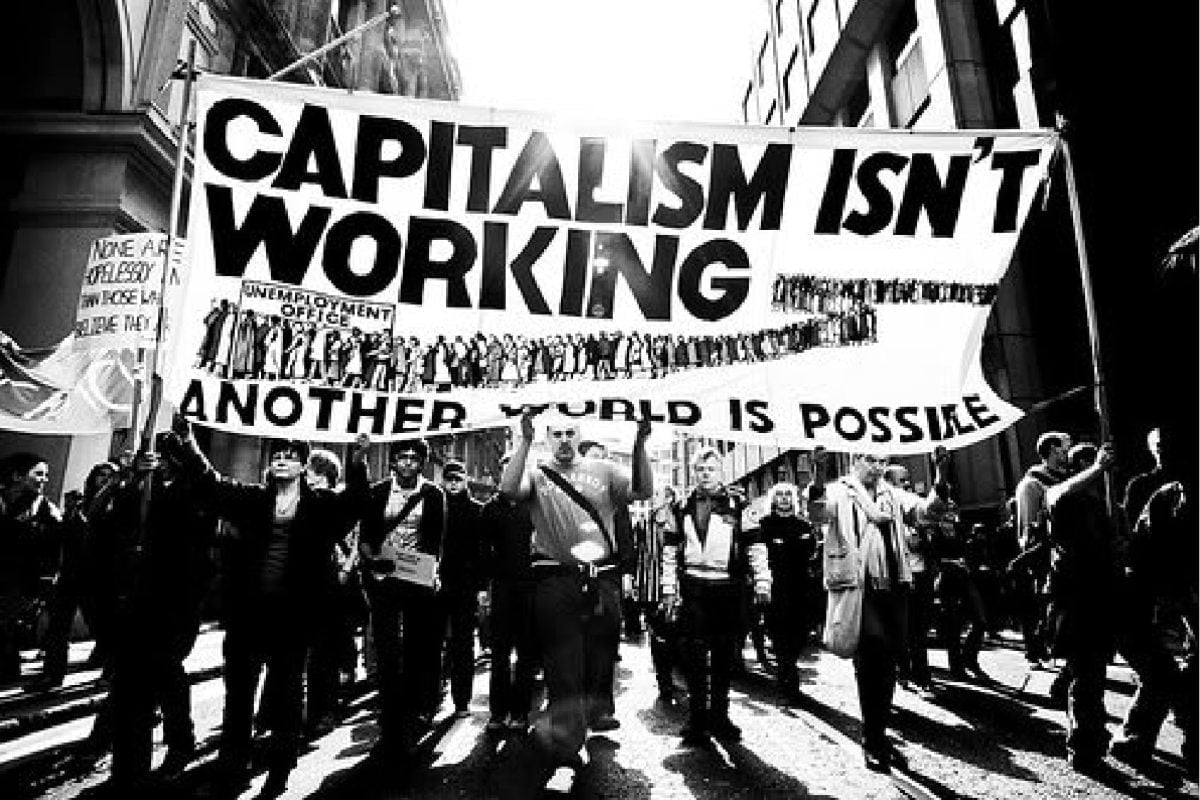
This weakness and scarring is acutely felt in Britain, which relies upon a casualised service economy.
In fact, low investment in productivity, and a turn away from manufacturing towards financialisation, were actively encouraged by the short-sighted policies of Margaret Thatcher and Tony Blair. Today’s politicians and strategists have been left to hopelessly heal the wounds made by their predecessors.
Today, the situation has never been so irrational. Secure, well-paid, meaningful jobs are dwindling; the working class is divided between those who are forced into economic inactivity due to burnout, injury, and sickness, and those forced to scramble for whatever work they can get. Everything feels broken, and young people feel hopeless. Meanwhile, obscene wealth is hoarded at the top of society, by the big banks and monopolies.
In the post-war period – when the capitalist system still had life left in it – full employment and a real living wage were seen as a given. But for British capitalism today, such moderate demands are an unachievable pipe-dream.
The leaders of the workers’ movement must refuse to accept this scrapping of our futures as inevitable. Higher wages, full employment, and safe, meaningful working is not unaffordable – capitalism is!