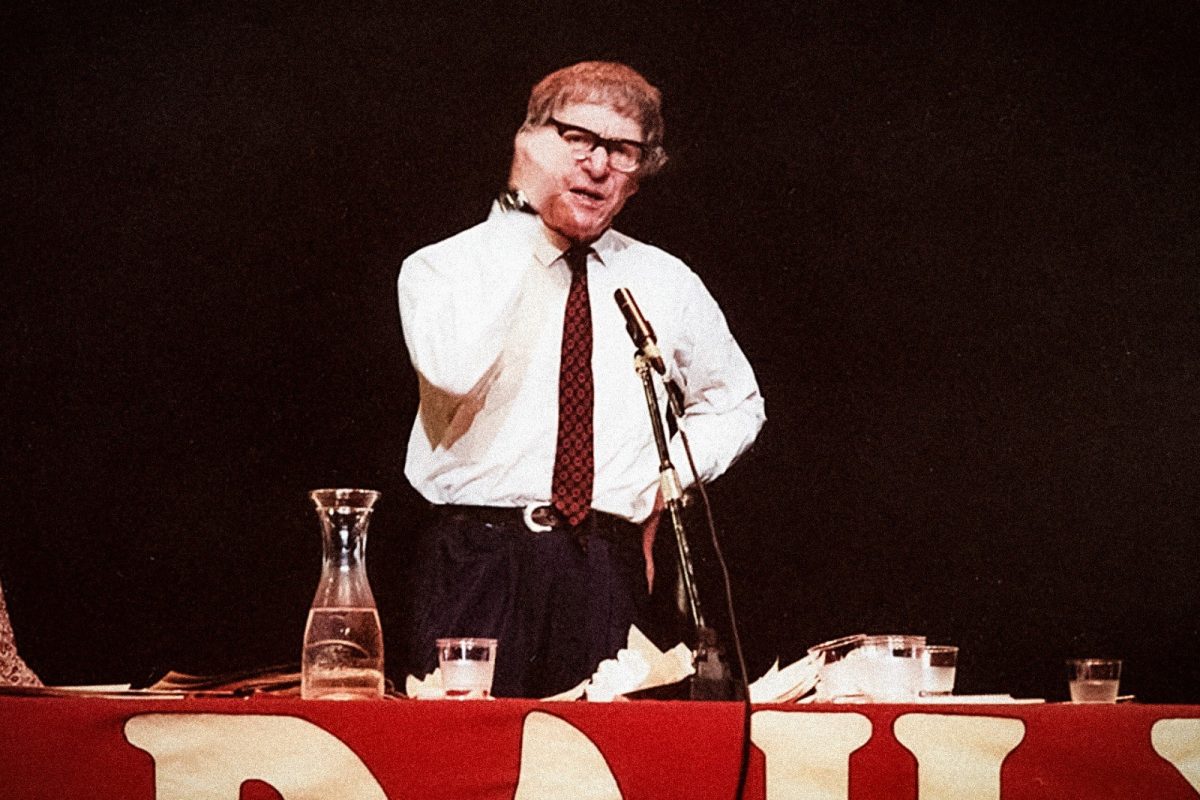
This month, on 20 July, marks the 20th anniversary of the death of Ted Grant, the founder of our organisation.
He was undoubtedly one of the greatest Marxist theoreticians of the 20th century. At every major turning point, he cut through the falsehoods of the capitalist apologists and their reformist shadows.
In 1960, in the midst of the postwar upswing, when everyone else was crowing that capitalism had now solved its problems, Ted wrote a reply called ‘Will there be a slump?’
In this article, Ted explained the reasons for the prolonged boom, and outlined the Marxist perspective that the capitalist system would again enter into a period of devastating crisis – a perspective that was fully born out in the years and decades that followed.
In honour of Ted’s life, legacy, and contribution to Marxist theory, we publish for our readers an extract from this marvellous work. The full version is available on the Ted Grant Internet Archive.
The prolonged upswing of British and world capitalism since the Second World War, in the areas where the capitalist system has been maintained, calls for an examination of the basic ideas of Marxism on the question of economic development. If there is a fundamental change in the working of the system, then it is necessary for Marxists to make a suitable reappraisal.
Marxism represents the concentrated analysis of the laws governing the development of society. In the field of economics, the laws underlying the development of capitalist society have been worked out and explained by Marx. Despite extension and deepening in the works of Lenin and Trotsky, these basic laws have remained fundamentally the same for more than a century.
Undoubtedly the economy, since the Second World War, has developed on somewhat different lines to those following the First World War. But every decade of capitalist development has tended to be different to every other decade. The basic laws underlying the development of capitalist economy have, however, remained intact.
Accumulation and overproduction
The world economy is beginning to move towards slump (or recession – a small slump that does not deepen into long-lasting depression – according to the definition of the capitalist economists).
Until recently, there has been quite a high rate of development of the economy in all the major capitalist countries, in fact largely throughout the capitalist world. This development in Western Europe and in many of the ‘undeveloped’ areas of the world is beginning to slow down. There are already signs in the fall of prices of shares on Wall Street – always a sensitive, if not always correct, barometer – that the economy of the United States may have its downswing in a deeper ‘recession’ or ‘slump’ soon.
At the same time, the huge investments in industry, the turn to mechanisation and automation, increase the amount of constant capital in proportion to variable capital – i.e. the capital invested in machinery, buildings, plant, etc, rises in proportion to the amount invested in wages. This must lead to a fall in the rate of profit. The present decline of investment is a reflection of the capitalists’ realisation of this tendency, even though they do not understand the reason for it.
However, these swings, up and down, are normal to the development of the trade cycle, at every phase of the development of capitalism. What has to be established is not the episodic differences, but whether there is a new element, such as the intervention of the state, which changes fundamentally the movement of the trade cycle from anything experienced by capitalism in the past.
The basic Marxist postulates, on this question, are that the exploitation of the working class by the capitalists means that the surplus value, created by the workers, is accumulated by the capitalists and then reinvested in industry.
The explanation of the development of the economy under these conditions is the division of the economy into ‘department 1’ (production of the means of production) and ‘department 2’ (production of the means of consumption).
The surplus produced by the working class, over and above its own subsistence is, apart from a small part consumed by the capitalists, ploughed back into production. The whole historic role of capitalism has been the development of the productive powers of society by the use of the surplus in capital construction. Hence the growth of production.
Competition between different capitals produced the need for ever greater productive equipment. This, in its turn, meant the gradual accumulation and concentration of capital in fewer and fewer hands. The continuous expansion of expenditure on constant capital (C), or means of production, in relation to the amount spent on variable capital or wages (V), in its turn produced the tendency of the rate of profit to fall.
This is confirmed in different language by all serious economists, including Keynes. Even the university professors, on studying the data, are compelled to admit the truth of this proposition for the modern epoch, even more than in the past.
The fundamental cause of crisis in capitalist society, a phenomenon peculiar to capitalist society alone, lies in the inevitable overproduction of both consumer and capital goods for the purposes of capitalist production.
There can be all sorts of secondary causes of crisis, particularly in a period of capitalist development: partial overproduction in only some industries; financial juggling on the stock exchange; inflationary swindles; disproportions in production; and a whole host of others. But the fundamental cause of crisis lies in overproduction. This in turn, is caused by the market economy, and the division of society into mutually conflicting classes.
Factors fuelling the upswing
It is true that the rate of growth in the period 1870-1914 was at a higher tempo than in the period between the wars. But that reflected the fact that the relatively progressive nature of capitalism had changed.
The world war of 1914-18 marked a definite stage in the development of capitalism. This was reflected in the impasse in which the private ownership of the means of production and the national state had landed society.
The economic upswing, following the Second World War, is due to a whole series of factors. There is nothing ‘unique’ in such an upswing.
Dealing with the trade cycle, the American National Bureau of Economic Research has prepared a table, dating back about a century. This table shows the peaks and troughs of economic activity in the United States in this period. To these could be added the peak of 1953, the trough of 1954, the peak of 1957, the trough of 1958, the peak of 1959-60, and the subsequent decline.
What then are the basic reasons for the developments of the post-WW2 economy?
- The political failure of the Stalinists and the social democrats, in Britain and Western Europe, created the political climate for a recovery of capitalism.
- The effects of the war, in the destruction of consumer and capital goods, created a big market (war has effects similar to, but deeper than, a slump in the destruction of capital). These effects, according to United Nations’ statisticians, only disappeared in 1958.
- The Marshall Plan and other economic aid assisted the recovery of Western Europe.
- The enormously increased investment in industry.
- The growth of new industries – plastics, aluminium, rockets, electronics, atomic energy, and by-products.
- The increasing output of the newer industries: chemicals, artificial fibres, synthetic rubber, plastics, rapid rise in light metals, aluminium, magnesium, electric household equipment, natural gas, electric energy, building activity.
- The enormous amounts of fictitious capital, created by the armaments expenditure, which amount to 10 percent of the national income in Britain and America.
- The new market for capital and engineering products, created by the weakening of imperialism in the undeveloped countries, which has given the local bourgeoisie the increased opportunity to develop industry on a greater scale than ever before.
- All these factors interact upon one another. The increased demand for raw materials, through the development of industry in the metropolitan countries in its turn, reacts on the undeveloped countries and vice-versa.
- The increasing trade, especially in capital goods and engineering products, between the capitalist countries, consequent on the increased economic investment, in its turn acts as a spur.
- The role of state intervention in stimulating economic activity.
All these factors explain the increase in production since the war. But the decisive factor has been the increased scope for capital investment, which is the main engine of capitalist development.
The relatively progressive role of capitalism between 1870 and 1914 consisted in the development of the productive forces, at a fairly rapid rate.
It is true that sufficient productive forces had been developed for the working class to take power – i.e. the material conditions for workers’ power had been created by the previous expansion of the productive forces under private ownership. Under workers’ power, the productive forces would then have developed faster. But nevertheless, so long as capitalism can develop the productive forces at a fast pace, it serves the need of progress and can maintain itself so long as it serves this purpose.
Since WW2, capitalism, in an uneven, contradictory fashion, has suffered such a period of ‘rebirth’. It is true that it is a temporary uplift of a rotten and diseased economy, reflecting the old age of capitalism rather than its resilient youth; that it shows all the feebleness of a decayed system. But even within the general decline of capitalism, such periods are inevitable so long as the working class, through faulty leadership, fails to end the system.
There is no such thing as a ‘last crisis’, a ‘last economic slump’ of capitalism, a ‘ceiling on production’, or any of the other primitive ideas put forward by the Stalinists during the great depression of 1929-1933. Nevertheless, the enfeeblement of capitalism is reflected in the revolutionary events following the Second World War.
Role of the state
From the viewpoint of Marxism, this economic revival of capitalism is not a negative phenomenon only. It enormously strengthens the numbers and cohesion of the working class, and of the position of the working class within the nation. The next break in the economic conjuncture will pose even greater problems in front of capitalism than in the past.
It is this economic revival, and not the role of government spending, or the increased role of the state, which is the main factor explaining the recessions or little slumps which have followed WW2.
Of course, the increased role of the state – with the end of laissez-faire – had already been pointed out by Marx and Engels. The tendency of the productive forces to outgrow the envelope of private ownership forces the state to intervene more and more in the ‘regulation’ of the economy.
Lenin, Bukharin, and Trotsky had shown the enormously increased role of the state, during and after WW1. In his last writings, Trotsky had reinforced the arguments on the increased economic role of the state.
The greatly increased role of the state was explained by the growth of productive forces, the concentration of capital, the growth of trusts, and the development of monopoly capital. All these developments had been summarised in Lenin’s Imperialism. There was a fusion of monopoly capital with the state which acted as the direct agent of big business.
The development of the economies in Western Europe, Japan, the United States, and Britain – with this or that national difference – all demonstrate the same phenomenon: the increase in capital investment, as the key to the economic upswing in the decade and a half following the Second World War.
Limits of reformism
It is true that the absolute standard of living has increased (overtime, women working, increased productivity of labour, bonus schemes, full employment, etc. would be the explanation). But the relative share of the working class has dropped.
So the ‘under-consumptionist’ idea that the capitalist crisis has been overcome by the increased share of the consumers is demonstrated to be palpably false. The share of the ‘consumers’, including the capitalists, has dropped from approximately 67 percent in 1938 to a little over 54 percent in 1957 of the total ‘cake’ of national production.
From the point of view of Marxism, in any case, a continuing rise in the share of national production by the working class, in itself, at a certain stage, would cause crisis and slump by cutting into the share of the national income going to the capitalists, thus over a period causing a fall in the rate of profit. This is so because it is only out of the surplus created by the workers that the capitalists find the wherewithal to invest.
The continuing technological progress, meanwhile, means that the capitalists are compelled to invest (in real terms, leaving aside the fall in the value of money) more and more in production for the purpose of competing on the national and international markets. Thus the explanation of the postwar period of ascent cannot be explained by the increase in the standard of living.
On the other hand, the statistics of national production, which, allowing for marginal errors, are an accurate description of the national economy from a capitalist point of view, demonstrate the shallowness of the theories of various Stalinists that it is the increased role of the state which has prevented another 1929. It is true that the role of the state has increased. But the statistics demonstrate the limits of this phenomenon.
In an epoch such as this, it is necessary for Marxists to have an answer to any tendencies – bourgeois, social-democratic, and revisionist (this is particularly necessary in the political climate created by the temporary upswing of capitalism).
A restatement of the fundamental Marxist doctrine on this question puts the whole problem in its proper perspective. There can never be a slump in an economy which is state-owned, as far as ‘the commanding heights of the economy’ are concerned, because it is then possible to plan production on the same lines as an individual factory. If mistakes are made, as in the plan of the Soviet bureaucracy, it is easy to overcome this by simple administrative decree.
Why cannot expenditure by the capitalist state solve the problems of the economy in a capitalist society? In an economy where private ownership is the dominant form of production, production remains for the market. All taxes must come from the economy itself: either they must come from the profits of the capitalists, or they must cut into the income of the working class. In either case, it cannot – over a period – prevent crisis.
To cut into the income of the capitalist would cut into the rate of profit. Money spent by the state, taken from the pockets of the capitalists, cannot be spent by the capitalists. Similarly, money extracted from the workers in taxes, for the benefit of the capitalists and their state, cuts into the market for consumer goods. Thus, either way, the state eats into the vitals of the economy.
The state in the modern period has become a monstrous incubus and parasitic burden on production. What the state gains on the swings, the capitalists lose on the roundabouts.
The worst thing from a capitalist point of view is for the state to cut into the profits of the capitalists. For that aggravates the crisis while 80 percent of the economy remains in the hands of private ‘enterprise’. That is why, as speedily as possible, the capitalists get their state to lessen the taxes on profits and especially the allowances for new investments. The Tory government (and the Labour government after them) systematically lessened the taxes in this way.
On the other hand the various Keynesian ‘solutions’ of this problem are basically unsound. If the state, by ‘deficit financing’, spends in effect money it does not possess, it means that there will be an inflation of the currency, and over a period it would amount to the above propositions on the distribution of the national income. The only difference being that crisis would be aggravated by the ruin of the currency.
The reason for this would be the inevitable rise of prices, other things being equal, to the same proportion as the increase of the money in circulation not backed by goods or money.
In other words, far from regarding the expenditure of the state as a saving grace and a blessing, the bourgeoisie is constantly groaning at the burden of the state (a necessary Old Man of the Sea it bears on its back).
An increase in state expenditure on police and army to defend the loot of the bourgeoisie, and social services necessary to keep the social demands of the masses in check, education, etc. etc., means less in the pockets of the capitalists themselves.
In fact, since the war, in proportion to total income and the increase in wealth, while armaments’ expenditure has enormously increased, there has been a neglect of the services, in real terms, which indirectly cater to the needs of the economy.
Capitalism’s coming collapse
The ‘excess capacity’ in industry in Britain is a symptom of overproduction of capital and the limits of the market. There have been a series of partial crises, affecting different sections of the economy in the past period, ‘excess capacity’ of capital, industry, consumer overproduction, overproduction of raw materials, food, etc. etc., at various stages and at different times.
It was only the simultaneous concatenation of all factors of crisis which led to the devastating depression of 1929-33.
The new recession bids to be far more serious and long-lasting than the last. The New York Stock Exchange is a harbinger of the coming collapse. The Financial Times of 30 January, 1960 in its editorial was already sounding the alarm:
“The disturbing feature in Wall Street’s behaviour is the talk of a new business recession…It is little more than a year since the USA was suffering from the effects of the last recession and another downturn in 1960 would be intolerable…On this side of the Atlantic the odds still appear against an early business downturn.”
Thus the ink had hardly dried on the prophecies of a new upswing before the first tremors of a new collapse were being reflected in the press. The capitalists themselves have too much at stake to have any optimism about the stability of capitalism.
Whatever the exact date, it is absolutely certain that the unprecedented postwar boom must be followed by a period of catastrophic downswing. This will have a profound effect on the political thinking of the enormously strengthened ranks of the labour movement.
Ted Grant: The permanent revolutionary
Alan Woods
In the field of theory, Ted was head and shoulders above any of his contemporaries. He was thoroughly grounded in Marxist theory and knew the works of Marx, Engels, Lenin, and Trotsky like the back of his hand. His admiration for that great revolutionary and martyr, Leon Trotsky, whom he habitually referred to as ‘the Old Man’ was boundless.
From a very early age, he was always a voracious reader. He always stressed the vital role of Marxist theory. He always insisted that young comrades should make a careful study of the works of the great Marxist teachers.
Whenever he had to write a theoretical work, Ted always first went back to the Marxist classics. You would often find Ted in his room, green pen in hand, completely absorbed in Anti-Dühring, State and Revolution, or something of the sort. This was in addition to The Financial Times, which was his daily bread.
A careful attitude to theory was the basis of all his work and the secret of his success. It explains how he was able to keep together a small group of loyal comrades in the dark and difficult years of capitalist upswing that followed the Second World War, when the forces of genuine Marxism were isolated for a whole historical period, reduced to a tiny handful of supporters in Liverpool, London, and South Wales.
We can learn a lot from Ted in this respect. He did not treat theory as if it were some fossil from a museum, but as a vital element in the equation, a compass that could show the way forward, a searchlight in the dark. He tried to teach us to approach it in the same way.
For my part, I took this lesson very much to heart. I consider it to be the first duty of every serious revolutionary to study theory. If this is not done, it is impossible to build serious cadres. At best, one will have half-trained people who are capable of mindlessly repeating undigested ideas and slogans. Such people can never think for themselves. That is quite dangerous for a Marxist tendency.
From Alan Woods’ biography of Ted Grant, ‘The Permanent Revolutionary’, available from Wellred Books.