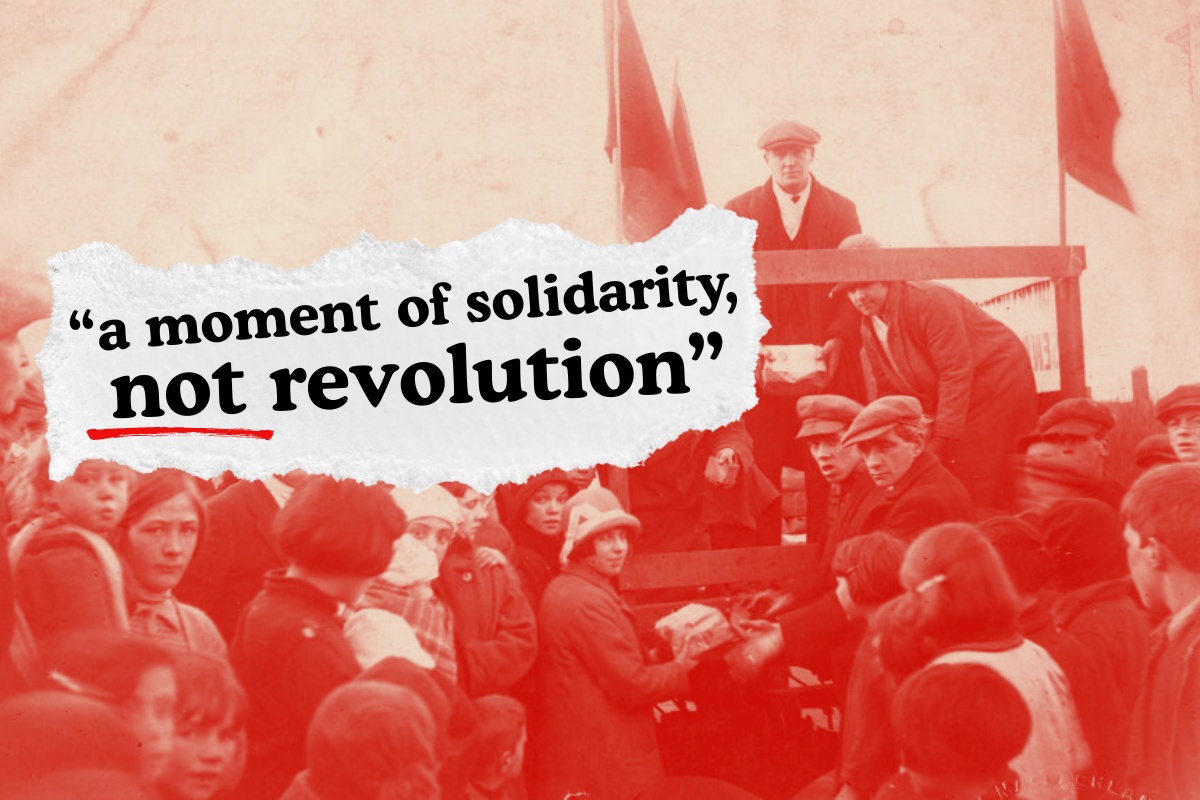
“As is only natural on a Saturday, the tension of the early days of the emergency is appreciably relaxed, and the holiday spirit has forced itself to the front”.
This was the spin BBC used in its evening address on 8 May – a quiet day with the government in control. Or so it said. In reality, the strike continued to grow in strength, and the government was getting desperate.
Prime Minister Baldwin gave the first emergency radio broadcast to the country. In his statement he said “I am a man of peace. I am longing and working, and praying for peace, but I will not surrender the safety and the security of the British Constitution”.
The Councils of Action pushed back against this mirage of peaceful negotiations. As the Oxford Workers Council put it: “IF YOU FEEL LIKE PRAYING, PRAY FOR THE VICTORY OF THE WORKERS, PRAY FOR BETTER CONDITIONS FOR THEIR WIVES & KIDDIES.”
In Plymouth, a football match was organised between the strikers and the police. The strikers beat the police 2-1, a score that was proudly displayed in the British Worker the following day. This was the kind of harmless activity the TUC encouraged from the pickets.
But across the country, the workers were moving beyond prayers and recreation. In Bristol, Fulham, Gravesend, and Darlington, electric power plant workers walked out. No buses or trams ran all day in Birmingham. Despite the government’s assurances that food supplies were being maintained, in Nuneaton there were severe shortages of fish, and in London a looming flour crisis, with just 48 hours supply left.
In a major escalation, a government convoy of 105 lorries defended by 16 armoured cars, mounted police, and cavalry left Hyde Park for the London docks. They aimed to unload some of the ships that had been docked there fully loaded for a week. The two-mile long convoy cut a path through central London.
When they reached the docks they were met by two battalions of guards and 500 volunteers that had arrived the previous day, occupying the docks to prevent the strikers from picketing. This was the reality of Baldwin’s ‘peace’ and ‘constitution’: military might and violent force to break the strike.
Despite the strike’s strengthening, the pressure of government propaganda was making an impact on one group of people more than any other: the TUC General Council.
The TUC had been sent the equivalent of £26,000 by the General Council of the Trades Union of Soviet Republics – a considerable sacrifice by Soviet workers to support the international struggle against capitalism. But the TUC, terrified of the label ‘Bolsheviks’, refused to accept the money.
In his radio address, Baldwin made the verifiably false claim that “my whole desire is to maintain the standard of living of every worker”. This lie was believed by no-one except, absurdly, members of the TUC General Council, like Arthur Pugh, Jimmy Thomas, and Ernest Bevin.
They now turned all their attention, not to building the power of the strike, but to negotiating with Sir Herbert Samuel – the government’s unofficial representative – to call off the strike. They met in secret and told no one of their treacherous plans.
In response to the government’s attacks, the General Council signalled its submissiveness: “There is, as far as the Trade Union Movement is concerned, no ‘attack on the community’. There is no ‘attempt to set up a rival Government’. There is no ‘challenge to the Constitution’. The workers have exercised their legal and long-established right of withholding their labour”.
By retreating to the limits of a narrow trade union dispute, the General Council was paving the way for the surrender to come.
Find more articles in our series ‘The 1926 General Strike as it happened’.