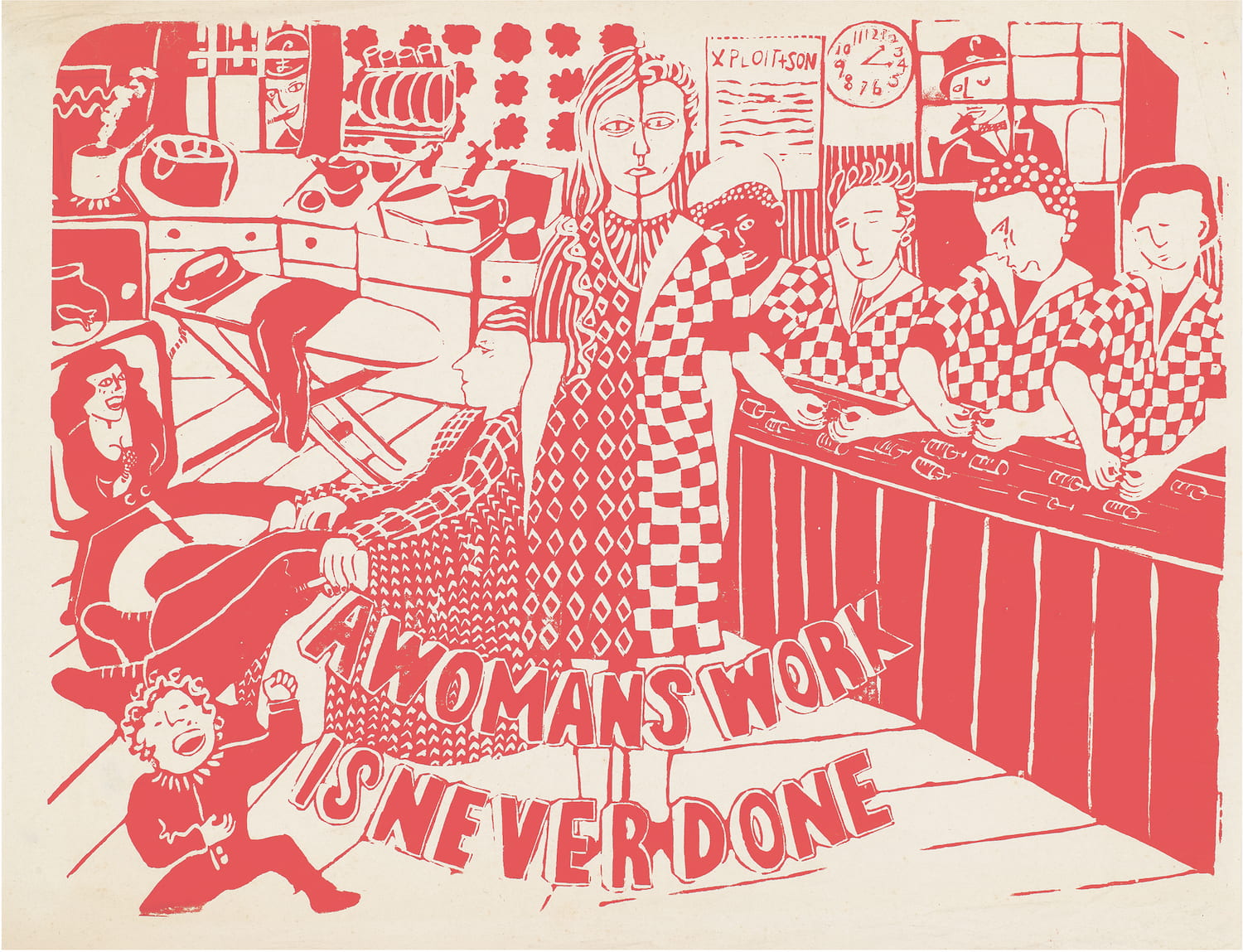

The communist movement has a proud legacy when it comes to fighting oppression, linking this struggle to the fight against class society itself. This is the tradition that International Working Women’s Day was based on, when it was first proposed in 1910.
The Marxist position on oppression is often attacked, however. One of those who slams Marxism is Silvia Federici. This article deals with the main points raised by Federici about women and the role they play in the family under capitalism, and defends the true revolutionary legacy of Marxism and its position on women.
Communism and oppression
“Life is beautiful. Let the future generations cleanse it of all evil, oppression and violence, and enjoy it to the full.” – Leon Trotsky
These words of Trotsky capture the essence of what communists fight for. For us, the fight against oppression has never been a secondary question.
Marx and Engels gave a scientific explanation of women’s oppression, tracing its roots to the emergence of private property and class divisions. They showed that the way to free women from subordination to men is through the fight against class society itself.
It was the socialist Clara Zetkin who proposed International Working Women’s Day in 1910. The aim was to link the fight for suffrage and democratic rights to the struggle against capitalism itself.
We come from the traditions of Bolshevism and the Russian Revolution, which began when women in the textile factories in Petrograd went out on strike on International Working Women’s day.
The Soviet state introduced full legal equality, equal pay, the right to abortion and divorce. It aimed at replacing private domestic labour through socialised childcare, communal kitchens, and public services.
Though civil war, economic backwardness and isolation prevented these plans from being fully realised, the revolution demonstrated what is possible once capitalism is overthrown.
Caliban and the Witch
Despite this proud track record, it is common to hear attacks on communists and the Marxist position on oppression – including claims that Marxists are ‘class reductionists’ who view the fight for women’s liberation as secondary.
Among the most prominent critics is Silvia Federici, who argues that Marxism fails to adequately explain women’s oppression and ignores women’s reproductive labour.
In her most famous work, Caliban and the Witch, Federici states that Marxists do not provide a satisfactory explanation of the roots of women’s social and economic exploitation under capitalism. According to her, capitalism intensified gender roles and deepened the division of labour between the sexes.
Caliban and the Witch focuses on the transition from feudalism to capitalism. She takes up Marx’s theory of primitive accumulation: the historical process involving the forcible creation of free labourers (i.e. proletarians, as opposed to serfs tied to the land) – a condition necessary for capitalist production.
According to Federici, Marx examined this only from the standpoint of the waged male proletariat and the development of commodity production. She, on the other hand, looks at the impact it had on women, their position in society and the production of labour power.
Federici claims that the introduction of capitalism created a new patriarchal order, based on the exclusion of women from waged work and their subordination to men, turning women into machines for reproduction of labour power.
To establish this new order, the ruling class used the witch-hunt to discipline women’s bodies, which Federici argued was as important to the development of capitalism as colonisation and the expropriation of the European peasantry.
Did Marx ignore women?
Federici’s assertion that Marx and Engels ignored women’s reproductive labour is simply false. In several of their writings they make the point that women were brought into the workforce, having a direct impact on the family.
In The Origins of the Family, Private Property and the State, Engels explained that during slave society in Ancient Greece, the monogamous family became the economic unit of society. The wife became the head servant, excluded from all participation in social production.
It was not until the introduction of the modern large scale industry that access to social production opened up for the proletarian women.
If she was tied to the household, however, she remained excluded from public production, unable to earn money. And if she did join the workforce, family duties had to suffer.
“The modern individual family is founded on the open or concealed domestic slavery of the wife,” Engels explained, “and modern society is a mass composed of these individual families as its molecules.”
Engels argued that women’s liberation required abolishing the family as an economic unit by socialising domestic labour: providing childcare, laundry, and canteens as public services.
Federici instead demands wages for housework, arguing that this would recognise domestic labour as “real work”.
Federici misunderstands how capitalism works and the role of the family within it. Part of what determines the wage of workers, like any other commodity, is the labour time necessary to produce and reproduce labour power.
“The value of labour-power was determined, not only by the labour-time necessary to maintain the individual adult labourer,” Marx explained, “but also by that necessary to maintain his family.”
It is in the capitalist’s interest to exploit workers as much as possible. If they could pay workers one penny for their labour-power, they would. But the problem is, workers would not survive – let alone reproduce themselves – on such a wage.
Wages are not determined mechanically, but are impacted by the class struggle. If discontent is building up due to worsening conditions and wages, the capitalists risk coming into conflict with their workers.
Capitalists therefore pay as little as they can get away with, which corresponds to what is necessary to reproduce the working class, i.e. for workers to maintain their families. It is therefore incorrect to claim that domestic labour is simply ‘unpaid’.
Wages for housework would further cement women’s isolation within the household. If the state were to provide benefits to compensate women for domestic labour, it would strengthen the idea that housework is inherently women’s responsibility.
Furthermore, the cost of the reproduction of labour would be covered by the state, which is funded mainly with the taxes of working people. Over time, capitalists would lower wages as a result, since the state would effectively be topping up the wages of working class families.
Communists are firmly in favour of women’s economic independence. But instead of raising slogans that would isolate women in the home, communists demand higher wages, equal pay, and better working conditions.
We fight for free education, childcare, social care, and health services; for better and affordable housing: demands that would materially improve women’s position and make them less economically dependent on men.
The Enlightenment and the witch-hunts
As a true postmodernist, Federici questions the progressive character of the Renaissance and the Enlightenment.
Federici thinks these represented a shift from an “organic” paradigm, rooted in spiritualism and animistic beliefs, to a mechanical worldview that legitimised the exploitation of women and nature.
She claims the emergence of the bourgeois state needed to combat pre-capitalist beliefs and practices, and argues that the Age of Reason served as a justification for disciplining women’s bodies and the workforce.
Federici argued that:
“The body had to die so that labour-power could live. What died was the concept of the body as a receptacle of magic power that had prevailed in the medieval world. In reality, it was destroyed. For the background of the new philosophy we find a vast initiative by the state, whereby what the philosophers classified as ‘irrational’ was branded a crime. This state intervention was a necessary ‘subtext’ of Mechanical Philosophy. ‘Knowledge’ can only become ‘power’ if it can enforce its prescriptions. This means that the mechanical body, the body machine, could not have become a model of social behaviour without the destruction by the state of a vast range of pre-capitalist beliefs, practices and social subjects whose existence contradicted the regulations of corporal behaviour promised by mechanical philosophy. This is why, at the peak of the ‘Age of Reason’ – the age of scepticism and methodical doubt – we have a ferocious attack on the body, well supported by many who subscribed to the new doctrine.”
She continues by saying: “This is how we must read the attack against witchcraft and against the magical view of the world which, despite the efforts of the church, had continued to prevail on a popular level though the middle ages.”
Federici describes the witch-hunt as a genocidal attack on women; as a tool to break their social power, destroy communal knowledge, and enforce new gender norms through terror.
She believes there is nothing progressive in the development of capitalism.
The problem with her argument is that witch-hunts began long before the Enlightenment. The witch-hunt took place during the period of feudal decline. The most active phase of the European witch trials took place between 1560 and 1630.
The state, which was deeply intertwined with the Church, a key pillar of the ruling class under feudalism, needed to cement their rule during a period of upheaval and crisis. Federici fails to point out that many of the revolutionary bourgeois philosophers during the Renaissance and the Enlightenment were themselves targeted by the church and the state, because they criticised the Church’s authority and their ideas contradicted what was said in the Bible.
In fact, it is during the period of the Enlightenment, beginning from about 1680, in which the rule of the bourgeoisie began to be established, that the witch-hunts started to decline.
Progress in history
Federici criticises Marx for arguing that capitalist development was historically necessary in preparing the conditions for human liberation. She writes that Marx would not have made such a claim had he examined history from the viewpoint of women.
To quote Federici directly:
“We cannot, therefore, identify capitalist accumulation with the liberation of workers, females or males, as many Marxists (among others) have done, or see the advent of capitalism as a moment of historical progress. On the contrary, capitalism has created more brutal and insidious forms of enslavement, as it has planted into the body of the proletariat deep divisions that served to intensify and conceal exploitation. It is in great part because of these imposed divisions – especially those between women and men – that capitalist accumulation continues to devastate life in every corner of the planet.”
Of course, capitalist society, just like all class societies before, bases itself on suppressing women.
What Marx did say was that with the incorporation of women in work, outside of the household, capitalism created the material basis for the liberation of women – not that this liberation would actually take place under capitalism.
Although capitalism can never liberate women, it once played a progressive role historically. Capitalism massively developed the productive forces, which created the resources and technology that could be used to completely free up women from domestic housework.

We judge something as progressive by whether it has moved society forward and developed the productive forces.
In this respect, capitalism – by creating an interconnected world economy, run by multinational monopolies, and kept going by the labour of the working class – has created the material conditions for socialism.
The resources now exist to completely eradicate hunger, poverty, inequality and scarcity. We have the capacity to produce enough food, housing, free education, and healthcare for everyone. The resources, the technology, and the science exist to do away with the drudgery of household chores.
What’s stopping us from this, under capitalism, is that workers are not in control of any of these colossal resources. It is a question of private property; of who owns the means of production.
The solution is to put the working class in power so that we can plan society according to our needs.
That does not mean that we deny human suffering throughout the history of capitalism. Marx said that capitalism was born “dripping from head to foot, from every pore, with blood and dirt.”
The point is to seek a correct understanding of why capitalism works the way it does, and to arm ourselves with a theory to change the world.
Could humanity have skipped capitalism?
Unfortunately, that is not what you get from reading Caliban and the Witch. The conclusion is that capitalism was not necessary, and that women had a comparatively better position in feudal society.
Federici argues that serfs had a more favourable class relation to the ruling class than workers have under capitalism.
Her argument is that serfs had their own plot of land, which gave them more independence from the landowners and a better position to struggle against them. She says female serfs were less dependent on male kin than women are under capitalism.
But oppression has been a constant feature of class society. Engels explained that the emergence of the patriarchal family, alongside the development of classes and private property represents the world historic defeat of the female sex:
“The man took command in the home; the woman was degraded and reduced to servitude, she became the slave of his lust and a mere instrument for the production of children.”
During early medieval Europe, the husband was legally considered head of the household. A woman’s legal identity was either tied to her father or husband.
Federici also devotes considerable attention to peasant revolts. According to her, widespread communal and egalitarian movements could have been successful alternatives to feudalism:
“The development of capitalism was not the only possible response to the crises of feudal power. Throughout Europe, vast communalistic social movements and rebellions against feudalism offered the promise of a new egalitarian society built on social equality and cooperation.”
Capitalism was the counterrevolution that crushed these alternatives.
Had the peasant revolts succeeded, she suggests, humanity might have avoided the immense destruction associated with capitalist development.

Throughout the Middle Ages, these uprisings expressed the dead end of feudalism and the discontent of the masses. Many groped towards communistic ideas, often under the guise of religious millenarism. But despite their struggle, the revolts ended in crushing defeats.
The reason why peasant revolts on their own could not do away with the feudal lords is due to their class position, which prevented them from having an independent role in social transformation.
It was not until the emergence of the capitalist class and the bourgeois revolutions that the feudal system was overthrown.
Most importantly, the material conditions for establishing a society free from oppression, class exploitation, and the state did not exist during feudalism.
To liberate humanity from the ills of class society, you have to erase the conditions that give rise to it in the first place.
It is vital to end scarcity, by rapidly developing the economy. The productivity of labour at the time was too low to allow for this. And the peasantry had no means to do so during feudalism, as they were completely tied to the land for their survival.
Critique of Marx
In A Feminist Critique of Marx, Federici continues to criticise the necessity of capitalism. She argues Marx must be wrong when he thought capitalism would lay the foundation for liberation through the development of the productive forces, because we now have developed machinery and industry, yet people are still oppressed.
To quote Federici herself:
“I suggest that Marx ignored women’s reproductive labor because he remained wedded to a technologistic concept of revolution, where freedom comes through the machine, where the increase in the productivity of labor is assumed to be the material foundation for communism, and where the capitalist organization of work is viewed as the highest model of historical rationality, held up for every other form of production, including the reproduction of the workforce. In other words, Marx failed to recognize the importance of reproductive work because he accepted the capitalist criteria for what constitutes work, and he believed that waged industrial work was the stage on which the battle for humanity’s emancipation would be played.”
Federici does not see the working class (by which she means only white male workers) as a revolutionary force. She thinks it’s impossible to fight oppression on a class basis.
Why is it that Marxists emphasise the role of the working class? It is because workers are the only class that has the power to threaten the capitalists’ profits by withholding their labour power.
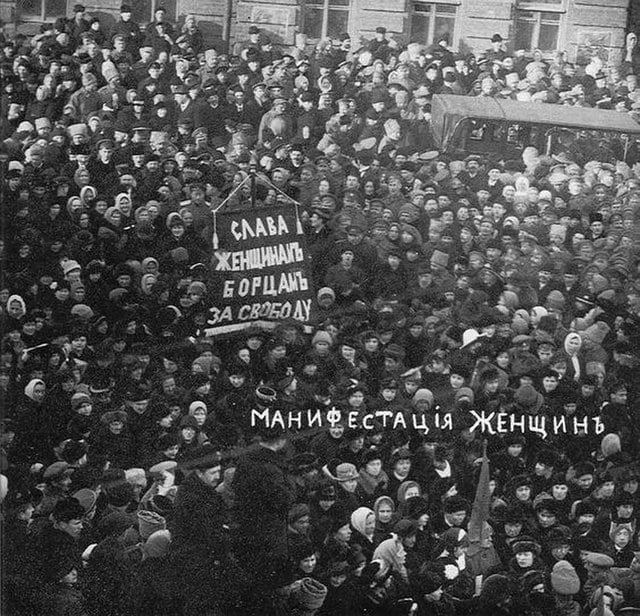
We have seen throughout history – from the Paris Commune in 1871, to the 1917 Russian Revolution, to the general strike in Italy last year – that, when the working class decides to mobilise, it is a force to be reckoned with.
Through their position in society, workers develop a collective consciousness. The only way workers can fight for better conditions and wages is by organising together. And because they keep society running, they are also the class that, through revolution, can take power and run the economy for their own needs.
Capitalism, through the development of the working class and large scale industry, has created this force – the gravediggers that can end class society once and for all.
Working-class women
Federici is incapable of understanding the role working-class women play under capitalism. She argues that women’s entry into wage labour has only produced “double oppression”, and concludes that fighting for waged work cannot be a path to liberation.
Federici says women being drawn into the workforce has not solved oppression, because women are still paid less than men – who she implies have an interest in maintaining oppression, as it benefits them both at work and in the household:
“First, fighting for waged work or fighting to ‘join the working class in the workplace’, as some Marxist feminists liked to put it, cannot be a path to liberation. Wage employment may be a necessity but it cannot be a coherent political strategy. As long as reproductive work is devalued, as long as it is considered a private matter and women’s responsibility, women will always confront capital and the state with less power than men, and in conditions of extreme social and economic vulnerability.”
Her solution is to “reclaim control over the material conditions of reproduction” and create new forms of cooperation around this work “outside the logic of capital and the market”. She argues that this process has already begun through land occupations, urban farming, community-supported agriculture, squats, barter systems, mutual aid networks, and alternative healthcare initiatives:
“A new economy is beginning to emerge that may turn reproductive work from a stifling, discriminating activity into the most liberating and creative ground of experimentation in human relations.”
The sort of activism she suggests is not new, and has never amounted to anything more than fringe activity by middle-class do-gooders. It is utopian to believe that it is possible to build an alternative to the family and end oppression without a social revolution, or without organising the working class as a whole.
Secondly, working-class men do not benefit from women’s oppression. Oppression is a tool used by the ruling class to hold down wages and conditions across the entire working class. It is in the capitalists’ interest to keep women’s wages lower, as this increases exploitation overall. Having sections of the workforce paid less allows capitalists to pressure all workers to accept worse conditions under the threat of replacement.
Oppression is the main tool dividing the working class, by encouraging workers to see one another as their enemy, rather than the capitalist system. Working-class men therefore have far more to gain from fighting for equality than from maintaining oppression.
Class struggle
Women’s integration into the working class is a profoundly progressive development, as it strengthens their position in society. It is through the united struggle of the entire working class – with women often playing leading roles – that reforms have historically been won.
Today, most women in the West are formally equal to men under the law. They have the right to vote, to divorce, to abortion, and to raise children independently. Through earning wages, women have gained a degree of economic independence. The expansion of public services has partially socialised aspects of domestic labour.
All of this has, to some extent, eased women’s oppression under capitalism.
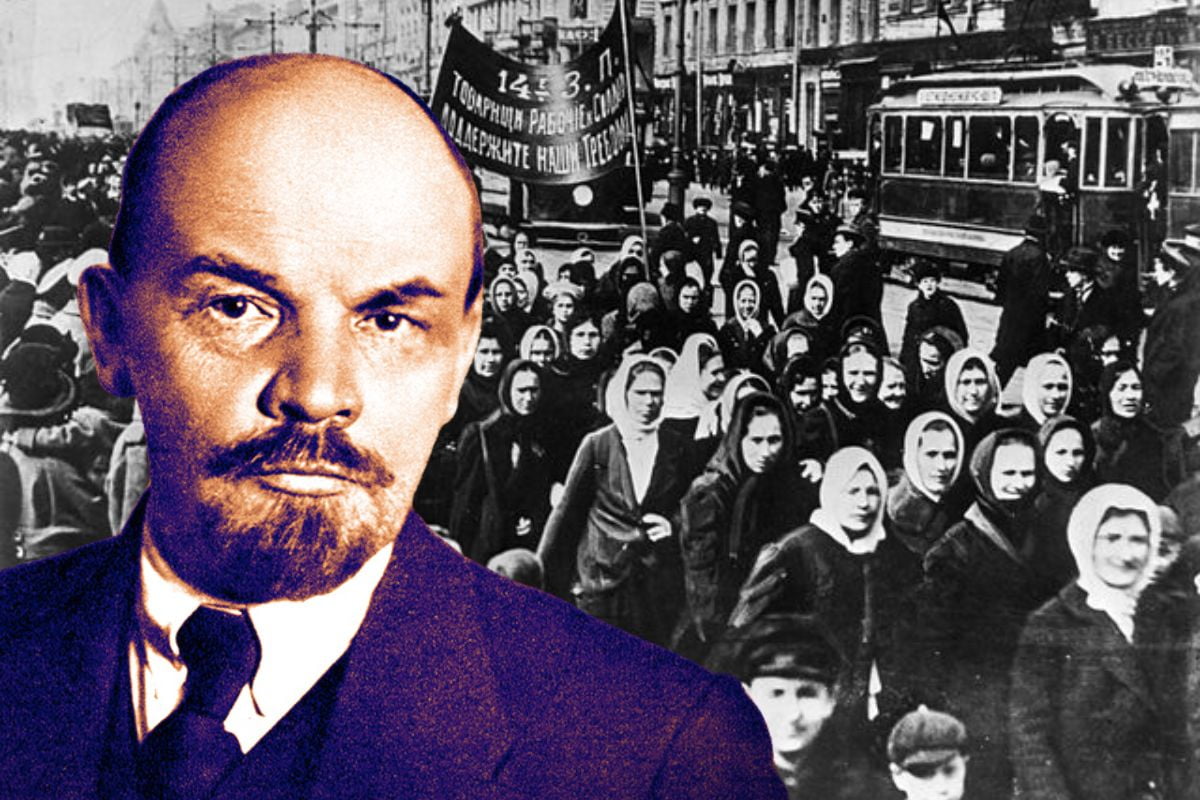
This progress has nothing to do with capitalist ideology or so-called ‘western values’. It is rooted in material developments and class struggle.
Between 1914-18, nearly two million women entered the workforce in Britain. This dramatically strengthened women’s social position.
It was no coincidence that the wave of revolutionary upheaval following the Russian Revolution pressured capitalist governments to grant concessions, including women’s suffrage.
Public services and the welfare state were not gifts from capitalists – they were concessions forced by immense pressure from a working class radicalised by war and hardship. In the years following the Second World War, Britain experienced significant strike waves that shook the nation.
To channel this social unrest into safe avenues, the ruling class conceded reforms. They were able to do so because of the postwar economic boom. In fact, expanding the welfare state partially served capitalist interests, as it freed up more women to become workers that could be exploited.
The changing social attitudes toward women reflect these shifts in material conditions.
This directly refutes Federici’s dismissal of the development of the productive forces. It is precisely in those countries where the productive forces have developed the most, and where welfare systems expanded most significantly, that women have seen the greatest improvements.
Under capitalism, gains are never secure, especially during periods of crisis. We have seen how the ruling class uses toxic culture wars to deflect workers’ dissatisfaction with the system.
In recent years, democratic rights such as access to abortion have come under renewed attack. Unlike earlier periods when capital had room to grant concessions, today meaningful reforms that would substantially improve workers’ lives are off the table.
As the welfare state is eroded, women are disproportionately affected. They make up the majority of workers in public sector jobs facing cuts, and they bear increased burdens in the home as public services are withdrawn.
History demonstrates, contrary to Federici’s argument, that united class struggle is the most powerful method both for winning reforms and, ultimately, for abolishing oppression, exploitation, and misery altogether.
That is why it is so important to reclaim the revolutionary history of International Working Women’s Day, and to follow the example of the Russian working women who initiated the Russian Revolution.
Unlike Federici, who tends to portray working women as victims, we see them as class fighters – who will play an instrumental role in the struggle for communism.