The British state is one of the oldest in the world. Some of its institutions have survived over a thousand years, having weathered the storms of many dramatic social, political, and economic upheavals.
This gives the impression that the current setup has always existed, and that today’s status quo will go on for eternity – an impression that the ruling class actively seeks to reinforce. But, in reality, nothing lasts forever.
In recent decades, there has been a steady decline in the moral authority of the state – undermined not only by scandal after scandal, but by its inability to uphold a rigged, rotten system that works against the majority of people.
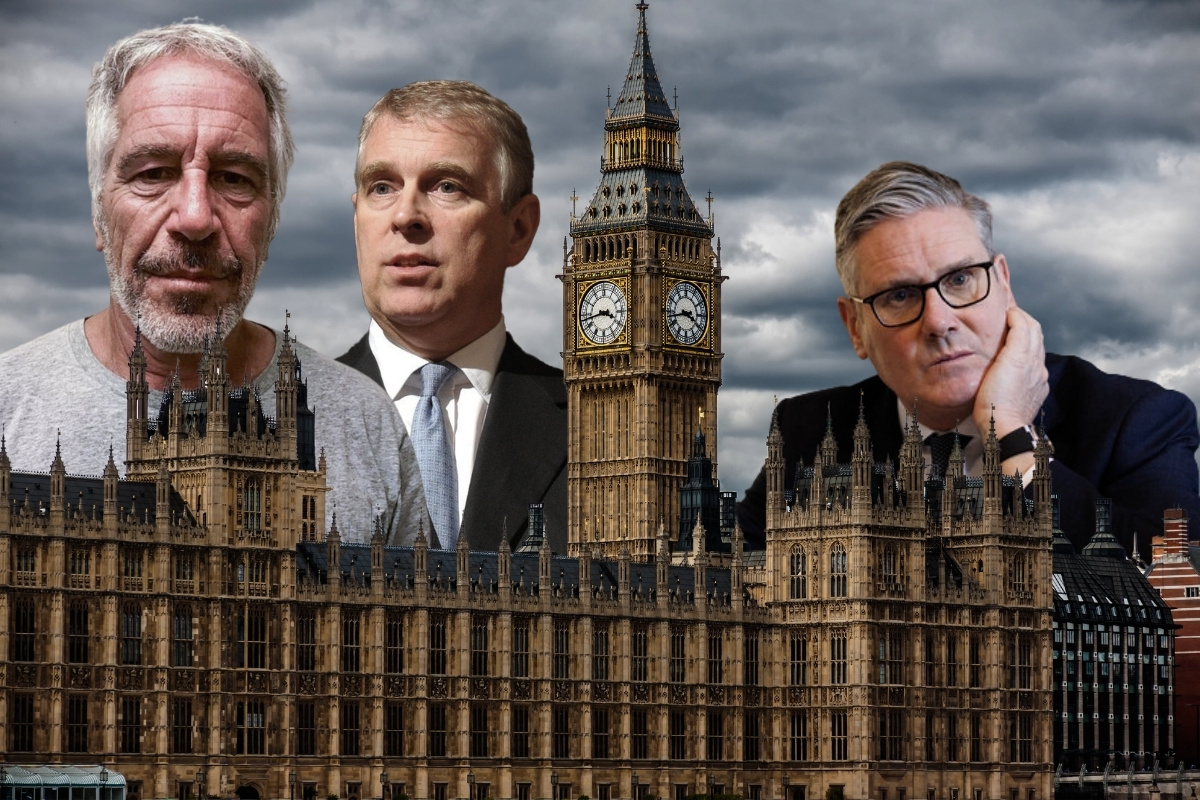
And in the midst of all this – when public trust in the establishment was already paper-thin – dropped the Epstein files, revealing perhaps the biggest scandal in the history of capitalism.
This scandal has engulfed every pillar of the capitalist state; every instrument by which the ruling class rules – placing all of these under the microscope, at a time when the discontent in society is already sky-high.
The corruption and depravity of the whole system has been laid bare by the Epstein files: the capitalists’ cover-ups; the government’s lies; the monarchy’s protection of (former prince) Andrew; the BBC’s silence; and the entire ‘justice’ system turning a blind eye.
All of these bodies are now dragging each other down. The Epstein scandal links these institutions together in people’s minds – not as separate aspects of society, but as an interconnected capitalist web: designed to entrap the poor and vulnerable, whilst protecting the rich and powerful.
Them and us
The anger unleashed against the Epstein class has not come out of thin air. Rather, this scandal has fallen on fertile ground when it comes to public frustration and indignation.
Capitalism is in a deep crisis. Skyrocketing living costs; layoffs; instability and uncertainty when it comes to making ends meet: this is the dire reality facing the working class and youth in Britain.
The job of the state, in essence, is to manage this decline on behalf of the capitalists; to keep a lid on the explosive pressures fomenting in the depths of society.
But as the pillars of the state disgrace themselves and go into crisis, the institutions and officials tasked with this role are finding it increasingly difficult to fulfil their duties.
On the one hand, then, the Epstein scandal has served to sharpen the ‘us vs them’ mood in society – clarifying in ordinary people’s minds exactly who falls into each camp.
On the other hand, the revelations surrounding Epstein and his associates confirm what many people already felt: that there is a cabal of politicians and powerful people who make the laws, yet are who themselves above them; that these institutions are not neutral or on our side.
For many, perhaps millions, therefore, this scandal is stripping away the mystical shroud that covers the state, revealing its true class character and purpose: to serve the interests of the billionaires; to protect the profits, property, and privileges of those at the top.
The monarchy
Most notably, the Epstein scandal has had a profound impact on the British monarchy.
The ruling class tries hard to keep this decrepit institution out of the spotlight (except when some royal pageantry is required as a convenient distraction). But the connections between Epstein and Andrew have put the Crown well and truly in the public eye.
There has been a slow, long-term decline in support for the monarchy for some time. Anger over Buckingham Palace’s treatment of Diana and Meghan accelerated this.
Nevertheless, until recently, the image of the Royal Family had taken fewer hits than other pillars of the British establishment.
Because it had more to lose, public approval for the monarchy is now experiencing a sharper downturn than any other state institution. For the first time, support for the royals has slipped below 50 percent – currently sitting at 47 percent, down seven percentage points since November 2025.
Significantly, 40 percent of Gen Zs think Britain would be better off without the monarchy – double the proportion that think we are better off with it. In other words, millions of young people are now open to the abolition of an institution that predates capitalism itself.
Given how interwoven the monarchy is with British capitalism, it is no great leap to go from contemplating this – a world without kings and queens – to imagining a world without billionaires and landlords.
Law enforcement
Given the recent wave of police scandals – from the murders of Chris Kaba and Sarah Everard, to the spycops inquiry and the mass arrests of peaceful Palestine protestors – it is no surprise that the reputation of Britain’s law enforcement agencies has fared little better.
Anger against the police has been further fuelled by international movements such as Black Lives Matter, which helped expose to millions the true nature of capitalism’s ‘boys in blue’.
In 2024, polls in Britain showed that trust in the police stood at just 40 percent, with the Metropolitan Police even lower, at 34 percent.
The Epstein scandal has poured petrol on these flames, with revelations that Met officers guarded dinner parties for Andrew and Epstein.
Voir cette publication sur Instagram
UK border security has also been implicated. This arm of the state is responsible for conducting checks on private planes entering and leaving UK airports. Yet there are records of 87 flights in which Epstein transported unnamed, unidentified women as passengers.
In other words, these authorities looked away and allowed women to be trafficked – effectively acting on behalf of Epstein’s billionaire grooming gang. No doubt they were too busy implementing racist controls against immigrants instead.
Not a single law enforcement agency in Britain can claim to have played any role in releasing the Epstein files or exposing his criminal network. They all did nothing.
What greater indictment of the British justice system could there be than decades of wilful inaction and refusal to investigate the plutocrats, princes, and politicians of the Epstein class.
Parliament
In the 1980s, around 12 percent of people in Britain said they never trusted governments of any party. By 2000, that figure had risen to 25 percent, and by 2010, 35 percent. So far in the 2020s, this number has been hovering at around 45 percent.
This has clearly been the direction of travel for decades. Years of scandal and sleaze – MPs’ expenses, lobbying, revolving doors, the prosecution of Post Office employees, dodgy Covid contracts – have steadily undermined the authority of the entire Westminster establishment.
This has all come to a head under Starmer’s premiership, with the Epstein scandal again acting as a catalyst, stoking distrust – and even outright hatred – towards Parliament.
Following the 2024 general election, the Labour leader enjoyed no honeymoon with the British public. Instead, the Prime Minister faced crises early on over the cost of living and planned welfare cuts. And he has never recovered since.
The ongoing saga around Mandelson – and his links to Epstein – has ensured that Starmer’s government remains in a permanent state of crisis, from which it cannot escape.
Over half of voters believe that Starmer should resign. And at its nadir, his net favourability rating reached a record low for a sitting PM, at minus 66 percent.
It is only a matter of time before Starmer goes, opening up an even more turbulent chapter in British politics. But no matter who replaces him, it is clear that the integrity and credibility of Parliament has been shattered and will not be revived.
Revolutionary implications
In periods of stability, the ruling class is able to govern through consent. People have confidence in the institutions of bourgeois democracy and the state – including Parliament, the police, and the courts – and are willing to accept their decisions.
In such ‘normal’ times, those in charge are able to present themselves as being a cut above the rest of us: responsible and respected; capable of managing the country’s affairs and looking out for the so-called ‘national interest’.
But those days are long gone. We are living in a new normal – one in which all these old illusions are being burnt away by events. In the eyes of millions, the establishment is losing its authority; its right to rule.
This is a necessary precondition for future revolutionary developments. The masses must lose any faith in the old order and question the status quo before seeking to build society anew.
Such sentiments and yearnings require a clear political expression, however: a class programme and Marxist perspective that ties all this together; that sharpens and nurtures this ‘us vs them’ attitude; and that guides these feelings towards the correct – revolutionary – conclusions.
Providing such a voice is the task of the revolutionary party.
On this basis, the Epstein scandal could prove to be the spark for a historic transformation in consciousness – and, in turn, for titanic social explosions, in Britain and internationally.
Letter: “They are all involved, every single one of them!”
On the drive to work, my dad and I were listening to the radio. A story began to play about Jeffrey Epstein and a house in London that had been used for sex trafficking, one of many in an extensive network that stretched Europe.
And what was the response of the Met Police? To actively ignore one of the victims’ allegations of having been trafficked to London – an allegation which was reported all the way back in 2015.
According to the BBC, the Met had plenty of opportunities to open an inquiry into Epstein’s activities in the UK, and knew of one property rented out by Epstein (one of four!), which was overcrowded with young women. He paid the rent, which he saw as a loan that needed to be paid back.
When one victim complained about the living conditions he swore at her, called her “rude” and said she had “disgusting behaviour”, telling her that she was a “brat who has yet to accept responsibility”.
According to the Met, the police had followed all “reasonable lines of inquiry” at the time, but decided not to investigate further due to “no allegation of criminal conduct being made against any UK-based individual”.
On hearing this, my dad grew furious. “That’s disgusting, that means the Met are implicated in prostitution!”. I pushed it further, and said “it really makes you think, who does the police really serve?”. He responded “Yeah! They are all involved, every single one of them. From the PM to that dickhead Andrew!”
As long as the Epstein scandal goes on, it will continue to expose the fact that it is not just individuals but whole institutions that are involved in this. And that will have massive effects upon consciousness.
Michael Stubbs, Reading