This article is the seventh instalment of our 12-part series ‘The Hungarian Revolution: 70 years on’.
Amongst revolutionaries, the Paris Commune of 1871 is often cited as the prime example of workers rising to power, retaining it briefly, then losing it and suffering counter-revolutionary violence. Studying such examples teaches us about the revolutionary process, and has lessons for today.
The oft-forgotten revolution in Hungary in 1919 trod a similar path, and etched revolution into the collective Hungarian consciousness 37 years before the revolution of 1956.
On 21 March 1919, the Hungarian Soviet Republic was declared. Power passed into the hands of the working class. This would last only 133 days before the revolution succumbed to the counter-revolutionary White Army. It is a tale of heroism from the masses, and mistakes by the leadership.
War and revolution
At the turn of the century the Hungarian masses had tough living and working conditions. Within the Austro-Hungarian Empire, Hungary was by far the more rural, less industrially-developed half of the two core nations. The working class was small and seemingly weak, with half of industrial workers concentrated in the capital, Budapest.
The effect of the 1917 Russian Revolution on Hungary was dramatic. The First World War was the main motorforce of anger and discontent amongst the masses, but it was the inspiration of the Russian Revolution, and in particular Trotsky’s anti-war agitation at the Brest-Litovsk peace negotiations, that spurred the Hungarian workers into action.
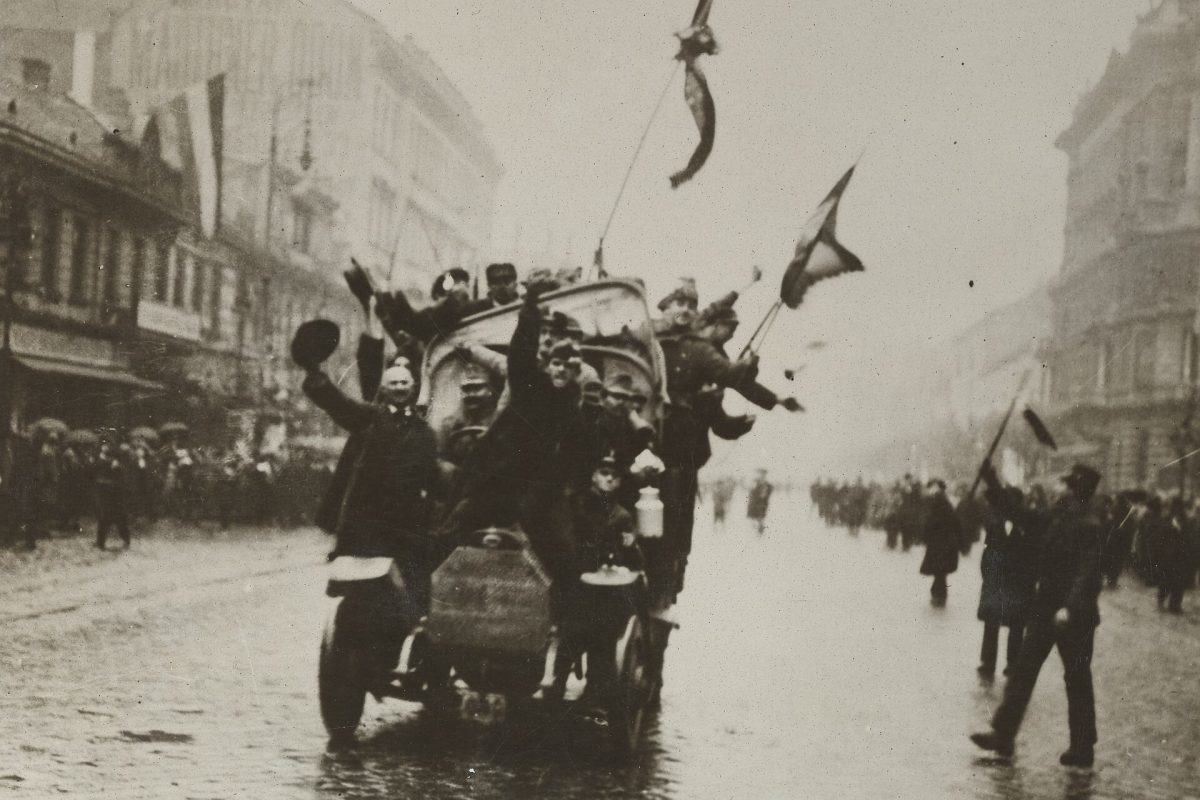
From January to October 1918, strikes and mass meetings spread, not only through Hungary, but across Austria and Germany too. Concession after concession was granted by the ruling class in an attempt to appease the masses and calm the movement down. But this was a time of revolution. Concessions only spurred the movement on, teaching the masses their own strength.
It was the apparently weak Hungarian proletariat that became one of the driving forces behind the revolutionary movement which overthrew the existing political order in October 1918 and paved the way for Hungary’s independence from Austria.
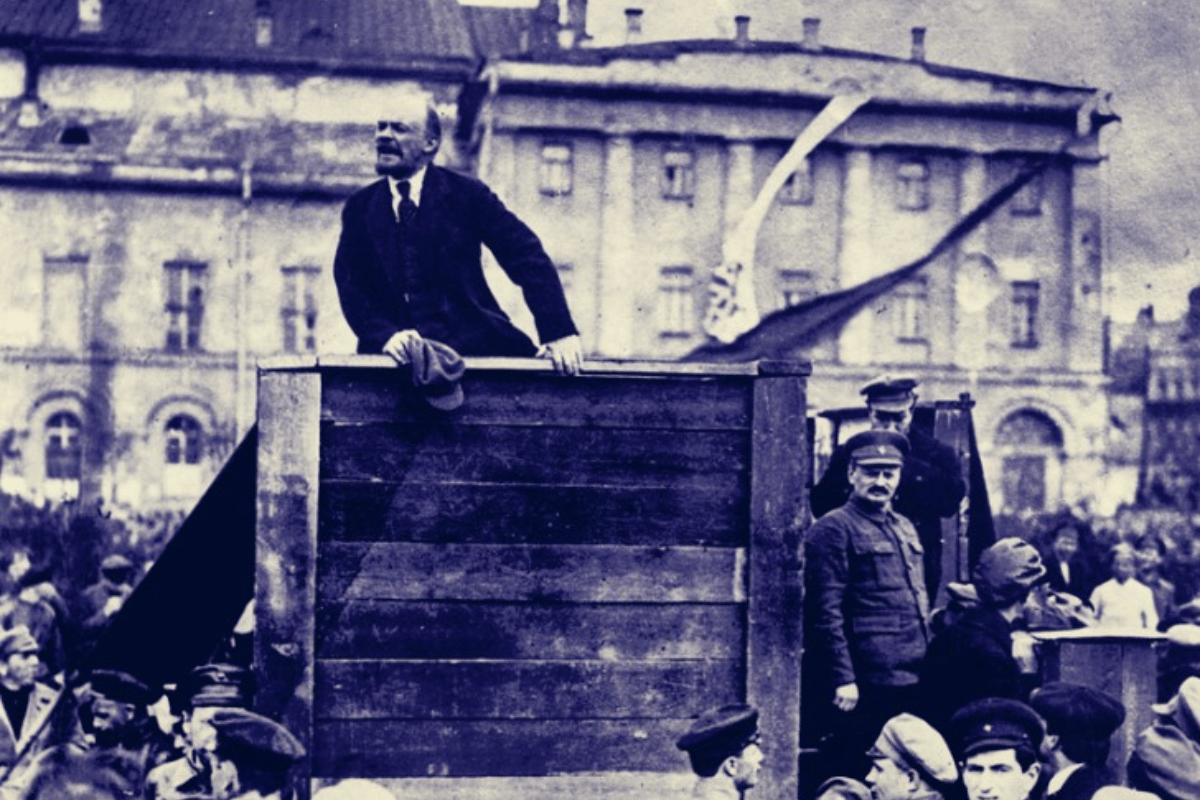
But it was not the workers who took power. The new masters of Hungary were the weak, liberal, Hungarian bourgeoisie, who had no answers to any of the problems facing the masses.
Hungary was riddled with a complex national question. Various minority groups had been oppressed for a long time by the Hungarian ruling class, in a bid to divide and rule the masses. This oppression could not be disentangled under capitalism, even under the liberal bourgeoisie, because they too relied upon it to maintain their rule.
Nor could the problem of land ownership be solved by the liberal bourgeoisie. The land was concentrated into a few large estates owned by aristocratic families. A capitalist government was unable to oppose the large landowners because they were completely interconnected with the industrialists and bankers. They wielded enormous power.
It became clear very quickly that only the workers and peasants themselves would be able to solve the issues.
These masses had toppled governments and gained independence. They were willing and able to continue their advance, this time against the liberal bourgeoisie, until they held power. The decisive question was whether they could find adequate leaders for the struggle.
The workers’ leaders
The Hungarian Social Democratic Party (SDP) was a substantial political force by 1918. It was the largest and best-organised party of the working class. Its leaders found themselves a reference point for the masses.
However, the leaders of this party had no perspective of revolution, or of the masses actually taking power. In fact, they were terrified of the power of the working class, and consistently made every attempt to halt the march of the working class by, for example, calling off strikes when they went ‘too far’.
The SDP had a theory of ‘stagism’, believing a period of capitalism was necessary to pave the way for socialism. In practice, this meant fighting the real instincts and desires of the working class, and holding them back at every stage.
Amongst the workers, the main organised opposition to the SDP was the young Hungarian Communist Party (CP), founded in November 1918, inspired by the Russian Revolution. Its members were eager and devoted, but theoretically untrained and prone to error.
As the working class became more militant and revolutionary sentiment intensified, the CP grew quickly, despite having poorly worked-out positions on a number of questions, including the complicated issues of land and national minorities.
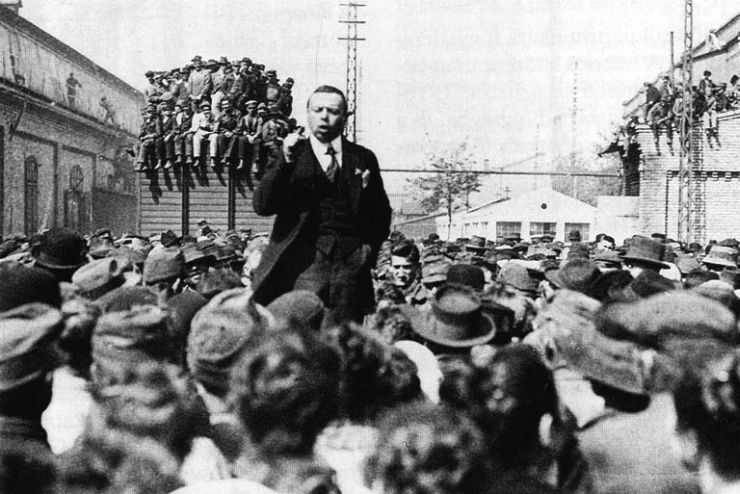
The old SDP leaders feared the growth of this revolutionary young party. Many among the ranks of the SDP were defecting to the CP, including local garrisons formed in the preceding years of struggle. The entire Youth League of the SDP joined the CP en bloc in December 1918.
Throughout late 1918 and early 1919, workers’ control of workplaces and neighbourhoods arose spontaneously. The masses were asserting themselves more and more. Things were slipping out of the control of the SDP leaders. They decided to act against the communists to try to stem the tide.
Having entered the government as part of a bourgeois liberal coalition in October 1918, the SDP leaders used the state apparatus to arrest the leader of the CP, Béla Kun, as well as other high-ranking communists.
This did nothing to stop the revolutionary wave or support for the CP. In fact, it had the opposite effect. Mass strikes erupted demanding the release of Béla Kun and his comrades.
The Hungarian Soviet Republic
The Hungarian state was on the verge of collapse. The bourgeois coalition government had run out of road. The victory of the revolution seemed sure, and the SDP was becoming more hated by the day.
What happened next has no precedent anywhere else in history. The SDP leaders went to the prisons to negotiate with their own prisoner, Béla Kun, to ask him for support in exchange for the release of him and his comrades. When this was refused, the SDP went further and proposed a merger of the CP and SDP into a government which would establish the Hungarian Soviet Republic.
This was a ploy by the SDP leaders to try to keep some control over the revolutionary situation, so as to be able to diffuse it later down the line. But Béla Kun failed to see this, and made the mistake of accepting their merger proposal.
The prisoners were released and took their seats of power alongside their erstwhile captors. Thus began the Hungarian Soviet Republic. Power was simply handed over to the workers’ parties by a bourgeoisie that openly admitted it had nothing to offer, and left the stage quietly.
Communist Party mistakes
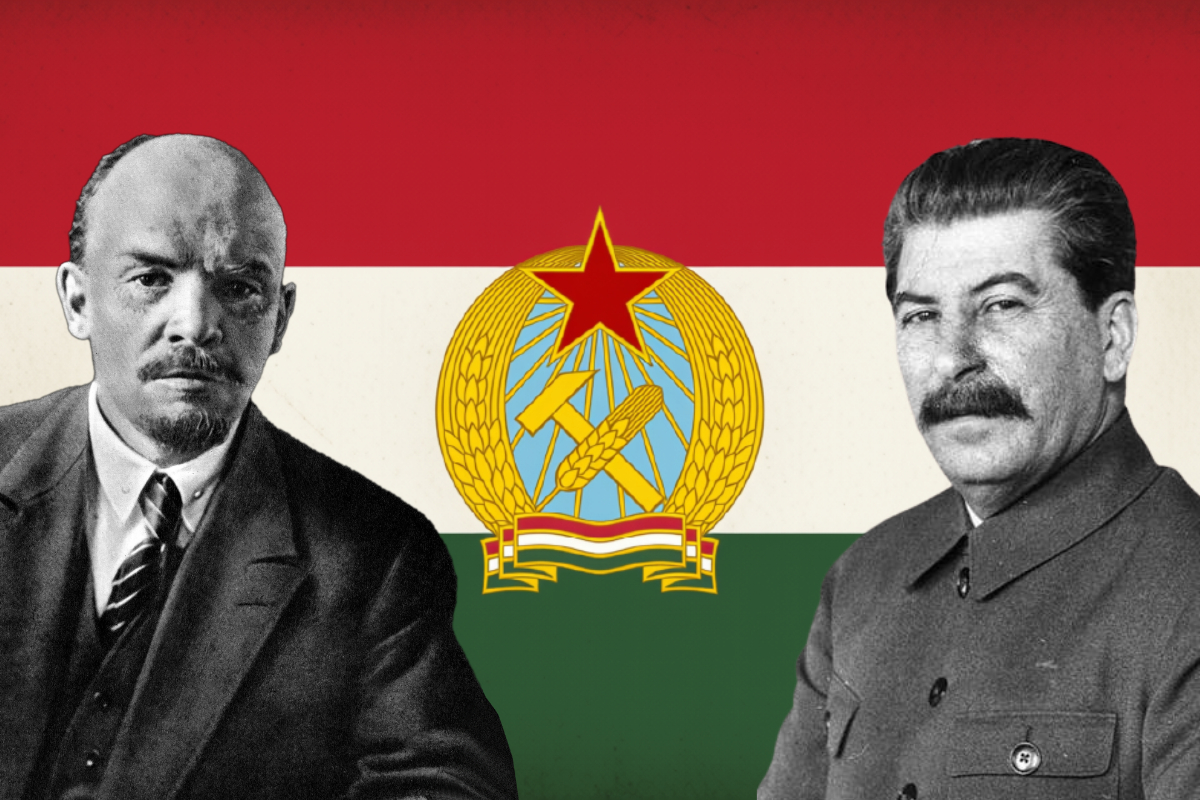
Upon hearing the news, Lenin was immediately sceptical of this merger between the SDP and the CP. He had seen a similar situation in the aftermath of the February Revolution in Russia in 1917. Some Bolsheviks, Stalin and Kamenev in particular, had felt the pressure to fuse with the Mensheviks after this revolution and lend critical support for the provisional government.
This was a mistake, one which Lenin sharply criticised in his ‘April Theses’, where he demanded no trust in the provisional government and the need for an independent banner. In Hungary, under the pressure of events, these young comrades had made fundamentally the same mistake. In a telegram to Béla Kun, Lenin warned:
“Please inform us what real guarantees you have that the new Hungarian government will really be Communist, and not just simply socialist, that is, a government of the social traitors?…
“Beyond any doubt the simple application of our Russian tactics, in every little detail, to the particular conditions of the Hungarian revolution would be a mistake. I must warn against these mistakes, but I would like to know in what you see genuine guarantees?”
Under the pressure of public opinion, particularly the fear of being seen as splitters, the Hungarian communists completely liquidated themselves into a political mish-mash of a coalition. Unification with the SDP was not inherently incorrect as a tactic, but any serious unity must be fought for, not bureaucratically declared from the top after prison-cell negotiations.
Rather than a cobbled-together political programme, which is what was produced, there needed to be a struggle for unification on the basis of a revolutionary programme. This ideological struggle should have been conducted in public, in front of the masses, and should have included a campaign to exclude the right wing of the SDP who had exposed themselves as agents of capitalism.
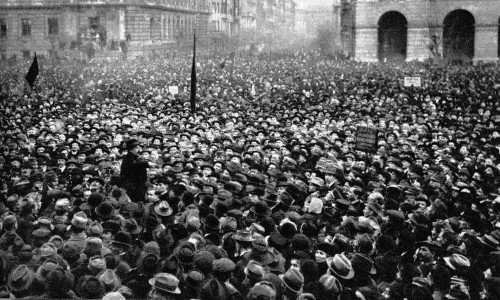
This was not done. And so this unification simply dragged the most advanced layers of the working class, who were already rallied around the communists, back into line with the more conservative layers.
The cobbled-together programme contained a whole host of mistakes. Chief amongst them was the position on the land question. In a country where the clear majority were peasants crushed under the heel of big landlords, the land question would decide the whole revolution.
Instead of prioritising winning over the peasants by breaking up the big estates and redistributing the land, the young Hungarian communists were more concerned with an abstract idea of establishing picture-perfect socialist relations in Hungary.
They confiscated the big estates, but instead of distributing the land to the peasants, they established large collective farms with ‘Commissars for Production’ in charge who, in many cases, were simply the former landowners themselves!
From the point of view of the peasantry, nothing had changed. There was, at best, indifference towards the revolution. In many cases, there was outright hostility.
Invasion and defeat
It wasn’t long until the capitalists of nearby countries moved to overthrow the new Soviet Republic. The allied powers joined together in an economic blockade to choke the country. Romanian and Czechoslovakian armies invaded from the north, whilst French troops occupied parts of southern Hungary.
Under the pressure of invasion and counter-revolution, all the mistakes of the CP became open wounds on the new Soviet Republic.
The unprincipled merger with the SDP was a disaster. It was clear that the right-wing leaders were hellbent on sabotaging the effort to defend the country against invasion, and were even in direct contact with the imperialist aggressors.
Too late, it became clear to Béla Kun that a split with the SDP was needed in order to carry out the task of defending the revolution. But with the imperialist forces already deep into Hungarian territory, there needed to be complete unity of action. A split would sow confusion and chaos that would certainly destroy them. And yet unity was destroying them too. In reality, there was nothing they could do to correct the mistakes at this point.
Their further mistakes – alienating the peasantry, a poor economic policy, retaining the old army without breaking it up and re-establishing it – simply compounded the inevitability of the defeat.
On 1 August 1919, Béla Kun agreed to resign and hand power back to the capitalists, who established a violent, vengeful, authoritarian regime which drowned the revolutionary movement in blood. Even at that late stage, Béla Kun had failed to learn the lessons from this defeat. In his final speech, he blamed the working class for its lack of revolutionary, socialist consciousness:
“The Hungarian proletariat betrayed not their leaders but itself… If there had been in Hungary a proletariat with the consciousness of the dictatorship of the proletariat it would not collapse in this way.”
The real history of 1918-19 showed Béla Kun to be completely wrong. The masses had overthrown governments, won independence, and gone on the offensive against the bourgeois liberal government. When the communists had been arrested, the workers fought for their release. The masses had begun building workers’ power, moving beyond the SDP leadership, and laying the basis for the communists to take power in a new Hungarian Soviet Republic.
But eventually, the repeated mistakes by Béla Kun and his party caused the masses to lose faith in their leadership. The communist leaders failed to base themselves on the most advanced, revolutionary layers of the working class. They failed to wage an ideological struggle against the political treachery of the SPD. And they failed to skilfully connect the struggle for socialism with the real conditions faced by the Hungarian masses.
The power of that movement in 1918-19 would show itself again 37 years later, in 1956. But once again, there would be no leadership to direct the revolution to victory. For today’s communists, the task of building that leadership in anticipation of future revolutionary events still remains our most vital.