The Socialist Workers Party (SWP) is one of the largest far-left groups in Britain. Through its various front organisations, such as Stand Up To Racism (SUTR), this self-proclaimed ‘Marxist’ party has held a monopoly on the anti-racist struggle for several decades. What does it have to show for this? Absolutely nothing.
Racism has not gone away in this period. Quite the contrary. Reactionary, right-wing forces are growing and feeling emboldened in Britain, as in Europe and America.
Nigel Farage’s right-populist Reform UK has stormed onto the scene, riding a wave of anti-establishment anger to become Britain’s leading political party in the polls, and a potential government-in-waiting.
Rupert Lowe’s Restore Britain – a hardline, nativist party which stands for the mass deportation of immigrants – is now a significant force in British politics.
And Tommy Robinson’s Islamophobic ‘Unite the Kingdom’ rally amassed hundreds of thousands of his flag-waving followers in central London last September.
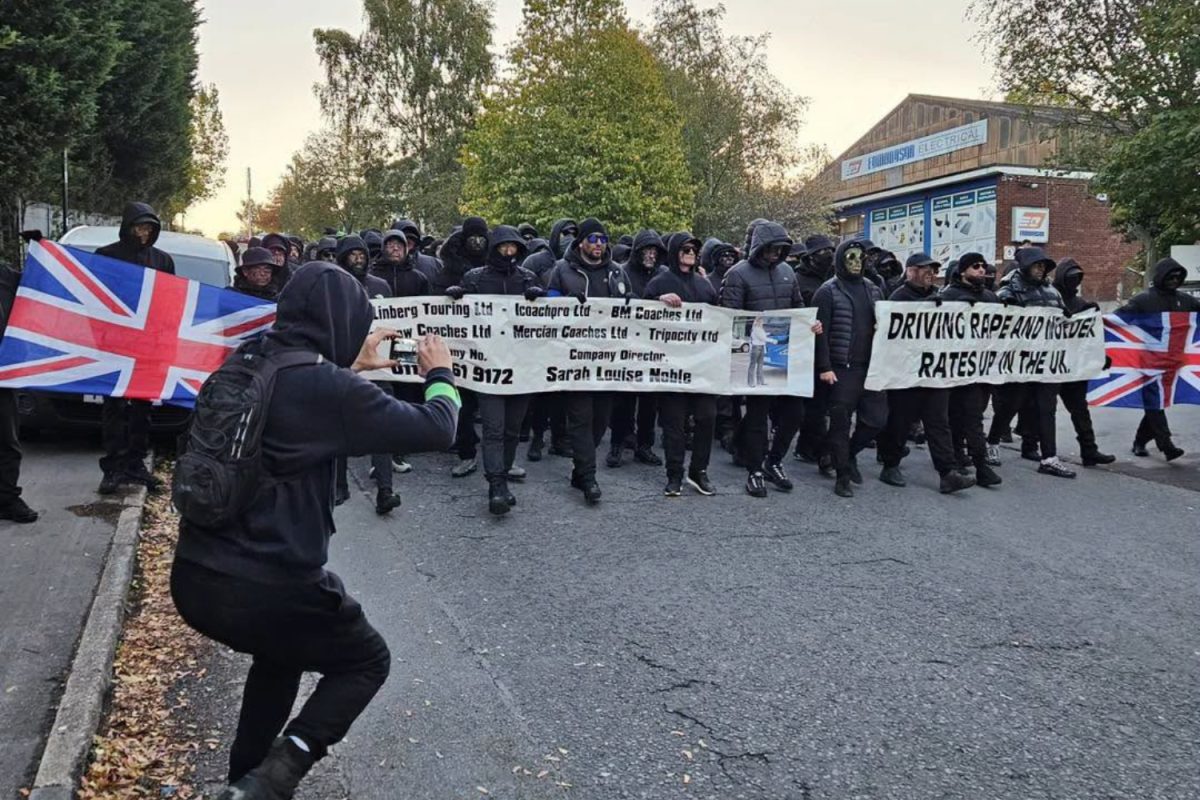
Meanwhile, far-right thugs have marauded through Britain’s streets for three years in a row now, terrorising Muslim, black, and Asian communities with their pogroms, riots, and racist violence. This has gone hand-in-hand with a rise in terror attacks targeted against Muslim communities.
And let’s not forget that the British state itself – under both the Tories and Labour – has continually ramped up its divisive ‘hostile environment’ policies against immigrants, including record deportations under Starmer.
What does the situation demand?
With the menace of racist reaction rearing its ugly head, the need for a strong, militant, and combative anti-racist movement could not be greater. The forces exist in society to crush the far right physically, and to destroy Reform politically – this is an undeniable fact.
Yet the SWP and SUTR have spent the past period pessimistically wallowing in the swamp of opportunism. Unable to see the power and revolutionary potential of the working class, they have sought shortcuts, abandoned a class-based outlook and programme, and built cross-class alliances on a liberal basis.
This opportunism was on full display earlier this year, when they uncritically cheerled for the liberal ‘Together Alliance’ coalition, with its tepid politics of ‘love, hope, and unity’.
The SWP’s strategy when it comes to ‘fighting’ racism, has consistently been confined to one of popular frontism and ‘lesser-evilism’: that is, forming broad coalitions and so-called ‘progressive alliances’ along with liberals, religious groups, and other middle-class elements; and campaigning for Labour in elections, on the pretext of stopping Reform and Restore.
In a number of instances in recent years, SUTR organisers have actively discouraged militant young Asians from organising self-defence against the threat of far-right violence; sowed illusions in the police when it comes to keeping communities safe; and prevented speakers at SUTR rallies from criticising Starmer’s Labour or denouncing the genocide in Gaza, lest this alienate Labour councillors or Zionist supporters, respectively.
This combination of weak, woolly politics and class-collaborationist methods has led the movement against racism into a blind alley.
Unable to mobilise effectively to combat the rise of the right, and having alienated radical young people with their soft, reformist, liberal politics, SUTR has frittered away its authority, and is on the decline, along with the SWP itself.
A vacuum is therefore opening up. More militant and youthful grassroots anti-racist groups have emerged in many local areas. This is an encouraging development, which deserves support from the left and the labour movement.
Above all, the situation demands clear perspectives, and a class-based programme that can politically arm the movement for the struggles in front of us.
This is what the Revolutionary Communist Party (RCP) is setting out to provide. A chasm lies between the objective situation – which is ripe for successful struggles of workers and youth against racism and capitalism – and the complete political bankruptcy of the existing left leaders. We need to bridge this gap, with a sense of urgency.
We, the RCP, are seeking to establish ourselves as the revolutionary wing of the anti-racist movement, and to become a leading force in anti-racist struggles in Britain, where we have the forces to do so.
To carry out this task – and to avoid succumbing to the same pressures and repeating the same mistakes of the past – we must draw up a balance sheet of the failures of the SWP and their SUTR front.
Is racism behind the rise of the right?
The first step of fighting a resurgent right is to understand what is driving its rise. That much should be obvious. But the SWP falls at this first hurdle.
They say, for example, that “Reform UK’s base is mobilised by a hatred of migrants…” (our emphasis throughout); that “racism is critical to [Reform’s] growth…”. In their recently published pamphlet How We Stop The New Far Right, meanwhile, they say that “at the centre of Reform UK’s policies is racism.”
There’s more. In what we suspect is an indirect reply to our own article ‘The meaning of 13 September: A damning indictment of the left’, the editor of Socialist Worker wrote a piece explicitly opposing the idea that the capitalist crisis (or “neoliberalism and austerity”, to borrow their language) is what is driving the rise of the right:
“It is true that you cannot explain the likes of Donald Trump in the United States or Nigel Farage here without looking at neoliberalism and austerity. But it’s wrong to say that austerity is the key driver of the far right’s growth.
“First, it ignores the character of Tommy Robinson’s [Unite The Kingdom] demonstration in London and what drives Reform UK’s vote.
“His march was not one of people whose main worries were about the NHS or school spending, but who happened to have ‘concerns’ about small boats. It was so large precisely because mainstream politicians have normalised anti‑migrant racism.
“The far right latches onto people’s anger at years of neoliberalism and austerity and present themselves as an ‘anti-establishment’ force. But opposition to ‘mass’ and ‘illegal’ immigration is the glue that binds together their story [!] of Britain’s ‘national decline’.”
In short, this argument can be boiled down to: ‘If the rise of the right was driven by the crisis of capitalism, right-wing individuals would be out campaigning for more public spending, not stopping the boats. Clearly, therefore, the rise of the right is driven solely by a rise in racism.’
We must ask: how do these ‘Marxists’ think that consciousness works? Have they forgotten that consciousness, by its very nature, is full of distortions, limitations, and contradictions?
If masses of people were able to understand their social conditions in a clear, direct, and automatic manner, then the world would look very different indeed.

To begin with, there would be no need for a revolutionary party to help guide and advance the consciousness of the working class, because people would automatically understand their class interests and how to fight for them.
And there would be no need for an anti-racist movement either – because racism simply would not exist. Ordinary people would immediately be able to see through the cynical attempts of the ruling class to sow division using racism and xenophobia.
Clearly, reality is not so simple. Anger and discontent against austerity, capitalist decline, and the establishment can be – and in most cases are – expressed in a distorted, confused, and even reactionary way. This can range from reformist illusions on the left, through to anti-migrant sentiments on the right.
The example provided of “concerns about small boats” is an apt one: working-class people don’t buy into the right’s fearmongering about small boats because they are stupid, inherently racist, or white supremacist.
Of course, there is a crazed, hardline fringe of extreme reactionaries and genuine fascists who believe in racial supremacy and other such nonsense. But these ideas are nowhere near widespread.
In the vast majority of cases, anxieties about migration clearly stem from underlying concerns about the economy and the state of society: a lack of jobs, housing, and public services; social decay and a rise in petty crime – and yes, national decline.
These anxieties – in the absence of a viable, class-based alternative provided by the left – can then be whipped up, distorted, and channelled towards immigrants and minorities by reactionary politicians. And not just by Farage, Lowe, and Robinson, we should add, but also by champions of the capitalist establishment like Starmer, Mahmood, and other Labour politicians.
Blinded by the surface of events, the SWP has mistaken one superficial aspect of right-wing parties and movements – their racist, chauvinist, and anti-migrant ideas – for what is actually driving support for these formations under the surface.
Idealist confusion
By taking an empirical, impressionistic view of this process, the SWP puts the cart before the horse. They think that the rise of the right is simply caused by a rise in racism in society.
As for where this rise in racism comes from, we are left scratching our heads. Their answer: “Because mainstream politicians have normalised anti‑migrant racism.”
Elsewhere, in their pamphlet, they again attempt to explain the rise in racism since the 1980s:
“Racism and immigration began to become part of the political debate, as mainstream parties embraced the demonisation of migrants, refugees and Muslims. The centre of politics began to shift to the right on these questions, giving fascist ideas around racism and migration more of a hearing.”
But this is a pure tautology, which says absolutely nothing. ‘Racism became mainstream,’ they tell us, ‘because mainstream politicians embraced racism, which made racism mainstream.’
What is not explained, however, is how mainstream politicians and parties have been able to do this. What provides the social and material basis for anti-migrant ideas to take root in people’s minds? And why are such ideas becoming more widespread at this point in time, and not another?
Are we to believe that people are gullibly lapping up anything that these politicians say? Are certain people naturally and organically inclined towards racism, perhaps? Such a perspective would be hopelessly idealist and pessimistic. But it would also fly in the face of reality.

We have explained in greater depth elsewhere the real basis for the rise of support for right-populist movements like Trump’s MAGA and Farage’s Reform, as well as the episodic flashes of support for racist demagogues like Tommy Robinson.
Suffice to say, this backing is rooted in a deep anti-establishment anger, driven by decades of austerity and attacks on the working class – anger that the likes of Trump and Farage then opportunistically deflect away from the system, and direct towards immigrants and other oppressed groups, as part of the ‘culture war’.
This has resulted in cross-class coalitions of supporters behind Trump, Farage, and co. that are extremely heterogenous and unstable.
This rise in support for right-populist figures is compounded by disappointment and disillusionment with the leaders of the left in the past period; by the massive political vacuum that has been created by the failures and defeats of the last left-wing wave, in the 2010s.
At best, in the previous decade, the left leaders have failed to wage an uncompromising struggle “for the many, not the few” (as with Jeremy Corbyn, in Britain), or for a “revolution against the billionaire class” (as with Bernie Sanders, in the USA). At worst, left-reformist parties have openly betrayed the working class by carrying out austerity and attacks on behalf of the capitalists (as with Syriza in Greece and Podemos in Spain).
By ‘explaining’ the growth of right populism simply in terms of the “rise in racism”, the SWP completely lets the ‘left’ leaders off the hook for their criminal role; for leaving the field wide open for reactionary demagogues like Farage and Trump, by failing to take the movement forward when they had the chance.
This is not coincidental. To criticise these ‘lefts’ would endanger the cohesion of the precious, politically-confused coalitions that the SWP has built up over the years and decades. Far more convenient and expedient to instead blame the masses for being ignorant and racist.
To reduce one of the most important political phenomena of our time – the large-scale support for right-wing populism – down to a mysterious, inexplicable “rise in racism” is the height of oversimplification, reductionism, and idealism.
This superficial method has nothing in common with Marxism, which seeks to explain the deeper, underlying processes for historical events and social developments; which looks at such phenomena in an all-rounded manner; and which explains the material conditions behind the changes in consciousness and spread of ideas within society.
How can we fight the right?
Herein lies the root of the SWP’s tactical mistakes on how to fight the right.
Taking as their starting point the idea that racism is to blame for the rise of reaction; that racism is the glue that binds the right together (a phrase that crops up throughout their material), the SWP thinks that simply denouncing and arguing against racist ideas is the best way that we can fight, split, and weaken the right.
In what we suspect is in part another indirect reply to the RCP, SUTR’s lead organiser Lewis Nielsen wrote an article entitled ‘How anti-racists can take the fight to the far right’:
“After Robinson outnumbered us, sections of the movement argued that anti-fascist counter‑demonstrations or saying, ‘Refugees are welcome’, had failed.
“They claimed those on the Robinson march could be won over through slogans about the cost of living crisis, downplaying the centrality of anti-racism.”
Similarly, we read the following in the aforementioned article by the editor of Socialist Worker:
“Anti-racism and class struggle have to go hand in hand – fighting oppression is not a distraction or an optional extra. Saying ‘refugees are welcome here’ is not a liberal or moral appeal not to be beastly to people.
“Breaking workers from racist and chauvinist ideas is vital if class struggle is to be successful.
“We do have to shout ‘Refugees welcome’ on Stand Up To Racism (SUTR) protests against the fascists and racists who demand ‘Remigration now’.”
In their pamphlet, they also write:
“All of those who are prepared to act (not just mouth platitudes) against Reform UK need to organise to take back the streets, argue against racist lies, defend refugees, migrants and Muslims and create networks of anti-racist resistance…
“The anti-racist response has to be uncompromising around, for example, saying that refugees are welcome…
“As the experience of Europe shows, unless you confront the racism of the far right, they will see their ideas legitimised and their audience grow.”
And once more, for good measure:
“Driving back the far right involves, among other things, building a mass movement that confronts fascists and challenges racists, as Stand up to Racism seeks to do… A clear anti-racist argument must be conducted, both nationally and locally, throughout the labour movement.”
Accordingly, in their pamphlet’s account of anti-racist struggles against the far-right National Front in the 1970s and ‘80s, they explain how “the central strand of the ANL’s strategy [Anti-Nazi League, a SUTR predecessor] was to try and separate hardline Nazis from the softer racists that were now voting for them”. To do this, they “wanted to put an anti-racist argument into every workplace, school, college and estate”.
They also claim that this “strategy” was what defeated the far-right British National Party, and Tommy Robinson’s English Defence League, “whose softer elements peeled away, and the hardcore Nazi elements began to fragment”.
But far from showing the need for moral pressure and ‘anti-racist arguments’, the history of anti-racist struggles in postwar Britain reveal the crucial role of mass organisation and militant, class-struggle methods, as we have discussed in our series ‘Here to fight! Here to stay!’
Taken together, we get a clear picture of the SWP’s ‘strategy’. They think that anti-racism – devoid of any class content – is the right wing’s kryptonite; a powerful weapon that can demoralise them and split their ranks.
Therefore, we must expose, denounce, and ‘win the argument’ against racism, and forcefully declare ourselves in favour of migrants and refugees.
Moralism and platitudes
This connected series of political errors is what lies behind the SWP’s dogged insistence upon repeating moralistic, virtue-signalling, and ultimately hollow slogans like ‘Refugees are welcome here’, ‘Reform is racist’, and ‘Stop racism and Islamophobia’.
Such sloganeering amounts to exactly what they profess to oppose: moralising appeals and empty platitudes. Those to whom this is addressed will already agree with such ‘demands’; those to whom this is opposed, meanwhile, will not be convinced by these vacuous cries.
None of these slogans actually addresses the real reasons for why some ordinary people are buying into divisive, anti-migrant rhetoric, or are throwing their support behind the likes of Farage.
This method also completely overlooks the understandable concerns that some working-class people may have over the migration crisis, which under capitalism leads to a race to the bottom in terms of housing, wages, and conditions.
Instead, these liberal do-gooders and ‘progressives’ try to downplay these problems – and even prettify the migrant and refugee crisis.
Such moralism is far from benign and harmless. This kind of empty, liberal anti-racism is entirely counter-productive, actively harming the struggle against the right.
Instead of winning over workers on a class basis, it reinforces the right’s stereotype that the left are a bunch of shouty, hysterical liberals who scream ‘racist’ and ‘Nazi’ at anyone with certain prejudices or concerns about immigration.
It also parrots the ideas of the liberal establishment, who for the past few decades have openly adopted identity politics as one of their main ideological weapons, and have cynically espoused pro-immigration, pro-multiculturalism, and pro-asylum-seeker rhetoric – when it suits them – to give themselves a progressive veneer.
Adopting the same ideas as the liberal establishment, and thereby appearing indistinguishable from it, can only serve to reinforce the right’s idea that the left is part of this hated establishment – which is responsible for attacking the jobs, wages, and conditions of both native and migrant workers.
Of course, we are in favour of opposing racism. But saying ‘stop racism’ and ‘racism is bad’ does nothing to actually oppose racism.
Marxists don’t believe that you can change society simply by ‘winning the argument’ or ‘changing the discourse’. Rather, we understand the need to unite and mobilise the working class in order to overthrow capitalism, transform society, and rip up racism at its roots.
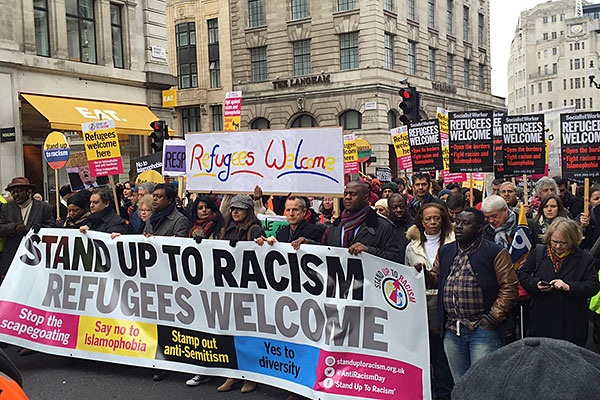
And the problem with the moralistic methods and liberal sloganeering of the SWP and SUTR is precisely that, instead of uniting the working class, they end up exacerbating ‘culture-war’ divisions, thereby playing into the hands of the capitalist establishment and reactionary demagogues alike.
We are also in favour of using political demands and slogans to weaken and split the right. But this means splitting heterogeneous, cross-class formations like Reform UK along class lines: using revolutionary socialist demands that could appeal to the healthy class instincts of many working-class Reform voters; and sharply distinguishing ourselves, as revolutionaries, from the much-loathed establishment and its political representatives.
But this is exactly the kind of thing that the SWP tries to keep out of SUTR demonstrations, for fear of alienating and scaring away more moderate types. “We cannot”, after all, “put barriers up to the involvement of people who don’t share the full anti-capitalist programme” – so states the Socialist Worker.
Their objection to such methods go deeper than their fear of scaring away moderates, however. The SWP actually openly objects to the idea that class struggle around socialist demands is enough to combat racism and the right:
“Of course, class struggle and the creation of a left party could help slow [!] the growth of the far right. However, neither the 100,000 who gathered in London at Robinson’s mobilisation in September nor the mass of Reform UK voters can be treated simply as ‘left-behind workers’, lost souls straying from the path amid deindustrialisation and economic decline, who merely require the kindly shepherds of social democracy to show them the way. Anti-immigrant and other reactionary ideas strongly motivate these groups… Just three percent of Reform UK voters say they would consider voting for a Corbyn-led party. [This article was written soon after Your Party was launched to mass enthusiasm.]”
In their pamphlet, meanwhile, they write:
“It is wrong to think that if we just fight on economic issues, the far right will just disappear. Having a strong trade union movement, a big social democratic party and even a high level of class struggle doesn’t mean the fascists will just fade away…
“The experience of France in recent decades is instructive. In the 1980s, the French left was one of the strongest in Europe. François Mitterrand was elected on a left-wing manifesto, and the trade unions were powerful bodies that resisted attacks on working conditions and the right to strike. At the same time, the FN [Front National] under Jean-Marie Le Pen began to see some electoral success.”
These passages say a lot more than the authors likely intended. The only kind of left-wing movement that they can possibly envision is a social-democratic, reformist one. ‘If’, they argue, ‘Reform voters wouldn’t consider voting for a (hypothetical, non-existent) Corbyn-led party, then clearly socialism and class struggle won’t appeal to them. Case closed.’
The references to Mitterrand are even more egregious, and border on plain dishonesty. Upon entering into power, the supposed ‘socialist’ Mitterrand soon backed down from carrying out his “left-wing manifesto” and capitulated to the pressures of the ruling class
In response to the economic blackmail of the capitalists, he ended up carrying out a Thatcher-like austerity programme, and oversaw the French Socialist Party’s drift into a right-reformist, bourgeois husk – hardly a model of class struggle and socialism. Of course a section of workers turned to the right after such betrayals!
All that these examples demonstrate is that reformism – with its weakness, vacillation, and treachery – is not the answer to combatting the right.
The fact that the SWP’s leading ‘theoreticians’ have no perspective of revolutionary class struggle or sharp swings in consciousness in the coming period speaks volumes.
It doesn’t even enter into their imagination to connect the struggle against the racist right with a perspective of revolutionary struggle against capitalism – something that could win over workers on both ‘sides’ of the culture-war divide. This should be ABC for any self-professed Marxist.
Do we need to ‘sound the alarm’ about fascism?
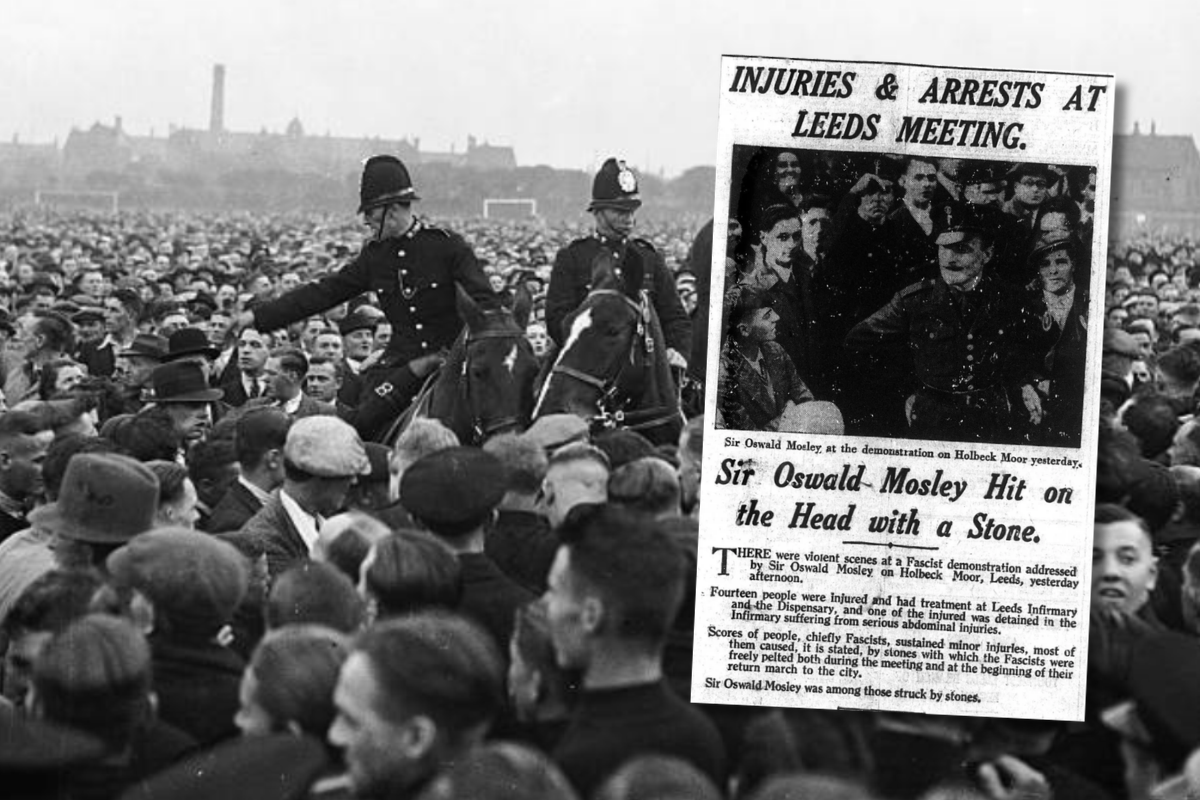
Another source of the SWP’s opportunist errors is their hysterical alarmism about the supposed threat of fascism.
“The dark storm clouds of fascism are gathering,” they write in their pamphlet.
“The rise of fascist parties has rapidly accelerated since the 2008 economic crisis… In many countries, they are setting the agenda politically… We need to sound the alarm about the scale of the fascist threat.”
The leading ‘theoreticians’ of the SWP are not stupid. They have read the works of Leon Trotsky on the rise of fascism in the 1920s and 1930s, and are able to regurgitate their main lessons in a more-or-less accurate manner.
We take no issue, for example, with quoting their pamphlet’s descriptions of the rise of Mussolini and Hitler:
“Across Europe, the threat of revolution gave rise to counter-revolutionary responses, from military coups to the formation of right-wing paramilitary groups. In Italy, it was Mussolini’s fascist Blackshirt squads that spearheaded a counter revolutionary wave that smashed workers’ and peasants’ organisations and eventually carried Mussolini to power in 1922…
“For Hitler all such [democratic and working-class] institutions – ranging from parliament to trade unions and socialist parties – all contained the seed of workers’ revolution and so had to be smashed…
“Therefore, the goal of the Nazis was the total annihilation of all forms of working class organisation…”
They also note that the petty bourgeoisie provides the key social base of a counter-revolutionary fascist movement, and that the ruling class made use of fascist organisations as a means to wage “open civil war against the working class and its organisations”.
We can agree with the SWP that the essential features of fascism are: a counter-revolutionary movement set in motion by the ruling class in response to the threat of workers’ revolution; a programme aimed at smashing the organised working class; and a mass base of enraged petty bourgeois, mobilised to carry out this programme.
Evidently, however, none of the factors matching this description are present today. We are not in the throes of a drawn-out revolutionary crisis; the ruling class is nowhere near the point of considering methods of open civil war against the working class; and the petty bourgeoisie has been vastly hollowed out and ‘proletarianised’ – certainly in the advanced capitalist countries, at least.
The forces of the working class are fresh, intact, and objectively stronger than they have ever been in history. Only the blindest of the blind could suggest that the organisations of the working class are on the brink of being annihilated.
So how does the SWP square this accurate historical description of fascism with their grim prognosis; with the need to “sound the alarm about the scale of the fascist threat” today?
Theoretical gymnastics
Trotsky’s analysis is “useful”, they admit. But he was apparently analysing a “specific movement” of “interwar fascism” – or “classical fascism”, if you will. And things have changed since then, you see. “Fascist parties had to adapt and reinvent themselves” and “distance themselves from the fascism of the interwar period.”
The Front National in France, for example: “Pursued an image of respectability, focusing on elections and posing as a normal party of the right… They dropped their talk of fascist goals and focused on migration and Islamophobia.” They also “haven’t been able to build a street movement similar to the 1930s”.
It must be asked: if groups like Le Pen’s Front/Rassemblement National and Meloni’s Fratelli d’Italia have consciously distanced themselves from fascism, dropped their fascist goals, and are unable to build a fascist street movement – what exactly makes them ‘fascist’ still?
The best that the SWP’s writers can offer is that the FN has its own security force – which today acts like any other professional event security team. And the party “has links” with smaller Nazi groups. This is really scraping the barrel. Such cherry picking cannot pass for a genuine Marxist analysis.
Their theoretical gymnastics get even more impressive when dealing with Trump. In an article entitled ‘Donald Trump, fascism and the state’, Socialist Worker’s editor Tomáš Tengely-Evans warns that:
“There are powerful political forces and social dynamics driving the development of fascism in the US…
“…Trump’s second presidency marks a qualitative shift – it is not a fascist state, but nor is it simply more authoritarian as many states today are becoming.
“Today, Ice and the Border Patrol function as a paramilitary force and are drawing the far right into its ranks…
“There is ample evidence of an interrelationship between ICE and street-based fascist groups.”
Through descriptions of such incidental and exaggerated links between the state and the far right – as well as by dragging in parallels to the Horthy dictatorship in interwar Hungary, and the regime of the late Weimar Germany – the author seems to ever-so-tentatively suggests that we could, maybe, describe Trump’s regime as “semi-fascist”. He ends the article without firmly deciding one way or the other.
Strangely, as a sign of the SWP’s complete eclecticism on this question, Germany’s Alternative für Deutschland – arguably the most extreme of the European right-populist parties – evades classification as ‘fascist’. Instead, they are described as a “hybrid formation” in their pamphlet.
Reform, meanwhile, gets off scot-free, earning the label “non-fascist formation of the radical right”. But we are reminded that the barriers between these different classifications are not rigid, and that the far right is fluid and adaptable.

Missing from all of this verbal jugglery and playing with categories is any serious analysis of the social basis for fascism today, which should be the first port of call for any Marxist. The SWP completely overlooks the dramatic shift in the class balance of forces in the past century.
Think, for one second, what would happen if a Farage or Le Pen government were to try and enact a fascist or Bonapartist programme, which would mean attempting to annihilate or heavily repress parliamentary democracy, trade unions, and all left-wing organisations.
This would provoke revolutionary convulsions – the likes of which we have never seen in recent memory. The ruling class knows that, which is why a fascist takeover – or any attempt at a full-on confrontation with the working class and its organisations – is decisively ruled out for the coming period.
The only place, as far as we are aware, that such questions are dealt with, is in an article analysing Tommy Robinson:
“The mistake lies in assuming that counter-revolution is only intelligible as a response to an already existing revolution. In fact, fascism can operate as counter-revolution without revolution: a pre-emptive strategy aimed at foreclosing future rupture, disciplining society in advance, and rolling back past gains before renewed challenges from below can coherently emerge…
“Revolutionary potential does not reside only in moments of insurrection. It exists as a horizon that structures fear, hope and strategy in the present. Robinson’s counter-revolutionary politics are oriented towards foreclosing that horizon in advance, disciplining society before a renewed challenge from below can cohere. Militant antiracist struggle disrupts this project through moral appeal and, importantly, by contesting control of social space and reasserting collective capacity.”
But, again, this is nothing other than confused theoretical gymnastics and liberalistic moralism, packaged in confusing academic jargon and pseudo-Marxist jibberish.
The common thread which runs throughout all of the SWP’s writings on this subject is an attempt to stretch the category or label of ‘fascism’ beyond all meaning, to apply to almost any reactionary phenomenon.
Then, by using the terms ‘fascism’, ‘racism’, and ‘far right’ freely and interchangeably, they can paint an alarming picture that the forces of counter-revolution are growing and on the march everywhere.
The result of this slippery formalism – this theoretical sleight of hand – is a completely one-sided, despairing perspective for the coming period. This serves as the political basis for their opportunism, popular frontism, and lesser-evilism.
Ironically, if it were the case that a fascist takeover is nigh, then the task facing the working class would be to prepare for an all-out showdown between the forces of revolution and counter-revolution: the arming of the working class, workers’ militias, self-defence organisations, and more-or-less immediate preparations for the seizure of power in a socialist revolution.
Instead, SUTR is busying itself campaigning for Andy Burnham’s Labour (painted in terms of opposition to Reform and Restore); talking about ‘defending democracy’ from Tommy Robinson; and singing and dancing while the far right roam the streets of Manchester.
In doing so, they ignore the elementary lessons of Trotsky’s writings on this matter: that the struggle against reaction requires a no-holds-barred, class-independent struggle against the capitalist system itself – not liberal anti-racism and popular frontism.
Is SUTR a united front?
Lastly, the SWP claims that SUTR is a ‘united front’, following the example of the united front tactic adopted by Lenin and Trotsky’s Communist International in the 1920s. This could not be further from the truth.
The united front was developed by Lenin, Trotsky, and the Comintern as a tactic for winning over the masses to revolution. It is based on the idea that revolutionary organisations should fight to establish unity in action with reformist workers’ organisations, in order to demonstrate to workers in practice the superiority of communist ideas and methods.
As explained in all of the speeches and resolutions of the early Comintern on the united front tactic, this unity should be practical, temporary, and formed around concrete questions.
The watchword of the united front, Lenin and Trotsky explained, should be ‘march separately, strike together!’ In other words: the communists must maintain political and organisational independence at all times, and not hide or obscure their revolutionary politics.
In essence, then, the aim of the united front is to undermine the reformist leaders by exposing their shortcomings, not to sow illusions in them.
What’s more, this tactic was devised in the context of mass communist parties – with hundreds of thousands of members – mushrooming across Europe, whose immediate task was to win over the bulk of the working class to a revolutionary programme.
While the united front tactic can be applied in a range of scenarios, it was never intended to be a long-term strategy, or an eternal law of party building.
On every single one of these points, the SWP has diverged from the Marxist understanding of the united front tactic.
SUTR is not a temporary, concrete tactical alliance, but a decades-long, indefinite political project with no clear aims other than to ‘build the movement’, ‘fight the far right’, and ‘win the argument against racism’.
Furthermore, the SWP does not use their SUTR platform to put forward their own revolutionary politics, but instead panders to the lowest common denominator politically, basing themselves on liberal anti-racism drained of any working-class content.
In addition, the SWP does not use SUTR to expose the shortcomings of the reformists, but rather to cosy up to the reformist trade union leaders, who subsidise and affiliate to SUTR in order to tokenistically pay lip service to anti-racism, while doing nothing in practice.
On the electoral plane, meanwhile, SUTR actively campaigns for and sows illusions in voting for Labour as a means to combat the right.
Great weekend of campaigning across Greater Manchester before Thursday’s election for mayor.
Together we can #StopReform pic.twitter.com/hgnXdr2vAe
— Stand Up To Racism (@AntiRacismDay) July 27, 2026
And lastly, SUTR is not based on the unity of workers’ organisations, but bases itself upon middle-class elements: petty-bourgeois community and religious leaders, and the like. It even explicitly welcomes Zionists to join its campaign (a fact that SUTR frequently reminds us of) – as long as they oppose fascism!
In essence, SUTR is what Marxists would describe as a popular front: a long-term political bloc with a thoroughly liberal programme and class-collaborationist outlook, acting as a conservative brake upon the class struggle. There is not a single ounce of working-class or radical content in anything that SUTR says or does.
In the 1930s, Trotsky once described the People’s Front in France as “a conglomeration of heterogeneous organizations, a long-term alliance between different classes, that are bound for an entire period – and what a period! – by a common programme and a common policy of parades, declamations, and of throwing up smokescreens”. Without changing a single dot or comma, this description applies wholesale to SUTR.
‘Creativity’ or opportunism?
Magnanimously, the SWP acknowledges that “SUTR is hardly a cookie-cutter version of the united front advocated by Trotsky in the 1920s or 1930s… Nonetheless, the underlying method follows Trotsky’s advice, creatively applied to present circumstances.”
But this ‘creative application’ of the united front is simply a euphemism for abandoning Marxism – that is to say, for jettisonising the class perspective that Trotsky and all genuine Marxists base themselves upon.
The SWP also recognises the difficulties posed by their ‘creative’ methods:
“Trotsky’s argument that revolutionaries only stand to gain from united front struggles that raise the combativity of the class is formally correct, but translating this into the numerical growth of revolutionary organisation is far from automatic. In the 1920s, the working class had participated in mass struggles, and levels of class consciousness and self-activity were high. This is far from the case today…
“Creating tension with reformist forces within the united front is further complicated by the fact that, due to low levels of struggle and class consciousness in the current period, the onus is often on revolutionaries to fight to preserve the unity of fronts.”
So the SWP recognises that, despite them having played a “hegemonic role” in anti-racist (and anti-war) struggles in Britain for several decades, its membership has effectively stagnated, and their organisation remains an isolated sect.
‘But how could this be?’ they ruminate. ‘After all, we are applying Trotsky’s advice – and creatively, at that.’
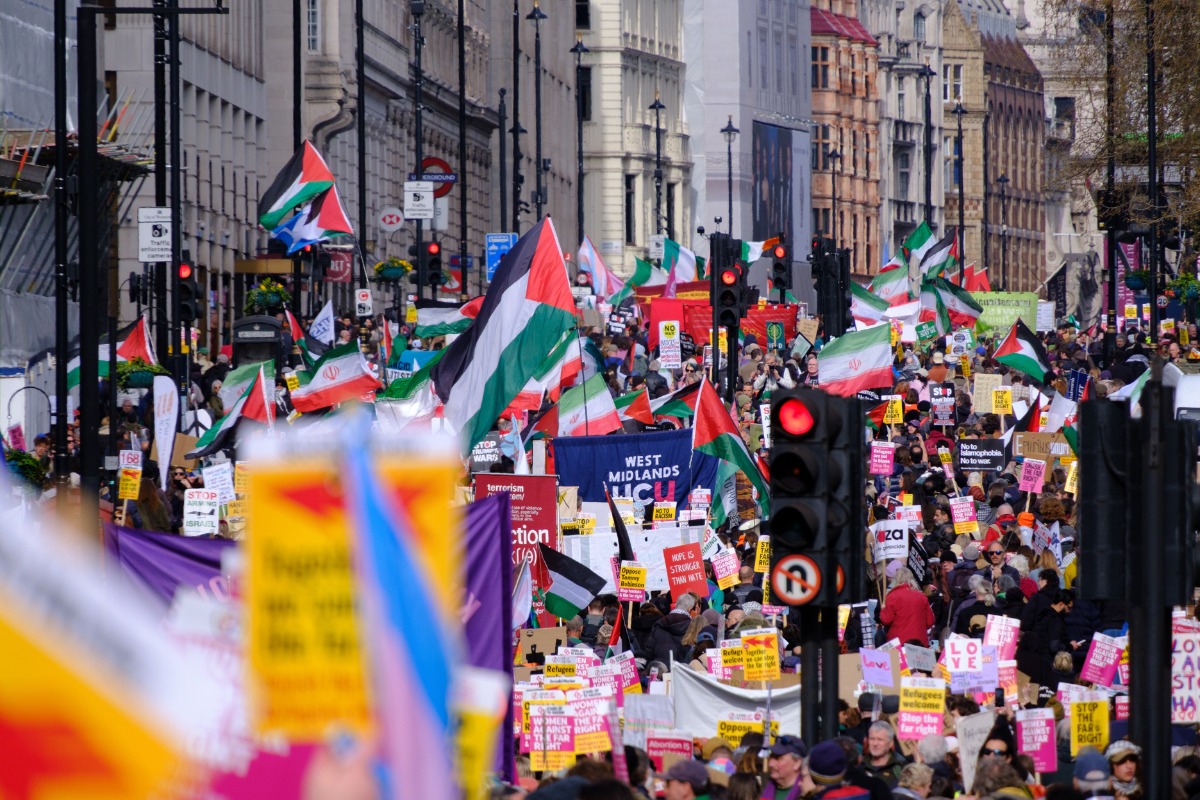
The problem, they conclude, does not lie with themselves; with their organisation and its ‘creative application’ of Marxism. Rather, they say, it is the low level of class consciousness that is to blame. In other words, they blame the working class for their own mistakes!
Such a conclusion is false from start to finish. How can one talk only about “low levels of struggle and class consciousness”? Millions took part in the Palestine movement in Britain. Almost half of young people – 47 percent – believe that revolution is necessary.
Far from living in a period of exclusive reaction, of utter doom and gloom, it is evident – to anyone but these bleating pessimists and sceptics – that we are living through a period of intensifying class struggle, polarisation, and radicalisation.
The answer to the SWP’s difficulties lies right under their noses, in their insistence that:
“The project of winning a majority of workers to revolution remains the only viable strategy for those wanting to overcome capitalism, and this cannot be achieved simply through the abstract discussion of ideas.”
This is correct, in the abstract. Winning the mass of workers to a revolutionary programme is essential for overthrowing capitalism and eradicating the forces of reaction.
It does not follow from this, however, that a revolutionary party should constantly be waging a battle to build and preserve cross-class coalitions, as the SWP does – running itself and its activists ragged in an effort to ‘build the movement’.
By attempting to find a shortcut to the masses without undergoing the necessary, patient work of theoretical clarification and cadre-building – a prerequisite for any successful revolutionary organisation – the SWP has consigned itself and its members to opportunism, demoralisation, and ruin.
By trying to prematurely hoist itself into a leading position in the British class struggle, it has wound up breaking its spine. In trying to ‘build the movement’, it has destroyed itself – burning out many honest activists, and alienating itself from large layers of radicalised young people and anti-racist fighters, along the way.
Where do these mistakes come from?
It is likely that the leaders of the SWP did not set out on this path intending to become opportunists. No one falters on purpose.
But by seeking shortcuts to the masses, by light-mindedly plunging themselves into struggles that they do not understand, they have opened themselves up to pressures that they cannot withstand. As a result, their trajectory carries a logic of its own.
In the process, confusion begets confusion. Having taken themselves and the movement down a proverbial cul-de-sac, the SWP’s leaders tie themselves in knots trying to reconcile their opportunist practice with Marxist theory. In doing so, they make a mockery of Marxism, by filling their material with all sorts of academic nonsense, vague equivocation, and intellectual dishonesty.
Above all – by one-sidedly focussing on the rise of reactionary forces in society, overlooking the immense polarisation and radicalisation to the left, and failing to see the potential power of the working class – they have become steeped in petty-bourgeois pessimism and despair.
This pessimism goes hand in hand with an incorrect, eclectic philosophical outlook: empirically and impressionistically skimming over the surface of events; and formalistically trying to fit reality into neat categories and labels.
This inability to apply the dialectical method is the underlying political root of all sectarianism. In fact, it is the definition of sectarianism.
This theoretical deficiency explains why the SWP and other sectarian groups make all the same kinds of mistakes – and more – in the trade union, Palestine, and anti-war movements.
When their faulty methods don’t get the results, the SWP does what all sectarians end up doing: blaming the working class for their “low levels of consciousness”. This is a mark of their complete political bankruptcy and degeneration as an organisation.
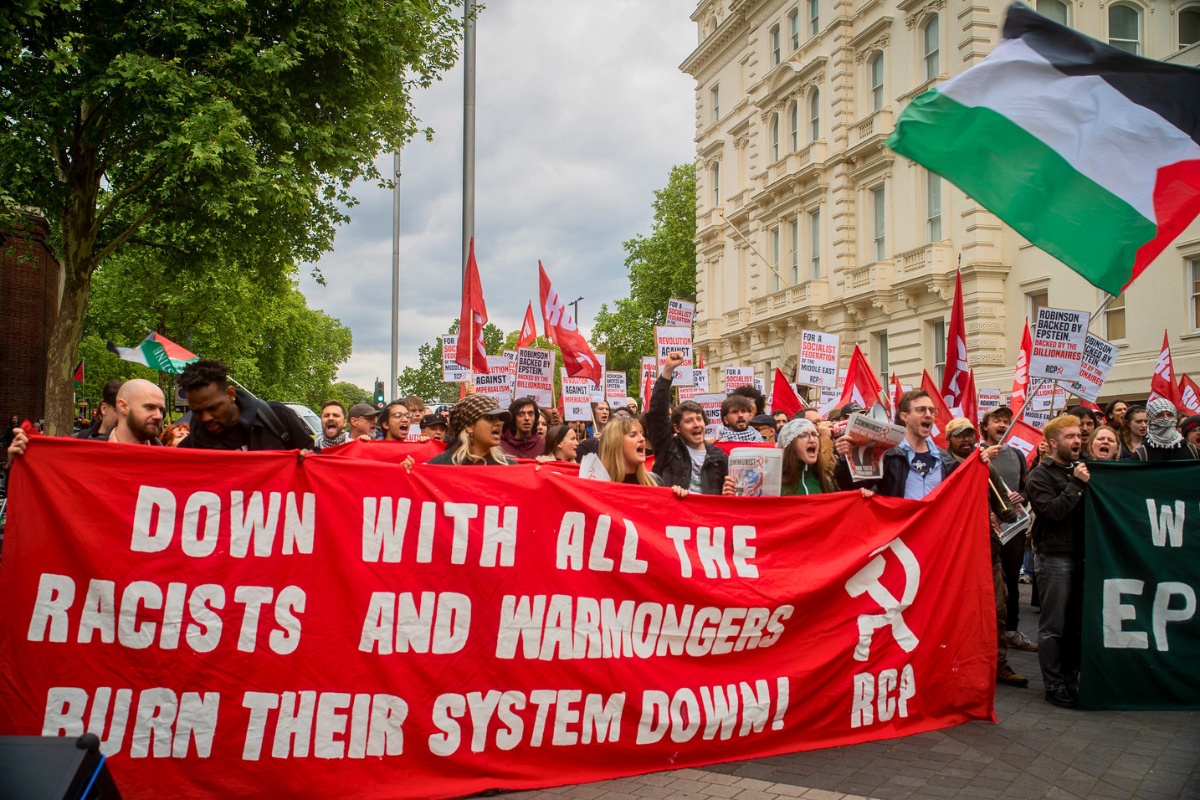
But despite their hopeless pessimism, the SWP and their sectarian ilk will cling on for dear life for as long as they can, as many political organisations do well after their expiry date.
If a leading member of the SWP happens to be reading this, we kindly ask of you: face reality; bow out quietly; wind up SUTR; relinquish what’s left of your grip on the movement; and make way for the fresh, young forces, to whom the future belongs.
We haven’t written this article for these tired cynics and sceptics, who will never learn from their own mistakes. We have no interest in trying to fix what is beyond repair, or reconciling ourselves with organisations that have become an objective barrier to the struggle against racism.
Rather, we have written this for the education of our own ranks – who are unencumbered by the political baggage of the past – and for all those who are looking for a revolutionary way forward in the fight against racism and capitalism today.
It is to these layers that we address our material; to whom we appeal to join us in building the revolutionary wing of the anti-racist movement, which means building a communist leadership. Only upon this basis can we eradicate the scourge of racism and reaction for good.