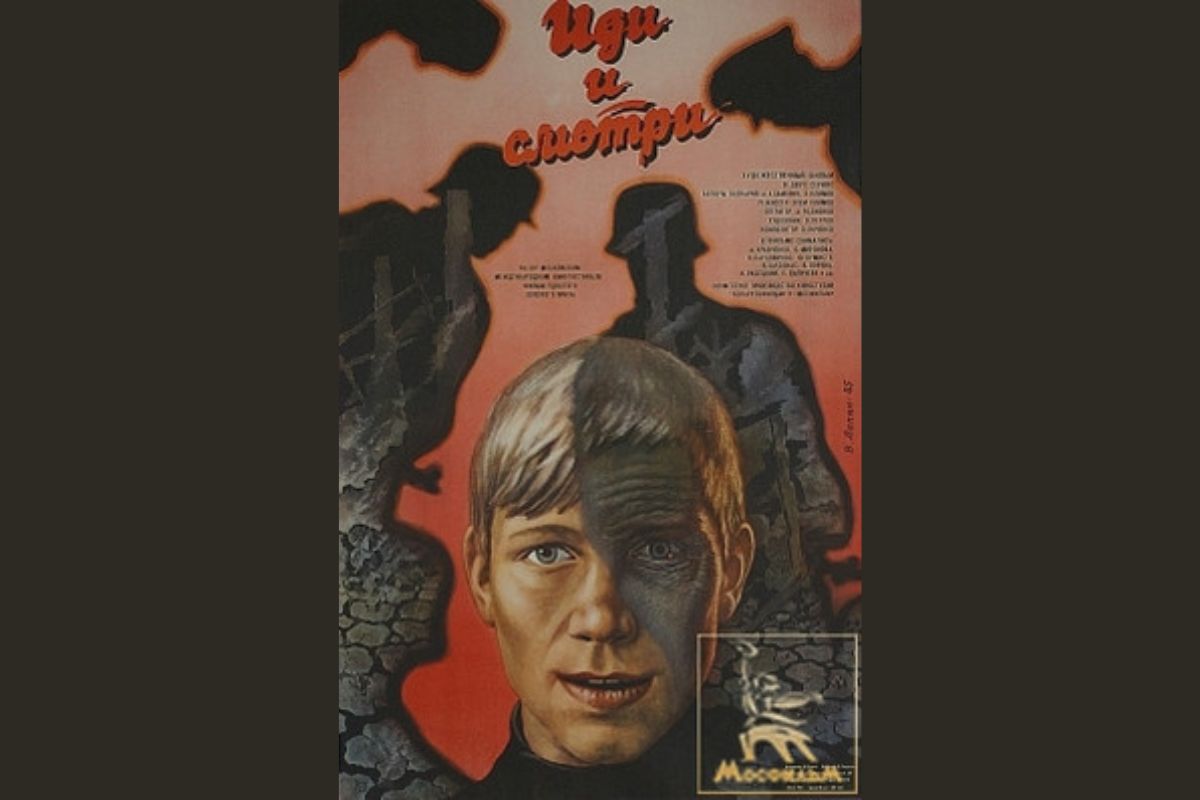

The 1941 Nazi invasion of the Soviet Union is, without a doubt, one of the most harrowing events in history. To attempt to artistically represent these cruel years is a daunting task. Nevertheless, Come and See, a stunning film from 1985 directed by Elem Klimov, succeeds in doing the job.
The film follows the story of a young boy named Flyora, who joined the Soviet Resistance against the Nazi war machine as a partisan. While the film is often portrayed as ‘anti-war’, this is a somewhat shallow understanding of it.
While the film obviously portrays war as something bundled with cruelty and tragedy, ‘Come and See’ goes so far beyond a simple message of pacifism.
The movie is intentionally filled with some of the darkest, scarring imagery you will find in film. However, in its context, it becomes clear that it is not a result of war in general; it is a result of fascism (and by implication, capitalism). Flyora journeys from one traumatic experience to another, discovering first hand the violence and cruelty of the Nazi army, including the decimation of entire villages.
Flyora is driven to continue fighting throughout the film, like all those workers who heroically fought against Nazi occupation at the time. The Nazis, meanwhile, are accurately depicted, through their senseless violence, as depraved – a product of fascism itself.
The director, Klimov, made a special effort to depict these Nazi atrocities as faithfully as possible. He shot the film only in Belarusian locations that the Nazis had actually invaded, and even included elderly people who remembered the War themselves.
The film was so shocking, in fact, that some officials of the Communist Party of Belarus initially attacked the film for being too “naturalistic”, as opposed to a stale glorification of the war like the average Socialist Realist propaganda film.
The reason why I find this film to be so valuable is because rather than simply being an ‘anti-war’ film, it faithfully depicts the reality of World War II. In one of the final, but most powerful scenes in the film, Flyora directly shoots at a painting of Hitler. As he does so, the history of the Nazi Party, Hitler’s life, and the conditions of Germany, flash past.
The tragedy of WWII, and the atrocities of the Nazi Party, did not come from nothing, they developed from history, and the failure of the German working class to take power in the 1920s and the 1930s due to the terrible betrayals of their leadership.
The horrors and violence of the Nazi Party cannot be understood abstractly or in isolation, they must be understood in the context of the conditions they arose from. The final scene perfectly encapsulates Flyora’s, and the film’s, understanding of this.