I joined the RCP last year after the burning political anger within me grew too big to be contained.
As an art student since the age of 16, I have used 3D metal as a medium to express myself. At college, I used fabrication techniques and sheet or wire steel. Now I am a blacksmith, and work with mild steel.
At the start of my third year of university, I was focusing on making technically and visually interesting sculptures, but only a few months in did I realise I had created these pieces with no explicit meaning.
View this post on Instagram
After reading Trotsky’s writings on art and literature, I came to oppose the idea of “art for art’s sake”, which consciously tries to separate art from society. I came to realise that all art has social content which reflects society in one way or another, and so I naturally began to channel my political ideas into my work.
Since joining the RCP, meeting our comrades, and attending events like the Revolution Festival, this purpose has only been made clearer in my mind.
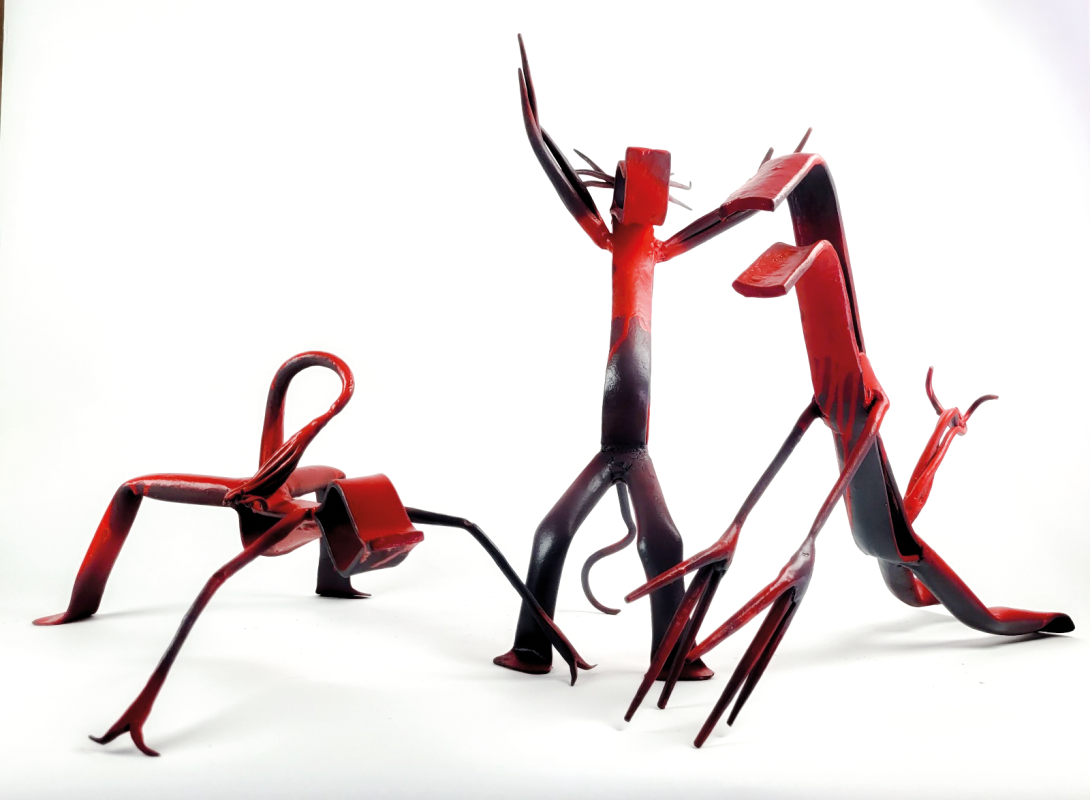
Even before I joined the RCP, I had created three cryptids which I called “Creatures against Capitalism” or “Blood, Concrete and Steel”. With Luigi Mangione on my mind, I spray painted the forged creatures red and grey to create a look of spilt blood on concrete. I had no class analysis or proper understanding at that point, just a hatred for the elites.
Now my coming degree show will have an explicit political message. I want my sculptures to show how rotten and decrepit the ruling class is, and that capitalism is nothing but a decaying corpse that deserves to be buried.
View this post on Instagram
I want to use my art like the RCP uses our paper, The Communist: as a political weapon and tool, and as a talking point to bring the audience into discussions on the art, but more so about capitalism itself.
As Alan Woods says, “the separation of art from life has reached such an extreme that the contradiction cries out to be resolved. But this contradiction cannot be resolved within the narrow limits of art itself, but only on the broader canvas of the struggle of living men and women to transform society, and in the process to change themselves.”
View this post on Instagram
Above all I want my work to show that capitalism is not the be all and end all. Nothing lasts forever, we have not lived under capitalism since the dawn of time, and revolutionary change is only a matter of time.
Ellie Peters’ work is being shown 1-4 July in London at the New Designers show.
Silvio Rodríguez: The poet of the revolution
Diego Leon, Crystal Palace
Internationally, Cuba is often associated with rum, cigars, and music. Yet beyond groups like Buena Vista Social Club, few Cuban artists are widely recognised in English-speaking countries. In Latin America, however, Silvio Rodríguez became a voice for revolutionary music.
Rodríguez was born in Havana in 1946, and was only 13 when Fidel Castro and the barbudos entered Havana during the Cuban Revolution. He played a role in the literacy campaign, joining the ‘literary brigades’, where a friend taught him to play the guitar.
View this post on Instagram
In the 1960s he began playing on Cuban television and became one of the founders of nueva trova, a movement linked to the ideals of the revolution.
By the 1970s, his music spread internationally; he performed in Berlin and Moscow. His music was banned for decades across Latin America due to his left-wing views. He went on to serve as a deputy in Cuba’s Popular Assembly for 15 years.
His work blends jazz, bolero, rumba, and Cuban son, alongside classical influences; exploring themes of love, life, and politics shaped by revolutionary ideals.
View this post on Instagram
Some of his most famous works are his 1978 album Mujeres, his album dedicated to the twentieth anniversary of the revolution; Rabo de Nube; and Silvio, which includes the song El Necio, influenced by the life of Fidel Castro, his defiance, and integrity.
Rodríguez has drawn audiences across generations, from stadiums in Latin America to small neighbourhood venues in Cuba, becoming an enduring emblem of the Latin American left.