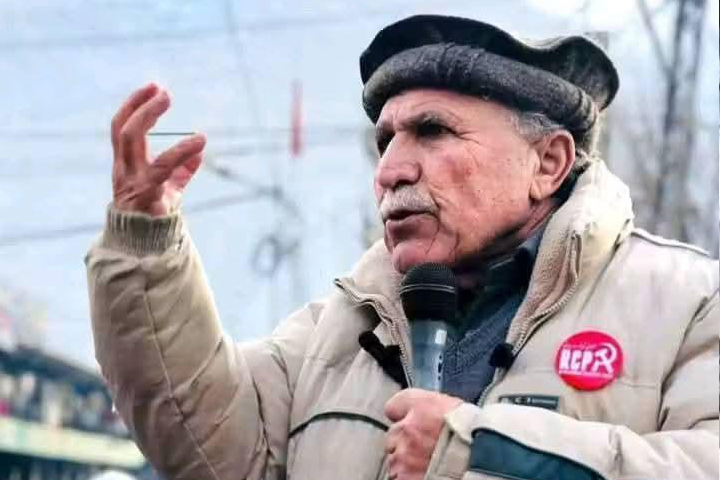
Ehsan Ali, a leading member of the Inqalabi Communist Party (RCP) and Chairman of the Awami Action Committee (AAC) in Gilgit-Baltistan, was arrested on 10 March alongside other AAC leaders after discussing peaceful protests in the region.
Lotta Angantyr, the British RCP’s national organiser, spoke with Adam Pal, leader of the Pakistani section of the Revolutionary Communist International (RCI), to find out more about the political situation in the country and the conditions that our comrades are facing in the struggle for socialism (see below).
Since Ehsan Ali’s arrest, an international solidarity campaign to demand their release has been launched by the RCI, and is now supported by Genocide Watch and Amnesty International, as well as public figures like Jeremy Corbyn.
Week of action
This week, we are organising a week of action to demand the release of Ehsan Ali and the other leaders of the AAC. This is part of an international day of action on the 4 June, organised by RCI.
Tomorrow, our comrades in London are going to mobilise for a protest outside the Pakistani consulate. It will be attended by former shadow chancellor John McDonnell and newly-elected Harrow councillor Pamela Fitzpatrick.
Together with RCP spokesperson Fiona Lali, they will attempt to hand a letter to the High Commissioner, with the aim of putting pressure on the Pakistani state to free our comrades.
View this post on Instagram
On 4 June, protests will be held outside of the Pakistani consulates in Birmingham and Bradford. Georgie, an RCP organiser from Bradford, explained that she sees the protests as “an important opportunity to demonstrate the traditions and methods of internationalism and solidarity.”
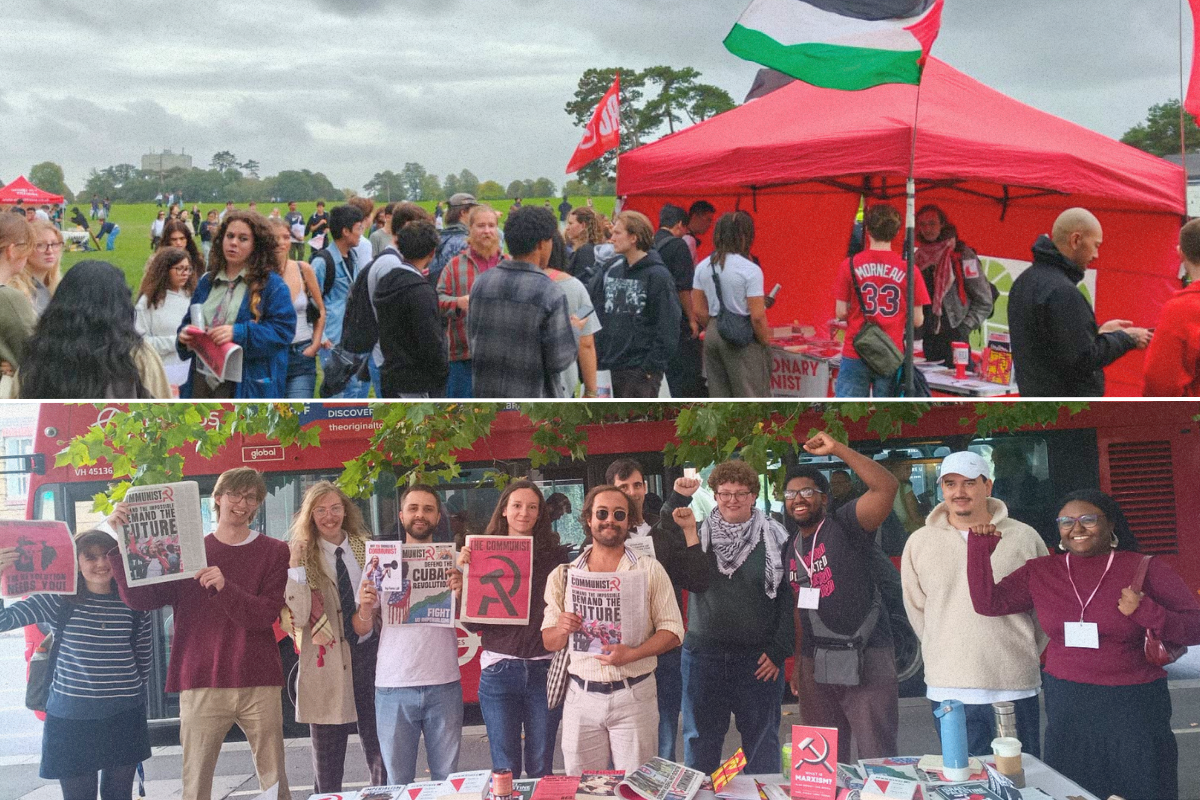
And on 6 June, the whole party is mobilising for ‘Super Saturday’ paper sales, with stalls set up in town centres across Britain.
RCP members will raise the ‘Free Ehsan Ali’ campaign through speeches and conversations with members of the public, asking them to sign the petition, and donate to the cause. In Edinburgh, we plan to hold a protest outside the Scottish Parliament with the aim of speaking with MSPs and gaining their signatures.
In the last couple of months, the solidarity campaign has received increased attention, with figures like Jeremy Corbyn, and trade union leaders such as Ian Hodson, National President of the BFAWU and Sarah Woolley, general secretary of the BFAWU, stating their support for Ehsan Ali.
We won’t rest until our comrades are free. Free Ehsan Ali! Hands of the AAC!
For updates and resources, head to pakistansolidarity.org – the official website of the campaign.
Lotta: Following the arrest of Ehsan Ali and other leaders of the AAC, we have heard reports of increased repression against political activists across the Pakistani state. What is the main political reason for this?
Adam: The ruling class has unleashed unprecedented attacks on the people of Pakistan. Apart from the economic crisis and near-bankruptcy of the economy, whose burden is being shifted onto the masses, state repression has reached new heights.
Pakistan is a country which has gone through many instances of martial law and dictatorships. In fact, for almost half of the 80 years since independence, Pakistan has been under army dictatorships, while for the other half it has been under indirect control of the generals through civilian leadership.
At the moment, it is an elected government, though the last elections saw the biggest-ever election fraud, even by Pakistani standards. The current regime is directly controlled by the army chief of Pakistan. Though this is nothing new, the regime is in deep crisis due to its lack of support among the public.
The ruling class is aware of the revolutionary movements across the region, including countries like Sri Lanka, Bangladesh, and Nepal. That is why they are afraid of a similar movement in Pakistan and are using every measure to suppress any kind of dissent.
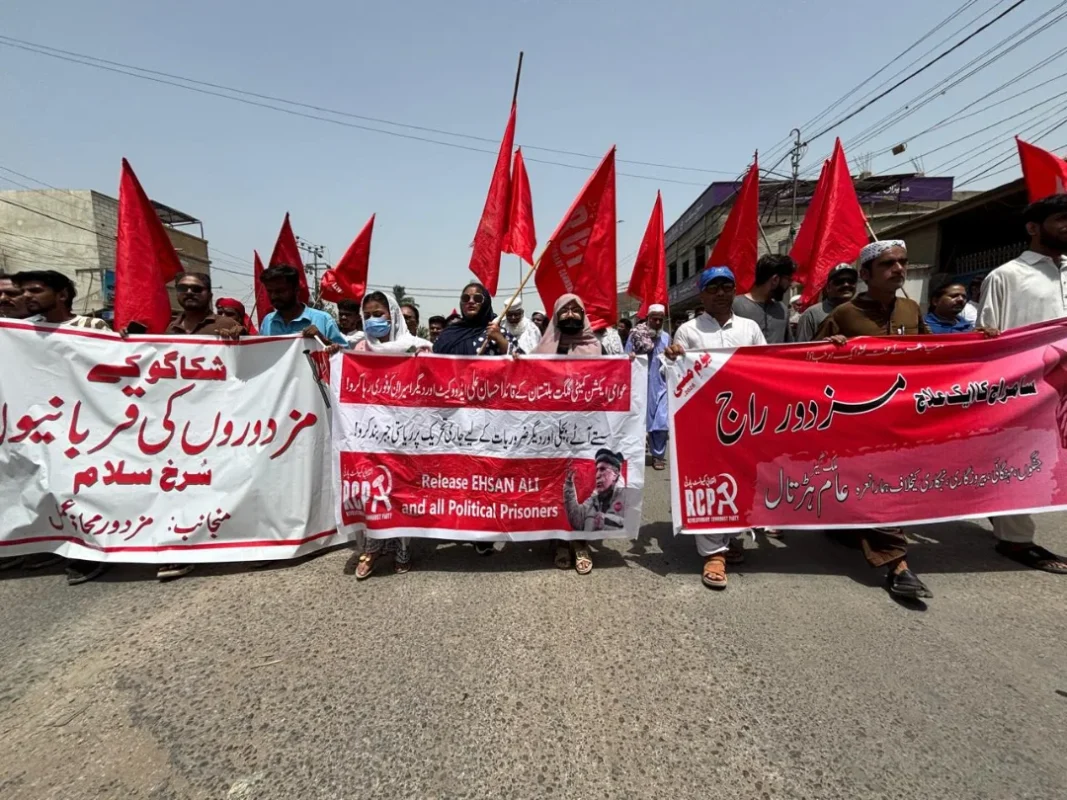
New legislation to control the media has been imposed, while posting on social media against price hikes or other policies of the government has become a crime. Democratic rights, which the people of Pakistan won after fighting against brutal regimes over the decades, are being snatched away gradually.
Today, we are in a situation where even organising a small protest against the government has become an act of huge courage. There are several cases where organisers of small protests are abducted and tortured by the state authorities or are arrested and charged under terrorism laws.
One of the major reasons for this has been the decline of all mainstream parties across the board. The Pakistan Muslim League, PML(N), which has ruled the country several times, is now in government. Traditionally backed by the bourgeoisie and petty bourgeoisie, in the last elections its main leaders lost their seats, including three-time prime minister Nawaz Sharif, who lost his own seat in Lahore, though he was declared victorious through fraud.
Another party in the government is the Pakistan People’s Party (PPP), which at one time was the largest party in the country and has ruled many times. This party was born out of the revolutionary movement of 1968–69, when its leader Bhutto raised the slogan of socialism and all power to the people. But after coming to power, Bhutto betrayed these objectives and strengthened capitalism, though he was forced to carry out some nationalisations of industry.
For several decades, this party was used as a vehicle by the working class to vent its anger against the ruling class; thus it came to power several times. But at the moment, it has become a tool of the ruling class to suppress people, and all the mass support it enjoyed in the past has totally evaporated.
Due to fraudulent elections and the dictatorial methods of the generals, this party is still in coalition in the central government and rules in two provinces. Both these main parties, along with smaller parties, have become symbols of hatred.
The main opposition party in parliament is Imran Khan’s Pakistan Tehreek-e-Insaf (PTI). It is an open secret that this party was brought up by the generals as a counterweight to the other political parties so that the generals can get better control of the situation.
In 2019, the PTI came to power with the blatant support of the generals and election fraud, though it got some support among the petty bourgeoisie due to its rhetoric against corruption in the other two main parties. After coming to power, it carried out severe attacks on the working class, and corruption reached new heights, while the bourgeoisie of Pakistan made unprecedented profits.
The PTI also unleashed a severe wave of repression against democratic rights in the country and crushed any kind of dissent. After the collapse of US imperialism’s puppet regime in Afghanistan, the imperialist powers, and especially the USA, turned against the PTI. The Americans faced a humiliating defeat and, in search of a scapegoat, they put all the blame on the ruling class of Pakistan.
Over the course of its history, even after so-called independence, Pakistan has been strictly controlled by imperialist powers. At first, it was mostly British imperialism, but gradually the Americans took over. For decades, the American ruling class has had the final say in all important matters of the state, while the economy is strictly controlled by the IMF and World Bank. Even important ministers, including the finance and home ministers, are mostly approved by the imperialists.
The process to kick out PTI from power in 2023 resulted in a split in the ruling class. Some generals supported the PTI while others wanted to throw them out of power. This narrowed down to the appointment of the new army chief, in which both factions wanted their favoured person in this most important seat of the country.
PTI lost this battle and since then all its main leadership is in prison, while the other faction is in control of the state. After being appointed army chief, the current incumbent has been able to get constitutional changes in his favour. He not only extended his tenure and elevated himself to field marshal, but got lifetime immunity from any prosecution. Pakistan is under de facto martial law.
The repression against the PTI paved the way for crushing any democratic forces present in the country. Due to the fear of a mass revolutionary uprising, state authorities are trying to nip this in the bud. Any attempt to organise workers or youth is regarded with alarm.
The issue of missing persons has been ongoing for a few decades now, where a political activist is abducted by the state authorities and thrown in a dungeon and kept there for years, sometimes even decades, without any trial, and nobody knows his whereabouts.
If he dies inside, the tortured body is thrown in a sewer. In fact, this shows the crisis of the judiciary as well, which has become so impotent and lame that the ruling class can’t use it for its own purposes. Extrajudicial methods have become a norm to enforce the writ of the state.
In fact, the whole state is in a crisis and the general public has lost trust in all these decaying and rotten state institutions. The only way forward is to overthrow this capitalist system and this rotten bourgeois state through a socialist revolution and replace it with a workers’ state.
Why has the state come down so heavily, specifically against Ehsan Ali, the AAC, and the Inqalabi Communist Party? How is it impacting our comrades?
Ehsan Ali is the most senior advocate [lawyer] of Gilgit-Baltistan and he has been fighting for workers’ rights in the courts of Gilgit since the start of his career in 1986.
He built the Awami Action Committee (AAC) around 2014 and led mass protests of tens of thousands across Gilgit-Baltistan for subsidised wheat flour and other basic rights. He won this battle despite huge state repression. Through this mass movement, AAC under the leadership of Ehsan Ali was able to bring together different sections of this diverse society on one platform.
Establishing an alternative mass platform in which the ruling class has no control was Ehsan Ali’s biggest ‘crime’, for which he was arrested several times in the last decade.
In 2019, he joined our party and is now one of the main leaders of RCP in Pakistan. In Gilgit-Baltistan, he was actively building the RCP and new branches were established in Gilgit and Hunza. Our young comrades also led a student movement in Karakoram University in 2023 against fee hikes in Gilgit, which is the main university of this region with thousands of students.
The RCP started a regular study circle among the workers of auto mechanic shops in Gilgit, still being organised by one of our leading comrades, who organised a May Day activity this year despite severe state repression.
In 2025, the state authorities brought a new land reform bill in the GB assembly to encroach upon lands owned by common people for the interests of imperialist powers, who want to loot the mineral and natural wealth of this region. Ehsan Ali organised AAC meetings against the bill and was planning a mass movement when he was arrested. When other comrades organised protests for his release, they were arrested and tortured.
But still there were several protests for his release across GB and in Pakistan. A huge international campaign was launched by the RCI across the world, after which the state authorities released him from prison. Due to the pressure of the movement, his name was removed from the notorious Fourth Schedule. This is a list of people being charged with terrorism, allowing the police to restrict their movements.
This year, US and Israeli imperialism’s war on Iran once again sparked anger against Pakistan’s slavish ruling class following the dictates of US imperialism. There were big protests in support of Iran in Pakistan and in Gilgit-Baltistan, in which security forces opened fire and several were killed. The ruling class was fearing that this movement could spread across the country and deepen the general sentiment of hatred against the ruling class. Thus, they doubled down on state repression.
Against this backdrop, Ehsan Ali visited the injured protesters in the hospital and organised a small meeting of the leadership of the AAC over an iftar dinner to discuss the situation and how AAC could plan its activities.
This meeting was declared a terrorist activity and Ehsan Ali and other leaders of the AAC were arrested on 10 March. Since then, he has been in prison and has been denied medical assistance and health facilities, despite his old age and declining health. One police officer in Gilgit said the state intended to let him die in prison.
Two other leading comrades of RCP in Gilgit, Waheed Hasan and Asghar Shah, are still underground as police are trying to arrest them as well. For the last two months, they have been in hiding and now their relatives are being harassed, threatened with arrest, and pressured to give them up.
Other comrades of the RCP are under strict surveillance by the state authorities and it is being said that they want to crush RCP in GB at all costs. Anyone who tries to organise a protest in support of Ehsan Ali is immediately arrested. One leading lawyer of Gilgit, Taaruf Abbas, who sent a voice message in a WhatsApp group asking other lawyers to actively fight for Ehsan Ali, was booked under charges of terrorism.
Another leader of AAC was booked for posting on Facebook in support of Ehsan Ali. Despite this situation, comrades of RCP, along with family members of Ehsan Ali, organised a strong protest in Hunza on 4 May. They blocked the main highway connecting China with Pakistan and continued the protest for several hours. During the protest, solidarity was growing and people from other districts were joining.
This invited a severe crackdown and police arrested three main organisers, who were released after a few days in custody. A police case was registered against the organisers of this protest, all members of RCP. Ironically, one sympathiser of RCP who had died one year ago was named in this police case. This shows that police are strictly targeting RCP and its sympathisers.
Police raided a sit-in in Hunza, Gilgit-Baltistan demanding the release of Comrade Ehsan Ali and other Awami Action Committee leaders, arresting three protesters. (1/4)👇 pic.twitter.com/bnzjJeErCt
— Inqalabi Communist Party (@rcipakistan) May 5, 2026
What conditions are our comrades facing while under arrest?
Last year, when the comrades were arrested, they faced severe torture. Ehsan Ali was denied medical care and only after several international protests was he shifted to the hospital.
Young comrades were interrogated by a Joint Investigation Team (JIT), in which police officers were accompanied by the military secret services. Our comrades were asked to give statements against Ehsan Ali and the RCP. They were interrogated under torture, asked how RCP works, how it is funded, any hint of its connection with enemy countries, and how it operates at the country level despite having meagre resources.
These young comrades were tied with a rope and hung from the ceiling, turned upside down, as well as beaten mercilessly during this investigation. After that, they were offered lucrative jobs if they left RCP or joined state authorities as informers.
What impact has the international Free Ehsan Ali solidarity campaign had on comrades in the Inqalabi Communist Party and the AAC?
The international campaign is having a huge impact here. The state authorities are under huge pressure and this is the only reason that Ehsan Ali and other comrades were released from prison last year.
This time we are again hopeful that this campaign will be successful. On the other hand, many other mass leaders are still in prison after several years. The leaders of Baloch and Pashtun mass movements in Pakistan have been arrested and are languishing in jails after years.
The international campaign has raised hope and a feeling of solidarity among the common people of Gilgit-Baltistan, who were happily surprised at such strong support for their cause from comrades around the world.
This helped to raise the profile of RCP across Pakistan at an unprecedented level. The campaign has strengthened the belief in the slogan of working-class solidarity and the ideas of class solidarity across divides of colour, language, and nationality.
In fact, the ruling class uses these prejudices and divisions to divide the working class, whereas this campaign smashed these divisions and brought forward the idea of class brotherhood.
What is it like to build the RCI in Pakistan?
In Pakistan, RCP has branches spread across the whole country. There are more than 70 branches which cover all the important areas and regions, from Karachi in the south on the coast of the Arabian Sea to the north in Peshawar, Kashmir and Gilgit and Gwadar in the south.
Our centre is based in Lahore, and we have presence in all major universities across the country. Our comrades have been intervening in movements of the working class across Pakistan especially in the industrial area of Karachi.
Over the years, we have intervened in the movements of public sector workers, workers for the railways and airlines, electricity workers, health workers, teachers, professors, and several other sectors.
This year, we organised or intervened in May Day activities in more than 20 cities. From coal mine workers in Balochistan, salt mine and industrial workers in Jhelum near Islamabad, to health workers in Kashmir, we are taking the message of revolutionary communism.
RCP activities across Pakistan on May Day 26 🚩#MakeMayDayCommunistAgain pic.twitter.com/UHTxjdqR4h
— Inqalabi Communist Party (@rcipakistan) May 4, 2026
The RCP has intervened in the mass movements of the oppressed nationalities. Our intervention in the mass movements of Pashtun and Baloch people played an important role in putting forward the perspectives and analysis for the active layers of the movement, which has proven correct over the years. We also condemned the forcible eviction of more than two million Afghan refugees from Pakistan and joined protests for this cause.
Another important role that we played has been in the mass movement of AAC in Azad Kashmir. This mass movement organised several long marches of hundreds of thousands of people and has won huge victories, including up to a 90 percent reduction in the price of electricity and more than a 50 percent reduction in the price of wheat flour.
We intervened with our paper The Communist, which we publish 2,000 copies of every month. Over the years, the section has published a quarterly theoretical magazine Lal Salam, and many books, including Urdu translations of Trotsky’s Permanent Revolution and Alan Woods’ Bolshevism: Road to Revolution.
DM us or contact us at the following number to get your copy: 0319-8401917
.
.
.
.
.
.
.
.#TheCommunist #CommunismInPakistan #inqalabicommunistparty #rcp #rci pic.twitter.com/aNjrUMZClR— Inqalabi Communist Party (@rcipakistan) January 20, 2026
Other booklets we published have been on dialectical materialism, how to fight imperialism, the women’s question, the national question and Kashmir, and on the imperialist character of Chinese investment in Pakistan.
Our website (communist.pk) is the only website in the Urdu language with communist views and analysis. Our social media presence attracts much attention and some posts get views in the hundreds of thousands.
We have produced our own revolutionary songs and some comrades are renowned poets. The section has a tradition of organising street theatre and music performances among workers and students and on bookstalls across the country to take our revolutionary message to the general public.
Comrades in Pakistan have to endure difficult financial situations to organise their activities. The country’s economy is going through its worst crisis in history and price hikes and unemployment have taken away most of the savings of the majority of the population.
There are no healthcare and education facilities for the majority of the population and whatever facilities existed, in dilapidated conditions, are now being privatised and getting out of reach of the general public. But despite this, comrades are collecting funds from students and workers and continuing their activities. We have a centre in Lahore with six full-timers, while seven full-timers are working in different cities across the country.
We have offices in ten cities. Our finances are mostly in deficit, but we use major activities during the year to raise funds to cover these monthly deficits. Comrades make huge sacrifices to cover our expenses on a regular basis.
RCP in Pakistan has faced state repression many times over the years. In 2018, several of our leading comrades were abducted by state authorities in Karachi after a protest outside the press club and were severely tortured for several days.
They were beaten with sticks, especially under their feet and other soft parts of their bodies. One comrade was given electric shocks as well. They remained blindfolded all day and night and were interrogated for their activities.
But due to a strong international campaign, they were released a few days after their abduction. Similar incidents happened a few more times and our offices have been raided many times.
Just last month, our centre was raided by Military Intelligence to force us at gunpoint to remove a report from our website. Sometimes, comrades and sympathisers of RCP are offered lucrative posts and some other benefits and incentives.
If a new recruit enthusiastically posts on social media about the party, he or she is immediately approached and told to keep away from this party for their own safety. Religious fundamentalists and other elements of the right wing keep on posting hatred against the party on a regular basis and are often joined by liberals, nationalists, and supporters of mainstream parties.
Sometimes, comrades receive threats and intimidation, especially during university work. Our comrades have to deal with several right-wing student organisations, from Islamic fundamentalists to nationalists, the security apparatus, faculty and administration, police, and other secret services of the state.
But for all those who are part of the RCP, all this repression and these witch-hunts strengthen our resolve even more and we continue to fight against the root cause of all this horror, which is capitalism, and are building our forces to overthrow it.
At our last congress, held in April this year, our membership stood at 752 and we have a target to reach 1,000 in one year. Our congress was held in very difficult circumstances.
Some glimpses from the First Congress of the Inqalabi Communist Party 🚩
Inqalab Zindabad 🚩
RCP Zindabad 🚩
.
.
.
.
.
.
.
.#InqalabiCommunistParty #LongLiveCommunism #CommunismInPakistan #FreeEhsanAli #LongLiveRevolution pic.twitter.com/h9jLp6FxES— Inqalabi Communist Party (@rcipakistan) April 9, 2026
Along with the start of the Iran war and arrests of our leading comrades in Gilgit, there was an unprecedented hike of 70 percent in fuel, due to which many were unable to travel. There was also a threat of a police raid on the venue as official permission from the district administration was denied. Though it didn’t happen in the end and we were able to secretly hold it. In fact, any meeting involving a few dozen comrades is becoming increasingly difficult.
But we are ready to fight this to the end. And the ideas of revolutionary communism give us all the strength and energy to fight for our cause. We understand that this is not a fight for the lives of a few individuals but a fight for the future of humanity and for the whole civilisation.
As capitalism has become a threat to the existence of the human race, we must spend all our energy and strength in organising forces to overthrow it. We are fighting for a socialist future free from all the misery, oppression, and exploitation faced by the working class everywhere today. This is the future which is worth living for and worth dying for.
- Death to capitalism!
- Long Live communism!
- Forward to socialist revolution in Pakistan!
- Workers of the world, unite!