India has just seen a week where decades happened. Against brutal repression, mass demonstrations organised by the Cockroach Janta Party (CJP) have forced the resignation of India’s hated education minister, Dharmendra Pradhan.
This is an important and rare victory, which has sent shockwaves across the country.
But at the moment that tens of thousands were only just preparing to enter the streets, and as Modi and the entire government were in an outright state of panic, the CJP abruptly halted protests. This is a major mistake that risks snatching defeat from the jaws of victory.
Gen Z fights back
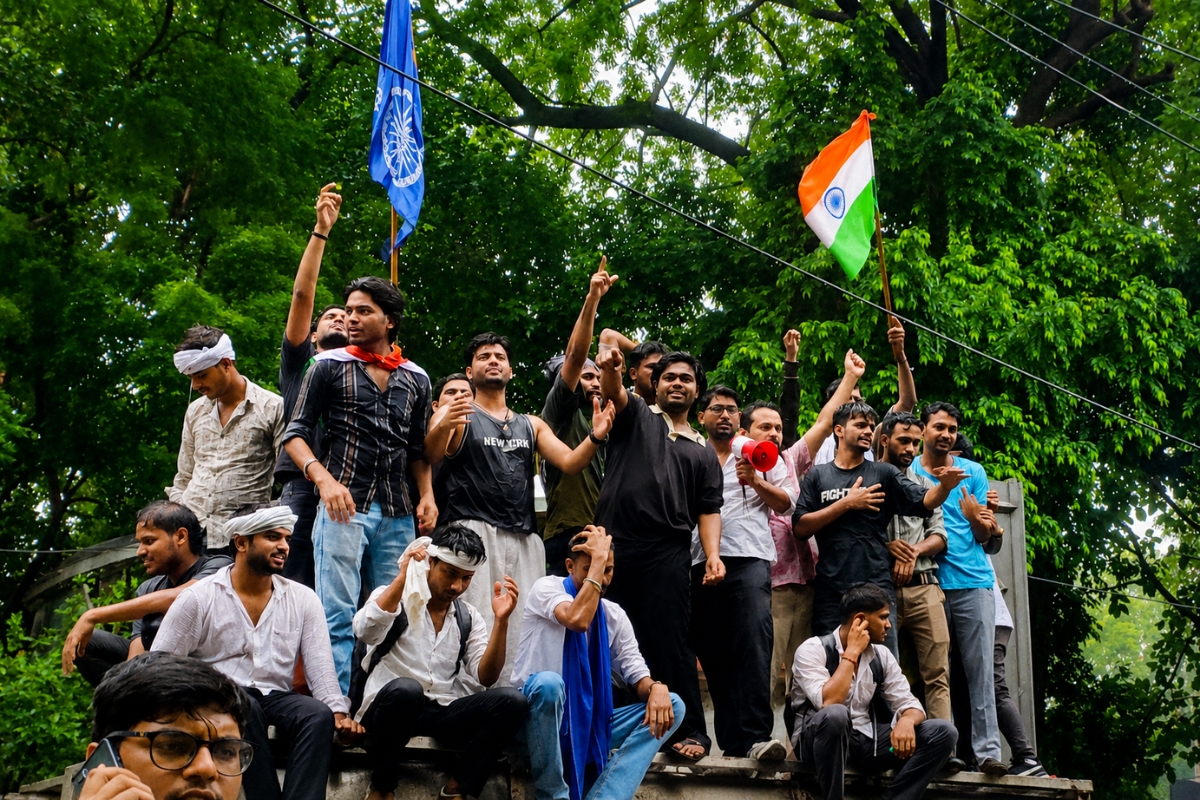
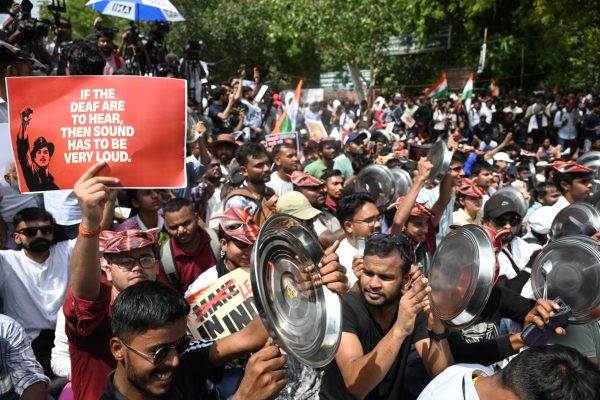
The unprecedented ‘Cockroach’ movement led by the country’s Gen-Z youth has engrossed the entire nation. The whole country is talking about politics. There was a carnival-like atmosphere in the big cities like Delhi, Mumbai, and Kolkata.
Even Bollywood superstars like Salman Khan and India’s greatest cricketer Sachin Tendulkar made vague statements of support for the student protesters.
This in a country where dissent against the government and its strongman leader Narendra Modi is usually met with smears, censorship, beatings, imprisonment, or even death.
Events have moved at speed. The Cockroach Janta Party (CJP) was only founded in mid-May in response to Chief Justice of India Surya Kant’s comments that the nation’s unemployed youth were ‘cockroaches’.
Its founder Abhijeet Dipke arrived back in India in early June and began to hold rallies. An encampment was set up at Jantar Mantar in the heart of Lutyens’ Delhi towards the end of June.
Their main demand was the resignation of education minister Dharmendra Pradhan, who they held responsible for the leak of the paper for the gruelling NEET medical examination, invalidating the test, which led to the suicide of at least 17 students.
In protest, Sonam Wangchuk, a well-known climate activist and engineer, began a Gandhian fast until death. He was forcibly taken away from the encampment on Saturday 18 July, which sparked the Sansad Chalo march to parliament.
Up to a hundred thousand attended the march, and they were met by the police with lathi (baton) charges, tear gas, and even pellet guns. The images horrified the country, and especially the youth.
But instead of repression cowing the masses, it unleashed the pent-up rage which has been building for over a decade. Incredible scenes emerged of tens of thousands of India’s youth pouring into the streets, showing they were no longer afraid.
This lack of fear of the repressive state apparatus was typified by a widely circulated image of a young woman standing in front of a police van filled with detained protestors, refusing to step aside until they were released.
View this post on Instagram
Other viral videos show protesters being smacked by lathi charges and standing right back up. In Delhi, the far-right thugs of the RSS (Rashtriya Swayamsevak Sangh) were chased away by students throwing flowerpots.
The movement had a jubilant and defiant mood throughout. Creativity and satire were on full display. Young protesters posted reels with titles such as ‘Getting ready to go get detained by Mumbai police’, or dressed as cockroaches, Spiderman, Iron Man, Batman, and Superman.
The encampment was inundated with food, clothes and blankets. Dipke had to publicly urge people to stop sending in supplies because they had too much!
One viral video really captures the mood. It shows an interview with a young, white British tourist from London, standing in the middle of the protests in Delhi. He talks about speaking to students who are “fighting for their education against this corrupt government.”
He goes on:
“[A]fter listening to so many people, about their stories… Modi is fucking everyone up, everything should be fixed in this country… the censorship in the media is wrong… fuck Modi.”
His words are met by screams and cheers, as though he had scored a goal in the World Cup.
View this post on Instagram
Strongman bows
Amit Shah, the Home Minister and the man in charge of the Delhi police, is a merciless monster who is considered even more brutal than Modi. When he saw the march towards parliament, he unleashed savage repression to destroy the encampment and crush the ‘Cockroaches’.
This was nothing unusual. But the defiant and angry response from the Cockroaches alarmed the BJP leadership, leading to recriminations. Some BJP leaders advocated more repression, others to placate the protesters. In the end, they ended up doing both.
For example, 300 FIRs (criminal investigations) and prohibitory orders were circulated against protestors in Mumbai. At the same time, the Central Government directly appealed for Sonam to end his fast, and by Friday the cabinet had rushed through 10-year jail sentences and fines of up to ₹10 crore (just over $1 million) for those officials responsible for the exam paper leaks.
Still, the protests continued to grow. In the big cities like Mumbai, Pune, Kolkata, Bengaluru, Indore and Jaipur, thousands upon thousands poured out. They also poured out in Modi and Shah’s homelands, Ahmedabad and Gandhinagar.
More significantly, on Friday the farmers’ union promised to march to the encampment and stay until the protesters’ demands were met. The farmers themselves previously inflicted a defeat on Modi when they forced him to withdraw his reactionary Agricultural Bill in 2021.
This is key to the concessions the students have wrung from Modi: he and his regime were terrified of the prospect of other layers, including the farmers and the broad layers of the exploited masses, being drawn into the student struggle. Individual youths in smaller towns and cities also started to take spontaneous action.
This is precisely what happened in Bangladesh: the movement started with protests by petty bourgeois layers of youth, but quickly expanded to draw in much broader, enraged layers of the masses who were outraged by the brutal repression against these brave and defiant young people.
The Indian Express reported that, in the last 48 hours before Dharmendra Pradhan resigned, Modi took direct control of the response. Modi posted a desperate, personal video to placate protesters, followed by a second at 23:00 on Friday night. Top BJP officials monitored responses closely. But in the end this only inflamed the situation. Comments such as ‘pack your bags’ and memes using Modi’s face ridiculed a man once feared.
View this post on Instagram
By Friday evening, Pradhan was still preparing for parliamentary questions. But things were getting out of hand. The spectres of Rajapaksa and Sheikh Hasina (the tyrants toppled by the Gen Z revolutions in Sri Lanka and Bangladesh) haunted Modi. But he has also learnt from them: better to cede some ground than risk a youth protest reaching revolutionary proportions.
A senior BJP source said “there weren’t many choices” left. And so, Modi bowed.
A mistake to call off protests
Dharmendra Pradhan’s resignation is only the second ever minister to resign because of protests during Modi’s 12-year tenure, and the previous one did not pose an existential threat to the entire government’s rule.
The real significance of this concession is that the Cockroaches have demonstrated that Modi is not invincible. The ‘strongman’ has been forced to eat a slice of humble pie.
Therefore, there was a feeling of pure elation after the news of Pradhan’s resignation on Saturday. The video of Dipke’s first reaction to hearing about his resignation has almost 150 million views on Instagram. Having succeeded, Dipke and the CJP have gained enormous authority.
But the CJP then immediately promised to end protests in ‘good faith’ with the BJP. We must be absolutely clear: this was a big mistake.
This has sown confusion at a time when Modi and his whole government were on the rocks, and tens of thousands of young people in cities outside of Delhi had only begun to move.
Pradhan has been replaced by someone worse, Pralhad Joshi. He is an RSS ideologue responsible for releasing 11 men who were serving life terms for raping Bilkis Bano and killing her family in the 2002 Gujarat pogrom – orchestrated, of course, by Narendra Modi himself.
The leadership of the CJP, the likes of Dipke, Saurav Das, and Ashutosh Ranka, are all accidental figures. They have been thrown into this position at the head of the movement simply because they said the right thing at the right time. Their ‘Cockroach’ slogan began as a joke, but it resonated powerfully with the contempt millions of Indians feel coming from their rulers.
These leaders are not hardened activists, let alone revolutionaries or Marxists. They all went to prestigious universities in the West not long ago, and the latter two had relatively comfortable middle-class jobs. Frankly, they seem shocked and terrified by what they have unleashed!
Their outlook is confused, as expressed in slogans like ‘Jai Bhim’ (‘hail Ambedkar’, the liberal Dalit who wrote the Indian constitution) and ‘Bande Mataram’ (a nationalist chant to the motherland). They have also stopped people from chanting ‘Aazadi’ (freedom).
This explains their extremely limited demands: to only remove one minister, and compensation for those who committed suicide after NEET exams.
Most importantly, it explains their faith in the Indian state – in the police, the Supreme Court, the ‘parliamentary opposition’ and the Indian constitution.
View this post on Instagram
They are feeling their way through events empirically. They do not really understand how they’ve been able to force the resignation of Dharmendra Pradhan.
Ultimately, the leaders of the CJP lack a revolutionary perspective. We must ask: Are these people fit to lead a life-or-death struggle against the Modi regime, behind whom stands the even more powerful ‘Billionaire Raj’?
On the contrary, Narendra Modi and the BJP government are extremely class conscious.
They understood that the real threat to their rule came less from the students themselves, and more from the threat by the farmers movement to link up with the student movement, and that other layers might follow suit. They understood that the danger lay in the waves of people who kept coming out. They have seen Hasina and Rajapaksha fall. They see that fundamentally similar conditions exist in India – which is a tinderbox – and that the movement of the students could act like a spark on this kindling.
Modi bowed not out of fear of the Cockroach movement itself, but because the movement threatened to spiral out of control and topple the whole regime. He is now intent on sowing confusion and fear through repression. And Modi has no qualms about taking back his ‘promises’, overriding the nice words written in the constitution, using his RSS thugs to beat up opposition, or abusing state power.
Having convinced the CJP to retreat by offering up Pradhan’s resignation, he is now acting decisively and with impunity to isolate and make an example of the most advanced and radical elements of the movement.
Foresight over astonishment
What we witnessed last week was entirely predictable to Marxists, given the similar conditions in other countries that have been swept by Gen-Z revolutions, like Sri Lanka, Bangladesh and Nepal.
Might we remind our readers of what we published on 3 October last year:
“The same conditions that sparked the Gen Z movement exist in India. And to emphasise again: when the revolutionary spark catches in India, it will have more far-reaching consequences than any of the movements we’ve seen in the recent past.”
We do not have a crystal ball and cannot say with certainty where the movement is headed. But since the cessation of protests, Modi wasted no time in taking repressive action. There are reports of hundreds of student protesters having been arrested with criminal charges in Bihar and West Bengal. Anti-government graffiti is also being painted over.
The illegal attempt by the Delhi Police to enter the CPI(M) Headquarters, AKG Bhavan, to arrest SFI leader Aishe Ghosh is a dangerous assault on democratic norms.
The police arrived in a private vehicle, with some personnel not even in uniform. When CPI(M) MP @JohnBrittas and…
— M A Baby (@MABABYCPIM) July 28, 2026
Pro-Modi cells are spreading propaganda that the CJP leadership are partying in five-star hotels and are completely out of touch. There are reports of anti-government social media content being taken down online and RSS thugs feeling emboldened to attack known Cockroaches in the streets.
Modi is rearming. But at the same time, he could also be overplaying his hand. Under pressure from this new wave of repression, the CJP leadership has been forced to say they will restart protests should those arrested not be released.
In Shivaji Park in Mumbai, on the day after the call to protest was unilaterally ended, thousands gathered to celebrate, raising the chant, “Modi, Amit Shah… Abhi Baaki Hai!” (‘Modi and Amit Shah are still left!’). Evidently, some of the ‘Cockroaches’ are prepared to go a lot further than the leadership.
The situation is very fluid, with no shortage of combustible material that could reignite the movement on an even higher level.
The fact that the CJP leaders are attempting to limit the movement to the single demand of removing Pradhan suggests that they fundamentally do not understand why they won. They won a limited concession out of fear that the movement could escalate into something much bigger. However, once the movement recedes, if Modi is left in place, the regime will be looking to get revenge.
How this all plays out from now on will be determined by events. The Cockroaches are throwing sparks into a volatile situation – the Iran War, Trump’s tariffs on India, the US killing of Indian seafarers in the Strait of Hormuz, the national question in Kashmir, ongoing tensions in Manipur, farmers protesting the US-India trade deal, rampant unemployment for graduates, etc.
The setback Modi received in the war with Pakistan has seriously weakened him. Meanwhile, the conditions of the masses are becoming desperate.
All the while, the mighty Indian working class, who are highly exploited but extremely powerful, are watching all of this, but have not yet moved. But the fact that the regime regards even privileged layers of students as cockroaches, that these students too are facing hardship and unemployment, and that these students are able to fight and win – this must be providing food for thought among the workers.
We can say with confidence that there is no shortage of revolutionary potential in India.
And we must also remember what a profound impact this week has had on India’s youth. Those between the ages of 15-29 make up a larger population than the entire United States of America. They have grown up in a world only knowing one leader, thinking he is all-powerful, understanding the cost of dissent, the cost of speaking out.
They are starting to lose their fear. There are more and more cracks in the facade, but it is yet to fully crumble.
These events prove how crucial leadership is in the decisive hour. The absence of revolutionary leadership remains a fundamental weakness of all the tremendous movements that have swept South Asia in recent years.
India is the key country in the subcontinent. We have seen a just small glimpse of the revolutionary potential that exists in Indian society. This will not be a one-act drama.
We have a simple message for those Cockroaches who are frustrated with their leadership’s premature demobilisation and who want to resist Modi’s crackdown:
- No compromise with the BJP!
- Indefinite protests until Modi resigns!
- Indefinite protests until the entire BJP government and the system they defend is swept away!
- Victory to the Indian youth, workers and farmers!
- We have a world to win!