At a time when climate change is no longer an abstract ‘question of the future’ for Britain, but is making itself devastatingly felt in the here-and-now, it’s right to ask: where has the climate movement gone?
For young people today who only have further ecological collapse ahead of them, it can be seriously demoralising to not see anyone taking action to save the environment. It’s no wonder that this summer’s rising temperatures have brought with them a rise in ‘climate anxiety’.
So what happened to the climate movement? And will we see its return any time soon?
‘Fridays for Future’
Before the pandemic, the international ‘Fridays for Future’ movement, which started on the initiative of a 15-year-old Greta Thunberg, did provide an outlet for the youth’s anger against the ruling class’s role in killing the planet.
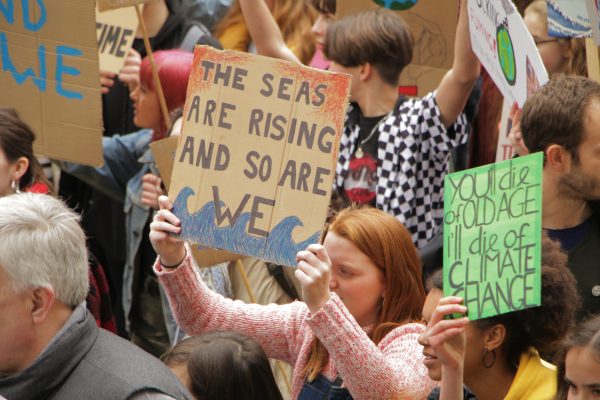
In September 2019, over six million young people took part in 4,500 school strikes and related climate demonstrations in 150 countries, including 300,000 who took part in protests in the UK.
This mass action was a huge step forward compared to the individualistic ‘tree-hugging’ climate activism of the past, and, importantly, put the word “strike” in the forefront of students and young people’s minds.
But the pleas for the capitalists and their puppet politicians to ‘take action’ fell on completely deaf ears and were only met with tokenistic phrases and empty promises.
To succeed, the movement needed to firmly cast off any liberal or petty-bourgeois illusions in ‘progressive’ politicians and their climate resolutions and link up with the organised working class to fight militantly against the establishment.
In Britain these methods could have landed decisive blows against the bankrupt Tory government, and today could force Burnham to abandon ‘pragmatic’ decisions about new North Sea oil and gas projects.
Unfortunately, however, the movement lacked a clear, class-based leadership, and that wave of the climate movement declined, leaving smaller groups mainly focused on individual direct action, like stunts and roadblocks.
Hanging up the hi-vis
While the current PM wrings his hands in response to the wildfires and droughts ravaging the country (calling performative Cobra meetings to produce yet more hot air, as if that’s what we needed), and pinning the blame on BBQs (while turning a blind eye to the construction of water-guzzling AI data centres) – what kind of fight is being put up by the left, or any of the climate activist groups?
One of the most well-known activist groups from over the last few years, Just Stop Oil, decided to give themselves a pat on the back and “hang up the hi-vis” in March 2025, declaring “mission accomplished” after the new Labour government promised no new oil and gas licenses.
🚨 BREAKING: WE’RE HANGING UP THE HI VIS
🦺 3 years ago we appeared in a blaze of orange. At the end of April, we’ll be hanging up the hi vis.
🛢️ Our original demand of no new oil and gas is now government policy. We’ve kept over 4.4 billion barrels of oil in the ground.
🔥 A… pic.twitter.com/DEXI2Q1WEf
— Just Stop Oil (@JustStop_Oil) March 27, 2025
Unfortunately, the memory of JSO’s soup cans and fancy dress might not haunt Burnham as much as the spectre of Donald Trump and his demands to “drill, baby, drill” when it comes to potential new North Sea licenses.
Ultimately, the ‘direct action’ methods of groups like Just Stop Oil, Extinction Rebellion, and Insulate Britain achieved very little to force the hand of Westminster politicians.
In fact, they did a lot more to alienate ordinary workers and to waste the potential of honest radical youth who ended up facing unnecessary criminal sentences.
The direct action of a small group attempting to block a road or disrupt a football match pales in comparison to the potential power of workers mobilised to shut down the economy and hit the ruling class where it really hurts.
Where next?
Especially after this summer’s heatwaves, the potential for such a mass campaign unquestionably does exist. And, this autumn and winter, Britain is set for more climate chaos, with the largest ‘El Niño’ in memory set to bring us storms and extreme weather. This potential could be unleashed at any point.
According to a recent IPSOS poll, 74 percent of Britons report being concerned about climate change (5 percent more than prior to this summer). Over half of adults in Britain reported that the extreme weather disrupted their ability to carry out normal daily activity.
The climate crisis is reaching deep into the lives of tens of millions of people, creating a sense of despair, but also a deep sense of anger and frustration waiting to be provided with an expression.
The Greens are well placed to tap into this mood, with their 215,000 members who are mostly energetic young people and workers who joined recently. But instead of mobilising these layers by tying the climate to social questions, Polanski’s party has been fumbling around and losing its momentum – partly thanks to its soft approach to Burnham, to whom they are appealing to “act now”.

But despite no leadership being provided for now, the climate movement is already taking important steps forward – not yet on the streets, but indirectly, in the minds of millions of radicalised youth.
These youth are connecting the dots between the struggle to save the environment and the fight against other symptoms of capitalism’s death agony, most of all imperialism and militarisation.
This process is reflected by Greta Thunberg’s turn towards anti-imperialist activism (like taking part in the Gaza Freedom Flotilla) and her social media, which now mostly contains content relating to Israel’s atrocities in Gaza and Lebanon, connected to the arms industries in the West and their impact on the planet.
This was also reflected by the launch of the activist group ‘Youth Demand’ as a spin-off from Just Stop Oil – which connected the struggle against genocide and militarism to the climate crisis.
In other words, none of the energy behind ‘Fridays for Future’ dissipated; it got channelled into different issues and struggles, namely the struggle for Palestine. And when this anger inevitably expresses itself over the climate issue once again, it will be on a higher level.
Firstly, it won’t just be based on an abstract idea of ‘saving the planet’ from a climate catastrophe years into the future, but it will be fuelled by anger and demands around concrete issues affecting the lives of masses of ordinary people now – like rising food prices, wildfire and flood defences, and workplace safety.
Secondly, millions of radical young people now understand that the climate crisis is not separate from everything else going on in the world. The same politicians who are letting the planet burn are the ones who helped carry out a genocide in Palestine, and who get rich from exploiting the working class. Moral appeals just won’t cut it.
It is our job to help people draw these connections between the climate crisis and the capitalist crisis, and to channel the revolutionary anger of a new generation towards overthrowing the entire system.