Britain is reaching boiling point, with anti-establishment anger spilling over everywhere. This will find expression in the trade unions, on the electoral front, and in movements of the youth.
Members of the Revolutionary Communist Party – present in every major city across the country – are working to connect with this anger, and organise it into a revolutionary force.
The last year saw some incredible achievements for the party, which is now over 1,300 members strong, across 117 branches. In particular, we doubled our student forces to 300 members.
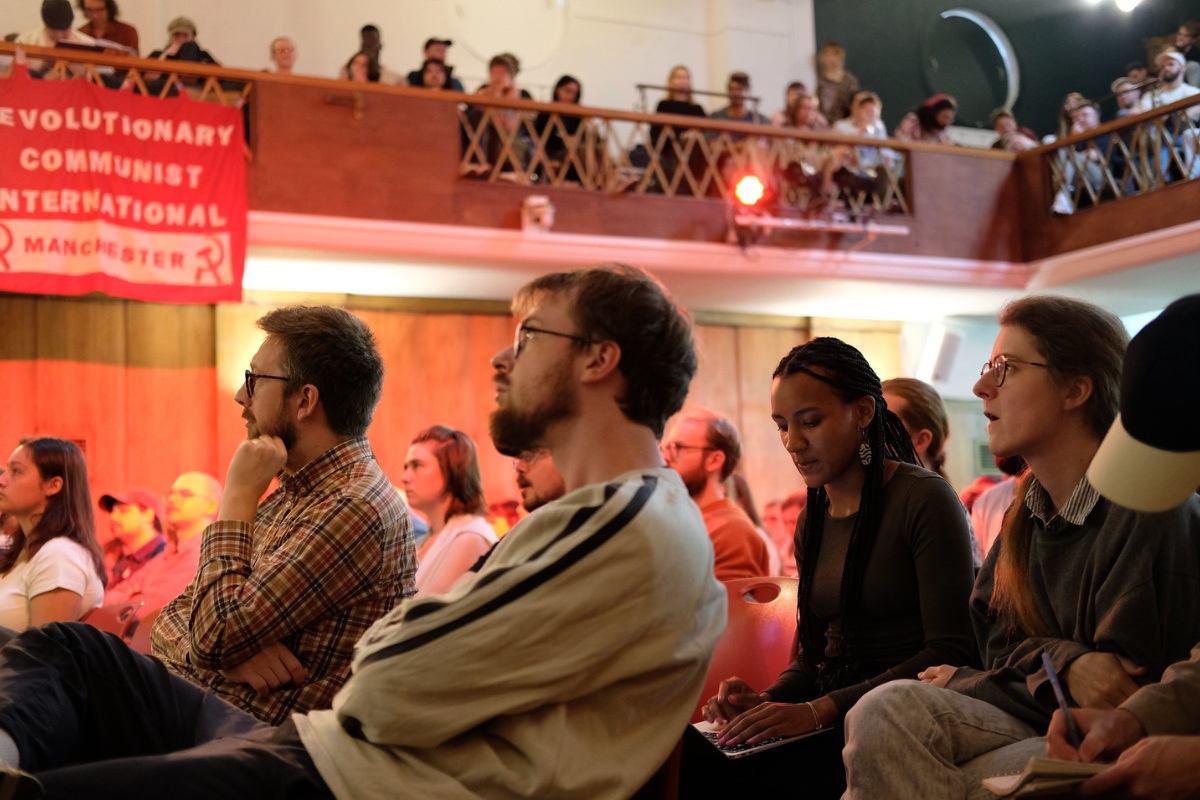
This was largely achieved through our ‘bread-and-butter’ activity: regular, well-prepared Marxist and Communist Society meetings, where we discuss and debate Marxist theory, revolutionary history, and world events. Having a clear understanding is the basis for everything else that we do.
But as the party grows in strength, we are coming across more and more opportunities to flex our muscles and try out new things. We encourage our comrades to reflect on some of the lessons of the past year, and keep a lookout for ways to connect the party with the living class struggle.
Campus struggle
The higher education sector is in a financial mess, and it’s only going to get worse. This will mean more jobs cut, departments axed, and services slashed. In turn, this will mean more ferment and action among campus unions.
One good example of seizing opportunities to connect the party with a wider layer of workers came from André, a member of one of our University College London (UCL) branches. After hearing about a cleaners’ strike at UCL, he threw himself into supporting the workers, offering to serve as a Spanish translator.
Through consistently showing up, early in the morning, to have conversations with cleaners outside the university, he was able to build a social – and through that a political – rapport with staff.
The strikers then asked André to MC the rallies. He used this opportunity to give speeches, connecting the needs of staff with a programme of workers’ and students’ control over the university.
View this post on Instagram
Soon after, another comrade in London was approached by someone who exclaimed “I love the RCP!” after having heard André’s speeches.
This patient work has now laid the groundwork for a potential RCP campaign this year, to mobilise students in solidarity with the striking workers on campus.
Seizing initiative
The Palestine movement rocked Britain, tapping into a visceral anger across the country, and mobilising millions. The general strike in Italy last September sparked a resurgence of the movement in Britain, but the official leadership in Britain failed to draw the lessons and carry the struggle forward.
But rather than taking a wait-and-see approach, members of the Cambridge RCP – based on an understanding of their forces, and a sense of the mood in the city – took the initiative to organise their own demonstration. With 29 members and short notice, it was crucial to be audacious and well-organised.
View this post on Instagram
They ran stalls to promote the demo, prepared posters and social media content, phoned up their members and supporters, and used their connections with local schools and workplaces to get the word out. With this attitude they drew 150 people to the demonstration, which was openly held under the political platform of the RCP.
They pulled this off with just eight hours’ notice, made possible by thorough political preparation. They gave speeches raising the demand of “block everything for Palestine!”, which stood out for their working-class outlook and clear perspectives.
One attendee who got up to speak – not themselves a member – called for everyone to join the RCP!
Not every branch or district will have the forces to call their own demonstrations at the drop of a hat. And not every situation will call for such an approach. But by sizing up the possibilities, drawing up serious plans, and politically preparing ourselves, we can evidently tap into the mood and raise the profile of the party.
Student union elections
View this post on Instagram
Last year, the RCP took the bold step of running student union election campaigns in four different places: Cardiff, Lancaster, Leeds, and Sheffield.
This allowed us to reach a much wider layer than we usually would through our regular activity. We used this as an opportunity to spread communist ideas and demands far and wide, even amongst people who felt they ‘weren’t into politics’.
The results speak for themselves. Everywhere that we ran, our openly communist programme achieved at least ten percent of the votes!
At Cardiff University, where the bosses’ course closures hit the university hard, a video by our candidate Alice went viral on social media. The campaign gained more momentum, campus notoriety, and a bigger platform to spread our message.
The election campaign also gave valuable experience of the struggle at universities – and practical experience in how to talk about the crisis of capitalism in a concrete and relevant way.
The Cardiff comrades are already planning for their 2026 campaign, starting by sizing up the mood on campus, and finding out which issues people are angry about. Frustration is building against underfunding, overworking of staff, and lack of contact hours.
The local branches are digging through the books, producing a report on the university’s financial situation. They’ll take this to classrooms, leafleting for meetings to discuss the reasons behind the crisis. Their goal is to turn Cardiff University into a fortress of communism.
Opportunities everywhere
The crisis of British capitalism is not going away – things will only get deeper and more fractious throughout 2026.
There will be all sorts of opportunities presented to us – whether it’s local strike action, national demonstrations; or general anger in communities, schools, universities, and workplaces that we can connect with. The sky is the limit.
The Communist will play an essential part of all our work. Its theory and analysis will help us properly understand and explain what’s taking place around the world. This is what draws people to the RCP.
Our newspaper is also our communist uniform. At campuses, high streets, and tube stations across the country, it sends a clear message: we are communists, and we’re here to change the world!
Smashing obstacles in Newcastle
Selling The Communist is a crucial tool for spreading our perspectives to the working class and recruiting new RCP members.
But public stalls are often where new comrades struggle most – fearing making mistakes, being ignored, or facing difficult questions. As I have found, however, these fears can easily be overcome through practice.
If Lenin and the Bolsheviks – facing conditions of tsarist censorship, state repression, and widespread illiteracy – could sell as many as 90,000 copies a day, then there’s no reason why we can’t find success today.
My branch recently had a very successful paper sale: we made thirteen contacts, sold forty papers, and seven pamphlets. We even sold some baked goods to raise money for the party’s fighting fund.
One brand new comrade sold six papers. All they needed was a bit of confidence to get stuck in, and the humility to ask for help from other comrades if they had difficulty explaining something.
Sometimes the problem is underconfidence. Other times it is overconfidence – treating a paper sale as an opportunity to lecture people on abstract theory or issues they are personally invested in, rather than discussing with people.
Lenin himself warned against this: “To carry on propaganda and agitation in an abstract manner, without taking account of the concrete conditions, is not Marxism.”
Talking to the public is not about proving how much you know. Concrete slogans, asking questions, and connecting with the issues people care about are far more effective.
When people misunderstand or disagree with us, we mustn’t take it personally and get frustrated. Lenin emphasised that revolutionaries must be capable of speaking plainly and persuasively to those who are not already convinced. Impatience convinces no one.
Successful conversations are the product of confidence combined with political education. If we take paper sales seriously – like the Bolsheviks did – then fear, abstractness, and frustration can easily be overcome.
Sophie Colclough, Newcastle Communist Society
Connecting with workers in Sheffield
It can sometimes feel difficult to engage with workers and students who aren’t politically organised. Even if we feel confident in our grasp of Marxism, it’s easy to fall short when trying to convey our ideas to others.
I’ve learned this all about balance: keeping it simple, while showing that we have the facts and arguments to back ourselves up. We want to bring the enthusiasm and hope that is often missing from drizzly picket lines and poorly-attended protests – but we also don’t want to be seen as utopian, naïve, or out-of-touch.
With this in mind, I recently met other comrades to head to the University and College Union (UCU) and British Medical Association (BMA) picket lines in Sheffield.
I found that the best way to engage people in conversation was to show genuine interest, solidarity, and empathy – often listening more than I was speaking, and asking questions that prompt people to expand on their initial comments.
Asking a simple question like “what have you learned from being on strike?” or “what do you think it will take to win this struggle?” allows people to arrive at ideas about workers’ control, anti-capitalism and the need for wider systemic change in their own way.
Through asking questions, listening, and responding, people feel heard and are more likely to engage with our ideas. We are not there to offer a generalised, half-baked solution, or tell them how they are doing their own industrial action wrong.
When it came to sharing my own reasons for being there, I gave an honest and simple explanation of what the RCP is: we are trying to build a party that can lead the working class in a struggle to overthrow capitalism. There’s no point in trying to hide who we are; boldness will attract the best people.
Anne Marie Beaumont, Sheffield Communist Society
Patiently explaining in London
We can’t expect people to be fully-formed Marxists from the get-go – especially in universities, where middle-class academic ideas flourish. So when we meet people with illusions in reformism, postmodernism, anarchism, etc. – we shouldn’t just write them off. Our job as communists, as Lenin often remarked, is to patiently explain.
This means skilfully tailoring our discussions. In one of our recent Marxist reading groups, one potential recruit expressed sympathies for anarchism. They explained that this came from a genuine concern about state power, and the Stalinist degeneration of the Soviet Union.
Rather than dismissing these views, we paused our planned reading to focus on the topic of Stalinism. Through this patient, concrete discussion, we won them over to Marxism!
Winning over the working class isn’t just about pickets and rallies. What happens on a minute, day-to-day level is just as important. This includes figuring out what makes people tick, and working through their misconceptions patiently.
Recruitment isn’t a checklist, or a test to catch people out. It’s about trying to understand people, and helping them to understand our ideas; combining our scientific approach with a human touch.
BM, KCL Communist Society