From 1 to 4 May, delegates representing over 100 branches of the Revolutionary Communist Party (RCP) – alongside visitors from across the country and internationally – met for the Third Congress of our party.
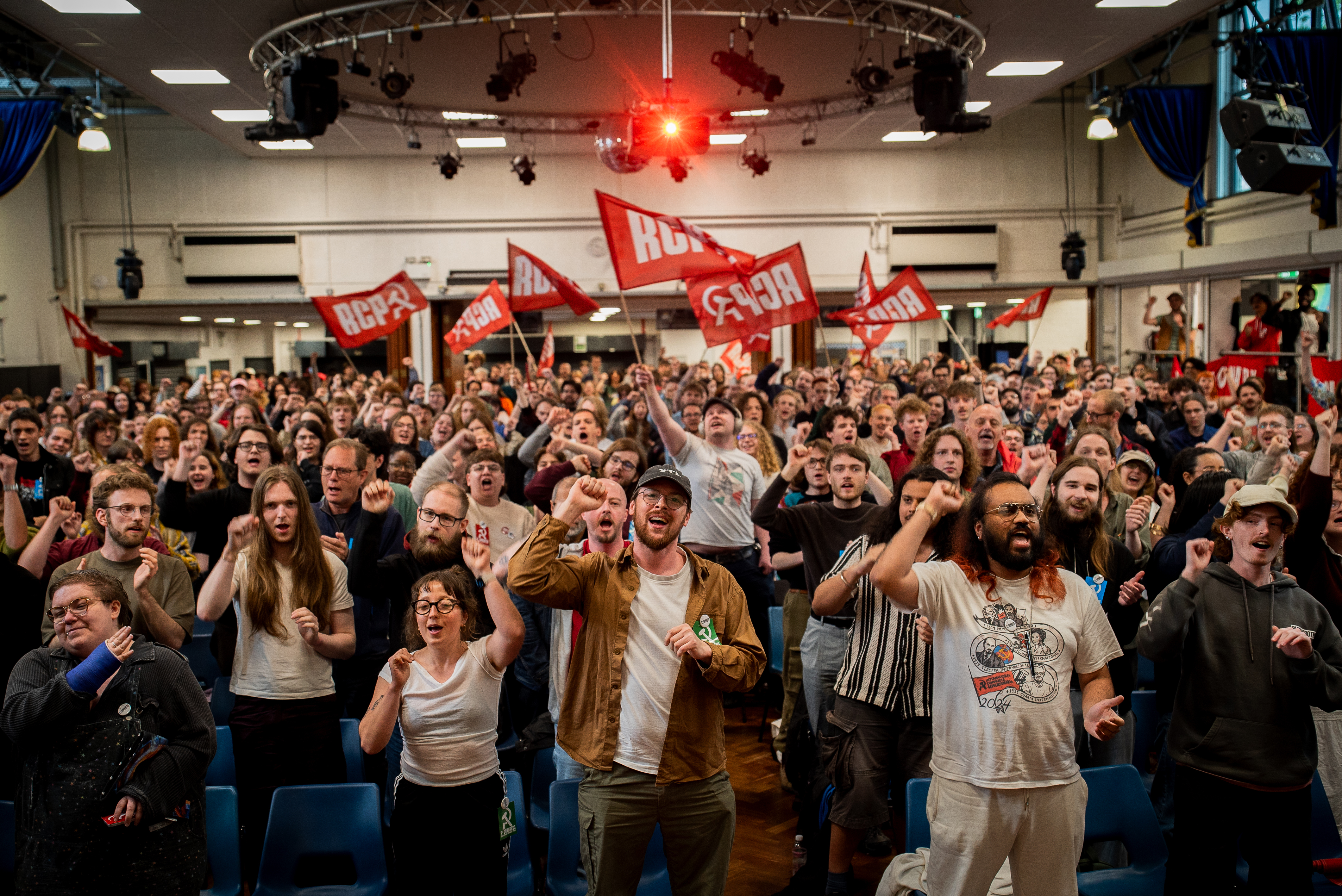
The Congress was an incredible event, and our biggest to date. 650 Communists were in attendance for three main sessions, discussing and debating the earth-shattering events taking place worldwide, the catastrophe facing British capitalism, and the strategy of our party.
View this post on Instagram
The quality of these discussions brought to life the importance of correct ideas and methods to weather the storm of capitalist crisis, and demonstrated the RCP’s success in strengthening the tradition of serious political discussion across the party in the past year.
As one new member from Cheltenham remarked:
“When I was asked to join a few months ago and was asked if I understood what I was joining, I think I lied. It’s only now, seeing everyone at the Congress and the seriousness with which everyone takes this, that I understand our historic task.”
This Congress will be looked back on by all attendees as a historic milestone for our party – and not just because of the announcement that we had reached 1,400 members on the eve of the Congress.
An electric atmosphere
The Congress opened amidst a catastrophic defeat for US imperialism in Iran; mounting class anger across the world; and, here in Britain specifically, the potentially imminent collapse of Keir Starmer’s premiership. Together, these events are elements of a pre-revolutionary situation.
This lesson was stressed by both Alan Woods, leading theoretician of the Revolutionary Communist International (RCI), and Rob Sewell – the RCP’s political secretary – in their respective introductions to the World and British Perspectives sessions.
The main purpose of these sessions, however, was not to get blown away or bogged down in the details of the tremendous events that are unfolding. Rather, the great advantage of the Marxist method is to step back and see the general picture. In her closing remarks, Fiona Lali – spokesperson of the RCP – summarised this sentiment:
“Right now, we are taking a step back – looking at the cause of all these crises around the world. That is why Rob, in his introduction, looked into the decline of British capitalism over a century – going through Thatcher up to the present day.”
Likewise, in the weekend’s opening session, Alan Woods explored not only the US’ calamitous war on Iran, but also the disastrous Ukraine war, in which the western powers are facing defeat. Both events demonstrate the relative decline of US imperialism, and the hubris, short-sightedness, and stupidity of its leaders in Washington.
The crisis in the US has far-reaching consequences for the world economy, international relations, and the consciousness of billions of people across the globe.
Rob Sewell reminded the Congress that sometimes, revolutionaries can be the most conservative of people: thinking about developments far into the future, without recognising the tremendous shifts in mass consciousness when they do arrive.
As an example of the already-existing class rage, Rob quoted from documents alleging the motive behind the recent Kimberly-Clark arson case in the USA: “All you had to do was pay us enough to live.”
The quote goes on to demonstrate a very advanced state of class consciousness: linking inflation and wages at home, and war abroad to the same, parasitic, scandal-ridden “Epstein class”:
“They had it coming … fucking eight hours, six days, stuck paying rent on a bullshit ass apartment that I can’t afford to fucking live … paedophiles out here fucking children, profiting off [unintelligible] fucking wars.”
To laughter and electric applause, Rob then concluded:
“I therefore propose a transitional demand: a £15 minimum wage… and burn their system down!”
The inspiration created by these discussions, in turn, resulted in the fantastic financial collection made at the Congress, which raised £173,463 – smashing our target of £150,000.
This includes one leading member in Liverpool, who gave a £7,000 donation from his pension fund after recently retiring. He has been part of the workers’ movement his entire life – and he said he had never felt as inspired and confident as he does today.
Clarity of ideas
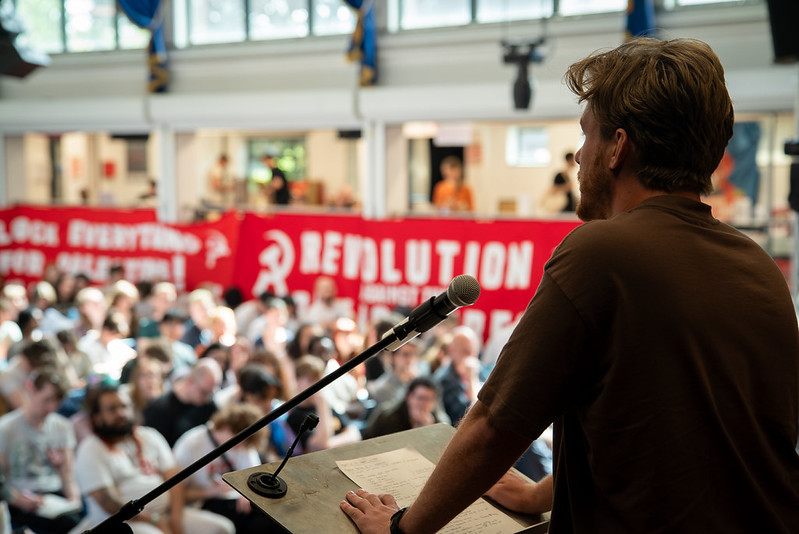
The many contributions that delegates, leading members, and international visitors provided deepened and concretised the general perspectives. Every session was packed, with over one hundred people putting their name down to speak.
Topics ranged from the economic questions surrounding debt, inflation, and the AI bubble; through to the crisis of legitimacy for the ruling class, accelerated by the Epstein files; to the decline of US imperialism, the rise of China, and the rifts opening up in Europe.
These seismic changes on the world stage are having an especially sharp impact on Britain. Trying to redefine its place in the world, the British ruling class – due to the weakness of British capitalism today – is being pulled in every direction at once, and getting nowhere.
“Britain is the sixth richest country in the world, so-called,” Rob Sewell remarked. “Well the riches are not for the workers!”
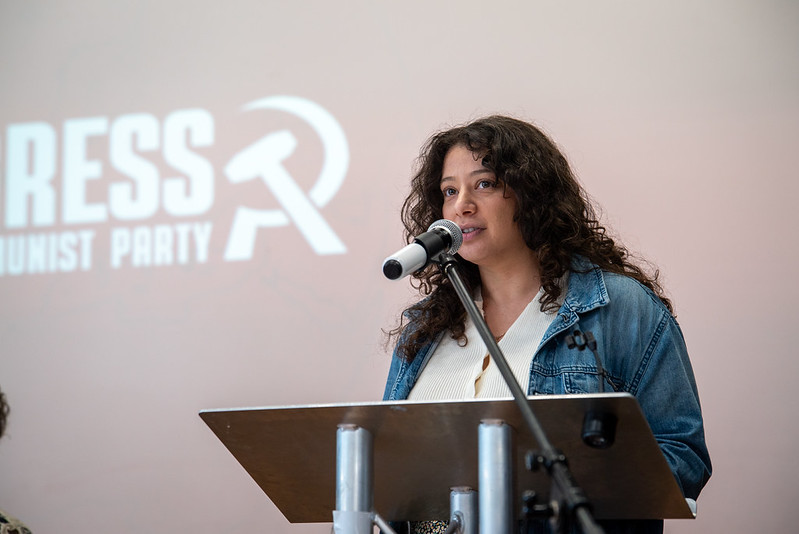
The consequences of this include total subservience of the government to the bond markets; a crisis of the state, including the unravelling of the century-old Labour-Tory duopoly; and a deep political polarisation, which is fuelling the rise of Reform and the Greens.
No wonder, with this immense breadth of contributions, that one visitor from Birmingham had to rush to the shops to get another notebook!
Charlotte from Portsmouth, meanwhile, gave her impression of the discussions:
“Four days of enlightening and inspiring camaraderie, theory, and democracy has kindled the fire that now burns inside of me. I look forward to taking this fire, and tripling the size of our local branch.”
View this post on Instagram
Thirst for theory
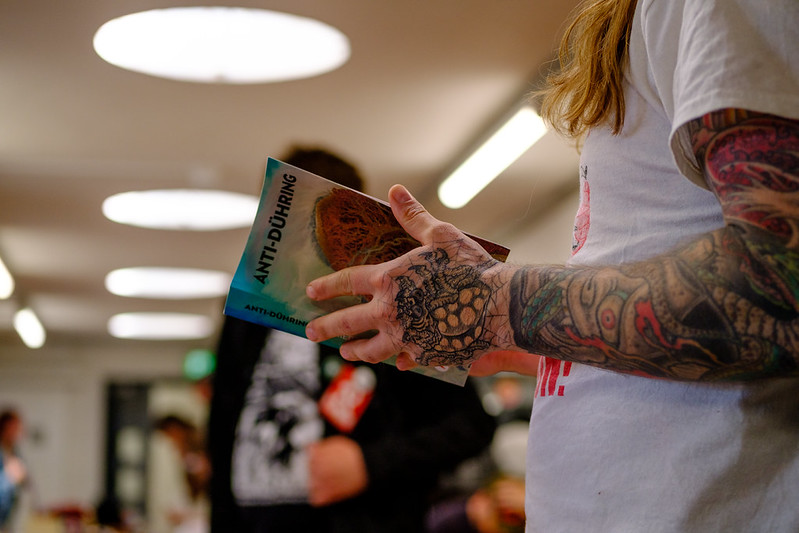
The discussion fuelled a desire among all those present to learn more: namely, to master the fundamentals of Marxist theory – which, as Fiona said in her concluding remarks, is so powerful because it is true.
At every opportunity, comrades were discussing politics – thinking back on the debates, asking questions about various new concepts, and pondering what lessons to take back to branches, in order to grow the party both in quality and in numbers. Many of these discussions continued well into the night!
“Going to an event like this is incredible,” shared Angel, a first-time visitor from Nottingham:
“Everyone here is so engaged. If there’s a political topic, or an event that’s happened, they want to talk about it. Not because they’re showing off that they’re so smart and know everything, but because they want to understand it.”
This thirst for theory was on full display at the Wellred Britain bookstall, which sold £8,015 worth of books and pamphlets. This is almost the same as what we sold at the Revolution Festival last November – which had almost double the number of visitors!
View this post on Instagram
Our place in history
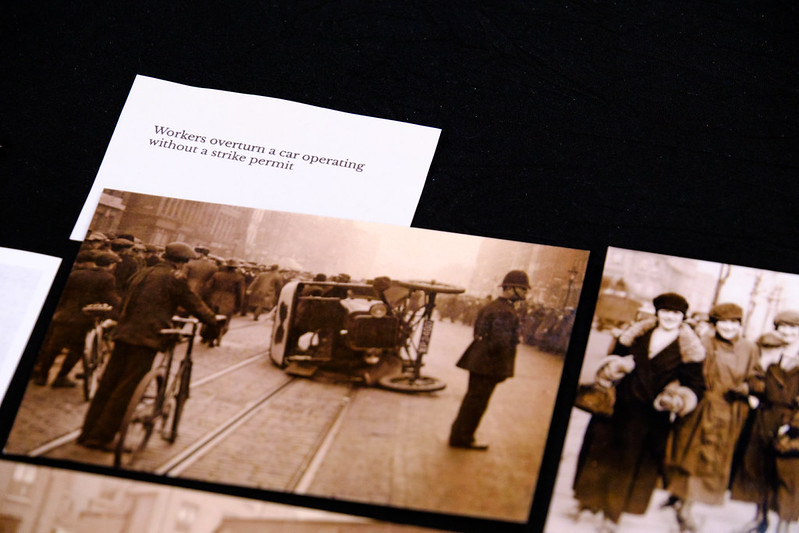
This Congress marked two important anniversaries: the centenary of the 1926 British General Strike, and 20 years since the death of Ted Grant, the founder of our movement, and the most important Marxist theoretician of the post-war era.
Two brand new documentaries, produced by the RCP to celebrate and commemorate these anniversaries, were premiered at the Congress.
RCP general secretary Ben Gliniecki, who wrote A Communist History of the British General Strike, explained that the Strike is seldom talked about because it demonstrates the power of the British working class. It is therefore our duty as revolutionaries to unearth this rich history, and draw the correct lessons from it.
If we do our jobs correctly, he explained, “when they write our history of our general strikes, of our class struggles, it will be the history of victory.”
View this post on Instagram
The documentary on Ted Grant, meanwhile, brought out another theme that ran throughout our Congress: the tremendous optimism held by members of the RCP – as opposed to the pessimism, cynicism, and scepticism of many others on the ‘left’. This optimism is something that Ted Grant harboured throughout his life.
“That is not accidental,” Fiona Lali explained to the Congress. “It’s because he was grounded; theory is the foundation that allows us to weather all storms.”
Internationalism
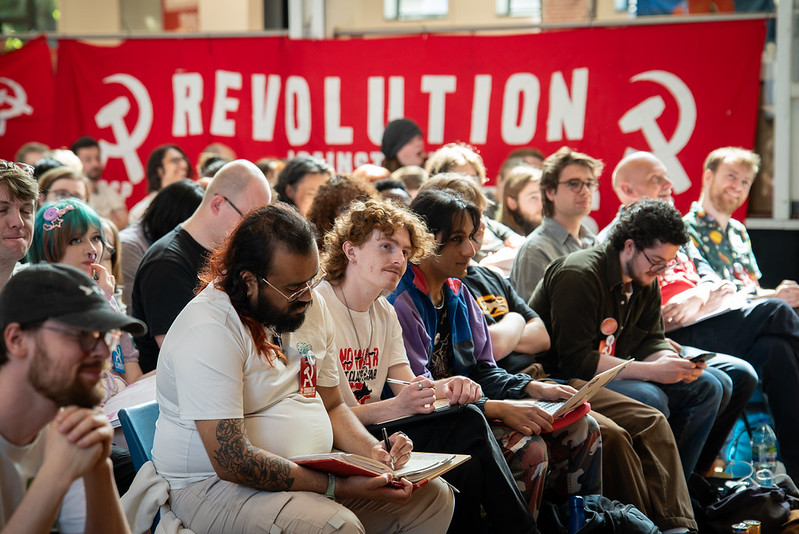
The Congress also took inspiration from the phenomenal developments taking place across the RCI, as reported by Ben Curry, the editor of marxist.com.
The whole International is developing and growing at an extraordinary rate, with four sections either at or approaching 1,000 members, and a total over 8,000 members worldwide.
This report was followed by a series of inspiring interventions from our international guests, from the USA, Mexico, Sweden, Switzerland, Italy, Ireland, and the Spanish state.
The session also outlined some of the hardships that other sections of the RCI face, in countries where living standards and political repression are far worse than in Britain – like in Pakistan, where our comrades are regularly targeted by the state.
Motivated by these reports, individuals pledged a total of £1,275 in monthly donations to the RCI directly to support its work worldwide. One individual pledged a £1,900 one-off donation!
“We ask everything of comrades and more,” explained Ben Curry to conclude. “And faced with pushback and repression, we refuse to lower our banner; we raise it even higher.”
This attitude is reflected in the determination of our comrade Ehsan Ali who has – along with other members of the Awami Action Committee in Gilgit-Baltistan – been arrested on false charges, with orders from the state to “let him die in prison” if he does not abandon his principles.
View this post on Instagram
Looking forwards
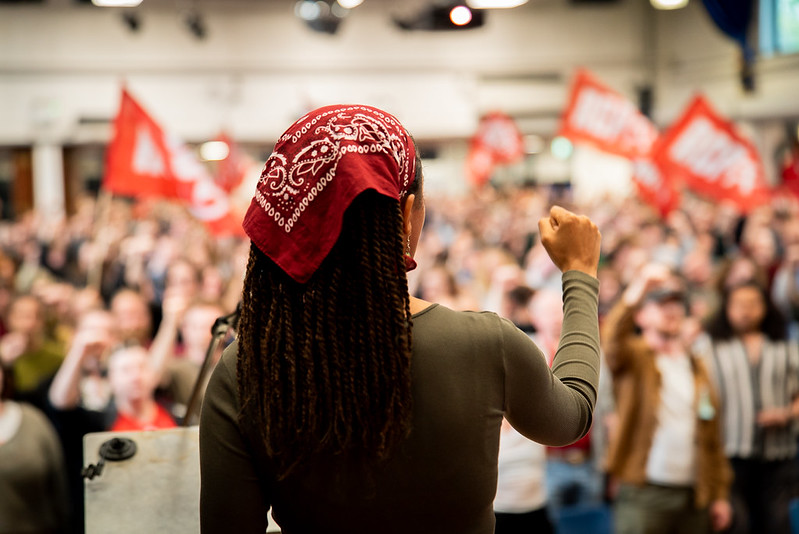
As Fiona said in her concluding remarks, there is a “quiet confidence” with which we are conducting our work. This was on display throughout the final day of the Congress, where we discussed the party’s strategy, tactics, and methods.
Attendees heard how we have successfully grown and developed the party in Edinburgh, London, Cardiff, Manchester, Brighton, Nottingham, Preston, Newcastle, and more.
The key to this success, which was mentioned across several reports, has been a solid approach to consolidation and retention: ensuring high-quality political discussions with all new party members, a fastidious approach to delegating the tasks of party building, and an open and welcoming culture within our ranks, to encourage new ideas, questions, and initiatives.
Our main aim going forward is to grow our membership, on a sound basis. This means energetically recruiting the young people being radicalised by war, imperialism, and the crimes of the billionaire class – while equipping them with a scientific method, and the ability to go out and build the party.
This Congress was an immense milestone, but there is more to do. As Ben Gliniecki outlined, the next milestone must be to achieve 1,500 members as fast as possible through our summer-long ‘Wipe out the Epstein class’ campaign. From there, we should aim to reach 2,000 by the next Congress.
To bring this inspiring Congress to a close, Ben quoted the defiant lines of Joan of Arc, written by the American poet Joseph Fasano:
Look at her, her eyes
like sudden thunder;
the armor
only flames
can take away.What does she say
in her patience?The age of stone
is over.
Turn
with all your fury
into the burning that will shake the world awake.
Ben concluded:
“That is us. With patient explanation and burning fury, we will shake the world awake.”