The Battle of Holbeck Moor in 1936 was a victory won by ordinary working-class people in Leeds against Oswald Mosley’s fascist Blackshirts.
A force of 30,000 workers drove these fascist thugs from the streets of Leeds. Seven days later, the British Union of Fascists (BUF) was dealt a decisive blow at the Battle of Cable Street, which led to its steep decline as a thuggish street force from which it never recovered.
Today, thousands of workers and young people are looking for a way to rid their communities of a modern day far-right vermin.
In the last couple of years in Britain, we’ve seen a growing number of far-right mobilisations. In Yorkshire roving groups of frenzied thugs have targeted minorities by setting up racist roadblocks, torching their businesses and homes, and smashing up asylum-seeker ‘hotels’.
The lessons of Holbeck Moor are therefore worthy of study for class fighters and anti-racists today, almost a century later.
View this post on Instagram
Mosley’s Blackshirts target Leeds
‘Sir’ Oswald Mosley built his BUF using demagogic, anti-migrant rhetoric. He spoke of “patriotism and revolution”; he appealed to veterans of the First World War to “end wage-cutting wars”; and railed against the establishment – “the present tyranny of great vested interests who are elected by none and responsible to none”.
In the midst of the Great Depression, he played on the insecurities of left-behind workers, ruined middle classes, and WW1 veterans. Increasingly, in the run-up to 1936, Mosley aped Nazi leader Adolf Hitler in scapegoating the Jewish population in Britain.
He also drew a lot of recruits to the BUF out of the disillusioned, middle-class layers of the Suffragette movement. He used the slogan, “Women of Britain, you have the vote but have you the power?”, and cynically used the questions of women’s wages, lack of political representation, and the appalling maternal mortality rates of the time to win them over.
View this post on Instagram
Despite all of this demagogy, the Blackshirts would still often have to bus in their shock troops from all over the country to conjure up a proper force. A report in the Leeds Mercury from the day after the Battle of Holbeck Moor lists injured fascists and their addresses. Hardly any were from Leeds, nor the deprived neighbourhoods Mosley was targeting.
The Blackshirts’ campaign of terror extended beyond physical threats, and saw a concerted campaign of propaganda graffiti.
They would whitewash the slogan, “Mosley right, Eden wrong” (in reference to then Foreign Secretary Anthony Eden of Britain’s National Government) in suburban areas around Leeds, as well as swastikas, BUF logos, and more antisemitic slogans.
Sick of this, some residents began taking matters into their own hands. One local Leodensian was arrested after he was caught adding underneath, “Workers unite: they are both wrong”! (Leeds Mercury, 28 May 1936, p.9)
How the communists mobilised
The Communist Party of Great Britain (CPGB) learnt of Mosley’s plans to march through the Leylands, which was a predominantly Jewish slum in Leeds. The CPGB had already sunk roots into this community and had a strong network there, which formed the basis of their response to Mosley’s march.
Mosley hoped to drum up support in the industrial centres of Leeds through terrorising the local Jewish community with this reactionary stunt. The growing rate of provocations, vandalism, and smaller BUF meetings across Yorkshire alerted the local CPGB branches that this was a threat that needed to be met head-on.
A successful BUF mobilisation would have intimidated and demoralised a whole layer of Jewish and minority workers, destroying class unity and the movement at large.
The Leeds branches of the CPGB were unanimous in their decision to call a meeting and confront the fascists on Holbeck Moor, where Mosley intended to give a speech.
View this post on Instagram
They built for it by appealing for a united front with the other mass organisations in the labour movement: namely, the Leeds Trades Council, Labour Party, and Independent Labour Party. This was not straightforward. They were met with resistance from the party bureaucracies, but found great success inspiring the rank and file, who were moved by the instinctive need to defend their communities and their class.
A leafleting campaign around the pubs and workplaces meant the CPGB were able to bring 1,000 workers to their meeting, set half an hour before Mosley’s march was to arrive on Holbeck Moor. This crowd grew to around 30,000 by the time the Blackshirts arrived.
Many trade unionists and Labour Party members had defied the positions of their official leaders, who were fearful of a physical confrontation and acted as a brake upon the movement.
The local Jewish community leaders played a similar role. Incredulously, the Board of Deputies of British Jews had refused to supply leaflets on battling fascism to their youth groups as they were “not opposed to fascism per se, only to antisemitism” (Agboh-Davison, 2026, Let Them Have It Lads!, p.12).
Even more scandalous was the advice of prominent Leeds-based Jewish solicitor David Sandelson who is quoted in the Yorkshire Evening Post the day before the Battle saying:
“As a community, we stand for complete freedom of speech, and no responsible Jewish leader would, for a moment, suggest the slightest interference with the Fascists’ meeting… We, the Jews, have made an appeal, particularly to the younger members of the community, to abstain from any form of demonstration or counter-demonstration” (Yorkshire Evening Post, 26 September 1936, p.7).
Despite this, there is considerable evidence of young Jews organising into self-defence groups, and figures suggest Jews made up almost half of the CPGB and YCL membership in Leeds at the time. (Agboh-Davison, Let Them Have It Lads!, p.12)
The British Jews also had strong militant traditions of their own. In Leeds, they had their own self-organised defence groups that physically protected their community. One young Jewish soldier involved in these self-defence groups was interviewed in the Yorkshire Evening Post in 1917. In it, he proudly declared that “I stand 6ft 2in in height, and I have a punch like the kick of a horse, and I am going to use that punch to the best of my ability.” (Yorkshire Evening Post, 5 June 1917, p.4)
The Leeds CPGB were also not acting fully in agreement with the priorities of their national leadership. There was pressure on party members to prioritise a campaign for the CPGB to affiliate with the Labour Party, as part of building a popular front movement against the Nazi-appeasing National Government. The CPGB leaders viewed the fight against the BUF as politically irrelevant.
But the working-class rank-and-file members of the CPGB in Leeds were clear on the priority of facing the direct threat of the fascist Blackshirts wherever they reared their heads – especially because Leeds had one of the highest Jewish populations in the country at the time.
The Blackshirts appeared to be gaining footholds, and the horrifying examples of fascism in Germany and Italy heightened the urgency to crush this menace.
The Battle of Holbeck Moor
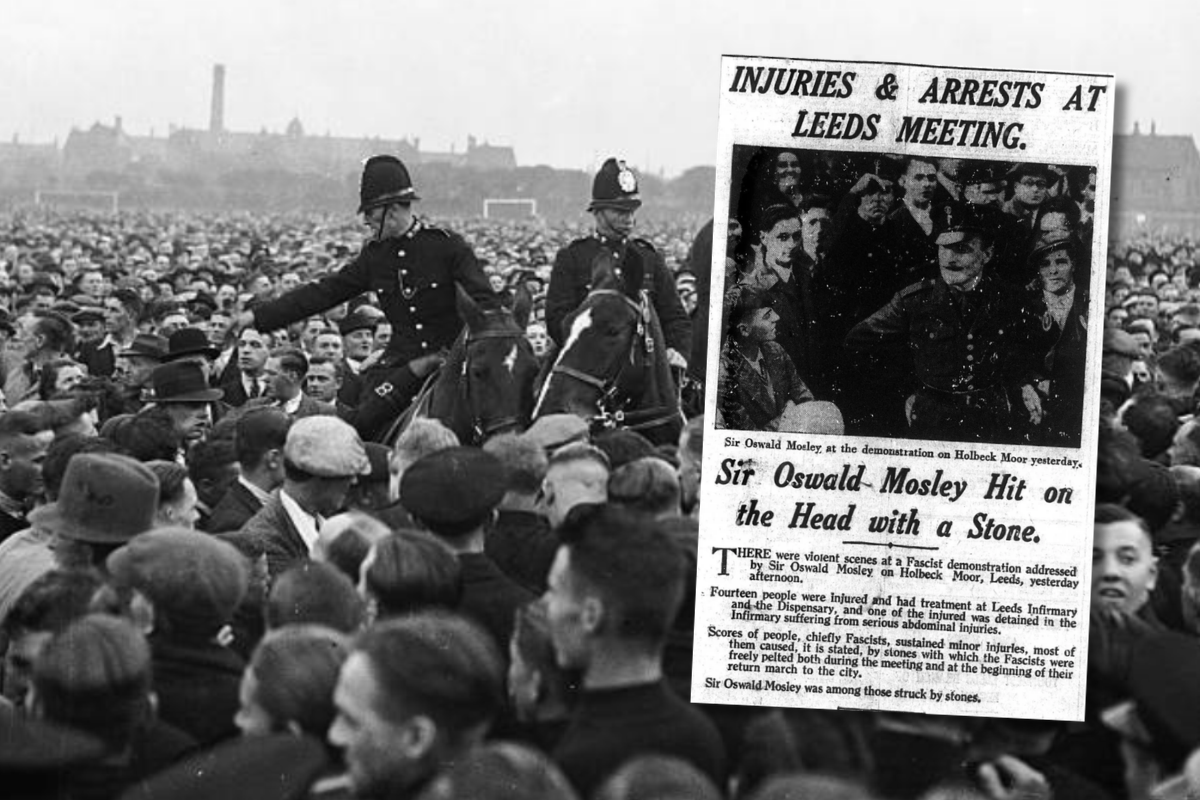
On 27 September 1936, around 1,000 Blackshirts began their march from Calverley Street in the city centre through to Holbeck Moor. There, Mosley would address the crowd from atop a van. A group of activists had surrounded the van, pre-empting his arrival, as numbers on the moor swelled to around 30,000.
Several hundred police – some mounted on draft horses – and Mosley’s own ‘I-Squad’ bodyguards cleared a route for him through the crowd. They were greeted with cries of “murderers” and “get back to Germany” from the gathered crowd (Manchester Guardian, 28 September 1936, p.9).
Sir Oswald Mosley had barely begun to speak when the first stones were hurled. Between the jeering, the stones, and the repeated choruses of ‘The Red Flag’, his vitriolic bile was barely audible.
View this post on Instagram
After his speech, Mosley and the BUF began to retreat from the Moor. Mounted police and eager Blackshirts beat a path through the protestors with batons and fists. The ensuing chaos almost caused a stampede.
But the crowd’s anger surged at these provocations. They began lobbing fireworks at the BUF standard bearers, swatting at them with table legs, and rolling marbles under the police horses’ hooves. Many Blackshirts were injured by flying stones to the head as they beat their hasty retreat under the protection of a thick police cordon.
Mosley later described the carnage himself:
“…bricks were still whistling freely through the air, and round us on the ground were unconscious Blackshirts, savagely mauled by a highly organised Red mob.” (Action, 24 October 1936, p.9)
After they left the moor, Mosley and his thugs were then ambushed by a second group of workers, who had built up a makeshift barricade. From behind their cover, they unleashed a barrage of stones, half-bricks, and half whatever else they could lay hands on.
Here, Mosley was cut under the eye by one particularly well-aimed projectile. After the events of Holbeck Moor, there were many workers who claimed responsibility for the rock that drew Mosley’s blood!
Another police charge against the workers resulted in three arrests – the only arrests made that day. The CPGB held a fundraiser directly afterwards on the Moor and raised three pounds for their legal defence fund (almost £200 today).
In the following week, the story of Holbeck Moor was plastered over the press. The bourgeoisie’s hired pens all repeated the same talking points in their editorials: that even fascists should be allowed free speech, that the communists are just as unwelcome as the fascists, and that political violence of any kind is utterly condemnable.
Papers like the Leeds Mercury decried the events as a “lamentable display of intolerance”, and that “every stone thrown was a direct blow against democracy, not fascism.” (Leeds Mercury, Monday 28 September 1936 p.6; Leeds Mercury, Wednesday 30 September 1936, p.3)
Unsurprisingly, these so-called ‘journalists’ had nothing to say of the indiscriminate police violence on the day.
In the CPGB’s paper, the Daily Worker, the report on the Battle of Holbeck Moor declared that “what happened in Leeds must happen in East London”! A few days later, it did, at the Battle of Cable Street.
The fascist threat in Leeds had been confronted physically by a mass working class mobilisation, which succeeded by appealing to workers across all lines of identity on a class basis. Mosley never held another open-air meeting in Leeds again.
The legacy today
Today, it is the duty of all revolutionary communists to uncover and preserve the genuine legacy of these heroic episodes in the class struggle and, crucially, to draw out the key lessons for clearing the far right off the street today.
What little press coverage the Battle of Holbeck Moor gets today is primarily cheerleading, with no serious attempts to understand how the workers defeated the fascists – much less how it can apply to the fight against the small bands of isolated fascists who rear their heads today.
The same liberals and reformists who celebrate the history of Holbeck Moor hypocritically maintain unconditional support of the crisis-ridden capitalist system, which is precisely what is fuelling the rise of racism.
Fundamentally, this is what the official left and the mainstream anti-racist organisations in Britain confine their struggle to. By spreading illusions in the ‘lesser-evil’ Labour Party, the police, in conservative community leaders, and trade union bureaucrats, they have proven themselves incapable of understanding or implementing the genuine, militant lessons of Holbeck Moor.
In beating back the Blackshirts in 1936, the workers and youth of Leeds demonstrated that the only force that can decisively defeat the fascists and the far right is the working class – militantly mobilised, and fighting on an independent class basis.