Remembering Pat Wall, Friend, Fighter and Marxist (1933 – 1990)
Today 6th August is the 20th anniversary of the death of Marxist MP and class fighter Pat Wall. In his memory we publish a tribute to him by Rob Sewell.
Marxist theory is our sharpest weapon in the class struggle. Here, you can find our most recent theoretical and historical articles. For news and analysis, click here.
You can also visit our education hub to find a selection of articles, books, talks and reading guides.
Today 6th August is the 20th anniversary of the death of Marxist MP and class fighter Pat Wall. In his memory we publish a tribute to him by Rob Sewell.
In this second part of Jeppe
Druedahl’s contribution to the
discussion on China, he explains how initially the Chinese bureaucracy,
after the death of Mao, introduced market methods as a means of
stimulating production within a planned economy. However, over time the
capitalist methods began to dominate and the relation between the plan
and the market were overturned. Quantity was transformed into quality,
and capitalism has come to dominate.
Does the development of China on a
capitalist basis deny the theory of permanent revolution? Does it mean
that capitalism on a world scale has a new lease of life? What was China
under Mao? In this first part of a two part article, which we publish
as a contribution to the discussion, Jeppe Druedahl looks at these and
other questions and draws lessons from the development of the Soviet
Union after the revolution and under the Stalinist bureaucracy.
Standing between the working class and the socialist transformation of society is a colossal state machine. In order to carry out this transformation, we must have a clear understanding of what the state is, and what must replace it.
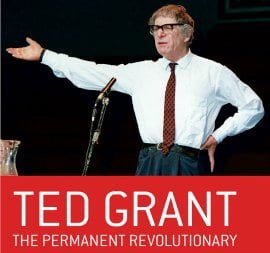
Today, July 20th, is the fourth anniversary of the death of Ted Grant, Marxist, Revolutionary, defender of the banner of Trotskyism. In the next few days we will be publishing the first volume of the collected writings of Ted Grant cover the period from 1938 to 1942.
This year marks the hundredth
anniversary of one of the great events in modern history. On November
20th of 1910 Francisco I. Madero denounced the electoral fraud
perpetrated by President Díaz and called for a national insurrection.
This marked the beginning of the Mexican Revolution. Today, the
conditions have matured for another revolution, this time with a mighty
proletariat at its head.
In the first of a regular
column where we look at DVDs which may be of interest to socialists, we pick up
on a DVD reissue of the classic film, Battle of Algiers.
Anarchism is a confused political creed. In fact some anarchists
take pride in the fact that it is difficult to pin their ideas down
almost as a point of principle. But their watchword has always been a
struggle against ‘authority.’ Some may find this slogan attractive,
but Engels’ brilliant essay shows that some class always wields
authority in society – the question is which one.
Ted Heath’s plans went very "agley" in the early 1970s, and he had a Tory
parliamentary majority that Cameron can only dream of. The volatility
of the world in 2010 means that this new Tory/Lib Dem government will be a
government of crisis. Certainly the story of Ted Heath’s demise has a
lot of lessons for trade unionists and socialists today.
After the Second World War the advanced capitalist world went through a prolonged period of boom, rising working class living standards and relative class peace. By 1970 it was clear that the boom was coming to an end. The ruling class saw the need to confront the working class and drive down living standards in order to restore their profits. Their chosen instrument in Britain was the Tory government under Heath, elected in 1970.
Copyright is in crisis. Photocopying, scanning, audio and video
recording, computers and now the internet have all made it increasingly
difficult for the owners of copyright to enforce their rights. There
has been a renewed effort, such as the Digital Economy Bill, to restore
the balance of power in favour of big business, but levies and legal
penalties only serve to patch holes in an already leaky system. The
flaw lies not in the technology, or in piracy or file-sharing, as
corporations would have us believe, but in the very notion of copyright.