Marx’s Capital: Chapters 2-3 – Money
In this video from our recent “Capital in a Day” event, Ben Gliniecki discusses the origins, societal role, and future of money.
This category is for Marxist economic theory and economic history. For news and analysis of the present-day economy, head to Economy.
In this video from our recent “Capital in a Day” event, Ben Gliniecki discusses the origins, societal role, and future of money.
In this first of a series of videos from Socialist Appeal’s recent “Capital in Day” event – held to celebrate the 150th anniversary of volume one of Karl Marx’s Capital – James Kilby discusses the concept of the commodity.
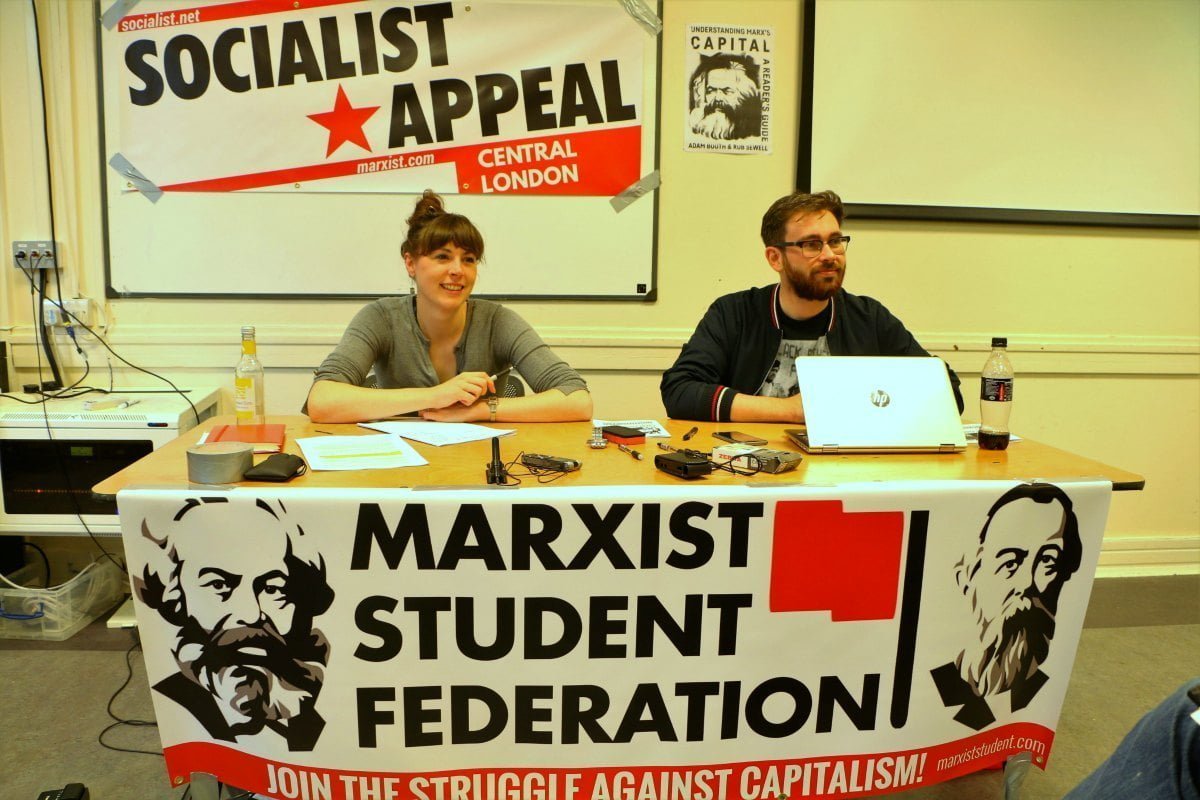
On Saturday 16th September, over 80 students, workers, and activists from across the country gathered for “Capital in a Day”: an event hosted by Socialist Appeal and the Marxist Student Federation to celebrate the 150th anniversary of the publication of Karl Marx’s Capital. The day’s event demonstrated the importance of theory and the relevance of Marx’s ideas in this epoch of capitalist crisis.
In amongst all the confusion and panic of the capitalist class, a handful of extreme right-wing economists have begun arguing for a return to the gold standard as a way of solving the economic crisis. The reality is that the contradictions of capitalism cannot be solved by measures taken within the capitalist system.
Today, in numerous areas, from automation to green energy to information technology, we are seeing a validation of Marx’s assertion: that society’s productive forces at a certain stage come into conflict with the way in which society is organised. These “economic singularities”, as Adam Booth discusses, demonstrate clearly that the system has broken.
Every Easter, millions of people tuck into inadvisable quantities of chocolate eggs. But crack the yummy surface and you’ll find a gooey core of brutality underlying the history of the sugar and cocoa trade. As Joe Attard of the KCL Marxists explains, those who desire guilt-free guilty pleasures need to support the revolutionary cause!
The board game Monopoly is a useful tool for understanding the transformation of ‘free market’ capitalism into monopoly capitalism. Under socialism, the monopolies can be nationalised and run for the benefit of the whole of society – not a tiny handful of capitalists.
Universal basic income (or UBI), an unconditional payment to all citizens, has become part of the economic zeitgeist in recent times, embraced by advocates on both the Left and the Right as a solution to the symptoms and sores of the crisis-ridden capitalist system. But who is actually raising the proposal – and in whose interest?
We are now in an era that many imagined would be a period of prosperity for all. And yet, far from living in the technological utopia once imagined, we are increasingly living in a dystopian nightmare of eye-watering inequality and poverty amidst plenty. Hugo Robles looks at the contradictions of automation and machinery under capitalism.
Today’s global economy is full of dangers, one of the most precarious being the Silicon Valley tech sector; in particular, the impending stampede of “unicorns”. This term has come to describe the primary threat facing the tech sector, with the possibility of a cataclysmic repetition of the 1999 dot-com bubble.
In the final part of his series on the history and development of money, Adam Booth explores how monetary theories and systems have changed over time in response crises, and looks at the “solutions” proposed to overcome the contradictions facing the money system today. How do we break the spell of the so-called “root of all evil” and free ourselves from these “chains of gold”.
In the fourth part of his series on the history and development of money, Adam Booth examines the factors lying behind inflation and explores the role of gold as the basis for an international monetary system. As the collapse of the gold standard – and more recently the European single currency – demonstrate, the contradictions of capitalism will eventually always come to the fore.