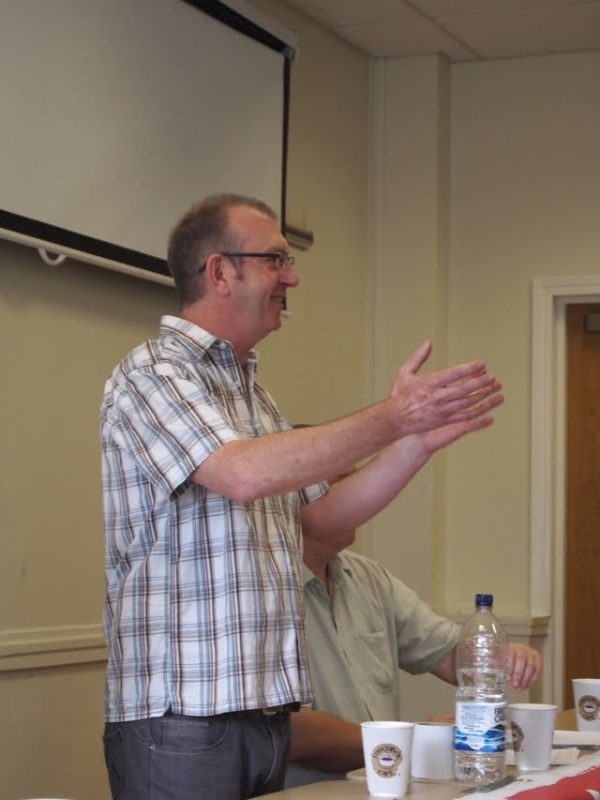
ULU Marxists meeting on the Arab revolution
Here are some images from the ULU Marxists meeting held in London on Thursday evening
IRELAND: Friday’s election saw Labour gain the most
votes and seats in its history. But Fine Gael came out as the largest
party. Eamon Gilmore and Enda Kenny have established negotiating teams
to prepare the way for a coalition government. While Labour’s leaders
have given the negotiations the go ahead any final decision must be made
by the party conference which meets on Sunday. Fightback is wholly
opposed to such a deal.
SAT UPDATE: The
picture emerging in the results from yesterday’s Irish General Election
is becoming clearer as the evening goes on. The outcome represents an
historic defeat for Fianna Fáil, the main bourgeois party
in the state. FF have been in power for 61 of the last 79 years. They
have been the largest single party in Dáil Éireann
since 1932 until… today. Although only around a third of seats have
been announced it is clear that FF are destined to come in third place
not far ahead of SF. Fine Gael will become the biggest party for the
first time although they will still fall short of an overall majority.
Labour however has made the biggest strides forward with around 20% of
first preference votes. This is double what the party achieved in 2007.
The wave of revolution that started in
Tunisia is now also reaching Iraq, where the Kurdish areas had already
flared up last week. But the protests are not limited to these areas. On
Friday an anti-government rally named the Day of Rage, was organised in
Baghdad and other cities with thousands taking part.
Hundreds of thousands marched today in
the streets of the main cities and towns of Tunisia against the
Gannouchi government and demanding a Constituent Assembly
The mighty power of revolution has
been demonstrated with the resignation of Mubarak. It has shown that the
staunchest, most vicious and stubborn of despots can be overthrown when
the masses enter the arena of struggle and their resolve becomes
absolute. But the most unique feature of this movement is that even
after the tyrant has gone it refuses to relent.
Power is rapidly slipping out of the
hands of Muammar Gaddafi, as anti-government protests continue to sweep
the African nation despite a brutal and bloody crackdown. As city after
city falls to the anti-Gaddafi forces his only base is now Tripoli. The
East is in the control of the insurgents and most of the West has fallen
into the hands of the rebels, including cities very close to the
capital.
In nature an earthquake is followed
by aftershocks. These can be as catastrophic in their effects as the
original explosion. What we are now witnessing is the same phenomenon
in terms of society and politics. The revolutionary earthquake in Egypt
and Tunisia has sent seismic shocks to the most distant parts of the
Arab speaking world. Algeria, Morocco, Libya, Sudan, Bahrain, Jordan,
Iraq, Yemen, Kuwait, Djibouti — the list is growing longer, not by the
day but by the hour.
The Egyptian military top brass have
taken over the running of the country and, while they are promising a
transition to “democracy” at some stage, they are more concerned in the
short term about what they see as “chaos and disorder”. That is, not
just the rallies that have gripped all of Egypt’s major cities, but
something far more dangerous in their view, the growing strike wave.
Contrary to what the bourgeois media claim, revolutions
are not made by individual agitators or small groups. They are made by the mass
of people and they are prepared for years by the decay of the old system which is
no longer able to take society forward. On the other hand, when a society is ripe
for revolution, that is, when all the contradictions have accumulated to a critical
degree, a small force can play a large role in the events that are about to
unfold.
Today (February 14th) marks one month since the
revolutionary overthrow of the hated dictator Ben Ali in Tunisia on
January 14. The last month has been a constant struggle between the
ruling class which wants to return to bourgeois normality and workers
and youth who carried out the revolution and who are struggling to stop
the old regime from trying to make a comeback.
IRELAND: While the political arithmetic of the next Dáil won’t be clear until after February the 25th,
the battle lines in the state have been drawn for some time. The Irish
bourgeois are well aware that Fianna Fáil are a dead duck. Now Enda
Kenny has decided to concentrate his fire on the Labour Party. There is
one reason alone for this. The bourgeois want full control of the levers
of power and to all intents and purposes they want a continuation of
Cowen and Lenihan’s austerity programme, regardless of whoever leads the
government.