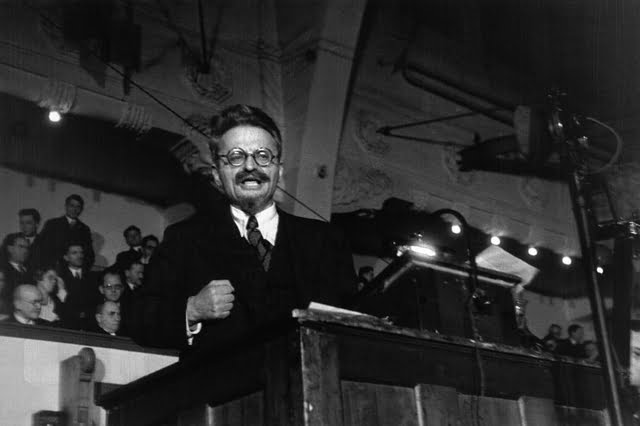
In Memory of Leon Trotsky
Next week we will mark the 80th anniversary of the assassination of Leon Trotsky with an international online rally. We republish here an article by Alan Woods reflecting on the incredible life of this revolutionary giant.
Marxist theory is our sharpest weapon in the class struggle. Here, you can find our most recent theoretical articles. For historical articles, click here
You can also visit our education hub to find a selection of articles, books, talks and reading guides.
Next week we will mark the 80th anniversary of the assassination of Leon Trotsky with an international online rally. We republish here an article by Alan Woods reflecting on the incredible life of this revolutionary giant.
Today marks the anniversary of Leon Trotsky’s assassination. Struck down 75 years ago by an ice-pick to the head from a cowardly Stalinist assassin, he soon fell into a coma and died the following day, on 21st August 1940. To commemorate the life and ideas of the great revolutionary leader, we are re-publishing an article here by Rob Sewell, written in 2012.
We publish here a letter from a comrade in West Yorkshire, who highlights Jeremy Corbyn’s programme for culture and the arts. Rather than simply protecting funding for the arts, socialists should be arguing for a revolution in how art is created, displayed, and distributed – and, in turn, for a revolution in how society is run and organised.
For many today, it is clear what we are fighting against: corruption, crisis and austerity. But it can be harder to articulate or even picture exactly what we are fighting for. Ben Gliniecki examines: how might a new society work? In what way would our individual lives be affected? What will socialism look like?
In the final part of his series on Marx’s Capital, Adam Booth tries to answer the question of how capitalism initially arose. In what way was an initial disparity and inequality created to allow for the laws of capitalism to set in? It is this issue of “primitive accumulation” that Marx turns to in chapters 26-33.
Adam Booth contrasts the economic theories of Thomas Piketty with those of Karl Marx.
In the final part of his series on the crisis of cosmology, Adam Booth looks at the more recent attempts to take the field of theoretical physics forward and explains the role that Marxism and the philosophy of dialectical materialism can play in guiding scientific research.
Continuing his series on the crisis of cosmology, Adam Booth analyses the philosophical problems at the heart of quantum mechanics and explains the problems facings scientists who are attempting to reconcile this theory with Einstein’s theory of General Relativity to create a “Theory of Everything”.
For many years now, storm clouds have been amassing on the horizon in the field of theoretical physics, with an accumulation of evidence and inconsistencies that bring the current cosmological models into question. In this article, Adam Booth explores and analyses the crisis in modern science from a Marxist perspective.
We continue here our series on Marx’s Capital, looking at the question of accumulation. Capital is dynamic. “Money never sleeps”. For capital to act as capital, it must continuously be in motion – continually seeking to create value from value. It is this overall dynamic of capital towards which Marx now turns his attention in chapters 23-25.
In this recent talk to the UCLU Marxist Society, Alan Woods explains the main concepts behind the ideas of Marxism, including dialectical materialism – the philosophy of Marxism – and Marx’s economic analysis.
Rosa Luxemburg was one of the most important figures in the history of the international workers’ movement.Reform or Revolution was one of the most important of her early writings. Written in 1899, it provides a devastating demolition of the theoretical and practical basis of reformism. It was completely valid at the time when it was written and it remains completely valid today.