A reader from Preston asks:
“What role can we expect the trade unions to play in the struggle against the far right, given the conservatism of their leaders?”
To most workers today, the trade unions feel distant and detached. At root, that is because the union leaders are failing to fight for better wages, conditions, and standards of living.
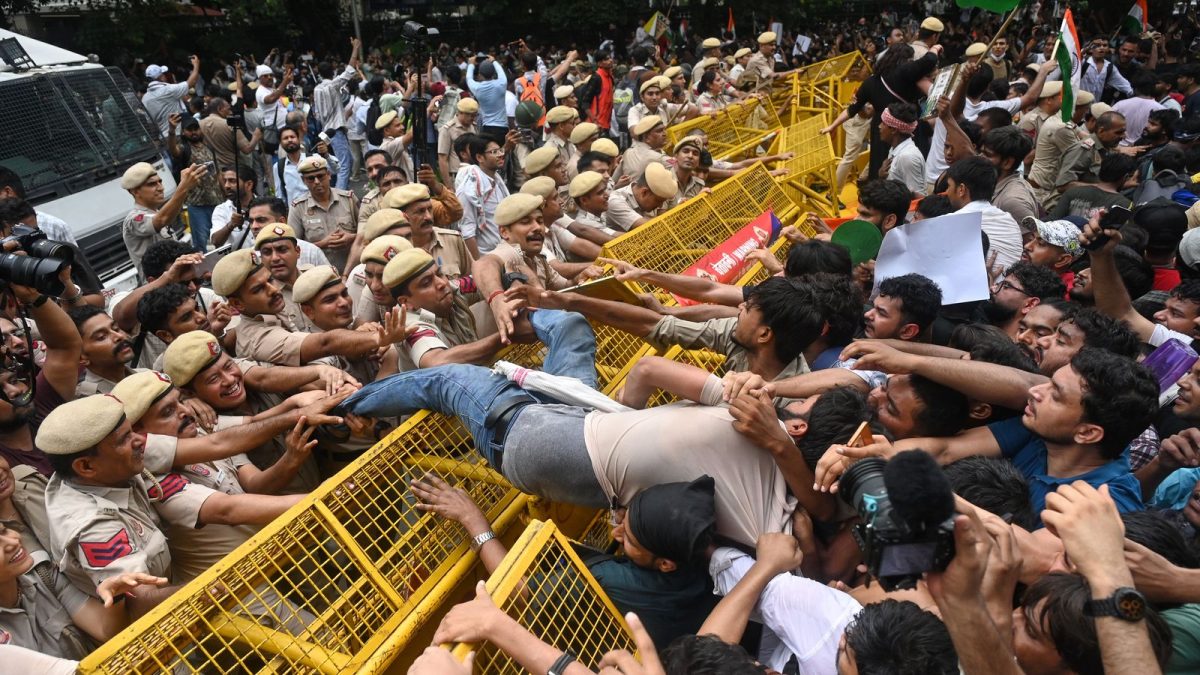
Nor are the union leaders offering workers any political fight. At most of the recent counter-demonstrations against the far right seen across the country, for example, the trade union presence was negligible.
The union leaders did not issue any serious call out to their membership in advance of these protests. And they did not campaign in workplaces to explain the need to confront the far right on the streets.
Instead, they issued a string of moral condemnations against these far-right riots in the press – all while sowing illusions in Andy Burnham, the police, identity politics, and workplace training as supposed means for combatting this menace.
The union leaders’ feeble response demonstrates that they do not take the threat of the far right seriously; that they are unwilling to offer the militant response needed.
They are supposed to represent workers as a class. At bottom, however, they have no faith in the potential power and strength of the working class.
Consequently, the idea that the unions could have an independent class position – standing in opposition to the Westminster circus and the bodies of the state – seems outlandish to these conservative, reformist leaders.
Instead, the trade union leaders effectively outsource their role to so-called ‘broad front’ coalitions, such as Stand Up to Racism and the Together Alliance – paying lip service to the struggle against the right and racism by subscribing to these organisations.
At the same time, the unions provide a left cover for the liberals: joining forces with all manner of charities and religious groups to proclaim wishy-washy, moralistic slogans about the need for ‘love’ and ‘hope not hate’.
🪧 Join @UniteSharon on Saturday. Let’s stop the far right in its tracks ✋
Unite members will gather at the stage on Park Lane, start of the march, at 12pm, where our general secretary will speak. After that, we’ll form up at the Unite balloons – head to the gazebo to pick up… pic.twitter.com/l9WHlx9w3k— Unite the union: join a union (@unitetheunion) March 25, 2026
All of this falls far short of what is needed, and of what the unions could – and should – be doing to fight the far right and racism.
6.6 million workers are organised in trade unions, many of whom are concentrated in key industries of the British economy. The union leaders should be mobilising these members into action.
If they just lifted their little finger, the unions could crush the far right – driving these ragtag gangs of thugs out of every town and city through militant mass mobilisation.
Furthermore, the unions should be bolstering the efforts of black and Asian youth to organise the defence of their communities. And they should be supporting local grassroots activists who swarm Home Office vans to prevent deportation raids.
Given their size, resources, and position within society, the unions could be playing a key role in uniting, organising, and giving solidarity to these struggles nationwide.
This should be accompanied by energetic efforts to organise workers of all backgrounds in the workplace, particularly the most exploited and oppressed layers; and to support militant action against the employers, and for democratic rights.
Such an approach would help to unite workers practically – overcoming any division and discrimination – and give them confidence in their power as a class.
Above all, the trade unions should be going on the offensive against the bosses and the government, in order to tackle racism at its roots: cutting across their reactionary, divisive culture war with methods of class war; and offering clear socialist answers to the problems that workers of all colours face.
The perspective ahead is one of storm and struggle; of social explosions and upheavals.
Whether it be further far-right riots, or the outbreak of a new wave of industrial militancy: events in the next period will put the union leaders to the test. Either they will shape up to tasks posed, or they will be replaced by leaders who will.
Our task, as communists, is to explain the class-based programme and methods that are required – and to build a revolutionary leadership that can put this into practice.
Nick Oung