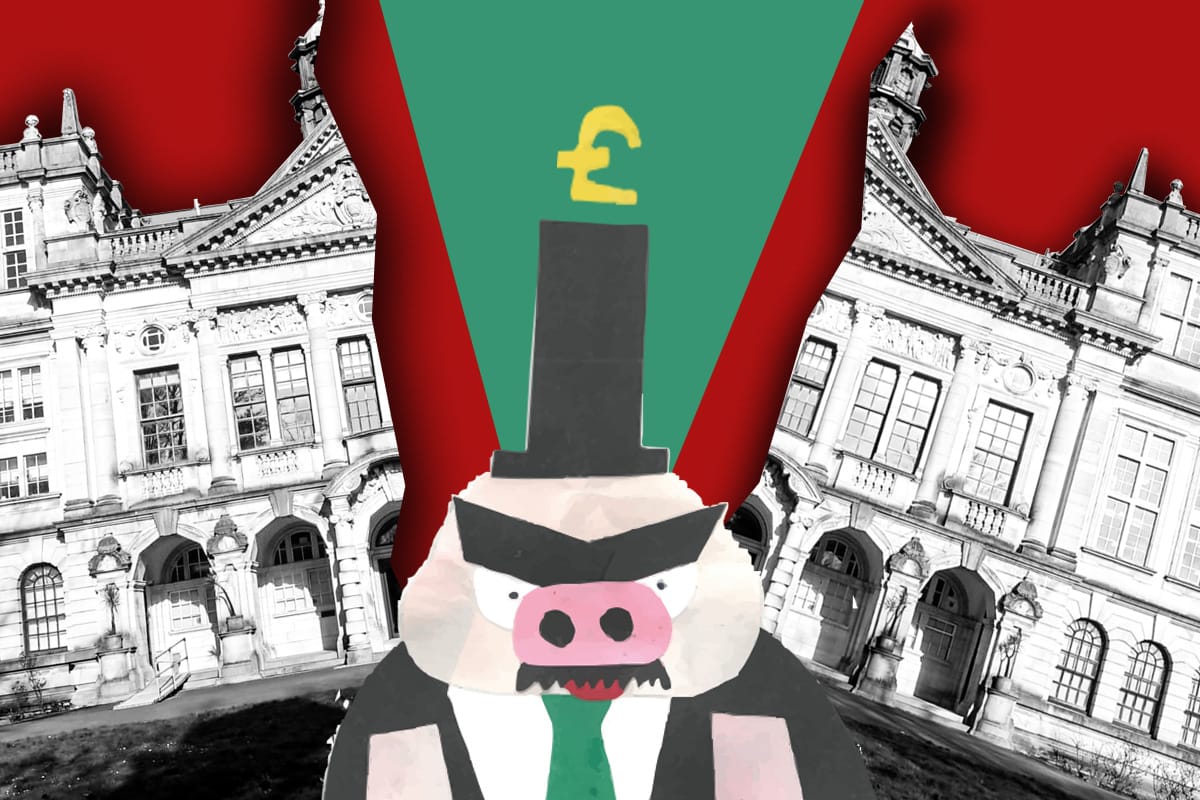

Course closures, ‘restructuring’, and redundancies. Overworked staff, overpriced accommodation, and paltry student services. The state of higher education in Britain is not just bleak: it is fundamentally broken.
The likes of Oxford and Cambridge remain internationally renowned, although even their position is slipping. But beneath the prestigious facades of this or that university, the sector is creaking and cracking.
The hollowing out over the past decade has become so dramatic, that many are now forced to ask: how on earth did we get to this point?
The university sector was once the crown jewel of British capitalism. Free and accessible to all, higher education was emblematic of social mobility in the post-war period.
Free university education
But patriotic illusions aside, the reality is that free, widely accessible university education – beginning in 1945, but only fully introduced in 1962 – was one of many gains given by the capitalist class to stave off revolutionary anger from below.
In the general context of the post-war boom, the ruling class made a whole host of concessions including the welfare state, social housing, and the NHS. These nationalisations, while welcomed by the working class, were primarily used to benefit the interests of big business – that is their profits.
Free education was no different. In fact it was a Conservative government that abolished tuition fees, with the 1962 Education Act! In the debates at the time, Hugh Gaitskell, right-wing leader of the Labour Party, summarised the consensus quite clearly:
“Brains and skill are the nation’s chief assets; we have not much else… As a nation that lives by importing raw materials, manufacturing them and selling them again, it must be obvious that this is our main material.”
This was the driving force behind the state-funded expansion of higher education: the creation of a skilled workforce that could help improve Britain’s productivity in a period where its role on the world stage was one of relative decline.
End of the boom
The capitalists were only able to introduce these changes because of the immense profits that came with the post-war boom.
A larger pie meant the capitalist class could take a longer-term view in terms of their investments – partially managed by their ‘common committee’ in the form of the state – as well as handing down a few more crumbs to stave off class struggle from below.
But what comes up must go down.
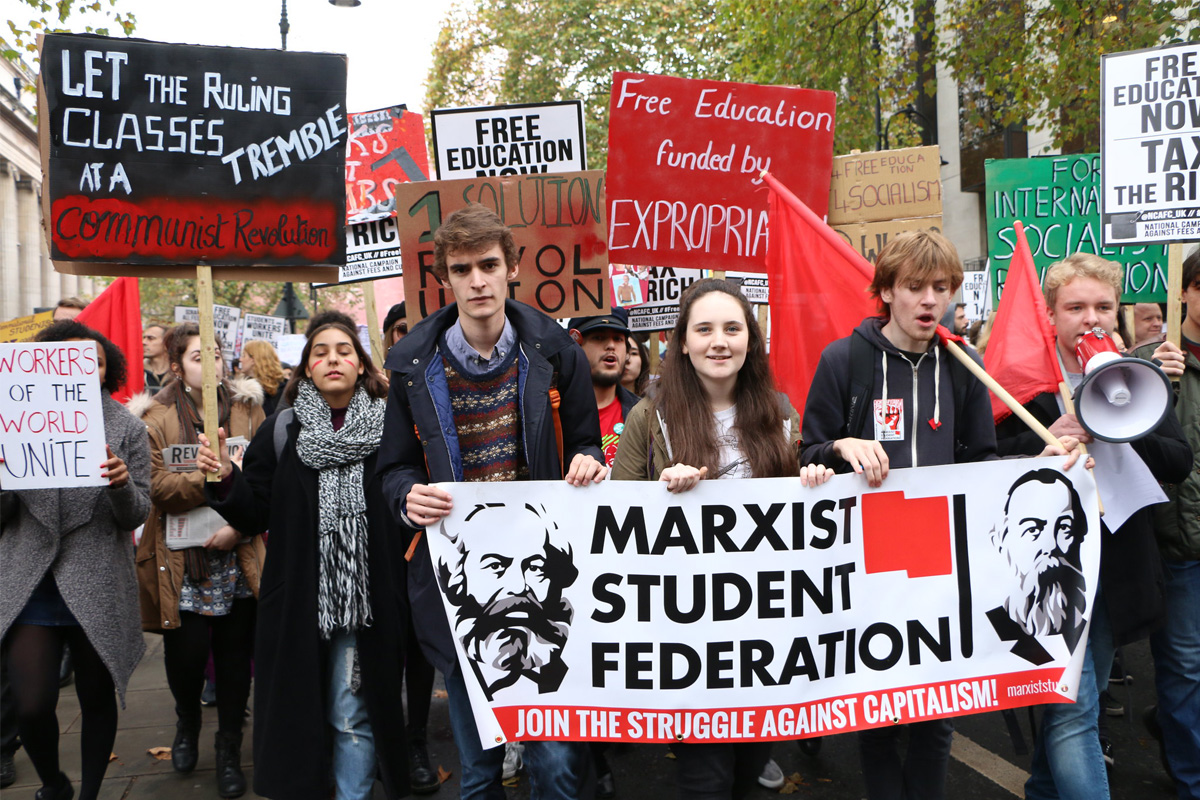
The crisis of the 1970s brought an end to the boom. Around the world, the capitalist class found their profit margins squeezed. This was especially the case in Britain, which lagged far behind the likes of America. Thus, as part of the ‘recovery’, the ruling class in Britain turned to privatisation and marketisation of the public sector.
This process began with Thatcher. But it was Tony Blair who ended almost four decades of free education in Britain. In 1998, he introduced paid tuition fees at the initial sum of £1,000 a year – later increased to £3,000.
These were the first steps on a slippery slope. In 2011, the Liberal Democrats and Conservatives cemented the marketisation of universities when they tripled tuition fees to £9,000.
Marketisation
With the planned cuts of 80 percent of government funding, universities were thrown into competition with one another.
Overnight, universities stopped seeking knowledge as their utmost priority, and started chasing revenue streams.
The 2010s became an arms race of construction and ‘streamlining’, as every institution fought to have the newest and shiniest campus. This was all in an effort to attract the most students – and big-business investors.
This gold rush rested upon cheap credit and a seemingly unlimited flow of international students, whose fees had no caps. Foresight went out of the window as vice-chancellors (VCs) and banks went all-in on what seemed to be a golden goose.
Inflation has slowly hollowed out the value of home student tuition fees, while at the same time increasing running costs and loan repayment bills. Meanwhile, there has been a steady stream of cuts in direct funding from the government. This all means universities now get just 66 percent of the funding they would have received a decade ago.
Cheap loans and high international student numbers at first covered this gaping wound. But now it is all coming loose. This financial year has seen a 37 percent aggregate drop in the sector’s aggregate surplus with 45 percent of universities at risk of running a deficit. It is clear the current funding model is broken.
Making students pay
University VCs have routinely turned to the government with the begging bowl – not to return to a state-funded model, but to expand the tuition fees that can be squeezed from home students!
Year after year, as the state faces its own budget crisis, VCs seek to pass the burden onto students: asking for a higher cap on home tuition fees.
While Starmer gave a slight increase last year, the scale of the hikes that these fat cats are asking for is politically and economically untenable for the government. With tensions so high across the country, no one wants to risk triggering a mass student movement on the lines of 2011.
Rather than rally the sector together, VCs are engaged in tearing it apart, making workers pay for the crisis whilst those at the top keep their cushy six-figure salaries. The UCU estimated that 15,000 jobs have been cut in the last year alone, with 10,000 more currently at risk.
Furthermore, the way the loan scheme is set up, the government is effectively bank-rolling this entire sordid process. As of March 2025, the government is holding onto £267 billion in outstanding student loans.
With shrinking prospects for growth and graduate employment, this has been predicted to rise to £500 billion by the 2040s. All this to turn universities into a vast money-pool for banks, construction companies, and well-paid VCs to leech off of.
This cannot continue. With ballooning government debt and a rising budget deficit, the bond markets are demanding cuts to the bone. Given the current trajectory, what seemed impossible yesterday may soon become a reality: universities going bankrupt, massive fee hikes, and perhaps even the selling off and privatisation of student debt.
All of this will only accelerate the decline of the sector, returning higher education to the position of a privilege for the elite few.
Free education funded by expropriation!
We can’t fix the crisis in universities simply by capping VC salaries. Although these fat cats should certainly be given the boot, a serious programme for higher education should recognise they are simply skimming the cream off the top of a broken system.
Students and workers should certainly be in charge of universities; and all the private companies that leech off the education system must be in-housed – from cleaning services to private student accommodation. But even these measures alone wouldn’t get to the root of the problem.
At bottom, there is a funding crisis in higher education. And this crisis – like that in schools, social housing, and the NHS – is caused by the capitalist system.
Voir cette publication sur Instagram
The money exists for a fully-funded, free education service. Student bursaries, decent maintenance grants, funding for staff, and government grants for research on problems that plague humanity. All of this is possible. And not only is it possible: for communists, for the working class, and for the future of humanity as a whole, it is greatly desirable.
Free education is not just some luxury that would be nice to have, in an abstract world. By making it a right for everyone, society would push its scientific and cultural horizons.
In turn, this flourishing of thought could only have the most positive effects on technology, creativity, and efficiency at work. Under a planned economy, this would mean shortening the working day – and thus giving everyone even more time to culturally and intellectually enrich their lives.
However under capitalism, the money and wealth of society is held by the capitalist class. The City of London itself highlights that Britain is home to a “£3.9 trillion pool of investment capital”. Yet they consider that there is an “investment gap” of a mere £150 billion (3.8 percent of the money available!) in critical infrastructure that is chronically underfunded.
These figures showcase the immense wealth that exists at the billionaires’ and bankers’ disposal, and how much of it sits idly in private bank accounts, uninvested in production, and even less so in basic – let alone high quality – services to satisfy social needs.
Therefore, the attacks on education are an immense indictment on the capitalist system itself. In a long-gone era, the ruling class was forced to try to overcome some of the contradictions in its system by granting free education. Today, it is forced to roll the clock back, undoing all the progressive potential that was previously achieved. As a whole, it has become incapable of taking humanity forwards.
That is why, to fix higher education, we must expropriate the capitalist parasites – the big banks, the construction companies, energy and infrastructure monopolies.
With the top 100 companies nationalised and democratically run as part of a planned economy, it would be the working class that has the final say on where to invest the vast wealth at our fingertips. This is the only way to return to quality, free, lifelong education for all.