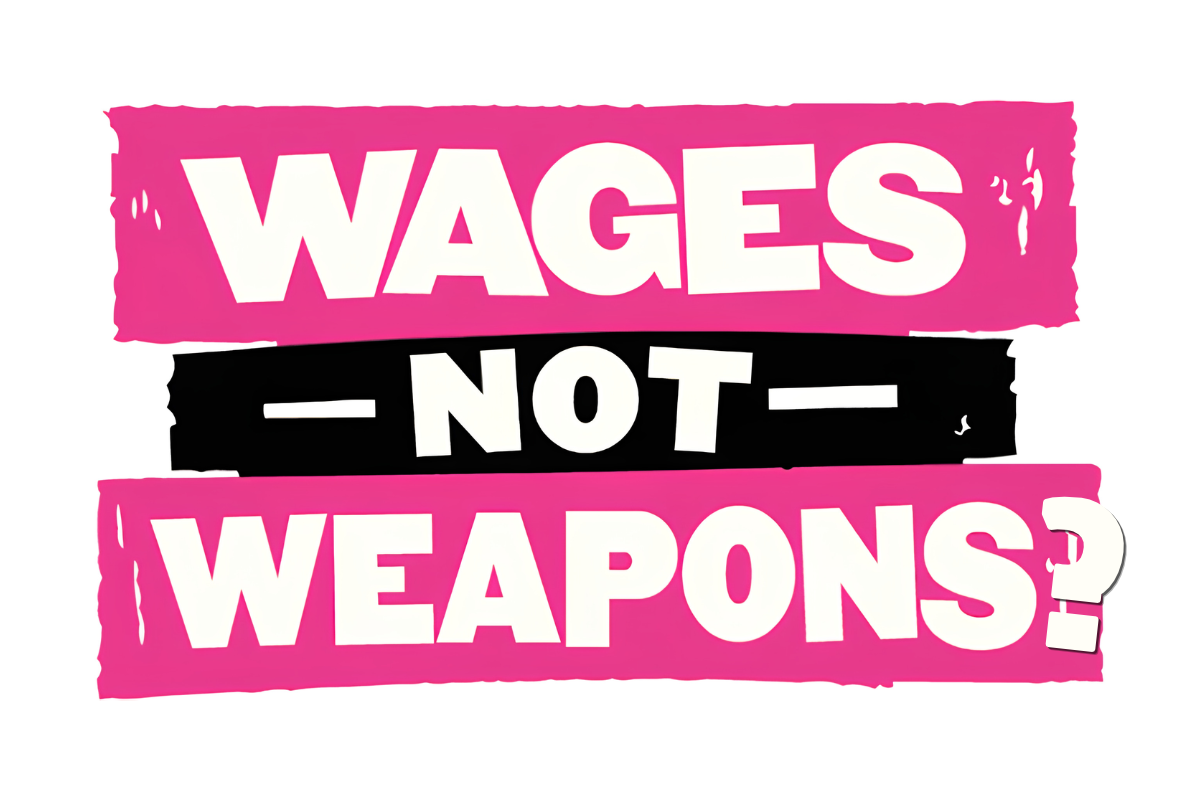

‘Wages not Weapons’ is the campaign of mainly public sector unions such as Unison, the UCU, the NEU, and the PCS, that came together to demand more resources for the NHS, education, transport, local government etc. rather than increased spending on defence. They also, as their name suggests, want more money for ‘fair wages’.
Their main campaign statement clarifies their aims:
“We are coming together as trade unions to demand investment in workers, not war. Standing in the best traditions of our movement – for peace and real security – we are demanding fair wages not more weapons.”
The main thrust of this campaign was to promote successful motions at the last two Trades Union Congress (TUC) conferences, against Unite’s and the GMB’s desire to increase ‘defence’ spending – in the name of protecting and creating jobs in Britain’s arms sector.
Supporting for Ukraine
Many young people and workers will no doubt be supportive of the stated aims of the unions behind ‘Wages not Weapons’.
But the question must be asked: how consistent are the union leaders in backing peace over war when it comes to an actual war conducted with the backing of British imperialism and NATO, albeit by proxy?
Labour’s budget last month heaped yet another £10 billion in economic and military support to Ukraine. Labour boasted it was the largest ever financial backing for Ukraine from the British government, which has already handed over £35.5 billion to Zelensky’s regime, according to the government’s own official figures.
Despite the fact that prices are rising, wages are stagnant, and austerity looms over the heads of millions of workers, you will search in vain for any comments from the general secretaries of Britain’s unions criticising this generous gift to Zelensky – which was the largest single item of expenditure in the whole Budget.
This is unsurprising. Unison, the UCU and the PCS all take a stance of firm support for Ukraine’s war effort, and consequently Britain’s fueling of the bloodshed.
This stance is summed up by Unison’s left-wing general secretary, Andrea Egan:
“We need to campaign unashamedly for Gaza. We need to campaign when Trump threatens Cuba, says he wants to ‘take’ Cuba. And when Trump’s mate Putin wants to take Ukraine we have to stand unashamedly with them too” (our emphasis).
Egan fails to mention that Palestine and Cuba aren’t backed and funded by the most powerful, imperialist military alliance in history, which is carrying out a proxy war against its rival
Whilst opposing increased defence spending, with their support for the Ukraine war effort, these union leaders are backing the main argument of the ruling class for more spending on weapons: hyping up the supposed “threat” to Britain and Europe from Russia.
I have no doubt that Egan, and the other union leaders who back ‘Wages not Weapons’, do not intend to back this justification for more defence spending. But as Lenin once said, “in politics it is not intentions that counts but deeds”.
Limits of pacifism
Back in 1917, during the First World War, Lenin criticised Karl Kautsky and other pacifists who “help[ed] their respective imperialist governments by focusing attention on the wickedness of their rival and enemy, while throwing a veil of vague general phrases and sentimental wishes around the equally imperialist conduct of ‘their own’ bourgeoisie.”
For the union leaders on both sides of this divide, the argument over imperialism and war goes little further than which policies benefit their members best: whether more or less defence spending means more or less jobs and wages for their members. This is an example of what Lenin would call ‘economism’.
Of course, in this fight, communists should back the anti-militarist ‘Wages not Weapons’ campaign against those who want to boost defence spending. The platform’s demand for investment in public services over bombs and missiles is one that we agree with.
As communists, we go further than this, by pointing out that in order to have ‘books, not bombs’ and ‘welfare, not warfare’ we need to overthrow the system that produces militarism and austerity – not just in Britain but worldwide.
But if you rely on a limited, economist argument against war – rather than a revolutionary anti-imperialist and anti-capitalist programme – you wind up opposing war in the abstract, while supporting it in practice.