
Following its Stalinist degeneration, the so-called ‘Communist’ Party of Great Britain (CPGB) carried out a series of dizzying about-faces prior to the Second World War.
Before Hitler’s rise to power, the CPGB declared that the Labour Party were ‘social fascists’. The CPGB was following the line of the Communist International (Comintern), which at this point had been reduced to a mere tool of the Stalinist bureaucracy.
This crazed ultra-left policy towards the mass social-democratic organisations split the working class in Germany, and left them defenceless in the face of the Nazis.
Following this disaster, the Comintern changed its line. The Stalinist policy of the ‘popular front’ was developed.
In reality, this was by no means a new tactic. The popular front was a re-hash of the old Menshevik tactic of collaborating with the so-called ‘progressive’ capitalist parties. This was bogstandard opportunism, plain and simple.
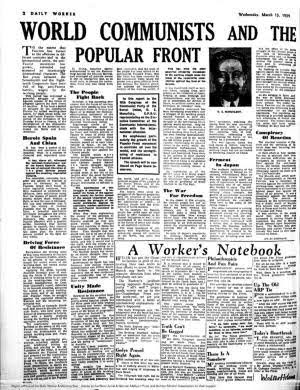
On the basis of this ‘new’ tactic, the CPGB now called for an alliance between the Communist Party, the Labour Party, the Liberals, and even elements of the Tory Party! This led to their leaders initially supporting British imperialism’s ‘just war’ against fascism.
In August 1939, Hitler and Stalin signed an infamous non-aggression pact, which we covered in the previous instalment of the ‘Under a False Flag’ series. This provoked another somersault in the policy of the CPGB.
The line of the Comintern was suddenly turned upside down, into an abstract anti-war position which reflected the narrow foreign policy interests of the bureaucracy of the USSR – which now declared ‘peace’ with Hitler!
So abrupt was the change of line that it caused a crisis within the CPGB. The most advanced Communist workers were alienated by this zigzag. They could not understand why yesterday they were supposed to support ‘democratic’ Britain against fascism, while today ‘peace’ had been made with Nazi Germany, and British imperialism was the enemy.
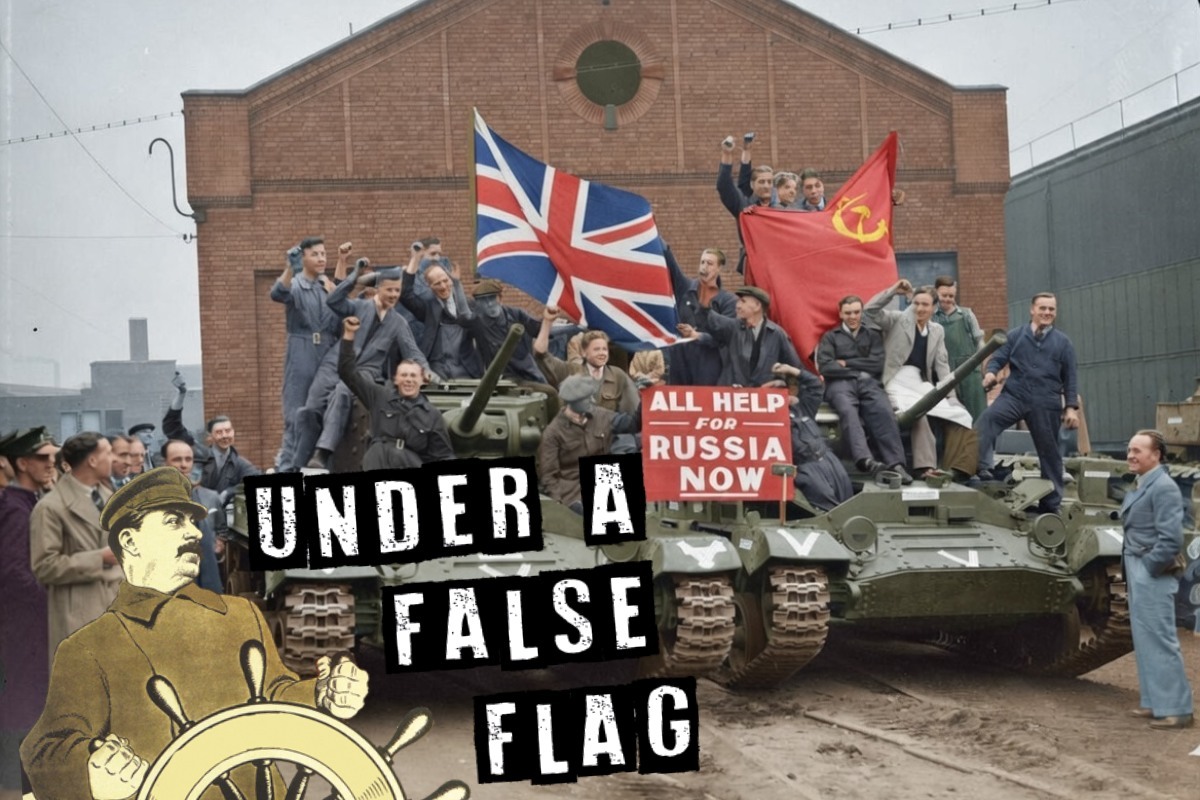
However, Hitler’s invasion of the USSR in June 1941 led to another dramatic U-turn. The CPGB now threw its support again behind the British ruling class, becoming some of the biggest apologists for British imperialism…
Second World War
The official tale told by the ruling class was that WW2 was a war between democracy and fascism. In reality the Second World War began as a continuation of the First: it was a reactionary imperialist war in search of markets, raw materials, and to defend the colonial possessions of the various European powers.
British imperialism, which had a head start over other empires, was desperately clinging to its position on the world stage. Britain declared war on Hitler’s Germany in 1939, over who was to be the top dog in Europe.
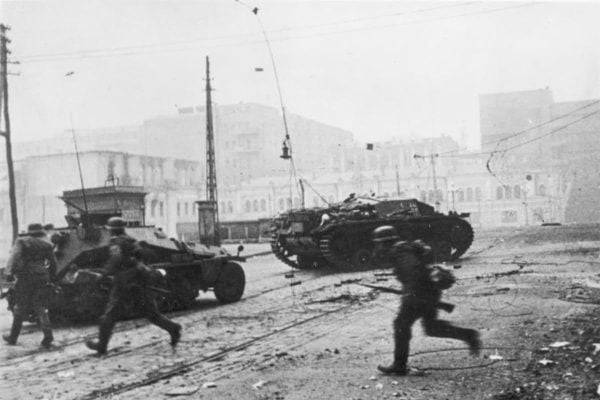
After Nazi Germany invaded the Soviet Union, Churchill and Roosevelt were cynically expecting the two countries to beat each other into a pulp, only for Britain to sit it out and sweep up the spoils when the time was right.
It was therefore necessary for workers everywhere to act in the defence of the USSR and the gains of the October Revolution. The revolution had been a huge victory for the international working class and remained a beacon even in its degenerated form, with unparalleled achievements in industry and culture.
Meanwhile, seeing the danger posed by fascist reaction in Germany, which led to the wholesale crushing of the German workers’ movement, British workers were keen to take up arms and fight the Nazis. This was a healthy class instinct.
But the ruling class seized on this mood, and cynically used the language of anti-fascism in their left-sounding propaganda, to conceal their real, predatory war aims. This is partly why the Labour leaders were invited to form a national wartime government with the Tories – to give the war effort a left-wing veneer.
Popular frontism
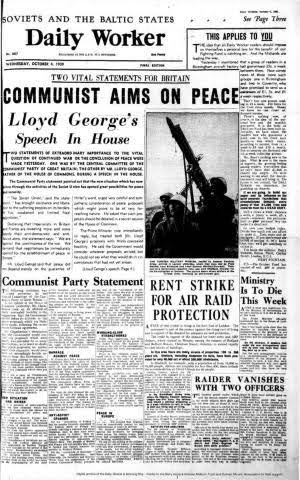
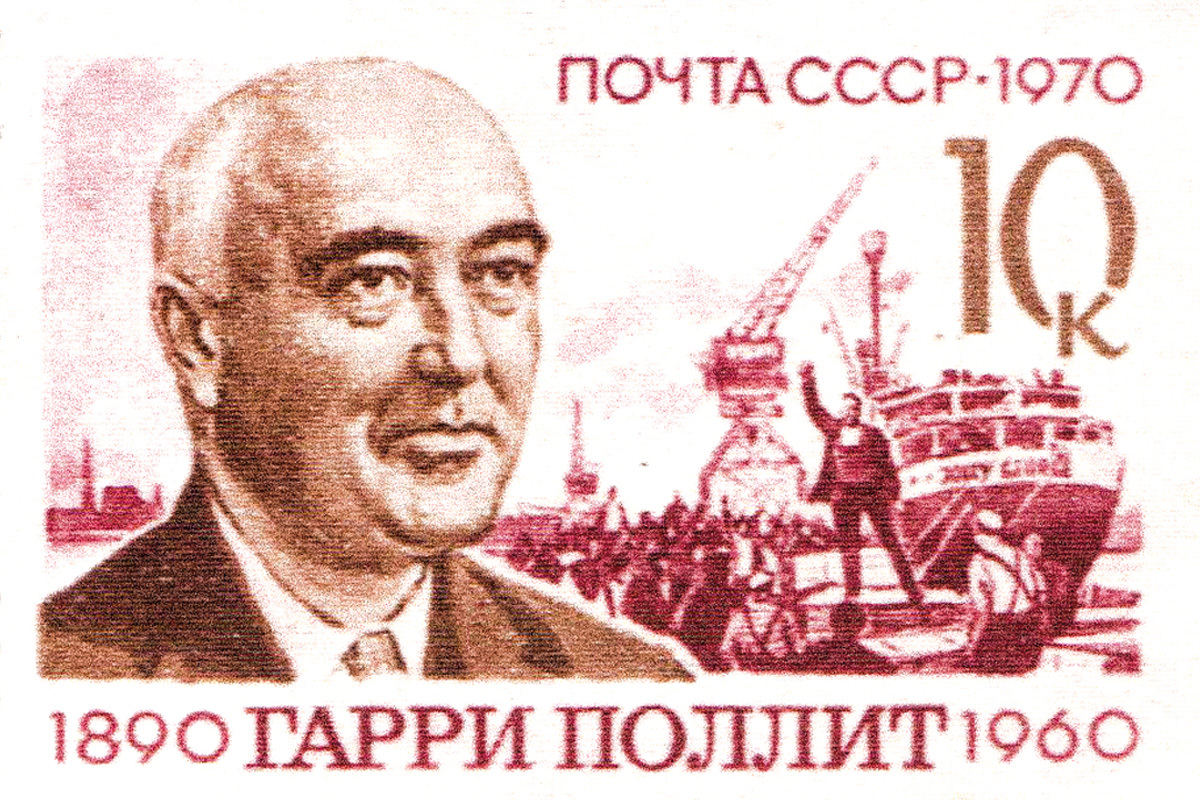
Unfortunately, the CPGB leaders went along with this charade – hook, line, and sinker! Harry Pollitt even indignantly argued that the Labour Party and the Tories should let the CPGB join them as part of the wartime national government!
In a speech titled Unity For Victory in 1942, he began by lamenting the “opposition on the part of the dominant Labour leaders to any joint activity with the Communist Party”. He called for “a nation firmly united and welded behind a national government”, reaffirming the CPGB’s commitment “to do everything in its power to achieve such united action”.
Yet, as leading Marxist Ted Grant later pointed out in his pamphlet The Menace of Fascism, members of the British establishment had supported fascism before the war, and could not be trusted to wage a real war against fascism, and to defend the Soviet Union.
It was only when alarm bells started ringing in London and Washington that the Soviet Red Army might march through the whole of Europe, as they single-handedly took on the Nazi war machine, that the Allied powers landed in Normandy, opening up a second front against the Nazis.
CPGB strikebreakers
To defend their popular frontism, the CPGB pushed the idea of ‘national unity’, i.e. unity between the British workers and their British capitalist exploiters. As Ted Grant describes in his History of British Trotskyism, they even donned a respectable, patriotic image, by carrying Union Jacks on demonstrations, and chanting “God Save the King”!
Scandalously, this led them to use their influence within the labour movement to restrain the action of the working class. From 1942 onwards, there was a growing wave of militant – and often illegal – strike action across various industries, for better wages and conditions.
Instead of leading these struggles, and linking the workers’ demands to the need for a workers’ government – which could wage a much more effective struggle against the Nazis – the CPGB played a strikebreaking role.
An example of this is the Tyneside apprentices’ strike in the spring of 1944. A year earlier, the Tory-Labour government introduced the ‘Bevin Boys’ scheme, whereby young men conscripted to join the army would instead be sent to the mines to make up for a shortage of coal. This was extremely unpopular, and led to 100,000 miners going on strike in March 1944.
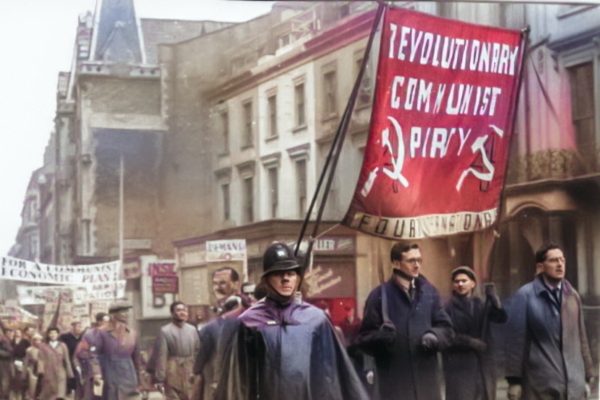
This was just as Ted Grant’s Revolutionary Communist Party (RCP) was meeting for its founding congress, as the successor of the Workers International League. Its bold name was chosen so as to draw a line between genuine communism and the opportunism of the CPGB – which RCP members referred to as ‘His Majesty’s Loyal Communist Party’.
While the CPGB were busy opposing these strikes, the RCP intervened in them, and helped to spread them nationally. This made them the regular target of attacks in the capitalist press, which was full of sensationalist reports about ‘Trotskyist agitators’.
Several leading communists from the RCP were subsequently arrested under the infamous Trades Disputes Acts of 1927, on charges of assisting an illegal strike. In response, the RCP launched a national solidarity campaign.
Scandalously, the CPGB sided with the ruling class at every step, printing stories about “saboteurs”. They even issued a pamphlet, Clear Out Hitler’s Agents, which denounced Trotskyists as “fascists” and “counter-revolutionaries”, and urged workers to treat Trotskyists “as you would an open Nazi” and drive them out of their workplaces!
Bear in mind that this was all while the Trotskyists were facing police raids and infiltration, MI5 investigations, and slanders in the press and in parliament! For the CPGB to join in with the ruling class’ chorus of baiting and repression was treachery of the highest order.
But the success of the RCP’s campaign within the ranks of the workers’ movement meant that the CPGB leaders soon had to tone down their slanders. And in the end, the comrades on trial got a sympathetic response from the jury, which found them guilty only on two counts.
In contrast with this ‘pragmatic’ Stalinist treachery, the Trotskyists put forward an independent class programme.
They called on the Labour Party leadership to break the wartime coalition and take power on a socialist programme. They demanded the arming of the working class under the control of the workers’ organisations, and the election of officers in the armed forces by the rank-and-file soldiers.
Such demands were also aimed at exposing the national government’s propaganda: if they were serious about defending the country against fascism, then they must arm and train the workers, expropriate the banks and heavy industries, and issue a class appeal to workers across Europe (including Germany) to wage a common, revolutionary struggle against Hitler – something which Churchill and his Labour hangers-on would never dream of.
The test of war
It is said that wars put all parties and tendencies to the test. The Communist Party of Great Britain failed the test of the Second World War.
It hopelessly zigzagged on its positions, replaced its leadership twice on orders from Moscow, sowed illusions in both the Nazi-Soviet pact and in British imperialism, supported the Tory-Labour national government, and clamped down on the independent action of the working class.
The forces of genuine communism, organised around Ted Grant and the RCP, passed the test of war with flying colours: putting forward an internationalist class programme, braving state repression to help workers in struggle, and fighting for a workers’ government as the best measure to defeat fascism and defend the Soviet Union.
Nevertheless, the Soviet people’s heroic victory over the Nazis strengthened the image of the USSR – and therefore the Stalinist parties – in the eyes of workers for a whole period.
View this post on Instagram
While the CPGB never became a mass party like the communist parties in France and Italy, in the decade following the Second World War it reached the height of its membership and influence, despite all of its mistakes. We will deal with how they squandered this influence in future instalments.
The new second edition of Ted Grant’s History of British Trotskyism is full of valuable lessons from this critical period of history. In particular, the experience of the RCP enriched the theory and programme of Marxism, leaving an indispensable guide for communists today.