Readers recommend: Colossus: The Rise and Decline of US Imperialism
Colossus was an amazing read. The book is an application of Lenin’s Imperialism, covering the rise and relative decline of American imperialism.
Lenin’s Imperialism is a brilliant book. Lenin wrote it at the birth of imperialism, when this phenomenon was emerging, so there were only so many examples that he could draw upon.
Colossus, however, provides a massive amount of examples from today and is a confirmation of Lenin’s Imperialism with facts, figures and historical examples. John Peterson really fleshes Imperialism out by using the example of America, and how finance capital in practice exploits and exerts control over foreign governments.
One of the main stand out lessons for me was to see concretely how the US military is used to get better deals, to exhort and basically tie other countries to America.
One of the quotes that stood out to me the most was in the section covering the occupation of the Philippines. The brazenness and the mentality of American military generals, these attack dogs of US imperialism – it sticks out in my mind. It was General Shafter who said:
“It may be necessary to kill half the Filipinos in order that the remaining half of the population may be advanced to a higher plane of life than their present semi-barbarous state affords.”
It shows you the kind of ruthlessness of these generals.
I also found fascinating the discussion of NGOs and organisations like USAID that are said by ‘liberals’ to be a great humanitarian thing. They have been invested in for the past 70 years, and yet these countries are still underdeveloped!
What do they actually do? They train up these libertarian cadres that wreck revolutions and lead to civil war, oppression, and austerity in so-called ‘underdeveloped countries’.
I would strongly recommend Colossus if you haven’t bought and read it already. It’s just a brilliant book to really put meat on the bones in terms of what imperialism actually is.
Katherine Zheng
Get your copy of Colossus: The Rise and Decline of US Imperialism from Wellred Books Britain
Extracts from Colossus: The Rise and Decline of US Imperialism
Already in the colonial era, the United States’ expansionist tendencies were evident. But it was the first American Revolution and its aftermath that really set the course for the future imperialist behemoth.
In a sublime example of the dialectic of history, the country that fought the world’s first successful war of revolutionary national liberation was eventually transformed into the greatest imperialist oppressor.
Out of necessity, thirteen diverse colonies had formed a military alliance to fight the British. However, it was unclear what would follow.
Would they form thirteen separate countries, a handful of regional confederacies, or a single united nation-state? How would they deal with external trade, tariffs, taxes, internal improvements, and security? What about the “moral depravity” and “hideous blot” of slavery, as the slaveholder Thomas Jefferson described it? And how best to derail the awakened masses’ demand for “democracy”?
In the end, under pressure from events like Shays’ Rebellion, they came to a series of ultimately untenable compromises and formed a constitutional federal republic.
As a result, this disparate collection of peoples, states, and territories emerged as the only serious power on a vast continent bursting with natural resources.
How best to dispense with that land and the peoples living on it would lead to bitter infighting and take more than a century to sort out.
The expansionist tone was set early on. In a letter to the Marquis de Lafayette, George Washington referred to his new country as an “infant empire”.
With the signing of the Treaty of Paris of 1783, the colonies’ territorial holdings had doubled, stretching westward to the Mississippi.
But it was Thomas Jefferson and his vision of an “Empire of Liberty” that really got the expansionist ball rolling. In his view, the US “must be viewed as the nest from which all America, North and South is to be peopled”.
In 1803, Jefferson purchased the Louisiana Territory from Napoleon for $15 million. Overnight, the country doubled in size yet again.
Monroe Doctrine
It was in this broader context that, on 2 December 1823, James Monroe, the country’s fifth president, articulated his famous foreign policy principle.
The Monroe Doctrine rejected any further colonisation or intervention in the Americas by European powers, and asserted that any such attempts would be viewed as a threat to the US. It also declared that, in exchange, the Americans would not meddle in European affairs – though that part has been conveniently forgotten.
As the Chilean businessman and minister, Diego Portales, wrote to a friend: “We have to be very careful; for the Americans of the North, the only Americans are themselves.”
The Industrial Revolution was in full swing. Between 1800 and 1840, the country’s population more than tripled.
Gathering steam on the road to becoming global power, the US economy began to outpace Western Europe, with annual per capita income growing at 1.26 percent.
Manifest Destiny
The Mexican-American War was the first serious imperialist foray by the newly-minted power, as it expanded from sea to shining sea.
President James K. Polk had run openly as an annexationist during the 1844 election. To this end, Polk orchestrated an incident of “Mexican aggression” along the Nueces River to justify sending US troops across the border. As he told a joint session of Congress in a classic example of imperialist doublespeak:
“As war exists, and, notwithstanding all our efforts to avoid it, exists by the act of Mexico herself, we are called upon by every consideration of duty and patriotism to vindicate with decision the honor, the rights, and the interests of our country…
“In further vindication of our rights and defense of our territory, I invoke the prompt action of Congress to recognise the existence of the war, and to place at the disposition of the Executive the means of prosecuting the war with vigor, and thus hastening the restoration of peace.”
But not everyone agreed. Even at that time, there was internal opposition. Many saw it as an overtly predatory war and believed pursuing an empire was a mortal danger to the virtues of republican government. As Henry Clay declared: “This is no war of defense, but one of unnecessary and offensive aggression.”
But the hawks prevailed, and US troops eventually marched all the way to the ‘Halls of Montezuma’ in Mexico City. All told, 13,283 Americans and an estimated 25,000 Mexicans died during the conflict, most of them from disease.
Along the way, many atrocities were committed by American troops against Mexican civilians. This included murder, looting and destruction of property, mistreatment of prisoners, and attacks against Catholic churches, fueled by racism and anti-Catholic sentiment.
The war officially ended with the Treaty of Guadalupe Hidalgo. Under its terms, Mexico was forced to recognise the US annexation of Texas and cede around half of its territory, including the present-day states of California, Nevada, Utah, Arizona, New Mexico, Colorado, Wyoming, and parts of Kansas, Oklahoma, and Texas.
In 1846, the teeming resources of the Oregon Territory were acquired from Great Britain by treaty, adding present-day Oregon, Washington, Idaho, and parts of Montana and Wyoming.
The Gadsden Purchase of 1853 squared things off, with the US purchasing an additional 29,670 square miles of land from Mexico, this time for $10 million. The territory included parts of south Arizona and southwestern New Mexico, with a view towards building a southern transcontinental railroad.
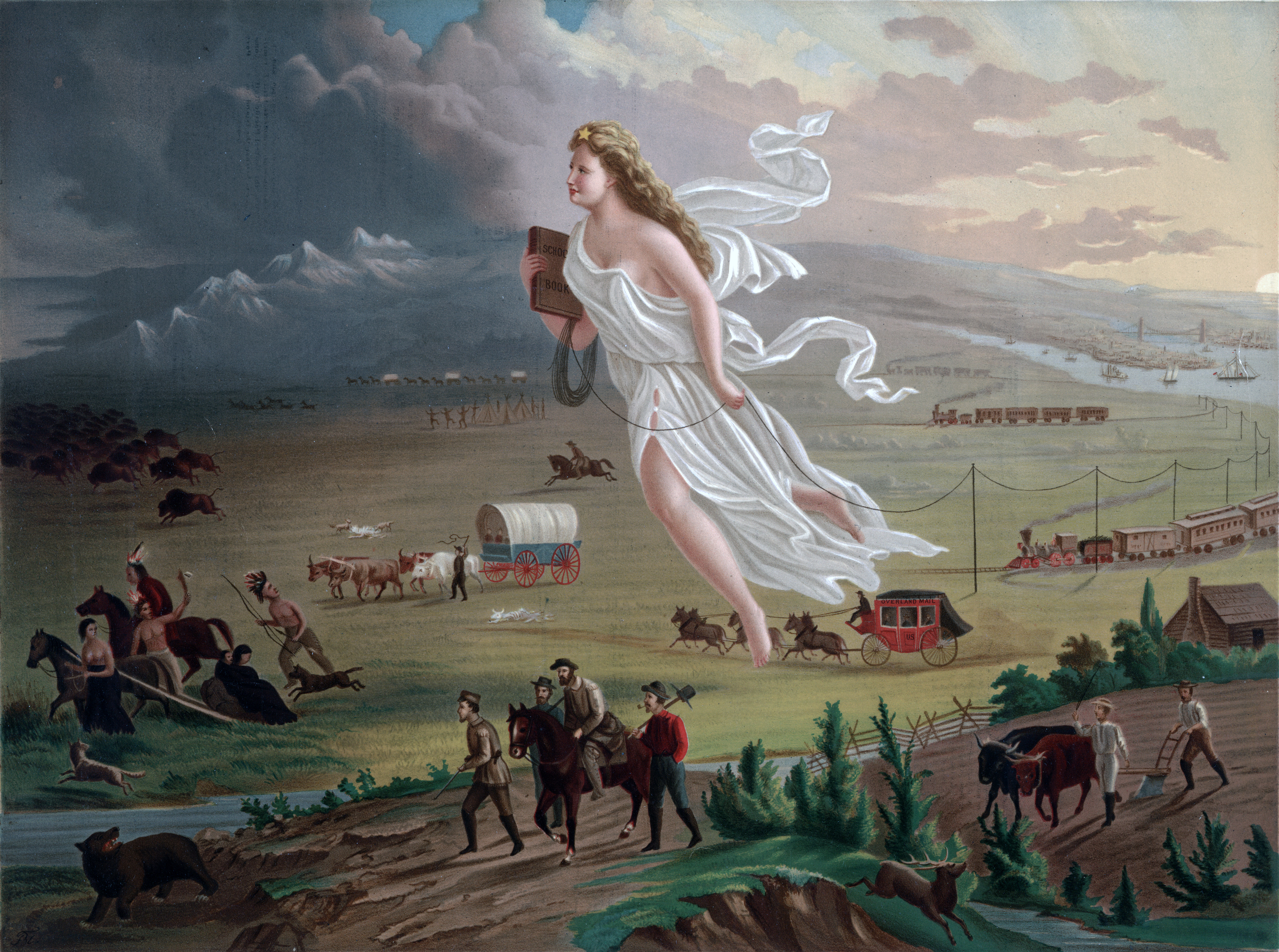
These heady years of constant expansion fed illusions in the not-so-veiled racism of American exceptionalism, epitomised by the idea of ‘Manifest Destiny’.
— Wellred Books Britain (@WellredBritain) January 14, 2025
Civil War
The Civil War’s causes are directly linked to the question of US expansion. What to do with all the new land that was being acquired?
The southern slave holding states (the Confederacy) needed the extra land because slavery was an inefficient use of labour, since the slaveowners had no incentive to innovate and invest in labour saving technology. Broadly speaking, the southern economy remained more or less the same in the 1850s as it had been in the 1820s.
In the North, on the other hand, the economy had evolved much more dramatically, with household production being transformed into small-scale manufacturing, and manufacturing transformed into full-on industry.
With growing international competition threatening the slaveowners dominance of the cotton trade, geographic expansion was essential to their survival as a class. They needed more land to grow cotton, or other useful ways to put their slaves to work.
Thus, geographic expansion posed the question: what character will this new territory have – slave owning or wage slavery? That is what the Civil War was fought over.
Over the course of four years of war, the old United States had been immolated, and a new country rose out of its ashes.
Along with tremendous advances in military and related technologies, the war accelerated the commercialisation of agriculture, industrialisation, the building of a continent-wide network of railroads, ports, and canals, and established a national banking system.
The war was followed by the tragic abortion of Southern Reconstruction, aggressive westward expansion into territories still occupied by Indigenous peoples, and the purchase of Alaska from Russia in 1867.
A juggernaut is born
Even the broad expanse of the American nation-state proved insufficient to contain the productive forces that had been unleashed, however.
The US bourgeoisie needed external markets to absorb the growing surplus of commodities and capital. More than that, they wanted their own overseas colonies – never mind that the main European powers had already carved almost everything up.
In 1898, Senator Albert Beveridge put the position clearly:
“American factories are making more than the American people can use; American soil is producing more than they can consume. Fate has written our policy for us; the trade of the world must and shall be ours.”
That same year, President William McKinley and the hawks in the US administration picked a fight with the sick and decaying Spanish Empire.
In 1898, the casus belli was a mysterious explosion in Havana Harbor that sank an American warship, the USS Maine. As always, this was combined with cynical calls for a ‘humanitarian intervention’ to fight tyranny and liberate Spain’s colonial subjects.
In just a few months, Spain was defeated and the US took possession of the Philippines, Cuba, Puerto Rico, and Guam. $20 million was paid to Spain as compensation for the diverse and fragmented island chain known as the Philippines.
Far from the freedom they were promised, however, Spain’s former subjects found themselves under the jackboot of a new and often even more oppressive master.
Gunboats and dollars
Lenin identified the early 1900s as the tipping point for full-fledged monopoly capitalism and imperialism.
Following the assassination of President William McKinley by the anarchist Leon Czolgosz in 1901, the first decade of the new century was dominated by the presidency of Teddy Roosevelt.
Roosevelt, who fought with his ‘roughriders’ in Cuba during the Spanish-American War, was an unapologetic imperialist with a special interest in the country’s ‘backyard’.
These were the years of ‘gunboat diplomacy’, including a series of military interventions and occupations in Cuba, Nicaragua, Honduras, the Dominican Republic, Venezuela, Haiti, and beyond.
‘Might makes right’ was on the order of the day, or, as Roosevelt bluntly framed his policy: “Speak softly and carry a big stick.”
In 1903, Roosevelt sent warships and orchestrated Panama’s independence from Colombia, after it declined to allow the construction of a canal across its narrowest isthmus. Needless to say, the new republic allowed the construction of the Panama Canal, with huge implications for the US economy.
In 1904, the President announced the Roosevelt Corollary to the Monroe Doctrine. At least in words, the original doctrine had been non-interventionist in nature. Roosevelt now asserted that the US had not only the right but the duty to intervene in Latin America to maintain stability, protect investments in infrastructure, trade routes, and natural resources, and ensure political stability favourable to US interests.
As an example of this policy, in 1954, United Fruit called in the CIA to overthrow Jacobo Árbenz in Guatemala, who they accused of being a communist for advocating land redistribution and workers’ rights.
In 2024, United Fruit – now rebranded Chiquita Brands International – was ordered to pay $38.3 million in damages to the families of those murdered by extreme-right paramilitary groups, hired by the company to terrorise and exterminate Colombians opposed to its low wages and dangerous working conditions.
It was William Howard Taft, however, Teddy Roosevelt’s successor, who really leveraged the growing power of US imperialism with what he called ‘Dollar Diplomacy’.
The US government began actively encouraging American banks and corporations to invest in the development of railways, ports, and other critical infrastructure in foreign countries. This would increase economic and political dependence on the US, thus opening opportunities for further expansion by American finance capital.
Entering the First World War
World War I and the presidency of Wilson (1913-21) marked another critical juncture. A fervent believer in America’s worldwide ‘Manifest Destiny’, Wilson told students at Columbia University in 1907:
“Since trade ignores national boundaries, and the manufacturer insists on having the world as a market, the flag of his nation must follow him, and the doors of the nations which are closed against him must be battered down.”
With the Allied and Central Powers slugging it out to determine who would rule Europe, the colonies, and the seas, American imperialism couldn’t resist putting its increasingly weighty thumb on the scale of world relations.
Wilson eventually found a convincing reason to join the Allies. The Kaiser’s submarines sank one too many American ships, and the Zimmerman Telegram urging Mexico to invade the US in exchange for some of its lost territories had inflamed public opinion against Germany.
On April 6, 1917, war was officially declared. By May 1918, over one million US troops were stationed in France, with half of them fighting on the frontlines.
Of course, entering the war had nothing to do with ‘honour’ or ‘making the world safe for democracy’, though that was the official line. As W.E.B. DuBois put it, this was “a war for empire”.
The American economy had boomed during the war’s early years as it flooded Europe with raw materials, food, and manufactured goods. Now it wanted boots on the ground to consolidate its gains.
There was also the small matter of nearly $10 billion in wartime loans made to Britain and France, repayment of which would have been jeopardised by a German victory.
As Wilson himself explained: “Concessions obtained by financiers must be safeguarded by ministers of state, even if the sovereignty of unwilling nations be outraged in the process.”
Balance of power
In 1926, Trotsky summarised the profound shifts taking place in the years between world wars:
“These last years, the economic axis of the world has been radically displaced. The relations between the USA and Europe have become drastically altered. It is the result of the war. Naturally, this change was prepared long since.
“The European bourgeois does not want to believe that he has been shoved to the background, that it is the USA that rules the capitalist world.
“It required the war in order at a single blow to raise America, lower Europe, and lay bare the abrupt shift of the world axis.
“The war, as an enterprise for the ruination and decadence of Europe, cost America around $25 billion. If we recall that American banks now hold $60 billion, that sum of $25 billion is relatively small. Furthermore, $10 billion went as a loan to Europe. With the unpaid interest these $10 billion have now become $12 billion, and Europe is beginning to pay America for its own ruination.
“Such is the mechanism whereby the United States was able to rise at one stroke above the whole world as the master of its destinies.”
By accelerating the development of capitalism, however, US imperialism was merely sharpening the system’s internal contradictions. As Trotsky noted in October 1929, just weeks before the Great Crash on Wall Street:
“The prewar power of the United States grew on the basis of its internal market, i.e., the dynamic equilibrium between industry and agriculture. In this development the war has produced a sharp break.
“The United States exports capital and manufactured goods in ever greater volume. The growth of America’s world power means that the entire system of American industry and banking – that towering capitalist skyscraper – is resting to an ever increasing measure on the foundations of the world economy.”
Second World War
World War II presented American imperialism with another unmissable opportunity. Whereas World War I was fought mainly in Europe to decide who would rule the colonies, World War II was fought on a world scale to decide who would rule the planet.
America’s wartime mobilisation was without a doubt the most extraordinary economic turnaround in the history of capitalism. During the course of the war, industrial productivity rose by 96 percent and 17 million new civilian jobs were created, wiping out the unemployment of the Great Depression. From the dark depths of the 1930s, the economy grew by an average of 11 or 12 percent a year.
Despite the many myths to the contrary, this dramatic economic and demographic reconfiguration did not flow from the genius of private enterprise. Rather, it required massive state intervention and the economies of scale only it can afford to turn things around.
Once the war was won, the capitalists were keen to get things back to ‘normal’ – lest the millions of returning veterans get any ideas about how the economy might be organised differently.
As had been the case during World War I, the US was formally neutral when the fighting first broke out. The national mood was isolationist, and laws were passed barring it from selling arms or offering credit to warring nations.
By the war’s end, however, US imperialism had embedded itself in the very fabric of the formerly dominant European empires – above all, the British. It did so patiently and deliberately, step by step.
In 1940, the UK was desperately embroiled in the Battle of Britain. The Americans came graciously to the rescue with the ‘Destroyers for Bases’ agreement, which provided the Brits with 50 naval destroyers in exchange for land rights on British possessions. As a result, the US received 99-year leases to set up bases in places like Newfoundland, the Bahamas, Bermuda, Jamaica, and Trinidad.
All told, the US sent 12 million troops to Europe during the war, bringing with them their food, music, sports, and more. Over two million G.I.s – short for ‘Government Issue’ – passed through Britain alone.
By the war’s end, Churchill grudgingly acknowledged that events had brought US imperialism to the “summit of the world”.
End of an era
By 1945, US imperialism realised it didn’t have to physically hold entire countries to control them. All they needed was to keep a few hundred military bases, many of them on remote islands. From these points, they could project overwhelming military force and dominate the key hubs of the global economy.
With a worldwide logistical network and a commanding position in banking, they could dictate the terms of trade and the flows of currency and capital.
The Marshall Plan was one piece of the puzzle, with $12 billion sent to Western Europe to rebuild after the war, equivalent to $173 billion in today’s dollars.
The plan was explicitly aimed at countering the weight of the Soviet Union and its Eastern Bloc, whose economies were also recovering and even booming after the war. However, these were loans, not gifts, and the money had to be used to buy goods from US producers.
In other words, this was yet another circular handout to private corporations using public dollars, with the added bonus that Western Europe was even further in thrall to the Americans.
On this basis, the postwar order was established under American domination. The decades after the war were the peak of the power of American imperialism. The world order it established held up for around eighty years (notwithstanding the important amendment of the collapse of the USSR).
Now, after years of gradual and relative decline of the US’ economic weight in the world economy, and the massive shift from being the world’s largest creditor to its largest debtor, the tectonic plates of world relations are shifting.
The US dominated order is no longer tenable; it is out of step with the economic reality. Its decline will have – indeed, already is having – revolutionary consequences throughout the world, not least of all in America itself.