Last year, with the launch of the government’s Strategic Defence Review, military chiefs called for a “whole of society approach” to defence. It has taken some time to fully reveal what this looks like in practice. But the launch of the Defence Universities Alliance (DUA) has made it abundantly clear.
35 universities have committed to increasing the amount of research directed towards the needs of ‘defence’; to ensuring that courses develop skills useful for militaristic ends; and to actively pushing students towards careers in the defence industry.
The aim is clear: to convert universities into extensions of the imperialist war machine. Instead of research aimed at addressing the most pressing social, environmental, and humanitarian problems, it will be aimed at fine-tuning the means of death and destruction. Academics will need to fall in line, or risk losing their funding altogether.
The more financially dependent universities become on funding from the military-industrial complex, the more their aims will become indistinguishable from the defence sector and the warmongers at the Ministry of Defence (MoD).
Careers in defence will be pushed at a time when graduates are desperate for employment. Campuses will become recruiting grounds, with the MoD, BAE Systems, Rolls Royce, and more all invited to coerce thousands of young minds into becoming tools to develop advanced warfare technologies and arms production.
Decline and delusion
Following a century of decline, British imperialism today is a second- or third-rate power. British capitalism is crumbling and decaying. The so-called ‘special relationship’ between the UK and America is increasingly neglected and abused by those in Washington. And with Brexit, Britain has lost the diplomatic influence it once had as part of the EU.
Yet the British ruling class and its representatives have not fully accepted these facts. Instead, they continually cling to a deluded fantasy, believing that Britain still rules the waves and holds sway internationally.
The British establishment’s drive towards militarism is a reflection of this delusion – a desperate attempt to preserve their perceived influence on the world stage.
For the last 80-or-so years, until recently, British imperialism’s decline was partially masked by its membership of NATO; by the military and security guarantees that it had from the biggest bully in the playground, US imperialism.
Last year, however, US President Donald Trump announced his intention to pull American forces out of Europe, whilst demanding that the rest of NATO increase their military spending to 5 percent of GDP.
This provoked a panic across Europe – and especially in Britain. Without the security assurance provided by US imperialism, these diminished powers would be unable to protect their markets and spheres of influence against rising rivals.
Since then, the imperialists in London, Paris, and Berlin have banged the war drums ever louder. They and their mouthpieces have ramped up hysteria about the threat of an attack – or even an invasion – by Russia against Europe. And they have sounded the alarm on the dire state of their armed forces, which fall woefully short of what is required to defend their imperialist interests across the world.
Defence dilemma
In Britain, decades of deindustrialisation and deskilling have completely hollowed out the country’s military capabilities. As a result, under increasing pressure from military chiefs, the Labour government has been scrambling to raise the defence budget.

This is easier said than done, however. The UK economy is stagnant. And clawing money back from other areas of public spending is fraught with political difficulties.
Consequently, in office, Keir Starmer could offer only a measly increase in military spending of 0.08 percentage points (relative to GDP) by 2030. This is well short of what was promised and what is needed, from the perspective of British imperialism.
This dilemma became one of the final nails in Starmer’s coffin, with then-defence minister John Healey resigning in protest against the government’s inability to commit to greater military expenditure.
Now Andy Burnham has taken over as prime minister, and made Healey what some have dubbed ‘the Warfare Chancellor’.
Just like his predecessor though, the latest head of the Treasury has found that he can’t just ramp up military spending at the click of a button. The economy isn’t growing; the bond markets are reluctant to let the government borrow more; and cuts to welfare to pay for warfare are likely to provoke an enormous backlash from below.
At the same time, given his previous resignation over this question, Healey is under even greater pressure than his forerunner, Rachel Reeves, to boost spending on defence. This means he has to find more ‘creative’ ways of expanding Britain’s military capacities.
Enter the Defence Universities Alliance (DUA).
Competing pressures
How does the DUA help the government fulfil its aims?
In the Strategic Defence Review, government advisors explain the need for Britain to apply the lessons from Ukraine: ramping up the development and capacity of drone, AI, cyber, and electronic-based warfare.
Furthermore, the warmongers in Whitehall want to give UK companies greater opportunities to develop and export defence technologies.
Having a ready supply of skilled – but cheap – researchers, scientists, and engineers would greatly help with both of these goals. And where better to find such a workforce than on university campuses.
Similar arrangements already exist in the British education system. BAE Systems is ploughing hundreds of millions into educational outreach and youth centres, for example, in order to funnel young people into the ‘defence’ sector. Starting this month, meanwhile, the government is opening five new defence technical colleges, focussed on advanced engineering, digital, and cyber technologies.
These measures aren’t part of any well-thought-out, overarching, grand plan. Rather, they are empirical responses from a government that is being pushed and pulled in different directions, by a multitude of competing pressures and interests – economically, militarily, and politically.
The DUA is merely a means of creating a bit of short-term breathing space. But it solves absolutely nothing in the long run, and simply highlights how the government is completely at the mercy of these forces, no matter who resides in Number 10.
Death, destruction, and desperation
On the other hand, university bosses are also keen on this deal.

UK universities already have partnerships worth over £1 billion with the arms industry. But with inflation eroding the value of domestic tuition fees, increasing loan repayments owed to the banks, and growing running costs, as well as a decline in international student numbers, universities have become desperate for funds.
The DUA only offers £182 million between the 35 universities involved. But it also offers closer access to the defence sector, which could unlock further funding.
As a result, vice-chancellors have enthusiastically signed up to the DUA. Over 100 universities applied to become a member of the militaristic network. The 35 who were accepted into the alliance, meanwhile, had to willingly submit themselves to the ‘national security’ aims and objectives outlined in the DUA Charter.
In order to be accepted into the DUA, sycophantic vice-chancellors have boasted of their ability to ‘innovate’ and develop the means of destruction, all whilst promising with a straight face that their institutional integrity – as places of learning and education – won’t be compromised.
With over one million young people currently not in education, employment, or training, and staff facing a constant looming threat of cuts, the vulnerable position of both workers and students in higher education is being preyed upon by the merchants of death. And all this without any consultation.
For many, however, this won’t come as much of a shock. In universities across the country, management have already attacked and intimidated students and academics for speaking out against the continuing genocide of the Palestinian people.
Declare war on the DUA!
There is no doubt that this move will be extremely unpopular amongst staff and students.
The vast majority of lecturers and researchers are in academia because they have a passion for their subject; because of a sincere desire to benefit society, not to aid in its destruction. They want to help develop the next generation, not facilitate the murder of innocent children.
These workers have been almost continuously fighting against attacks on their wages and conditions for most of the last decade. Due to the poor leadership of the UCU, however, thousands of their colleagues have lost their jobs, and a swathe of courses have been axed. This has led to widespread demoralisation and a growing mental health crisis amongst academic staff.
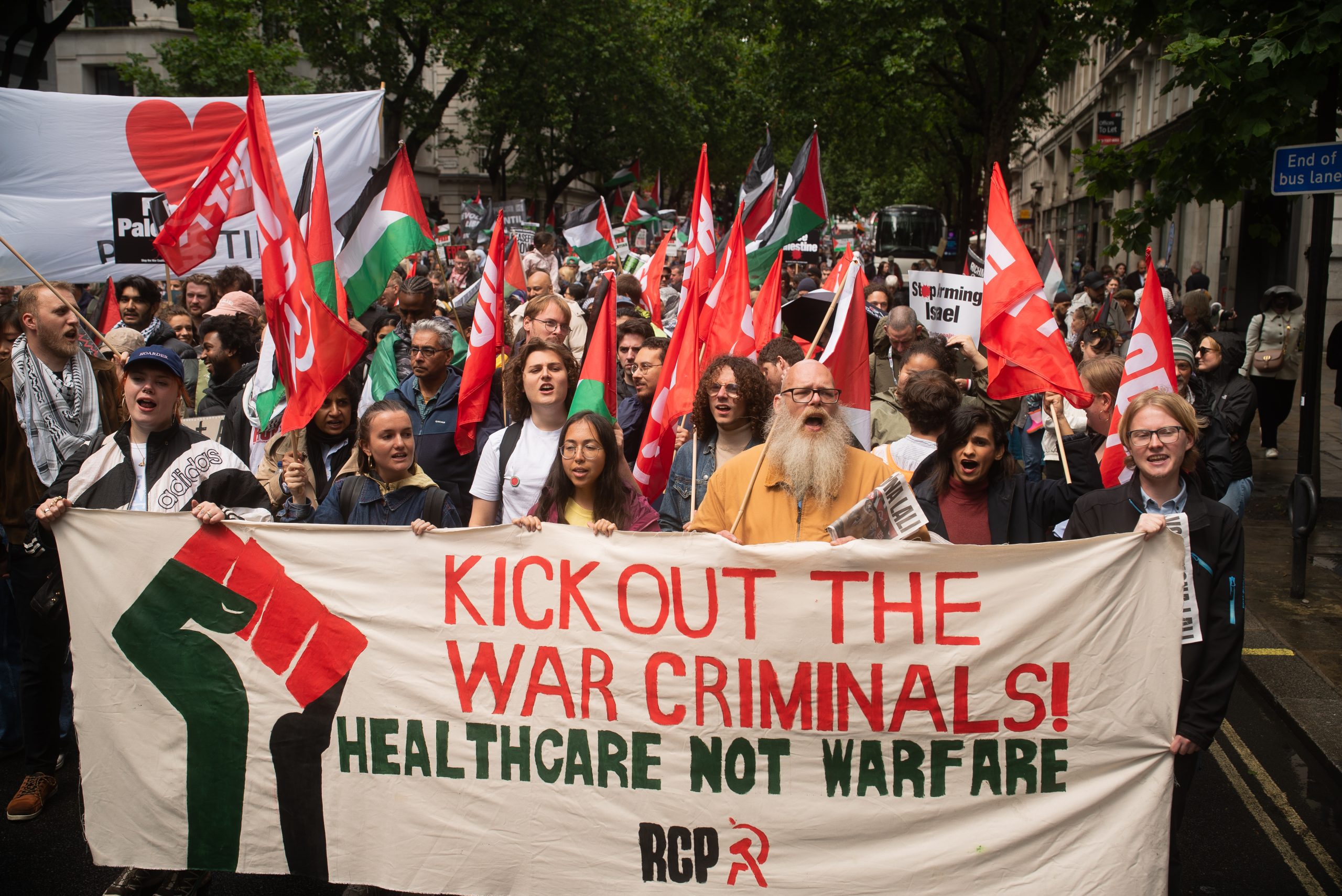
Likewise, students have been at the forefront of the struggle for Palestine. This includes the encampment movement from the summer of 2024, which spread across the Atlantic from US universities to UK campuses.
Elsewhere, in Germany, school students have been fighting against the introduction of conscription. And in Bangladesh, Nepal, and Serbia, it is students that have led revolutionary movements and helped toppled governments.
The fight for Palestine; against war and genocide; against corruption and militarism: these struggles have brought a new wave of youth into political activity, and shaped the consciousness of an entire generation.
Government ministers and the profit-hungry arms companies they serve will therefore find little support amongst students for the militarisation of higher education.
Students and staff must unite and declare war on the DUA. The alternative is clear: billions wasted on bombs and bloodshed, whilst universities are moulded to suit the interests of arms manufacturers and the MoD.
Those pushing the DUA can be defeated. This is a weak government. The Westminster carousel of seven prime ministers in ten years exposes the deep crisis facing British capitalism and its representatives.
A united struggle of staff and students, linked up across UK campuses, could therefore stop the warmongers in their tracks, and halt the march of militarism in our universities.
That is why we say:
- Declare war on the DUA!
- No to the militarisation of our universities! Kick imperialism off our campuses!
- Expropriate the war profiteers! Overthrow the warmongers!
Oxford: The university of war
Oxford University management has welcomed the Defence University Alliance (DUA) with open arms.
The University not only joined the alliance, but is deeply intertwined with the people who first formulated the idea for bringing universities into British defence architecture.
Six months before the government announced the DUA, the Council of Geostrategy thinktank published a report proposing a “University Tech Alliance” between the Department for Education and Ministry of Defence (MoD).
The cofounders for the thinktank, James Rogers and Viktorija Starych-Samuolienė, have regularly given talks, and are both fellows at Oxford University. The research center they are fellows of is directed by Dr Rob Johnson, who spent two years in the MoD, and is “in a position to significantly influence defence strategy at the highest level”.
Johnson still “conduct[s] policy engagement with UK, US and other governments”. This is not an isolated military researcher or thinktank – this is a researcher and organisation who shapes policy for the MoD.
The ‘Council’ are headbangers for war: they support NATO, western intervention, military strikes into Russia via Ukraine, and the militarisation of British industry to bolster defence.
Yet Oxford University management soothes its students and staff with talk of “ethical governance” and “responsible innovation”. But this means nothing in practice; their hypocrisy is insufferable.
Let us remember the University of Oxford has always invested in and promoted the horrors of British imperialism.
For example, Wadham – the apparently ‘progressive’ college – and another college put money into the South Sea Company which was granted a monopoly to supply African slaves to islands in the ‘South Seas’ and South America in 1713.
There is a house, scholarship, and statue dedicated to Cecil Rhodes, the arch white supremacist and British coloniser. Fellows are rumoured to have used a human skull from an enslaved woman as drinking cups. To this day, colleges refuse to release information regarding investments related to Israel. This list goes on, from past to present.
The same institution claims to take a neutral position on war, stating that with “all international conflicts and crises, we will not take a particular advocacy position”. But how does this stand up practice?
When the Ukraine War broke out – a war which Britain directly helped to instigate – the University hypocritically chimed that “members of our community are appalled by Russia’s action and in awe of the bravery shown by Ukrainians”.
Yet when it came to the genocide in Gaza – where for every one Israeli killed, 40 Gazans were butchered – the University’s expression of horror was ‘neutral’, stating they were “deeply saddened by the continued loss of innocent lives in Gaza and Israel”, and nothing more.
Not even after liberal bodies like the United Nations declared this a genocide did the University follow suit.
Oxford University is deeply embedded into the interests of British imperialism and its institutions. Their role in helping form the DUA is just the latest example.
If we want our universities to act for us – the students and the faculty – we can have no trust in the management. We have to understand the role our universities play under capitalism, and expose their imperialist interests and hypocrisy.
This is the first step in how we can fight against the rise of militarisation in our universities.
Oxford RCP
Glasgow University joins University Defence Alliance
On 13 July, the University of Glasgow (GU) joined the Defence Universities Alliance (DUA), drawing the institution further into the orbit of the arms industry.
The DUA is part of the government’s Defence Industrial Strategy which aims to increase defence spending to 2.6 percent of GDP by 2027 and commit an additional £1.5 billion to create an “always-on” munitions production pipeline.
Currently, 19 of the 24 Russell Group universities are members of the DUA. Under Britain’s newest warmongerer Burnham, this gang is not going to get any smaller.
What does this mean concretely for staff and students? For students, it funnels their studies and future prospects into the defence industry. For staff, it creates pressure to pursue defence-linked funding and orient research towards the needs of the military
But students themselves outright reject this prospect. In a referendum of GU students held last year, almost 90 percent voted in favour of divesting from companies that earn more than 10 percent of their revenue from the arms industry.
Despite this, GU still holds a reported £5.2 million in investments in arms companies and maintains research partnerships with defence firms worth approximately £69 million.
GU’s Student Representative Council has already, before term has even started, condemned management’s decision to enter the DUA without any consultation with them. They rightly stated this was “continued contempt for student views”.
The university’s Divestment Coalition, made up of over 80 student societies, has also spoken out against the alliance.
This is only a glimpse of the immense bubbling anger against DUA and the university’s wider imperialist links – and we say this opposition must go further.
University management is tied by a thousand threads to the state, its politicians, and the arms industry. Until they are all done away with – and universities are put under staff and student control – the ruling class will continue to dictate from the top and make universities dance to the beat of the war drum.
Nel, Glasgow Communists