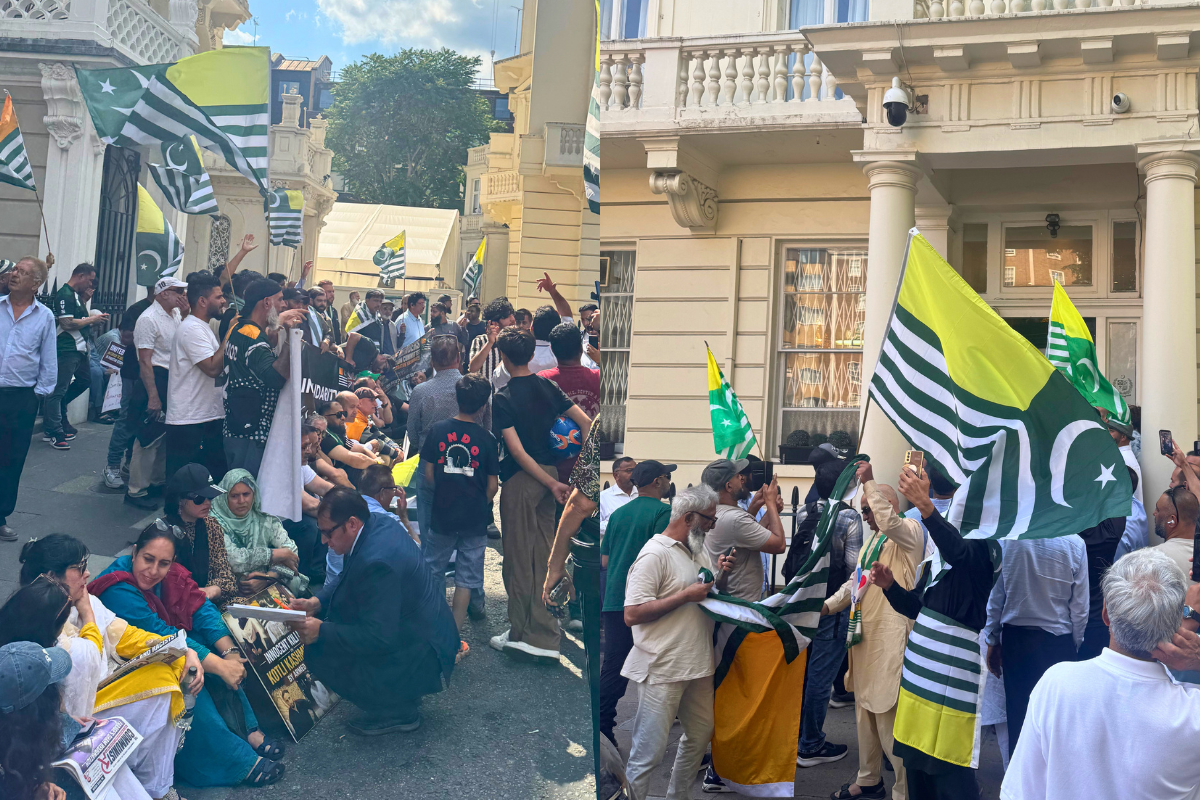
On 15 July, comrades of the Revolutionary Communist Party joined a protest in solidarity with the mass movement in ‘Azad’ Kashmir outside the Pakistan High Commission in London.
This was the day that the Long March to Muzaffarabad was due to resume, before it was postponed by the Awami Action Committee (AAC), the movement’s leadership, to conduct ‘negotiations’.
About 100 people gathered, almost entirely young people from the Kashmiri diaspora.
The mood was incredibly radical, with protestors holding no illusions in these negotiations with the Pakistani regime – one protestor said he would not believe a word from the Pakistani government until he saw the demands of the movement actually met.
Everyone we spoke with understood that the masses in ‘Azad’ Kashmir must not back down or allow their leaders to make any concessions – instead, the next step must be to escalate the movement until full victory is achieved.
Silence in the media
When we arrived, we were the only political organisation there besides the community groups that organised the protest. The ‘left’ were unfortunately conspicuous by their absence, despite the organisers telling us they had made every effort to reach out to them.
The latest issue of The Communist – which features an article on the situation in Azad Kashmir – went down really well. Some protestors immediately bought several copies of the paper to distribute amongst themselves.
The mainstream media has completely ignored not only the revolutionary movement in Kashmir, but also the solidarity protests in Britain.
And so we also began to conduct interviews with the organisers. Enthused at the possibility of getting the voice of the Kashmiri people out to a broader audience, many of the other protestors actively came to us asking to give their own interviews.
View this post on Instagram
One man recounted his experience of being imprisoned in Rawalakot just as the movement began:
“I was locked in a cell. […] You all probably know how many people were killed that day, and many young people were taken inside [to prison].
“And what happened is that young people between 18 and 30 were being brought into the police station. Once the gates were closed, they were beaten up.
“I cannot explain to you what I saw with my own eyes. I saw young people being kicked by police in their downstairs, and beaten with a leather strip, which had a weight at the bottom. I saw this throughout the night.
“Throughout the night, each and every young person was beaten up. They were humiliated, they were disgraced.”
This kind of brutal repression at the hands of the Pakistani state is what hundreds of thousands in ‘Azad’ Kashmir have been bravely facing down since the Long March began earlier this month.
“Action Committee, move forward!”
Everyone we spoke with pointed out how the Pakistani regime is clearly on the backfoot. That is why they are now offering negotiations – it comes from a place of weakness on the part of the government.
And, many protestors pointed out, that is why there must be continued, uncompromising struggle until victory, with no surrender to any partial ‘gains’ from negotiations.
Chants reflecting this determination to continue the Long March echoed through the streets:
“Action Committee, kadam badhao (move forward)!”
“Freedom will come from Muzaffarabad!”
“From your blood and mine, freedom will come!”
For the protestors, victory for the movement in ‘Azad’ Kashmir means not just securing the demands for basic rights that the AAC is fighting for – such as free education and free healthcare – but full freedom for all of Kashmir and an end to the oppression faced by the Kashmiri people.
As another protestor explained, this is not about India or Pakistan, nor a fight between Kashmiris and Pakistanis, but a struggle between rich and poor – between the ruling class and the masses of the region!
Many shared this view, with numerous speeches outlining how freedom for Kashmir would not be achieved by putting power in the hands of the ruling elites, but rather on the basis of a government of the people and the workers.
At one point, we were also asked by the organisers to give solidarity speeches. Our calls for all power to the AAC – and for the Kashmiri workers to only trust themselves and their own power – were met with raucous cheers of support.
Internationalism
It’s clear that our presence and solidarity had a profound impact on the demonstrators, who were moved by the fact that we had turned up despite not being Kashmiri ourselves.
A victory in ‘Azad’ Kashmir would be a victory for the working class internationally in our shared fight for the genuine freedom for all peoples from their oppressors.
Throughout the protest, however, we emphasised how such freedom can only be achieved with a revolutionary programme for the overthrow of capitalism – in Pakistan-occupied Kashmir, in Indian-occupied Kashmir, and here in Britain too.
We offer complete solidarity with Kashmiri people in their struggle – they have a historic opportunity to show the way forward to the workers and the masses of the whole world!
Curious to learn more about the RCP and our perspectives, some independent Kashmiri reporters asked to interview our comrades.
During the course of an interview, one of the comrades briefly mentioned that we had also been protesting outside the High Commission just weeks prior, demanding the release of our comrade Ehsan Ali and other leaders of the AAC in Gilgit-Baltistan.
As a result, the interviewer asked if we could restart the interview in order to focus on this instead!
Someone we met at the protest wrote to us the following day, requesting not just to find out more about joining the RCP themselves, but asking when we could arrange a time to speak with their local community about what we fight for and what we think needs to be done to free Kashmir.
They explained further:
“I want to educate myself and my daughters and play a role to make this society a better place for the future generations by actively campaigning against capitalism.”
We appeal to anyone who agrees with this to join us.
Forward to victory in ‘Azad’ Kashmir! Workers of the world, unite!
Manchester: “If any more are killed, we will overthrow the dictator.”
Alex Palmer, Manchester
The other day, myself and one other comrade went to the Pakistani Consulate to join the demonstration called by a local Kashmiri group that are, interestingly, calling themselves the AAC in Manchester!
The demo had only been called the day before so we weren’t sure what to expect. The atmosphere completely took us by surprise – we arrived early to find 40 or so people already there, which soon grew to 100 with a very radical, militant mood.
We quickly started introducing ourselves and taking interviews for The Communist. We asked one young Kashmiri man why he was there and his first words were, “We don’t want a revolution necessarily, but if tomorrow any more are killed then this is our red line. We will overthrow the dictator.”
View this post on Instagram
We explained who we were and our perspectives, as well as about the Revolutionary Communist International and the work of our comrades in the Inqalabi Communist Party.
He immediately asked us to speak on a livestream. We were not prepared to be thrust into this position at all, but at the end of our stream I spotted on our interviewer’s screen that the video was being watched either by 40,000 or 400,000 people!
We were then asked to give speeches. By this point, the crowd had grown to at least 200, maybe 250. We explained to those gathered how the AAC must step forward and form a new government by, for, and of the working people in ‘Azad’ Kashmir – as a stepping stone for the same across the whole region.
These speeches were very well received, with people shouting support and agreement of the points made!
Five weeks of defiance and determination
Thomas Soud, Birmingham
For five weeks, dozens of Kashmiris have gathered outside the Pakistani Consulate in Birmingham in solidarity with the revolutionary movement in ‘Azad’ Kashmir.
These workers know all too well the horrors the Pakistani state inflicts to quell the masses – many have relatives abducted by paramilitaries.
And all have faced indifference to these crimes not just from the Consulate, but from the British state and media. They have met these demonstrations – which have seen turnouts of as many as 50,000 – with a near-total conspiracy of silence.
The mood on the ground is defiant and determined. Local workers are deeply inspired by the actions in Kashmir.
Frustrated by the dead end of the Palestine movement and the intransigence of the British state, a layer of activists is beginning to look beyond simply attending solidarity protests for their own sake.
View this post on Instagram
Yet, while everyone agrees that action is necessary, a clear programme has yet to emerge.
The protests have seen lively debates over whether Kashmir should strive for independence, the role of populist figures like Imran Khan, and how to connect with the wider British working class.
The RCP addressed the demonstration amid these debates, arguing for a programme that links these struggles.
We argued that the Awami Action Committee must seize power in the name of the masses, mobilise Kashmir’s resources to improve working-class lives, and appeal to workers across Pakistan and the wider Indian subcontinent to follow suit.
Such a programme would undoubtedly resonate in Britain, where both the ruling and working classes have deep links to Kashmir.
The speech was warmly received, though future events will inevitably clarify these questions further.